Categories
Technical Lighting Help

LED Tape and Glass-Front Cabinets

A designer called me a few weeks ago with a simple question, “Where should I place LED Tape inside a cabinet?” While deceptively simple, a one sentence answer turned into a response with multiple provisos. With LED Tape inside glass front cabinets, there are a few approaches, depending on the cabinet construction, size and content. Here are my recommendations.

The Typical Installation

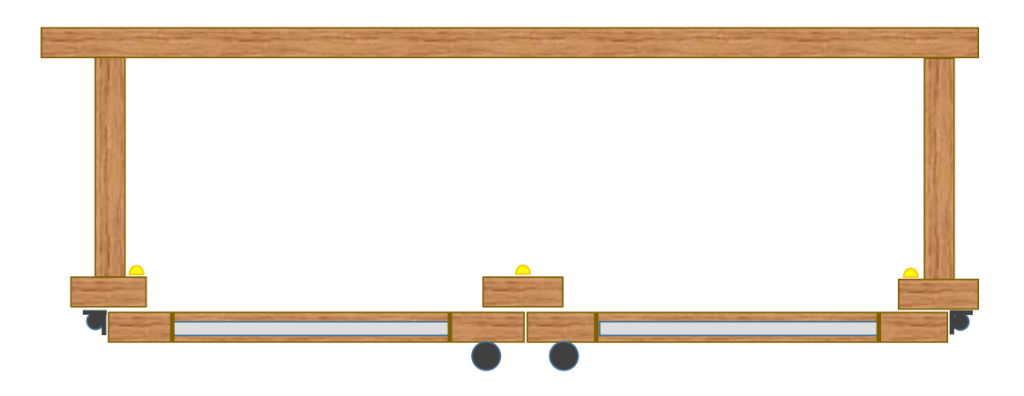
Normally, I use one strip of LED Tape installed on the hinge-side of each door. This tack works for most cabinets with a light-colored interior, average door sizes and typical content. Should the cabinet be wider, a second door and a second strip of LED Tape would be installed. Remember, use tape at each hinge. That solves a large percentage of the cabinets in North America.

For one-door cabinets, install the LED Tape on the hinge side. If additional light is needed, add a strip on the handle side. LED Tape across the top is also an option. For two-door cabinets, install the LED Tape on each hinge side. If additional light is needed, add a strip on the handle side. If the cabinet is divided, two would be needed. LED Tape across the top is required for cabinets without a center divider.

Cabinet Construction

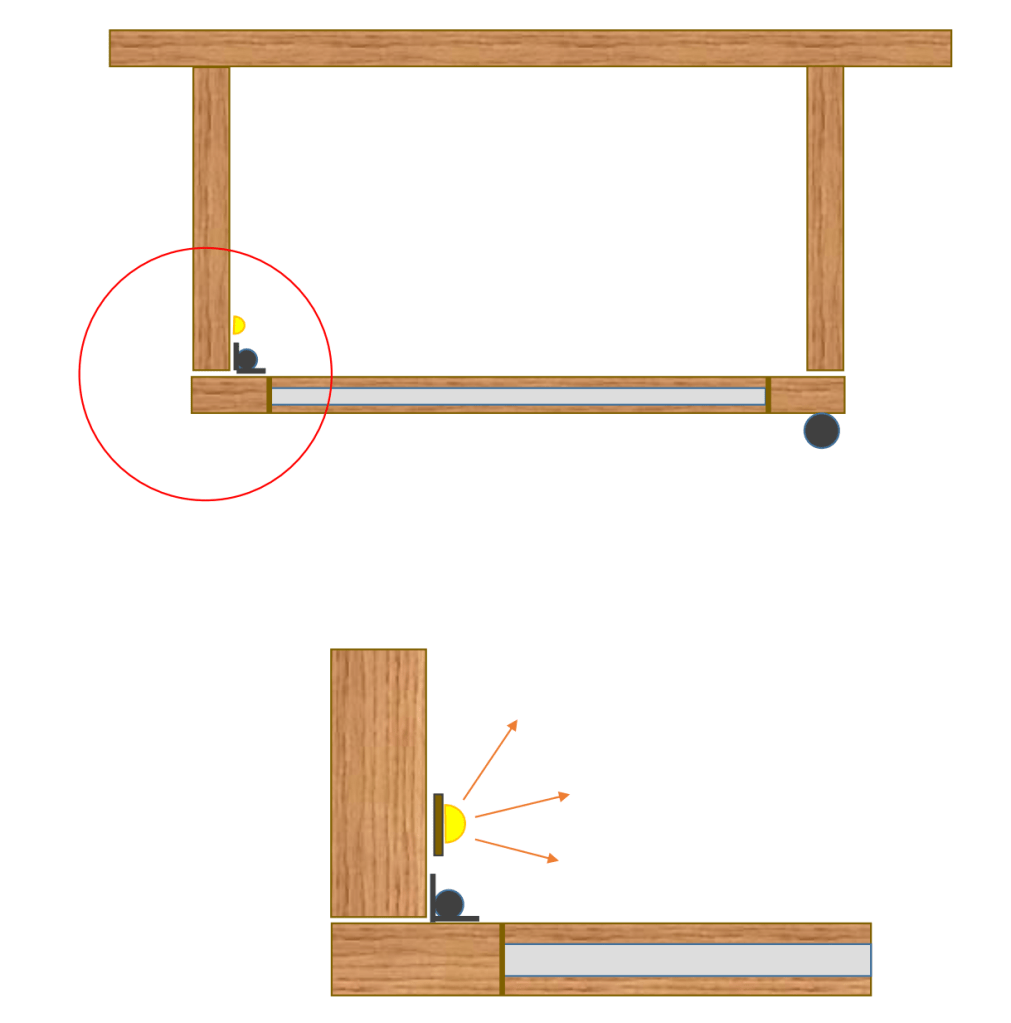
Many cabinets have a face on the front. When that occurs, the LED Tape should be mounted on inside of that face surface, aimed into the cabinet.

For faced cabinets with the exposed hinge, place the LED Tape on the backside if the face, aimed into the cabinet. This is the cleanest, easiest and most popular install.

If there is NO front face on the cabinet, (sometimes called frameless) the LED Tape should be installed perpendicular to the door on the side panel as close to the front as possible. Please be mindful of the hinge and its moving parts! The door will hide most of the light, but the light on frameless cabinets will be a bit more visible.

Frameless cabinets usually have hinges inside. Place the LED Tape perpendicular to the door and away from the hinge mechanisms.

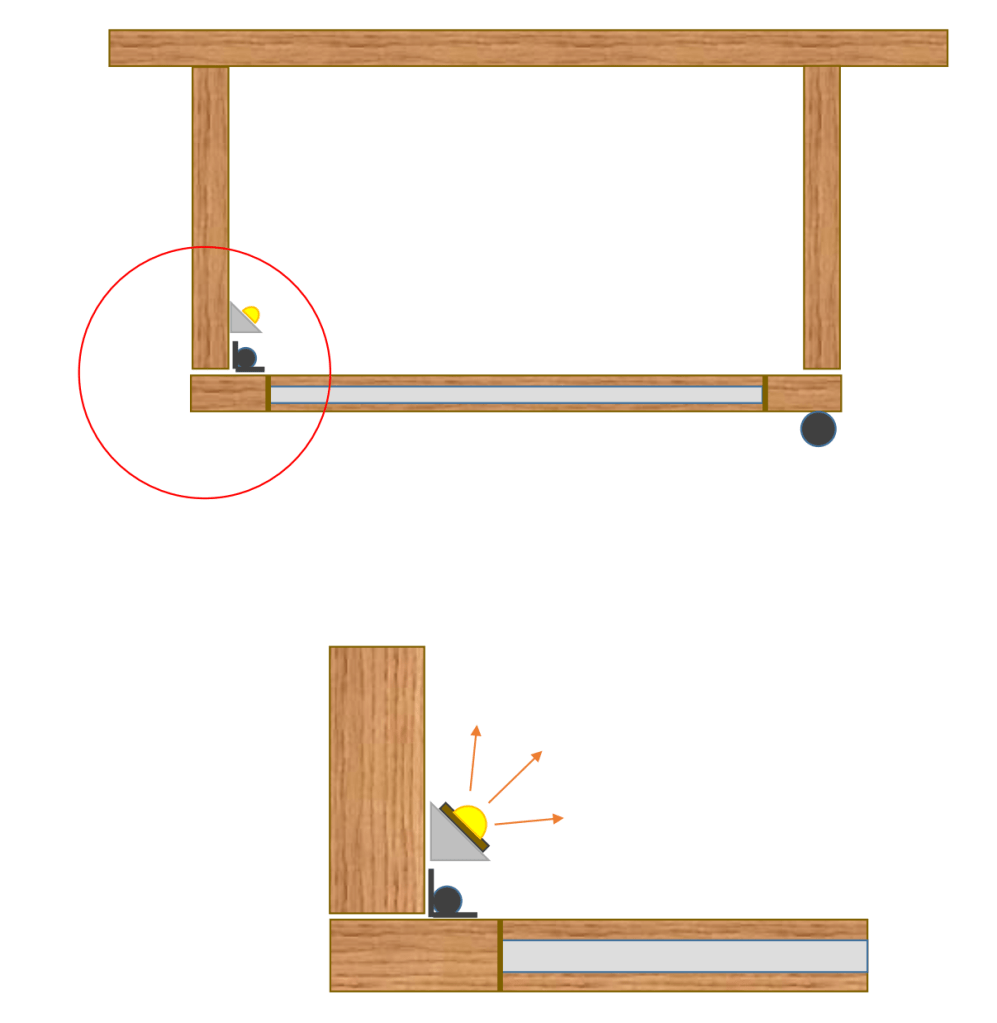
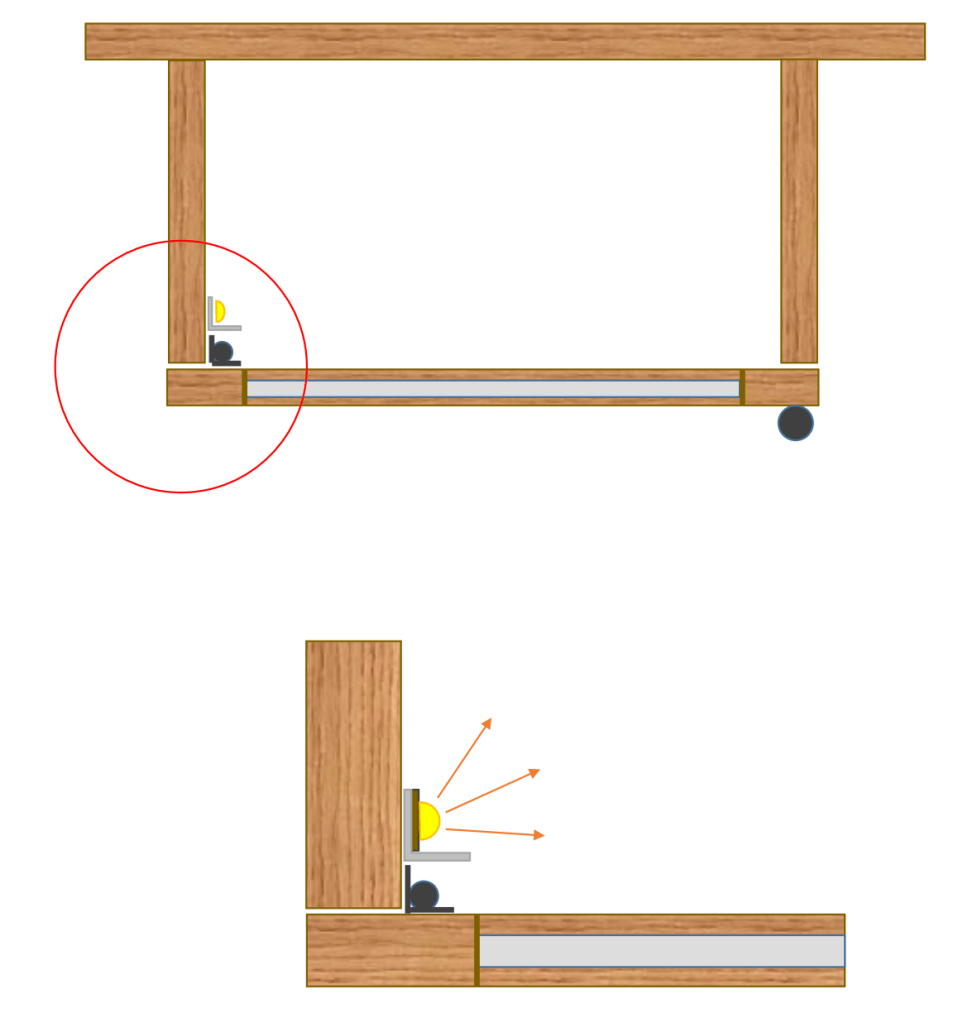
If the visibility is objectionable, all LED Tape manufacturers sell aluminum or plastic channels. Two options work, a ½” x ½” 45° channel or a ½” x ½” “L” channel. The 45° channel would be installed in the hinge corner. The LED Tape would then be connected to the 45° angle, aimed into the cabinet at an angle. If you elect to use the “L” channel, install the channel against the side with one legs of the “L” facing the front. The LED Tape is installed on the other leg. The forward leg of the “L” will block the view of the light from the user.

To reduce the visibility of the LED Tape when opening the cabinet door, install a 45 degree channel to the cabinet side. Install the LED Tape on the angled surface of the channel. This will aim the light inward and reduce glare.
An “L” channel can also prevent the glare delivered by side-mounted LED Tape. Install the “L” channel to the cabinet side and then install the LED Tape on the channel surface. The leg of the channel will prevent unwanted glare.

If the top of the cabinet is open to the ceiling, drill a 1/8” hole in the corner, pull all the wire to the top of the cabinet and make all wire connections above and out of sight. The same could of course be done under the cabinet, but that would be much more visible and often found objectionable.

Cabinets Used For Display or Cabinets With Dark Interiors

Employ two strips of LED Tape on glass front cabinet if they are used to display prized crystal, collectables or something of higher value. Consider using two strips if the inside of the cabinet is especially dark.

With two strips, one will of course be at the hinge and the other on the handle side. With framed cabinets, this installation is easy. The LED Tape is installed on the backside, aiming inward. For frameless cabinets always use a channel.

For wide faced cabinets with a divider, install the LED Tape on the backside, aiming into the cabinet.

Include LED Tape across the top when a two-door cabinet design has no center divider. You’ll want more light, especially if the width is such that you will end up with a darker area in the center. Lighting across the top is also needed if horizontal flip doors or lift doors are used. If light is included at the top, remember to use a channel (again, unless there is a front panel). Without the panel or channel, when you look-up, you will definitely see the light and that will be unacceptable.

Frameless wide cabinets, without a center divider will require supplemental light. That can be accomplished with the placement of LED Tape across the top surface. Don’t forget to shield the light by installing the LED Tape on a 45 degree or “L” shaped channel.

Any Alternatives?

I prefer LED Tape on cabinet verticals because regardless of the shelving material, the entire cabinet is illuminated. Disc/Pucks only work with glass shelves and only when nothing is on the shelf. Because, you do not want to see the light, only the effect, the front surface is always preferred.

If you find a spot where you want to try something different, the only other option would be the bottom of the shelf at the back/rear. Remember, this will deliver more shadows, but with the right content in the cabinet, this could be an interesting option.

What Type of LED Tape Should I Use?

Most LED Tape comes in low, regular and high output. Inside a cabinet, low should be acceptable, again, unless you are dealing with dark colors or featured pieces. You might want to test the light output in specific applications with a small section of LED Tape connected to a transformer plug. This will allow you to see the output for yourself, should you have a concern.

Lighting inside a glass front cabinet is easy, until the installation varies from the norm. With these alternative and optional installations, you’ll be ready for anything a cabinet throws at you.

Categories
Technical Lighting Help

What’s A Beam Angle?

Last week, I delivered a webinar to over 450 designers. The most popular request was for clarification of beam angles. If smart professionals need a refresher, then perhaps others do, as well.

Directional vs. Omnidirectional Light

Light from a light source is delivered to us in one of two ways, directionally, or omnidirectional. A typical 60 watt incandescent lamp is an omnidirectional source. Light exits the lamp in all direction and around the full circumference of the glass envelop.

In this typical incandescent lamp, light is delivered 360 degrees around the circumference of the glass envelope and about 280 degrees from the screwshell to the top and back down to the screwshell on the other side.

A directional light source is different. Light is delivered in only one direction. Think of a flashlight. A reflector built inside influence the delivery of light and prevent it from traveling backwards. Luminaires can be directional as well. Consider undercabinet lights or a recessed can. Light is emitted in a single direction aimed toward a task below.

Directional light is delivered from the lamp in only one direction. Light rays, which might have illuminated the screwshell are instead re-directed out the front with engineered reflectors that cover the side.

Beam Angle

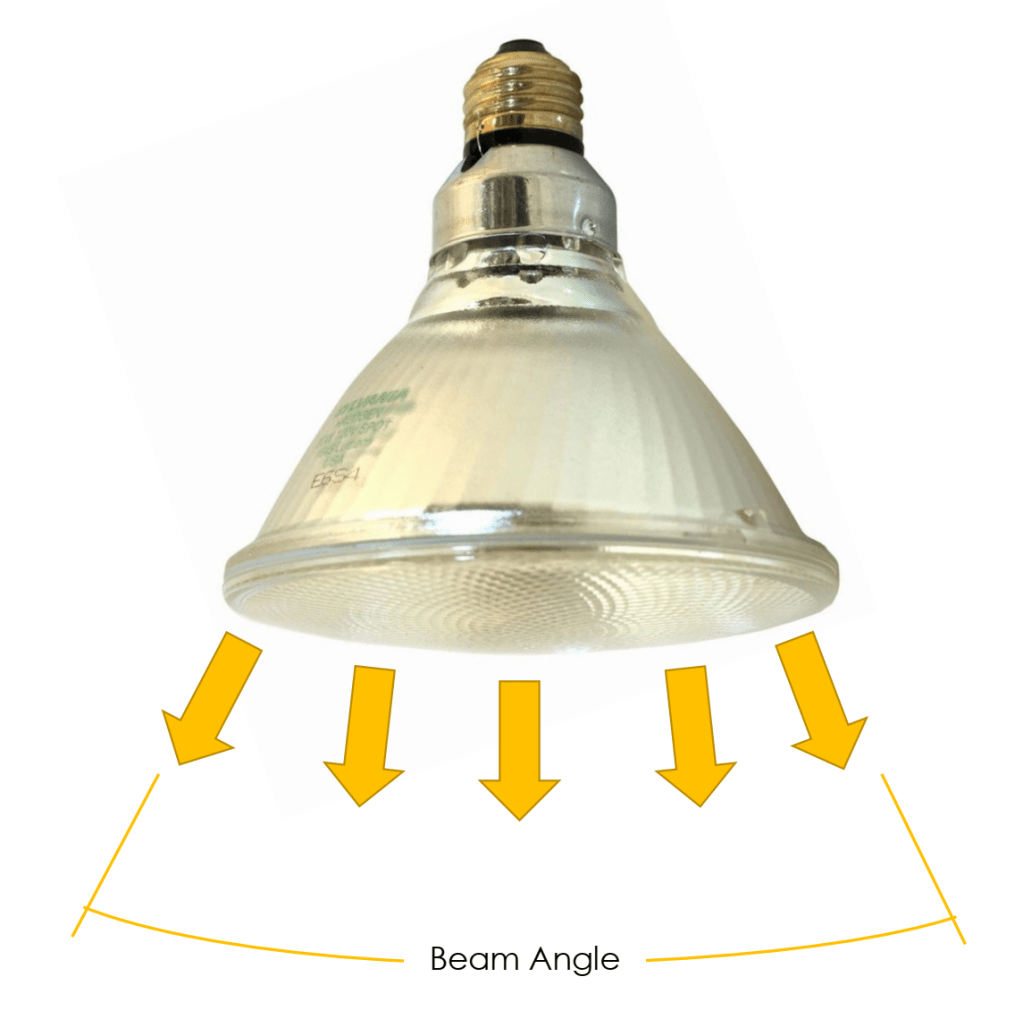
The delivery of light from a directional source can be broad or narrow. Those triangles of light are defined by a geometric angle and known as a beam angle. Previously given a name (spot, flood) or a number, with the introduction of better optics and LED technology, beam angle are now much more specific and an angle is now much more common than a name.

When designing a grid of recessed cans for a kitchen ceiling, or determining the correct accent light in a landscape lighting design, angle is crucial to a successful job. Failure to heed the importance of beam angle will result in a poorly illuminated kitchen and incorrectly lit trees and buildings.

Understanding Beam Angle

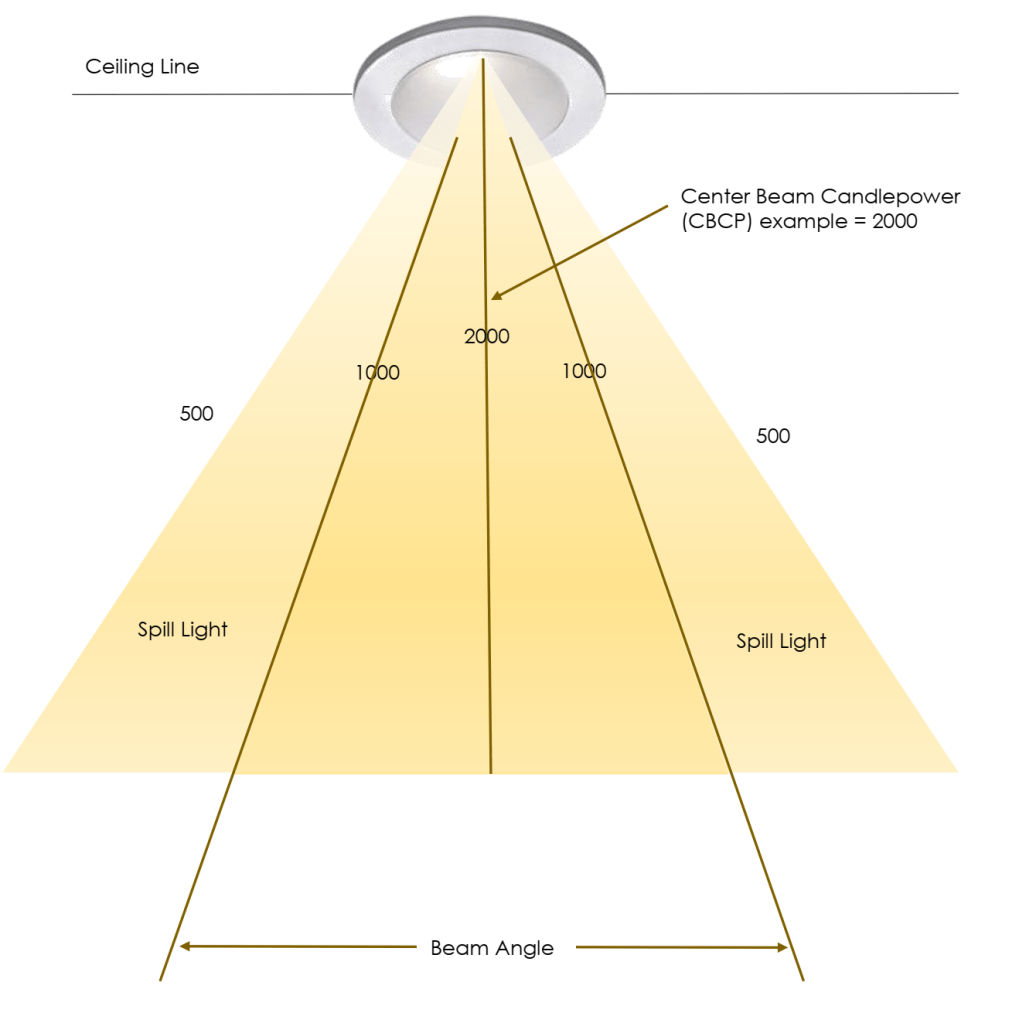
In a directional light source, the most intense light is measured at the centerline. This is called the center beam candlepower (CBCP.) Intensity dissipates as it moves away from the center. When that intensity is reduced by 50%, the beam angle is established. All remaining light, outside of the beam angle is called spill. Some light sources create a large amount of spill, others are engineered to drop off to black very quickly. In some applications, such as landscape lighting, you want a tight, defined angle. In others, spill can be an advantage. In heavily regulated outdoor environments, spill can impact plants and wildlife, so it is deemed detrimental. It is important to understand what light you want, how it is used and how it will impact the lighting design.

In this fictitious luminaire, we imagine the CBCP to measure 2000. When that measurement drops 50% to 1000, the angle is established. Everything outside the beam angle is considered spill. The amount of spill varies according to luminaire, lamp and reflector design.

Information From Manufacturers

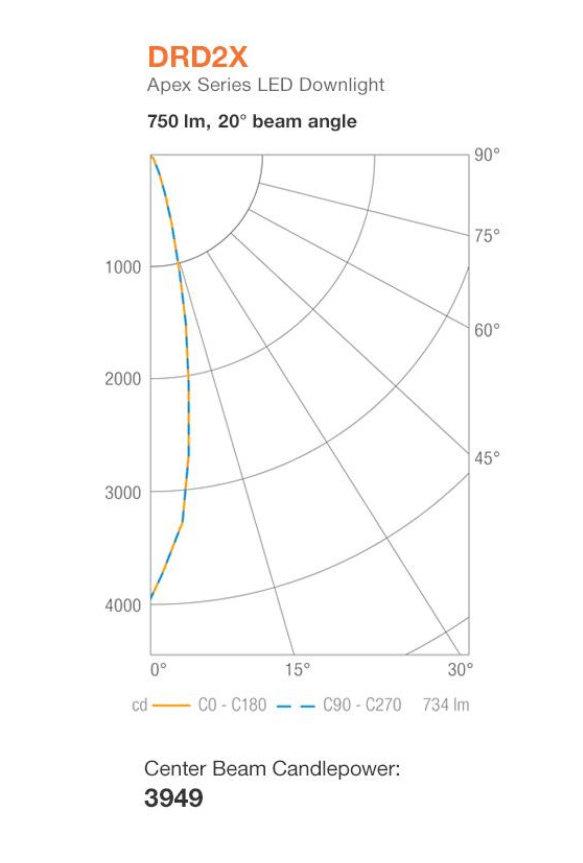
It is very common for manufactures to provide photometric data that helps in the selection of a product. This will appear in the form of a rectangle with rays and quarter-circles. Through the center will be an irregular shaped arc. At first glance, they may appear confusing. Use these helpful descriptions.

  • The Center Beam runs along the left side of the rectangle
  • The quarter-circles represent different amounts of candlepower
  • The rays represent angles
  • The Center Beam Candlepower (CBCP) is reflected in the point where the arc intersects the left side of the rectangle
  • The arc represents the light delivery for that particular light source. As it moves from its maximum delivery of light at the lower-left corner to zero at the upper-left corner, it defines the quantity of light at various angles.

To determine beam angle, if not provided by the supplier, simply divide the CBCP in half and find that point on the chart. Move right and find that point on the arc. Remember, this chart represents  “half” of the light, so if 50% of CBCP intersects with the arc at the 30° ray, then the beam angle is 60° (30° + 30° = 60°). On the example, this manufacturer calls out the CBCP and the beam angle, but that is not always the case.

This rectangular image is a common way for manufacturers to tell users about their product photometry. (My notes inserted.) The arc that runs through the quarter-circles and rays represents the light for that particular product. The intersection points provide the needed data.
Here we see a very similar rectangle, from the same company (DMF) but with a luminaire that is delivering a lot more light in a much smaller beam angle. Regardless, the same chart layout is used.

Beam angle is an important part of lighting design. Knowing what is meant and how to find it will make all your design work easier and better, to say nothing of the improved light quality!

Categories
Aesthetic Lighting Help Technical Lighting Help

Front Door Lighting

The coach light on my neighbor’s home is installed upside-down and on the wrong side of the door. Each time I leave my house, I look directly at a very common lighting mistake. Here are a few things to understand in order to get the lighting on your front door correct.

Size

Lighting fixtures located at the front door should be sized somewhere between 1/5th and 1/6th the height of the doorway. A large majority of front entries are 7’-0” tall, (6’-8” door) so most homes will be well served with a luminaire height between 14” and 17”. (84” ÷ 6 = 14” / 84” ÷ 5 = 17”) With this baseline understood, let’s take into account reasons to vary.

Ranch style homes built with 8’-0” ceilings will have a “low” exterior elevation, so the smaller dimension will appear more visually comfortable. Conversely, a two story home with 10’-0” ceilings will demand a taller light at the door. Even the 17” height might appear puny. This taller architecture needs a light somewhere between 20” and 24”.

Many very old and very new homes employ 8’-0” to 10’-0” front doors. Some even feature double-doors. Additionally, these homes often include tall, dominant rooflines that extend the verticality. Commensurate fixture heights up to 30” should be considered.

Quantity

Most homes will be well suited with a single light, located on the side of the door that contains the handle/keyhole/doorknob. Unlike my neighbor, where the open door blocks the light, the proper location will easily facilitate key entry. If you have a new digital keypad lock, having the correct amount of light becomes even more important.

With a larger front entry, the inclusion of a second light becomes more important. If a double-door is installed, a second light is an absolute necessity.

Orientation

The reason for my neighbor’s unfortunate luminaire orientation is the overhead eave. It prevents the light from being installed correctly. Their solution was to turn it upside-down. While it looks bad, this can also be a safety concern. Most outdoor products are UL listed for a specific orientation. Ignoring that requirement will void the protection, and could cause an electric short, should there be a buildup of rainwater. Always follow UL installation labels.

Most major manufacturers build products in multiple configurations. Catalogs and websites will include a “height from center of wall opening” dimension. This will insure the product fits. Measure before buying! Coach light are made with a mounting canopy high, midpoint and low. Select the correct configuration to meet your home’s outlet box placement.

In new construction, install the product 66” above the floor, or threshold of door. With taller doorways, that dimension can be increased.

Style

Relative to the building, a lighting fixture is small. The style of architecture is the dominant feature. The lighting style should always bow to that of the building. This is not a place to make an aesthetic statement. Match the product style to the architectural style. Anything less will look wrong.

Additionally, all lights installed on a home should be of the same aesthetic family. Again, this is a very common feature provided by almost every manufacturer. The large porch light, garage lights, post light and backdoor light should be from the same supplier and of the same design family. This is the only way to respect the architecture.

Lumen Output

While large amounts of light can usually be installed in outdoor luminaries, I always suggest using very low levels of light. Remember, when we are outdoors at night, our eyes adapt to the dark. A bright blast will hinder rather than help our ability to see. This momentary blindness could also prevent us from noticing any security infractions. Visually, the lower lights will look better on the home as well.

Lighting at the front door is only one part of a well-lit home. The perfectly lit residence should also include a professional landscape lighting systems, but that is a topic of another post! Meanwhile, the correct selection, installation and illumination can be a great first step to an inviting introduction to your home.

Categories
Technical Lighting Help

Lighting the Home Office

You probably thought you’d be back in the office by now. Instead, recent media reports indicate that “working from home” is likely to be a permanent part of almost everyone’s weekly schedule. That might mean you’re considering a new desk chair or a better internet connection, but what about lighting? Here are a few things to consider as you establish a more permanent home office.

The Office

At the start of the pandemic, offices were carved out of dining rooms, plopped on kitchen counters and even squeezed into large closets. As you plan to move from temporary arrangements to a more defined space, care should be taken in considering the location. To insure a good night’s rest and the maintenance of a balanced circadian cycle, humans need plenty of blue-rich daylight. Seek an office space with windows. The results of almost every scientific study indicates that blue light during the day and the lack of blue light at night maintains good melatonin production and insures a good night’s rest.

Computer Placement

Because so much work centers on the computer, placement in relation to those important windows and the light they invite is crucial. A window in front of the computer screen will be blinding and a window behind will cause glare on the screen. The best place for the computer is perpendicular to the window.

Artificial Light

While there is no medical evidence to suggest that working on a computer in a dark room is bad, it does increase eye irritation. To avoid this common problem, supplemental light should be included in the room where you work. The amount may differ depending on the type of work and your age.

Generally speaking, older adults will need more light to perform almost any task. For a variety of reasons, as our eyes age, less light reaches the retina. Including supplemental task lighting, like a shaded desk lamp or floor lamp will help. If all the work performed is on the computer that may be enough. If, however your work involves reading from printed sources, more light is required. A typical office is lit to about 50 footcandles of illuminance. Most bedrooms measure less than half of that. If the job involves detail work, replace the existing ceiling light with something that can provide more lumen output.

Teleconference Lighting

If you are going to be working from home, you are going to be joining more video conferences. Along with a professional microphone and an upgraded camera, proper lighting should be considered essential.

Basically, you want the light in front of you. Lighting from behind places you in shadow, making it difficult for viewers to see your facial features. Desk lamps might be the easiest solution. There are also USB plug-in video conference lights that are even more effective. You will need to experiment. Every video conference program allows you to “test” audio and video. Most of us typically ignore this step and simply jump right into the call. Take a few minutes to check the video results. Try it with the lights on, off, half & half, or any other variation available. Settings may vary with each program. Check each one prior to a call.

If you did change the ceiling fixture to get more light, it does not mean anyone wants to see it! Remember to aim your camera away from direct view of the luminaire.

Burning the Midnight Oil

Most computer monitors emit a very blue light source that, when viewed at night can deliver adverse reactions in our body. If working late into the night on a project, the background color and intensity of the computer should be adjusted. Find an amber color with a reduced brightness that is comfortable. Avoid working on, or making any aesthetic decisions under this new background, as it will alter appearances. Save color choices for the morning!

Working from a home office on a much more permanent schedule is going to change how the world functions. Because it is such a crucial aspect of our life, doing it with good lighting will be more important and provide better results.

Categories
Aesthetic Lighting Help Technical Lighting Help

Bathroom Lighting Alternatives

Whether it is cost, space or wall configuration, sometimes you cannot enjoy perfect, three-direction lighting at the bathroom mirror. That’s when alternatives come into play.

Vanity Lights/Strips

Vanity lights deliver light from only one direction, above. That means there will be shadows on the face. Those can be ameliorated by using the widest option that will fit in the space. Over a 20” mirror, for example, a 24” unit will deliver some light from each end, thereby reducing a portion of the shadows. Do not go overboard! The light and the mirror should be of a similar width.

Some of the new LED linear strips emit evenly distributed light across the full length of the unit. This is different than the individual 2-light, 3-light or 4-light styles. They should be considered as well.

A light strip over the mirror may be needed and may be the only thing that works in many applications, but remember, it will not deliver the same quality of light as two fixtures flanking the mirror. (See previous blog post.)

Lighted Mirrors

With the advent of LED, there is an explosion of mirrors that feature integrated light. Visually, many look great. Functionally, just as many deliver glare-inducing light that irritates more than assists. These are growing in popularity. Some believe they are set to overtake conventional lighting fixtures. If you are drawn to this type of bathroom option, consider one which includes indirect light.

Indirect light is the easiest light for our eyes. It removed glare and provides an unobtrusive delivery of illumination. Many of the mirrors present light from behind the mirror surface, not poking through the mirror face. Indirect light surrounding the perimeter of the mirror will provide even light, much like that which is delivered by sconces and a recessed can. This can be a very good option.

Avoid those which feature a visible light on the forward facing surface of the mirror.

With a lighted mirror, some additional ambient light may be needed. If recessed cans are included as that solution, one over each sink will be helpful. A smaller vanity light over the mirror could also be considered.

A Few Other Suggestions

Seniors are especially vulnerable to glare. A vanity light over the mirror provides more glare than almost any lighting fixture in the home. If the bathroom will be used by an older adult, work hard to employee a light on each side rather than over the top.

Over the mirror vanity strips should be installed 72” to 80” from the floor, regardless of ceiling height.

The glass position up or down, is a common question. I suggest you hang it according to your aesthetic preference. There will be a bit more delivered light with the diffusers in a downward direction, but that is accompanied with more glare, unless the diffuser has a closed bottom. The metal support structure will block a touch of the glare when hung with shade in an “upward” direction, but that will reduce the amount of delivered light. Let artistic taste guide you here.

Keep the mirror width and the length of the vanity lights similar. Mirrors and vanity lights are available in nominal 18”, 24”, 30” and 36” sizes. Stay reasonably close, a few inches longer or shorter will appear proportional. A tiny mirror and a long light will look odd. The reverse will appear equally out of balance. Seek continuity of width for the best results.

Even if “perfect” light is not an option, pretty darned good light can be employed. You just need to follow a few simple guidelines.

Categories
Aesthetic Lighting Help Technical Lighting Help

Perfect Bathroom Lighting

After walking out of the house with yet another razor nick on the chin or eyeliner that doesn’t exactly line the eye, you’ve finally realized it is time to improve the lighting in the bathroom. With bathroom remodeling pulling ahead of kitchen remodeling in resale value, it is a good decision. Where do you start? Relax. With a little information and a few quick decisions you can be out of the door each morning, clean shaven and nicely coiffed.

Perfect Mirror Lighting

Experts agree that the best way to light a bathroom mirror is placing a light on each side, then supplementing the pair with light from above. Lighting from three directions eliminates shadows and illuminates the face perfectly so shaving is uneventful and makeup application is easy. In any new construction or remodel project, this should be the aim.

With that goal in view, preference can now come into play. A single sconce on each side works well and there is a wide variety to meet almost any aesthetic preference. You might also consider a linear light, mounted vertically. This works especially well if multiple people of varying heights share a mirror. The linear pieces will deliver ideal light whether the user is short or tall. Mini pendants, while installed on the ceiling can be positioned so the light falls in the exact same spot as the sconces. This opens yet another avenue of options.

Lights on each side of the mirror should be placed from 36” to 42” center-to-center, 66” to 72” from the floor. If there are two lavatory bowls in the bathroom, don’t cheat! Treat each sink individually. Light should be equidistant from the center of the mirror/sink. In an effort to save money, some people will place one light between the bowls. To do this correctly, the distance between the centerline of each light and each mirror should be exactly the same, from 18” to 21” in all four spots. Failure to position the lights equidistant will deliver uneven levels of luminance to the face. If the sinks are father away, add a fourth fixture. On longer vanities, this will actually look better and more balanced.

To add illumination from above, I like to use a recessed can in direct line with the sink drain. Find the center of the drain and place a dotted line to the ceiling. That should be the centerline of the recessed light.

Some Other Considerations

Clear glass and vintage light bulbs are nice, but they make it difficult to see because of their piercing light and the glare that creates. In a bathroom, seek out, etched glass, white glass, etched cased opal glass (white glass encased within a clear layer that has been etched) or a fabric shade covering the light bulbs. This softer delivery of light will make functionality better and easier to use.

Is the room big? You might need to add some ambient light to the mix. A group of recessed cans, some decorative flush or semi-flush pieces or even a chandelier will work here. Connect them to a separate switch.

Add some LED tape to a separate switch and place it under the vanity or at the toekick. Alternately, connect one or two step & aisle lights to the switch. Either will add some interest to the room, but more importantly serve as a functional nightlight for safer nighttime navigation.

Pretty simple, right? One light on each side of the mirror. Each light should be equidistant to the center of the mirror. One light above, placed at the centerline of the sink. Pay attention to glare for more comfortable use and you’re done! Of course, this method might not work for everyone. If that is your case, check back for the next blog entry, “Bathroom Lighting Alternatives.”

Categories
Technical Lighting Help

Three Steps to Buying LED Light Bulbs

I’ve been around lighting since I was nineteen years old. As the lighting world morphed from incandescent to fluorescent, then to LED, it was easy for me to understand the differences. For everyone else, light bulbs are just another thing to buy when you’re shopping for home essentials. Laundry detergent, glass cleaner and light bulbs. Easy, right? Well, it used to be.

Soap still comes in a bar and household cleaners still come in a spray bottle. While light bulbs look the same, today, there are far more decisions to make than selecting a 4-pack of 60 watt bulbs. Don’t worry. It just breaks down to three simple steps, color temperature, color quality and lumens.

Color Temperature

For the typical home, I recommend one of only two options, 2700K or 3000K. Nothing else. Color should be matched to the room in which it will be used. This will make every room look its best.

Use 2700K if you have warm color rooms with lots of beige, wood, gold and earth tones. The warmth of the 2700K light will reveal their tonal richness.

Use 3000K if cooler color dominate a space. Black & white, grey neutrals, blues and purples will appear more vibrant, more intense under 3000K light.

Color Quality

Color quality is measured in Color Rendering Index (CRI). This is a scale from zero to 100. A black & white movie has a color rendering of zero. The blood that runs down the drain in “Psycho” is of course red, but with no color rendering, we see it as black. With incandescent light bulbs, there was no choice in CRI. With LED, options abound.

I recommend seeking out a CRI in the mid to high 80’s. If you live in California, 90 CRI is the minimum available for sale. Keep in mind, there is a cost to achieve higher CRI, so if you do not see it advertised, be warry. Manufacturers will not want to hide a good CRI number.

Lumens

Wattage is a measurement of energy consumed to power electrical equipment. It has nothing to do with the amount of light produced. Because we have been using incandescent light bulbs for over 130 years, we simply got accustomed to using wattage. Lumens tell us how much light is produced by the light bulb. As we move into the future, wattage consumption is going to constantly change, so we need to become comfortable with lumens.

If you were buying an incandescent light bulb that consumed this quantity of electric power:It was providing this amount of light*    
25W150 lumens
40W450 lumens
60W800 lumens
75W110 lumens
100W1600 lumens
150W2600 lumens
*Incandescent candelabra lamping is lower.
Be careful. There are few to no LED candelabra based light bulbs delivering over 500 lumens at this time. That could change as technology advances.

The process of light bulb selection is not that complicated.

  1. What color does your room tell you to buy? 2700K or 3000K?
  2. Find a color quality CRI above the mid-80s
  3. Buy based on lumen needs, not the advertisement on the package

With those three simple steps, light bulb purchases can be as easy as buying paper towels.