Categories
Technical Lighting Help

DOE Solid State Workshop 2022

Photo by Olya Kobruseva on Pexels.com

Earlier this month, I spent a lot of hours in front of the computer listening to the virtual, U.S. Department of Energy, Solid State Workshop. This was four days of in-depth conversation covering the current-state and likely, future direction that solid state lighting technology will take. There was a ton of information shared and honestly, I felt somewhat like comedian George Gobel in the classic Tonight Show episode where he walked onto a dais with Bob Hope, Dean Martin and host, Johnny Carson. Clearly outclassed, Gobel quietly commented to Carson, “Did you even get the feeling that the world was a tuxedo and you were a pair of brown shoes?”

Like Gobel that night, a lot of the information was over my head. These highly educated individuals reached beyond common knowledge and current circumstances. The introduction of LED into the lighting world has elevated the conversations and concepts to heights heretofore unimaginable. Even for a lighting geek like me, it is hard to keep up!!

With that in mind, I’ve tried to boil down the information to that which concerns residential users, or might be of interest to “average” brown shoe-wearing folks.

  • No surprise, but LED efficiency continues to improve and gains in efficacy are likely well into the future. LED energy efficiency will however, be less important because of the tiny incremental growth the technology now experiences.
  • The use of smarter, better, more carefully programed controls will continue to earn larger and larger shares of the energy savings. The possibility of less expensive electricity (don’t add the money to your bank account, just yet) will change a lot in the way we consider operational value and energy investments.
  • In customer preference studies, 5000K lighting was considered the most favorable light in parking garages to find cars and find a parking space.
  • The same study showed that the old adage, “We cannot light our way to seeing better or feeling safer.” remains true. At a certain point, regardless of how much light is added, the perceptions of safety and our ability to see in the space do not improve.
  • The biggest barrier to altering state and local lighting ordinances for better efficiency, is public perception – people still believe MORE light is the best light.
  • As we learn more and more about the body’s need for light, some key metrics will be set on their ear. Initially, daylight harvesting was set in place to save electric lighting energy, but the byproduct may be a healthier environment. That healthier setting could result in higher rents garnered by the owner.
  • Additional study are showing that melatonin suppression has a more complex manor of functioning. The wavelength of melatonin sensitivity is different from the visual wavelength. That means, most, NOT ALL, of the impact comes from ipRGC (intrinsically photosensitive retinal ganglion cell) with the cones primarily responsible for short, initial reaction. As science gets closer and closer to understanding this complex interplay, expect lighting to be adjusted with the idea that good lighting can mean good health. This will be a powerful step in the maturation of solid state lighting! (I wrote about this point in a previous post, if interested in more information: https://wordpress.com/post/lightingbyjeffrey.com/483
  • Because of this newer understanding of melatonin wavelength peak, we now know that it overlaps with the blue LED that is the basis for most white light. There is now talk of changing blue to violet and then adjusting the phosphor blend resulting in the same visual appearance, but without the harmful byproduct. While not mentioned in this talk, there had been some concern that violet would reintroduce ultraviolet light, losing one of the key benefits of LED light. As with so much of these findings, more information is yet to come!
  • Remember the “L” prize light bulbs? The first 60-watt, incandescent LED retrofits announced in 2011? Those lamps are still energized and operating in the test lab! They are all operational, now at 90,000 hours with NO failures and virtually no reduction in light output and color shift! (Remember what I said in the previous post on “buying cheap? https://wordpress.com/post/lightingbyjeffrey.com/603 )
  • Many parts of a building are moving to a more sustainable version, but lighting is lagging behind. (Sound familiar? Remember the halcyon days of residential energy use improvements, pre-LED?) It is expected that lighting too, will be dragged into this desire for a more sustainable product. There are reasons why it is more difficult, but in the long run, change will be demanded.
  • Diffuser science is getting VERY interesting. Because of the adverse initial reaction to the intense LED “dots” of light, a substantially different diffuser is needed. Diffusers are not just pieces of plastic any longer! Waveguides push light in complex directions to eliminate the glare. Micro-printing adds microscopic dot of wave scattering ink onto the surface, without much light loss or color characteristics reductions.
  • Customers are now faced with a much more complex lighting systems. Because everyone want to “invent” the next, best, great luminaire, product has arrived in a silo and the backlash has started. There is growing demand for interchangeability. There is a need for a more common language. In the past, a 40W ballast on a luminaire could easily be swapped. That is not the case with LED. An industry agreement is needed to achieve cross-vendor flexibility. The customer is rumbling and this must be solved soon.
  • There is growing evidence that communication between the HVAC system and the lighting systems is needed. Both are needed when people are in a space and not needed when empty. Expect more conversations to come on this merger.
  • 28% of carbon emissions are from building operations. That includes lighting. If we are able to bring the cost of electricity down through the use of non-fossil fuel creation (still a while, in my estimation!) then the onus will be on carbon emission from buildings, not power plants! Improvements will be needed, fast.
  • The large-scale use of LiFi is as close as two to three years away. Because of our cluttered radio wave environment, this will be a welcome relief and a game-changer.

We need to design light for a space, rather than fitting light into a form that has previously existed. Remember, lighting started with a candle, replaced with gas, delivered in a pinpoint shape, like a wick, changed to a filament in a glass enclosure the shape of a flame and now we are stuffing LED componentry into the same flame shaped envelop! As the science matures, lighting used in the future will be very different. The arc of change is very long, but it does indeed bend. Get ready for it!

Categories
Technical Lighting Help

Buying Cheap Will Cost You!

Photo by Medhat Ayad on Pexels.com

A recent Wall Street Journal article (Why LED Bulbs Don’t Always Live Up to the Hype About Their Life Span – Jo Craven McGinty 10-1-2021) detailed some of the frailties surrounding expected lifespan of LED light bulbs. Unfortunately, they failed to discuss a crucial element that is now leading to shorter lived lamps…the desire for cheap.

The reporter talked to the Director of Research at the Rensselaer Polytechnic Institute and he clearly defined the reasons for lower longevity. There is, however an underlying reason for his recommendation to use “LED System Life” rather than LED life as a better way to measure expected life. Multiple reports and investigations indicate failure is most likely to occur in the driver and electronics. The LED have proven to be very effective and hardy, failing at a very low rate. A quick overview by the DOE https://www.energy.gov/sites/prod/files/2014/04/f14/life-reliability_fact-sheet.pdf helps us to understand the conclusion delivered by Rensselaer.

Consumers were never able to justify a light bulb that cost tens times a conventional incandescent lamp. Initial sales were poor. At those prices, efficiency needs would not be met.

One of my favorite jokes tells the story. A kangaroo walks into a bar and orders a martini. The bartender prepares the drink and places it on the bar. “That will be $35.” The kangaroo pays the bartender and the bartenders comments, “You know, we don’t get many kangaroos in here.” The kangaroo responds, “At these prices, I’m not surprised!”

To make LED lighting more acceptable to the greater kangaroo population, they had to be cheaper. That means money needed to be extracted from the components and manufacturing process. Using high quality LED, electronic circuitry, drivers and a strong deference to thermal management, the original LED would last far longer than the advertised 50,000 hours. Cheaper electronics, disregarding heat or combining circuits on a common board all make the light bulb less expensive, but at a cost to longevity.

There is a wonderful analysis conducted by the website “Hackaday” that tells this tale. By analyzing the components and construction of three readily available LED lamps, understanding “you get what you pay for” is easy.

To paraphrase the research, a very inexpensive lamp combines the LED and driver on a single board. (There are other electronic and wiring variations I will not recount.) With inexpensive components, wiring and assembly, this lamp promises a life of 7500 hours. The second lamp is a bit more expensive and the life expectancy is doubled to 15,000 hours. This is accomplished by separating the driver, thereby protecting it from the heat and delivering an incrementally better product. The best of the three tested light bulbs separates the driver and LED and uses superior capacitors rated for higher temperatures. (There are other improvement as well.) The price is the highest of the three and it lasts the longest, at a promised 25,000 hours. If longer lasting light bulbs are desired, they can be had, but it will cost more.

(If desired, you may read the full report here: https://hackaday.com/2019/02/05/what-happened-to-the-100000-hour-led-bulbs/)

LED System Life should be the barometer of the future. The reality of our desire for cheap, cheaper and cheapest has forced a realignment of expectations for LED. It is a shame that the LED is getting the bad name.

Categories
Technical Lighting Help

Non-Visual Photoreceptors

What the heck are non-visual photoreceptors and why do I care about them? I’m not a research scientist, so let me explain this in the way I understand it. Please don’t use this simplified explanation in your application for a Nobel Prize!

Photo by Dih Andru00e9a on Pexels.com

When I started to research the color of light and its impact on human health, perhaps ten years ago, I became aware of the circadian cycle built into the human body (and almost every animal.) Our understanding of the circadian rhythm is actually new science. It was first realized in 2000. At the time, we began to learn about non-visual receptors in our eyes (iPRGC) whose singular job is to detect levels of blue light, thereby turning on and off the body’s production of melatonin, which in turn drives our circadian. More recently, scientists have learned that there are other factors that control this important body-clock.

An educational session at LightFair 2021 talked about new research that has uncovered additional non-visual photoreceptors that help our body function, based on the color of light with which they interface.

In a previous post, (Baseball and Lighting) I reminded readers that our body was engineered with only natural light in mind. The body needs blue light during the day and darkness at night. Unfortunately, we have chosen, over the last 100 years or so to live in opposition to the natural environment, employing artificial light. That artificial light presents to our body wavelengths different than the sun’s and different than what we need, hence the health problems we are encountering.

Melanopsin regulates the circadian with input from the iPRGC in the eye. New research indicates we have other “light sensing proteins,” opsins that have their own specific demand for light and their own specific reason for needing it. Because artificial light does not now deliver that type of wavelength, adverse medical conditions are occurring. Opsin 5, Neuropsin is located in the brain, skin, retina and cornea. Opsin 4, Encephalopsin is found in the brain, skin, retina and fat cells. That means there are tissues in our body that are light sensitive.

It is believed that a reduction of the light anticipated by these opsins is responsible for elevated retinopathy in infants, increases in myopia and the regulation of metabolism. Most every lighting system used today is designed, understandably, for the body’s visual system. In the future, we will likely need to design and employ systems that address the needed wavelengths of light by these opsins.

How Will This Be Done?

Again, we should remember the sun. The sun delivers light at every wavelength, in varying values. By looking at the research and the levels of light required, engineers can create artificial light commensurate with the needs of our visual system AND our non-visual receptors.

The direction in which light reaches us is also important. As you know, most artificial light comes to us from overhead, but the sun travels through the sky in an ever-changing pattern starting very low in the morning, overhead at midday and again, near the opposite horizon in the evening. That means our bodies anticipate more vertical light than we currently receive. We should expect this solution to come in fewer ceiling flush lights, more task plane lighting and even illuminated walls and panels.

At this point, there are some products on the market that address this need. As the research continues and grows, expect to see and hear more. Just remember, like so much in lighting lately, change is afoot!

Categories
Technical Lighting Help

Baseball and Lighting

Photo by Pixabay on Pexels.com

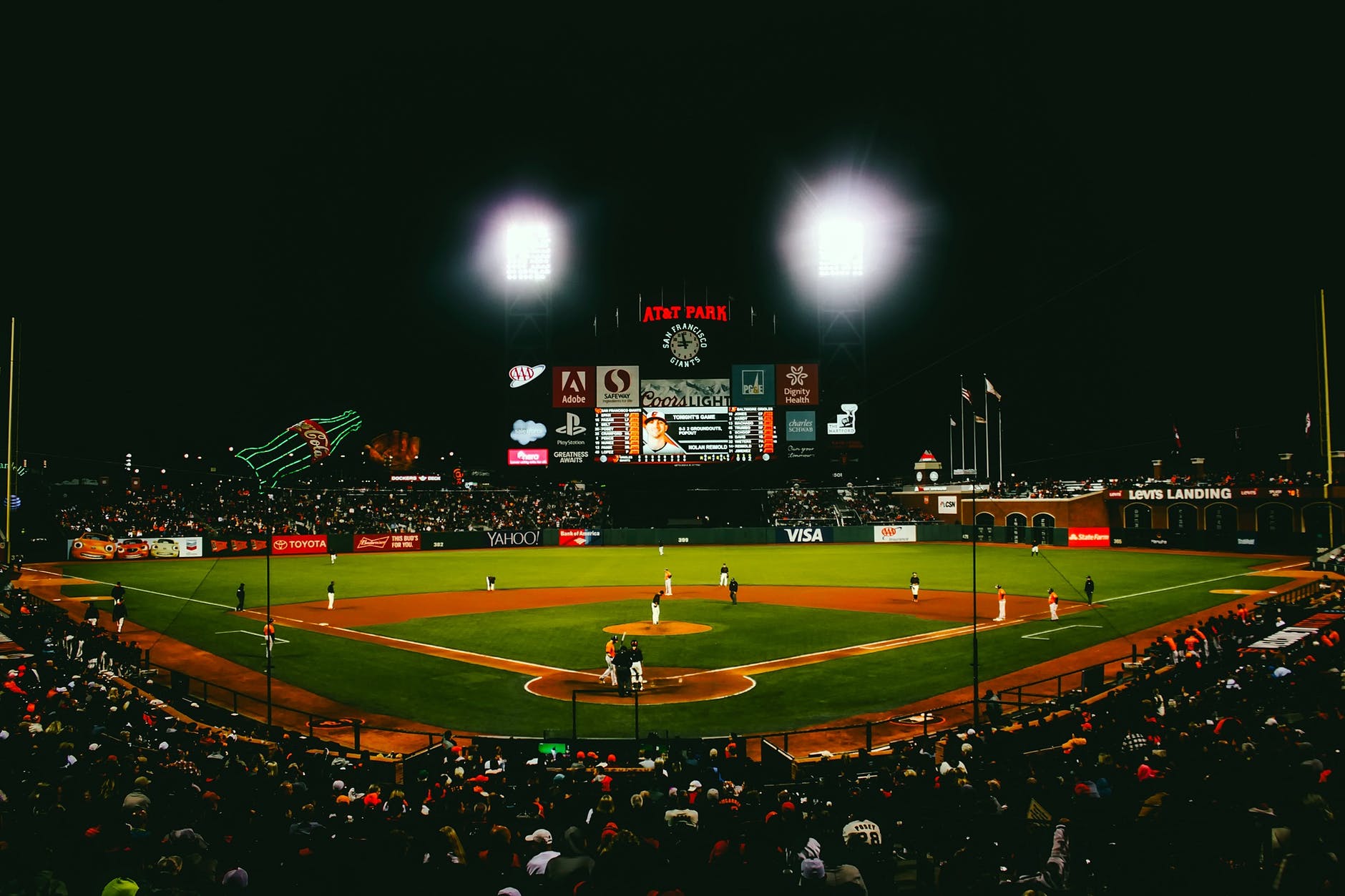
Summer has ended and that means we’re in the thick of baseball playoffs and well into football season, with most taking place under artificial light. The first Major League baseball game played at night, under a lighted stadium took place in Cincinnati, at Crosley Field on May 24, 1935. The Reds beat the visiting Philadelphia Phillies and a new era in sporting events was born. Along with baseball, high school football games are typically played on Friday nights under the lights. There was even a movie and popular television show that co-opted the term – Friday Night Lights. The NFL regularly schedules professional games on Monday, Thursday and Sunday nights and NCAA football features numerous games on Saturday night. (Should Tuesday and Wednesday feel slighted?) Lighted fields are de rigureur. We might wonder, without light, would these games be as popular? Without popular nighttime competition, would we have fewer self-centered, millionaire, adult-teenagers? One thing is certain, it would be as smaller business.

Before electric lighting, people awoke with the sun and went to sleep at sunset. Work in the fields was impossible in the dark. Candles and fire could provide only a few additional hours of light, before prudence forced their being extinguished. Light substitutes were expensive. Tallow candles in 1880 cost 40¢ per 1000 lumen hours. A fluorescent lamp cost about $0.001 per 1000 lumen hours for the same amount of light. The kerosene required for three hours of light cost about one hour of a workers wage at the time, while today, one hour’s pay buys about 300 days of light.* Sure, baseball would be different, but home life would be equally affected.

Would there be positives to an absence of nighttime illumination? An agrarian economy would likely still exist, forcing most of us to heed the dictates of the sun. Dark nights and blue-rich, sun-filled days are exactly what our body wants and needs. This circadian balance would, with a few exceptions, end sleepless nights and insomnia. There is mounting evidence that cancer rates would be lowered as melatonin levels are no longer suppressed. Of course we’d all need to balance that against the grueling hours of backbreaking physical labor.

We are living in a bit of a lighting renaissance today. The engineers have abandoned 130 year old incandescent technology and continue to escalate improvements in LED. That has allowed designers to reimagine what light could be. Doctors and scientist are developing a better grasp on how light impacts humans (and animals and plants and sea life and….) Both will allow us to enjoy the advantages of light and avoid all of the bad parts light used to deliver.

So is there a happy medium between Laura Ingalls and Aldous Huxley? We are still a few years away from definitive directives on light from the scientific community, but the direction is becoming VERY clear. If we think about a time when farm families arose early, spent most of day out of doors and prepared for sleep around the reddish-amber color of firelight, the closer we can replicate that, the better off we will be today. Our bodies have not changed, the surroundings in which we place them have. In short, we need to consider attending more day-games and fewer nighttime gridiron matches. Despite its impact on team owners’ player’s and groupie’s pocketbooks.

*Steven Johnson, How We Got to Now: Six Innovations That Made the Modern World 2015.

Categories
Aesthetic Lighting Help Technical Lighting Help

Too Much Light, or Not Enough?

A friend allowed me to borrow a book he thought would interest me. The 99% City (Mars & Kohlstedt) is described as “a field guide to the hidden world of everyday design” whereby it explores the important, but overlooked elements that make a city function. He knows my passion for better lighting and called my attention to sections on street lighting.

Photo by Pixabay on Pexels.com

Not Enough Light

“City of Light – Dissuasive Illumination,” explains that street light was an early way to make streets safer at night. They raised visibility and invited community. Street lights are certainly not new. Ancient Roman, Chinese and 15th century Europe all found value in better nighttime illumination and levels of use continued to increase, until, the book points out, there was pushback. Dark nights were good places for French Revolutionists. On the opposite side of the equation, people engaging in unseemly activities also preferred the dark.

Too Much Light

Another chapter, “Moonlight Towers” talks about the multi-story, arc-light towers that were constructed in Austin, Texas, among other US municipalities in the 1890s. Along with the required daily replacement of the electrodes, the noise, waste and intense glare caused push-back from residents. They were eventually removed in every city, except for the cash-strapped, Austin. The un-electrified towers remain as an indicator of the city’s historic past. Welder’s helmets, no longer required.

Like Austin, at that time, most of our cities are over-lit. Every alleyway has lighting, car lots are blasted with light all night and downtowns are bombarded with excess light that often does nothing but erase our ability to see the sky. Plants and animals are subsequently impact by excess nighttime lighting, effecting migratory patterns, nocturnal predators, adjoining aquatic life and a fairly large swath of conifer varietals, among other plants.

Just the Right Amount of Light

We are nearing a similar “good/bad, more/less light” position today. New research has been published recently that shows lower levels of light, but with better color properties is better for the user, pedestrian and worker in nighttime situations. Most of these measurements are substantially below government mandated levels. We all know that changing government regulations is akin to a “U” turn in an aircraft carrier, but the enticement of lower electric costs should make change inevitable.

Many people still believe more light is better and even higher levels of light are even better than that. Simply put, they are wrong. Our eyes function very well in extremely low levels of light and are slow to adjust to higher levels. Turn on the bedroom light in the middle of the night and you’ll know what I mean. This can be a difficult argument to win, however, especially when perceptions of safety are at stake.

Roadblocks!

Just as headway was being made in convincing people to reduce lumen amounts in outdoor residential applications, energy efficiency introduced better fluorescent, then new LED lamping. Light quantities popped back up. With integrated LED luminaires, the lumen output is staying high and a front porch light is often the last place you’ll find a dimmer. The use of color temperatures over 3000 doesn’t help either. In an effort to do the right thing, the unexpected consequence was the wrong thing. Sigh.

I have always recommended the lowest wattage possible for any surface mounted light on a home, especially if a professional landscape lighting solution has been installed. Anything higher will force visitors to squint as they approach the door. As we adjust to energy efficient product, find the LED lamp that delivers 200 to 400 lumens rather than the 800 lumens you got from a 60 watt incandescent lamp. If using an integrated luminaire, (bravo to you!) install a dimmer. Your guests, along with the birds and trees will thank you.

I do not expect lighting professionals to become Robespierre, shouting “À la lanterne!” if lower light levels are not heeded. (Lampposts served as impromptu gallows for hanging during la révolution française.) I hope some common sense is employed and a happy balance between no light and too much is found. Now, if we are going to argue over the effectiveness of the Jacobins or Cordelier factions as they relate to the French Revolution, a lamppost might be in order. On or off won’t make a difference.

Categories
Aesthetic Lighting Help Technical Lighting Help

Assistance With Lighting

During a recent lecture with a large group of designers, “lighting brand recommendations” was the most popular request I received. Because there are so many brands, it is often difficult for designers, to say nothing of the typical consumer to wrap their arms around this broad category. Combine that with placement optimization and technology changes and the average consumer and professional designer is left with a challenge. So what do you do?

Lighting Designer

As lighting becomes more and more complicated, the need for a professional, well-versed in the practice is becoming more important. The percentage of projects that employ a designer to specifically address lighting is in the single digits. That must increase. LED has created “The Wild, Wild West” where new suppliers crop-up hourly, deliverables are knowingly, or unknowingly exaggerated and the foundation a conventional 60-watt light bulb provided has been shattered. People can’t intuitively relate to lumens. They don’t understand integrated installations and luminaire-control compatibility remains a mystery. We won’t even try to broch the subject of voice-controlled, smart systems.

While it could be a pipe dream, I have to think the employment of lighting designers will increase in the coming years. With Boomers and Gen X holding large percentages of wealth, residential projects should be increasing in value and a desire for a “better” lighting option should be inevitable. Insuring great lighting that saves money and performs more effectively will be worth the professional fees associated with the expertise delivered.

A Friend in the Biz

Weeding through the mass of decorative product is almost as daunting. One of the most popular requests I receive is for a curated list of lighting options. With selected furniture, floor-coverings, window dressings and wall-covering choices made, “What are the decorative lighting options?” if you talk to anyone who works in lighting, this is a common request. Showrooms display a thousand products. E-retailors fill websites with postage-stamp sized images of 36” diameter chandeliers. Both have pros and cons. An internet site allows you to shop in your PJs with no disturbance other than the incessant pop-ups. In the store size and scale is easier to imagine, if there weren’t so darned many other pieces encroaching on the vision. Mass retailers hang hundreds on wire racks, far overhead in a lovely warehouse setting. If that doesn’t get the creative juices flowing, I can’t imagine what will!

Having someone whittle the mass down to four or six options can be amazingly helpful for many people. Unfortunately, not everyone knows someone in lighting. That is why the next group is so valuable.

Lighting Sales People

You can’t buy a mattress without a salesperson. Try; it’s just too complicated. A salesman-free car buying experience could be a joy, unfortunately it is all but impossible, even via an online site. It is time to respect Lighting Salespeople more. Most are real pros. Most have multiple years of experience. A large quantity are ALA (American Lighting Association) Certified. While the average citizen buys a lighting product every seven years, these folks think about, discuss and learn about lighting daily. They are a great resource. What’s more, they are free! Talk to them online or in the retail establishment and they will provide a career of expertise.

Remember, many earn a commission. If you’ve received usable information, buy the luminaire from them! They worked. You learned. Respect that and allow them to earn money and help the next person. Didn’t get what you needed from the sales person? Ask for someone else or try another establishment. Perhaps the lighting store owner is trying to staff their place with minimum wage, junior-high school dropouts. They might be crappy employers and pros refuse to work for them. Taking your business elsewhere will help them understand their poor decisions. Just buy from a quality retailor with good salespeople.

HELP!

When each room in a home featured one light bulb in the center of each room, it was simpler. When each city had one retailer handling lighting and the internet was not yet imagined, it was simpler. Before LED, Smart Homes, Energy Efficiency and sustainability, it was simpler. Now, we need help to insure we are specifying, buying and using the best lighting options possible. Whether it is a Lighting Designer, a professional lighting salesperson or (if you’re lucky) a friend in the business, call them. You’ll be amazed at the difference they make. You’ll be amazed at the difference it will make in your home or business.

Categories
Aesthetic Lighting Help Technical Lighting Help

Consider the Application

So often, aesthetics drive our lighting selection. We pick a luminaire with the idea that it blends well with the surroundings, is decoratively relevant and has spacial parameters that fit in the room. Often times, we overlook the use, or application. That can be a big mistake.

When I started to exercise at my current gym, three corners of the room were somewhat dimly lit. That was ok with me. One corner held bench press equipment and the other two are used for mat work (crunches, abs, etc.) A few years ago, someone must have walked through the place and noticed the inconsistency. The dark corners could easily be resolved with the addition of new lighting fixtures. In a day or two, three new, 2×24 fluorescent wrap-around fixtures were installed and the overall lumen intensity was much more balanced. Great, right? Not so much.

Whether on a mat or under a barbell, you are looking up at the ceiling. Now, instead of non-aggressive overflow lighting from the rest of the room, a glaring light pokes users in the eye as they attempt a crunch or a lift. I realized this a few months ago when the gym reopened after the COVID shutdown. The mats and benches were relocated to a space that features indirect light. Initially, I didn’t understand why I was enjoying my workout more (or, enjoying it as much as one can!) As I laid on the bench or the mat, glaring light was not aimed directly at my eyes. The soft, buffered light was doing its job, but not annoying me. The application of light was good for the user. What a wonderful idea!

Bathroom Lighting

Glistening clear glass has been a HOT lighting trend for almost ten years. While it is beginning to cool now, there are still hundreds of thousands of bathrooms illuminated with clear glass. They look great, but completely ignore the user. Undiffused light, aimed directly at your eyes while in the midst of personal grooming hinders more than helps. What’s more, most are located over the mirror, rather than along each side, making them even more difficult to process. Younger folks can get by with these excesses, but as we age, it becomes more and more of an annoyance. I have predicted for many years that thrift shops and Goodwill stores everywhere will be overwhelmed with these difficult units as soon as the trend is fully buried and gone. To be more helpful to the user, well diffused light will always be a better option, especially in this important area of the home.

Kitchen Island Lighting

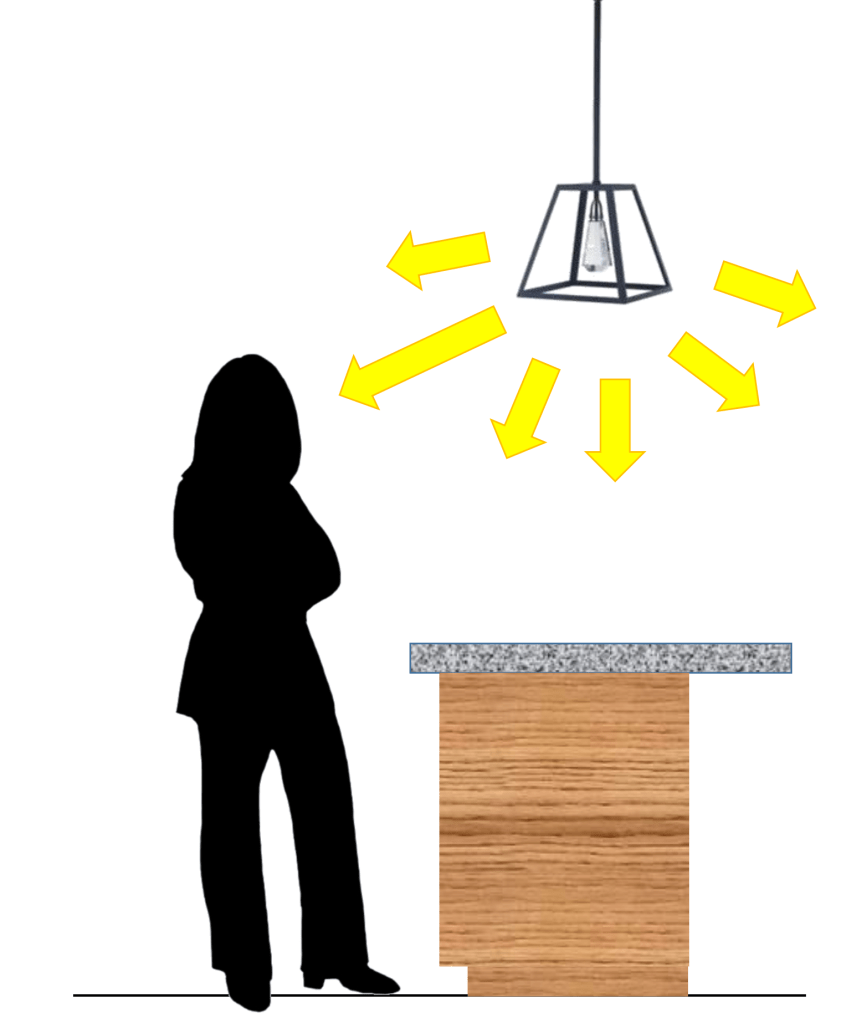
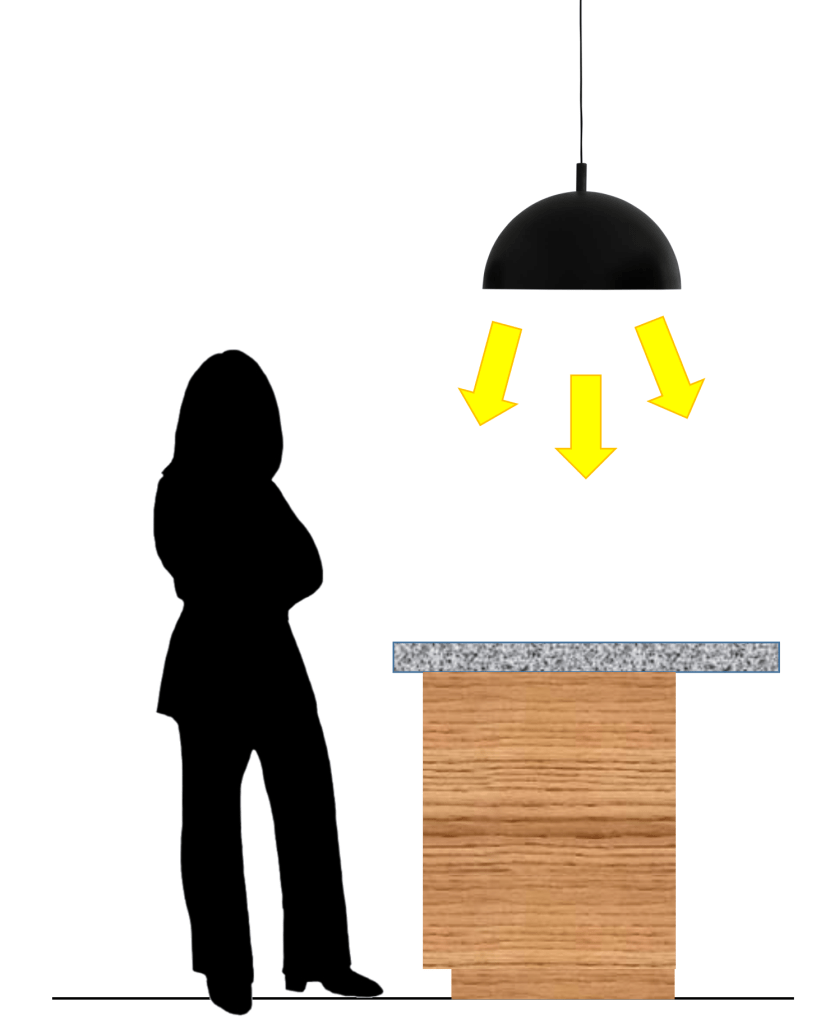
The bottom of island pendants are best positioned 36” over the top of the countertop, which is 36” above the floor. That means the light source is typically 6’-0” to 7’-0” off the floor. This location is VERY similar to the over-mirror lights in the bathroom. This location works against the user in much the same way, when the pendants feature clear glass and exposed light bulbs. Rather than aiding in meal preparation, the light causes glare and distracts from the detailed work that occurs on the surface below.

Unshielded light aims directly at the user’s eyes, even when hung in the correct location, making food preparation more difficult that necessary.
Well shielded light does not interfere with function. Light application and the user interaction should be considered along with amount, placement, style and size.

Landscape Lighting

The backbone of good landscape lighting is the obfuscation of the light source in favor of the delivered light. I’m always amused when I see a landscape lighting accent light aimed at a beautiful front door. The house typically looks great. The door becomes a highpoint and visitors can easily find their way to the home’s threshold. Unfortunately, the problem comes when they leave. The light is now aimed directly at the departing guests who are temporarily blinded as they grope toward the unknown step edge. Bad lighting, not the nightcap is the more common cause of sprained ankles and family spats.

Think About the Application

In each instance, lighting was selected and positioned to complement the space, but little regard was given to the humans who will inhabit and use the end result. Sure, we want the place to look good. We need certain amounts of light to function once the sun sets. We also want lighting that physically fills the area. It is time to include one more parameter, the user. With all these points considered, proper lighting application can be achieved.

Categories
Aesthetic Lighting Help Technical Lighting Help

Lighting and Sustainability

I was recently asked to speak about sustainability and how it impacts lighting. I have to admit, this is a tough one. There are a lot of elements under the sustainability umbrella; only a handful relate to lighting.

Much effort has occurred over the last fifteen years centered on the reduction of energy consumed for illumination. Lighting, specifically designed to respect the “Dark Skies” (light pollution) and sea turtle habituate is now readily available. Pendants constructed of old, recycled wine bottles are available. (Desire for them is another thing.) Digging deeper into sustainability will require an almost complete rethinking of how we light our homes, in much the same way that commercial buildings are embracing daylight harvesting, site placement and advanced fenestration design.

In a recent post, I suggested the reduction of decorative lighting would be an inevitable aspect of the future of lighting. Sustainability is the main reason. Lighting as we see it now is a fashion business. Like necktie widths and hem lengths, lighting goes in and out of style. With long-lasting LED, the twelve year aesthetic cycle is anathema to lighting that could be functionally viable for thirty. This fissure can only be overcome with good lighting design and application that promote the appearance of light, not the look and form of the luminaire.

Another aspect of sustainability we have heretofore ignored will be reuse. Tossing a dated chandelier in the garbage is pretty common. Creative people will need to come up with adaptive reuse as we enter the sustainability era.

My wife and I took on our first rehab project when we moved into our second home in 1990. It was a great 1917 colonial with much of the original lighting still in-place. Despite an update on the entire living room, we kept the slightly gauche ceiling light in place. It was just too, “too” to remove!

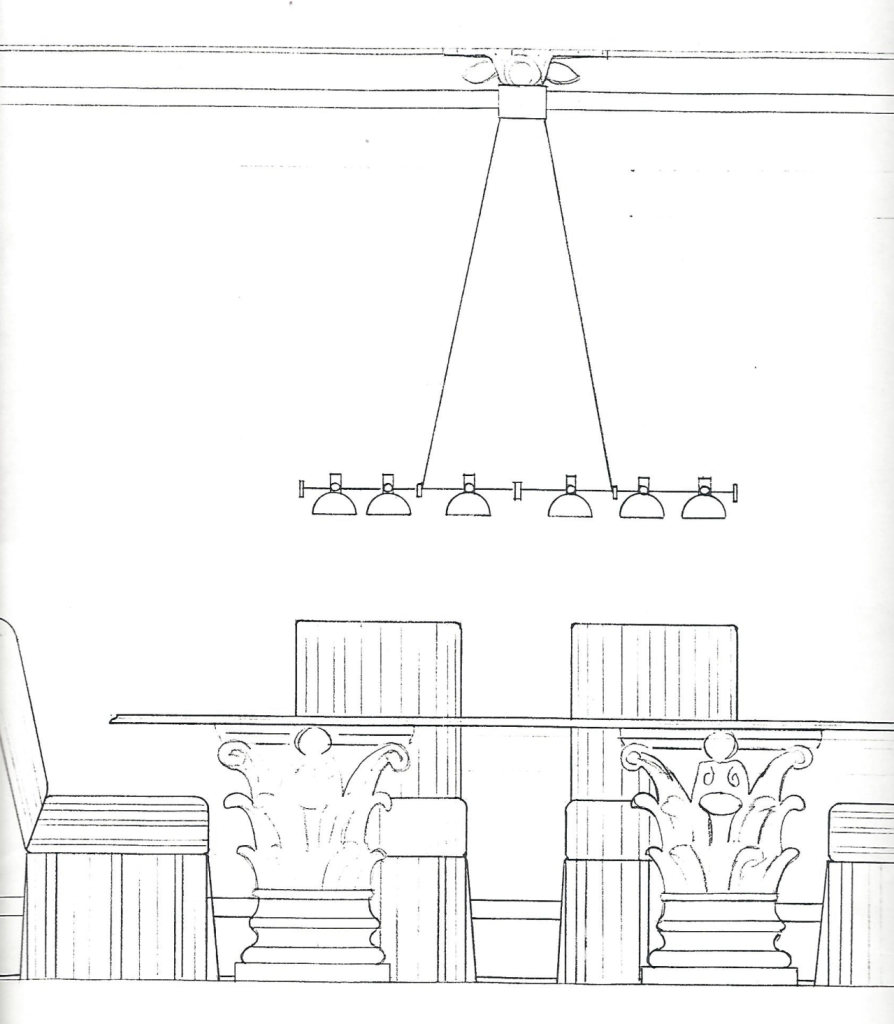
When we redid the dining room, we wanted a chandelier over the table. The room was already equipped with a ceiling flush-mounted, gold plaster starburst with five light bulbs jutting out at a 45° angle. We simply could not remove it, so I turned the piece into an exaggerated, lighted ceiling canopy. I wired it into the chandelier and it remained proudly on the ceiling until we sold the house.

My circa 1990 dining room sketch with the original ceiling flush light serving as a canopy for the modern linear chandelier.

To the obvious benefit of Salvation Army and Goodwill stores everywhere, spray painting old Spanish Bronze and Faux Williamsburg chandeliers manufactured in the 1970’s has been a popular way to light kitschy boutiques and cutting-edge restaurants for years. Like all trends, that too will end and we will be left with hard sustainability decisions. With more lighting hidden in the structure and fewer decorative pieces, future generations will be left with usable lighting AND a more receptive planet.

Before creating your next room design, give a moment of thought to sustainability. Is there possible adaptive reuse of existing lighting? Would the room be better served with creatively applied utilitarian lighting that will last through the next two redesigns? Considering a sconce made of recycled 2-liter Mountain Dew bottles, might, however be a bridge too far.

Categories
Technical Lighting Help

Circadian Supportive Lighting

In my last blog post about the future of lighting, I only mentioned circadian-supportive lighting in passing. I received a few comments that suggested I should be more-bullish on this type of light. Here’s why I stand by my opinion.

Over the last decade, I have attended countless lectures and panel discussions covering light, more specifically how light relates to health and our perception of color. Following the completion of the first session, I was immediately optimistic for the future. Initially, change seemed so easy. Unfortunately, the more I learned, the dumber I got.

Color wasn’t just CCT and Color Rendering. After each lecture, another wrinkle was added. Chromaticity, spectral power distribution, gamut, tri-stimulus values and metamerism all turned a simple solution into a complicated problem. What seemed like a “no-brainer” quickly turned into a much more complicated issue.

I remember attending an annual Energy Star conference. An open session on color damn-near turned into a bar fight between an audience member and the moderator. The topic was not a political fight, a sports-based disagreement or even a spurned lover. This was a harsh exchange about each person’s understanding of the color of light. Certainly not the typical argument you’re likely to overhear at Danny’s Tavern. (Feel free to insert the name of the local watering hole of your youth.)

Early on, the importance of circadian-based lighting in the future seemed obvious. Its increased use became my assumption, too. The more I learned and saw of the trajectory of LED, I began to pull back on the notion. LED is getting cheaper and with that, delivering poorer quality light. Why would I now expect a reverse of that trend? Will circadian sensitive lighting be the one thing that reverses our desire for cheap?

In one of the lectures, an audience member asked the speaker if he thought all light in the future would be circadian-regulated. He flatly stated, “No!” he gave his rationale. “We all know the typical office chair is bad for our body. Engineers have developed the quintessential solution to solve all of the problems that harm our musculoskeletal systems. How many people have purchased these chairs? Ten, twenty percent? If consumers will not purchase a more expensive chair to solve a known medical problem today, why would we think they will do so tomorrow?”

From my perspective, I want to believe lighting is much more important than a chair; but is it? I don’t suspect I’d get into a bar fight over it, but the evidence is not very compelling. Circadian lighting, like the Aeron Chain and GE Reveal lamps will appeal to a rarified population. They will be available, helpful and better, but because of the cost, ignored by the bulk of the population.

Categories
Technical Lighting Help

The Future of Lighting

I was asked an intriguing question this week. “What do I think lighting will look like in the future?” With all of the changes that have occurred in lighting over the last decade, you might expect a period of rest or inaction, but I really don’t think that is likely. The cat is out of the bag. Users, creators, scientists and researchers are more aware of lighting then at any time since Edison. Lighting will remain a kinetic force in our lives.

Outside of the residence, there are going to be even more changes, but if I strictly concentrate on residential lighting, I (and my Magic 8 Ball) feel pretty comfortable with the following observations.

Less Decorative Lighting

Two-story foyers are gone (for the most part) dining rooms are disappearing, flex-space is growing and landscape lighting is a much more effective way to light an exterior of a home then a surface mounted porch light. Couple that with an increase in the amount of pre-fab or modular construction and lighting built into the fabricating structure of a home will be more and more commonplace.

Decorative lighting also carries with it a “style.” Whether contemporary or traditional, some portion of the population doesn’t like it. Style becomes an alienator, preventing a sale. If the core building is style-agnostic, it becomes easier for a future homeowner to imagine herself in the space. Removing decorative lighting, perhaps as slowly as bedroom lights and hallway light disappeared, appears to be a sure bet for the future.

Integrated LED

We are all lighting maintenance people. We don’t service washers, dryers or ovens, but lighting is different. As if it were a birthright, we feel compelled to change light bulbs. Our incandescent mentality causes us to worry about buying lighting that eliminates the need for re-lamping. We are suspicious, unbelieving and skeptical, this innate portion of our psyche being so powerful. Despite our overwhelming resistance, integrated LED lighting will overtake and replace lighting with replaceable light bulbs. It has quietly gobbled up lighting category after category. First landscape lighting, then recessed, linear architectural detail lighting, under-cabinet lighting, contemporary chandeliers and the table is set for bathroom lighting…and the world has not ended! There is life after light bulb replacement.

As we move into tomorrow, the shift will be further advanced by poorer quality (but cheap!) replacement light bulbs and a shifting aesthetic direction that will be more clearly borne out with integrated LED. Well-designed integrated LED lighting will operate in a residential setting for over twenty years. When the average redecoration of a home is every seven years, this is likely to exist through three remodels.

As the Gen Z and Alpha demographic will understand best of all, there will be much better things to do than change light bulbs!

Smart Lighting

Home automation is inevitable. Your great-grandmother couldn’t understand the need for a cloth dryer, your grandmother didn’t need an air conditioner and your mother doesn’t need a smart phone. Like the preponderance of dryers, AC and smart phones indicates, home automation is going to happen. A voice activated home will be de rigueur. The typical consumer has already linked an intelligent home to automatically turning on and off lighting. It is one of the first things people do with their new Alexa or Google voice system.

A few things could happen. The luminaire will include a smart “dongle” or, “dongles” will be wired between each luminaire and the house wires, but rest assured, the ability to configure it to a smart system will be there. That then leads to the next prediction.

The Elimination of the Light Switch

When a luminaire is intelligent, why does it need something as “dumb” as a light switch? When you remove the switch, you also eliminate the yards of wire that link it physically to the outlet box. The home becomes easier to wire, holes are removed from walls, backsplashes and panels. The cost savings alone might make this the first prediction to come to fruition.

For Better, or Worse

When LED was first introduced, the sky was the limit and lighting professionals felt, finally, we would have GREAT light. That optimism was unfortunately, a bit too much and too soon. To get prices down, many concessions were made. Those concessions resulted in lower quality products. One need look no farther than the surface-mounted, recessed can replacements. These are a poor light source that creates far too much glare. Take a look in a “big box” store, also. The 40,000 to 50,000 hour light bulbs are slowly being replaced with 10,000-15,000 hour models.  Yes, they are cheap, but….

I suspect that the future will re-find a place for better lighting. It will appeal to a select clientele who understands the value of good light. More effective, less glary cans, circadian adjusted light output and adjustable bathroom lighting are just around the corner, especially for those who appreciate the difference between good and poor lighting.