If you have read any number of my blogs posts, you know I am “bullish” on technological advances in the home. I was involved, early-on with adopting LED to residential products. I firmly believe smart home automation is inevitable and self-controlled residential environments are going to be more common than not. That said, the lighting industry has NEVER been a tech-industry and as such, they are wholly unprepared to deal with problems, such as quickly evolving and improving products. This inability has gotten them into trouble with consumers.
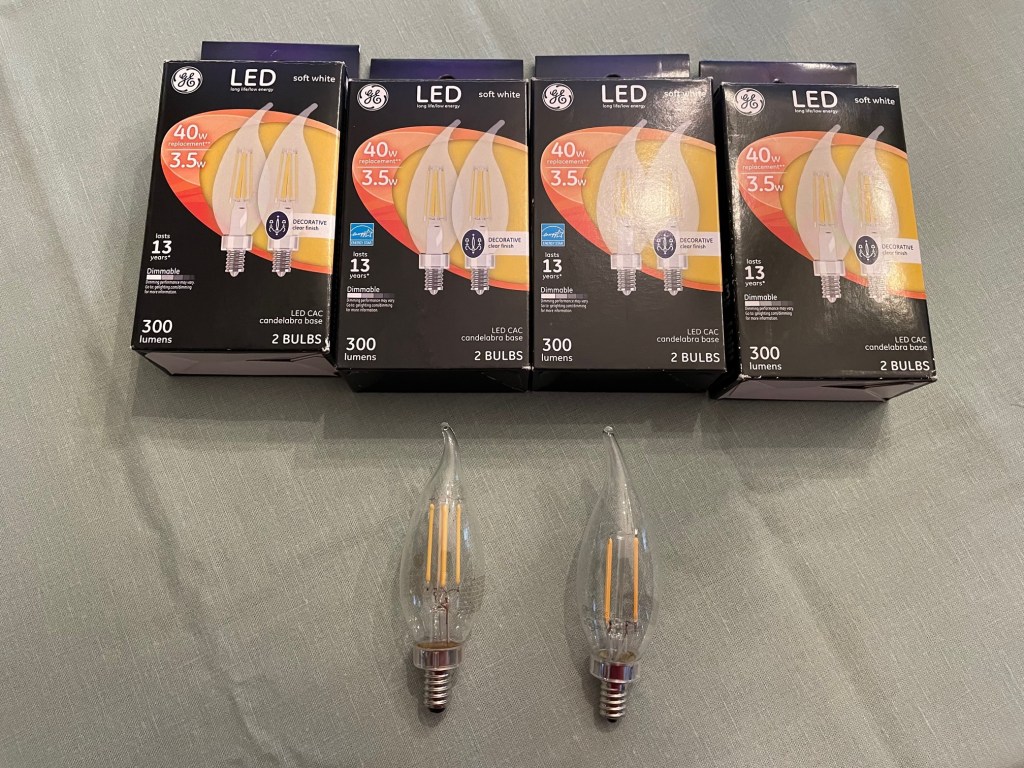
A friend called last week. He was trying to re-lamp his dining room and foyer chandeliers with LED retrofit candelabra lamps. In a previous conversation, I suggested he stick with a major brand, buy all the same product at one time and I also gave him color temperature (CCT) recommendations. (This is advice I also give to industry personnel and related design professionals.) He needed 23 lamps, so he “cleaned the shelves” at a local retailer. The ladder was out, the lamps were going in and once he had finished, he noticed a difference.
To create an LED version of a flame-shaped candelabra lamp, the engineers have strung LED into bands to visually replicate the appearance of a filament. Most of the lamps employed two bands of LED, but a handful use four. While the lumen output was equal, the appearance was different.
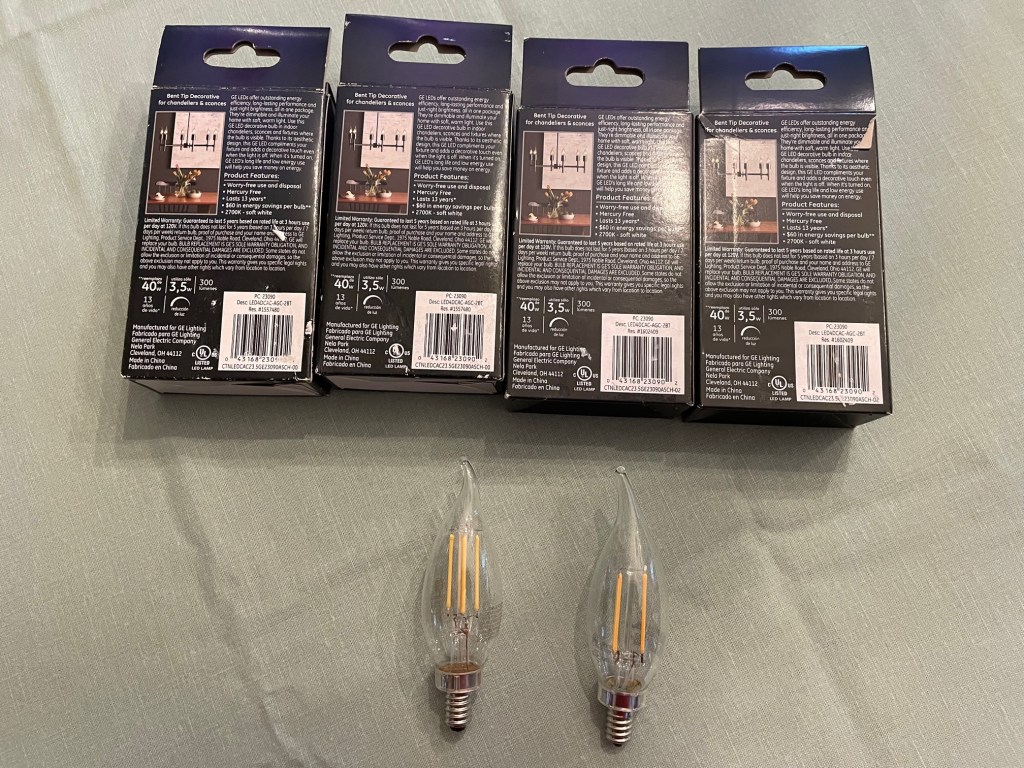
The packaging was the same. Lumen output was the same. The UPC number was the same, as were two additional sets of numbers. The rub arrived in the sixth number printed on the back of the carton. There lay the difference.
My friend did all of the right thing. He consulted with a lighting expert (me!), bought the same brand product with the same color characteristics, bought them from the same retailer, at the same time and still got burned. Honestly, I wonder if I would have noticed the variation and I have been helping people buy the correct lighting for almost a half-century.
The exact same lumen output, wattage consumption and carton appearance, but inside were decidedly different looking lamps.The same PC number, the same description code, the same UPC number, but a different Res number, the only indicator that there is something amiss.
The incandescent light bulb you bought in 1985 is exactly the same as the ones on a shelf today. That is how consumers currently relate to light bulbs. It is also, apparently, how major manufacturers treat them. It is time for them to do better so the consumer can easily transition to the new world.
Visit your local Best Buy and ask them for a 2015 Samsung flat-screen and you will be laughed out of the store. There are a ton of iPhone 8 still in use, but you cannot buy a new one. Technology companies, with rapidly changing product know how to get the correct version to their customer. Lighting people do not.
I recently bought a sleeve for my iPad and could not complete the order without including the model and version. A small, one-person, technology support supplier making hand-stitched, felt covers for computers, iPads and phones has adapted her business to the multiple versions of tech products. It is time for the lighting industry to up their game. We are not living in Thomas Edison’s world any longer.
For a long time, I have indicated a preference for new integrated LED luminaires, as opposed to socketed luminaires using retrofit LED lamps. That works for most product, except where the lamp is a part of the aesthetics. Integrated luminaires will not have this problem.
We still live in an incandescent world, we are incandescent-inclined, we are born into a world where lighting fixture maintenance and repair is an innate skill. We feel compelled to change light bulbs. This will be hard habit to break. Dumb missteps by lamp suppliers will make the path harder, not easier.
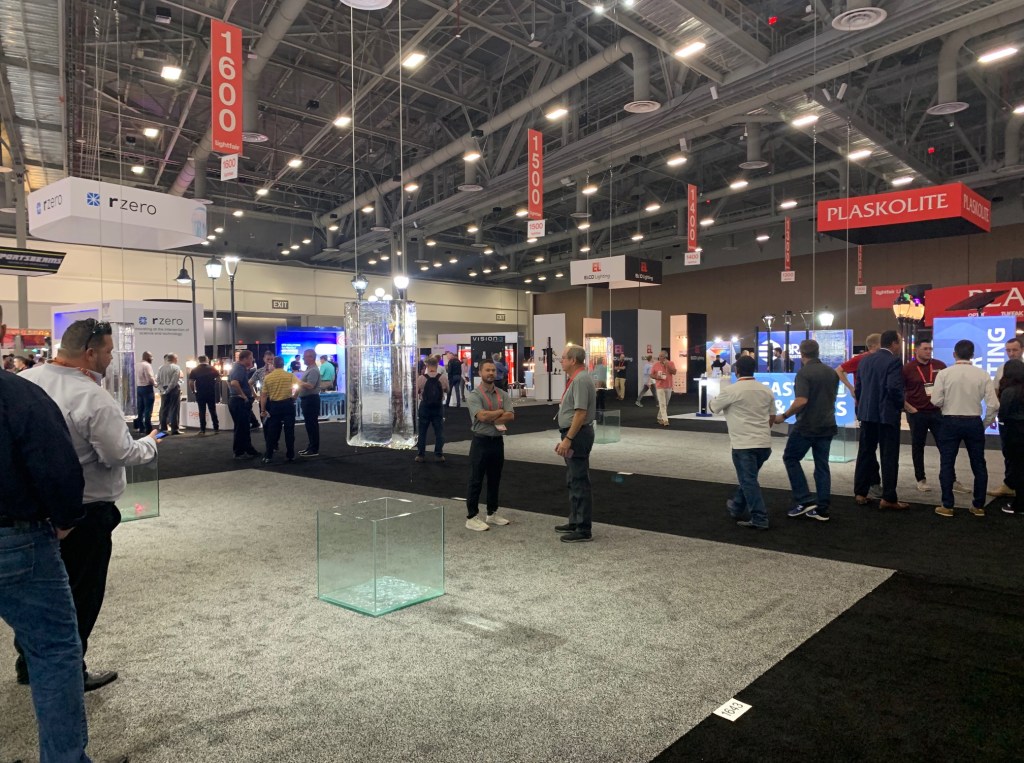
While I did attend some extremely informative education sessions this year and the information I took with me will be helpful, my overall experience at LightFair 2022 was lukewarm. Part of the reason was the limited quantity of exhibitors, part was the physical space and the last part was a simple lack of enthusiasm.
Education
I attended educational sessions covering Turtle Protection Lighting, Visual Complexity, Resilient Lighting, Built Environment Lighting, Sustainability, Custom Luminaires, Replicating GUV lighting with existing software packages and the dynamic lighting effects available with the use of DMX512. My challenge now is to sieve through the data and determine how that will realize itself in residential lighting. Look for future posts on these topics.
Products
Only a few things on the show floor piqued my interest. Here’s a quick rundown.
The Glint Lighting Hero track-head is different than most. The head stays in place and direction of light is regulated with the use of a small “joystick” that can be fixed, once placement has been established. This is great for two reasons. Visually, you don’t have competing heads bent in varied directions along a ceiling. Secondly, the light will stay where the designer wants it. Once fixed, errant lights, loosened joints and drooping cans are a thing of the past. This is a nice simple solution.
LightFair 2022 – Glint – Fixed track head with fully adjustable direction via internal mechanics.
Beelite, a company I have only know as providing ammonia resistant poultry lighting, showed a cute little collection of rechargeable patio lights. Nothing on their website as yet, but keep an eye out for these!
I know there have been a lot of variations on the theme of flexible LED filled tubing, but the Tivoli Flexile could be a nice addition to a space. To prove my point, right down the aisle was LumoTubo with very much the same thing. This proves again how much LED has changed our approach to lighting.
Within their architectural systems category, Wagner Architectural Products includes Lumenrail, lighting solutions for railing. I was especially drawn to the lighted post, a dot of light tucked up inside a wrap, rather than on the rail portion. I thought this was a nice idea.
LightFair 2022 – Wagner Architectural Products lighted post cuff.
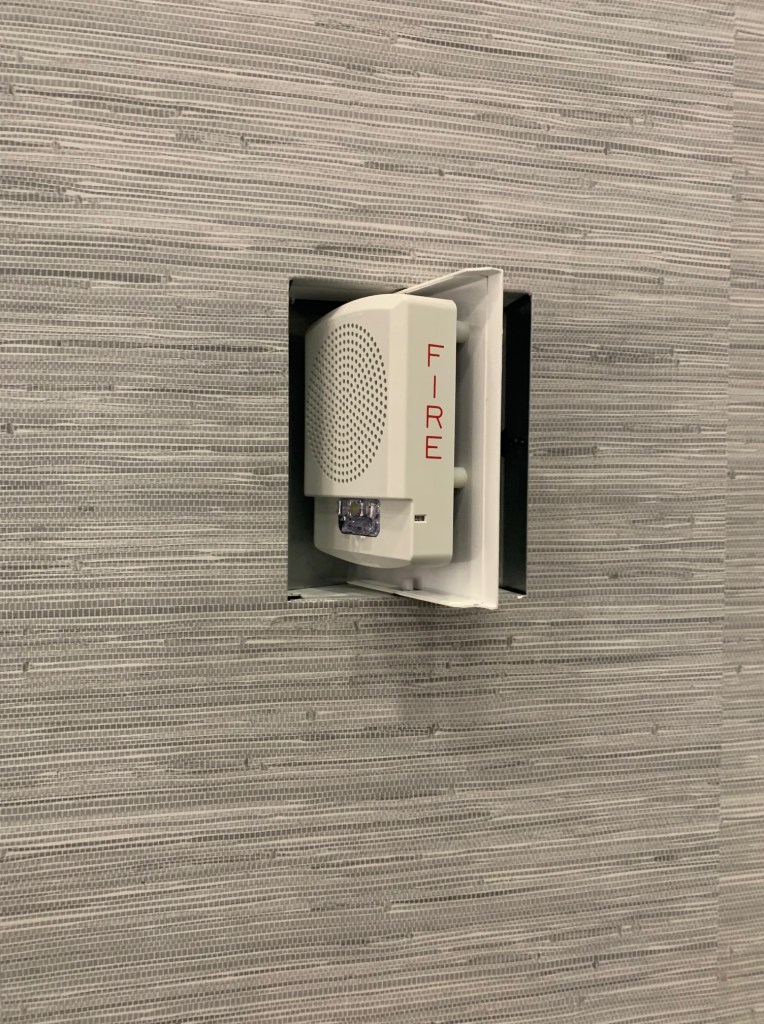
I was reminded of this product while talking to a friend on the show floor. Concealite hides fire alarms and emergency lighting behind revolving panels. GUV lighting options are recently available. They also provide emergency “Exit” signs that disappear into the drywall for a much more aesthetically sensitive result. If you’re involved in a commercial buildings, this is a nice resource.
LightFair 2022 – Concealite – Fire alarm hidden within the joist space of a wall.
Both Pure Edge and Klus showed customizable LED solutions using aluminum extrusions. The Pure Edge TruCirque allows for the creation of drywall deep circles from 3’-0” to 18’-0” in diameter. The LED Tape is applied to the edge(s) of the extrusion and a snap-in lens is then provided. Klus MIFOR70 invites custom designed curved form luminaires (within some pretty broad parameters) to be imagined. Both clearly indicate how LED is changing the concept of lighting and decorative luminaires.
Try as I might, I could not seem to navigate my way effectively around the show floor. Aisles seemed to “dead-end” and booths were placed pell-mell around the floor. Right before I left, I figured I’d cruise once more around the show. Amazingly, I saw some things I had not noticed before. Trade shows often have a few aisles that do not conform to the “x-y” grid, but when the bulk of the show is like that, it becomes an issue.
To get inside the show, everyone was funneled through a single opening. That opening led everyone to a divider-protected “pen” with two, even smaller openings to enter and exit the show floor. I think Temple Grande designed this entrance, assuming we were all cattle in need of guidance, on our way to slaughter.
The Las Vegas Convention Center West Hall Building
As you might expect, the new hall is modern and pleasant. The three older halls have become dated and in need of a clean-up, so it was nice to be in a new space. Unfortunately, little thought was given to the visitors arriving at the hall.
The Monorail, simply the best way to get to the old halls now drops attendees over a mile away from the new hall doors. After exiting the Monorail, it travels directly alongside the new building. Wouldn’t it have been nice to have coordinated with the city and add a stop at the West Hall? Taking the SDX strip express bus would seem to be a perfect alternative, but unfortunately, the RTC has suspended that express service! The LVCC solution is, walk more, or….
The LVCC LOOP
Moving people is obviously an aspect that was overlooked in the planning of the convention center expansion. Sure, walking is an option. Exactly what every show attendee wants to do more! Why wasn’t a much more comprehensive and usable solution installed?
Instead of a bi-directional Monorail or tram, or even a loop system (not sure about the right-of-way across the street from the convention center) connecting the halls, the LVCC bought into Elan Musk’s boring system. This has resulted in the most cumbersome people moving concept I’ve ever experiences.
A tunnel has been bored between the South Hall and a plaza space between the North and Central Halls, then onto the new West Hall. Rather than installing a train, or tram to travel the underground route, individual Tesla cars are driving people, three at a time to their hall destination.
WHAT??
You read correctly. On the first day, I waited with two others for fifteen minutes for the next available chauffeured car at a poorly attended show!! What is going to happen at the Consumer Electronics Show with almost 200,000 attendees? Even worse, if you are arriving at the show early, as I did for the early morning education sessions, the LOOP is closed!
LightFair 2022 – Las Vegas Convention Center LOOP – Waiting for the next chauffer to arrive and take guest through the tube to the West Hall.
I actually think Musk has something in his bore technology. This, however is a laughable implementation with which he should be embarrassed to be associated.
LightFair Booths
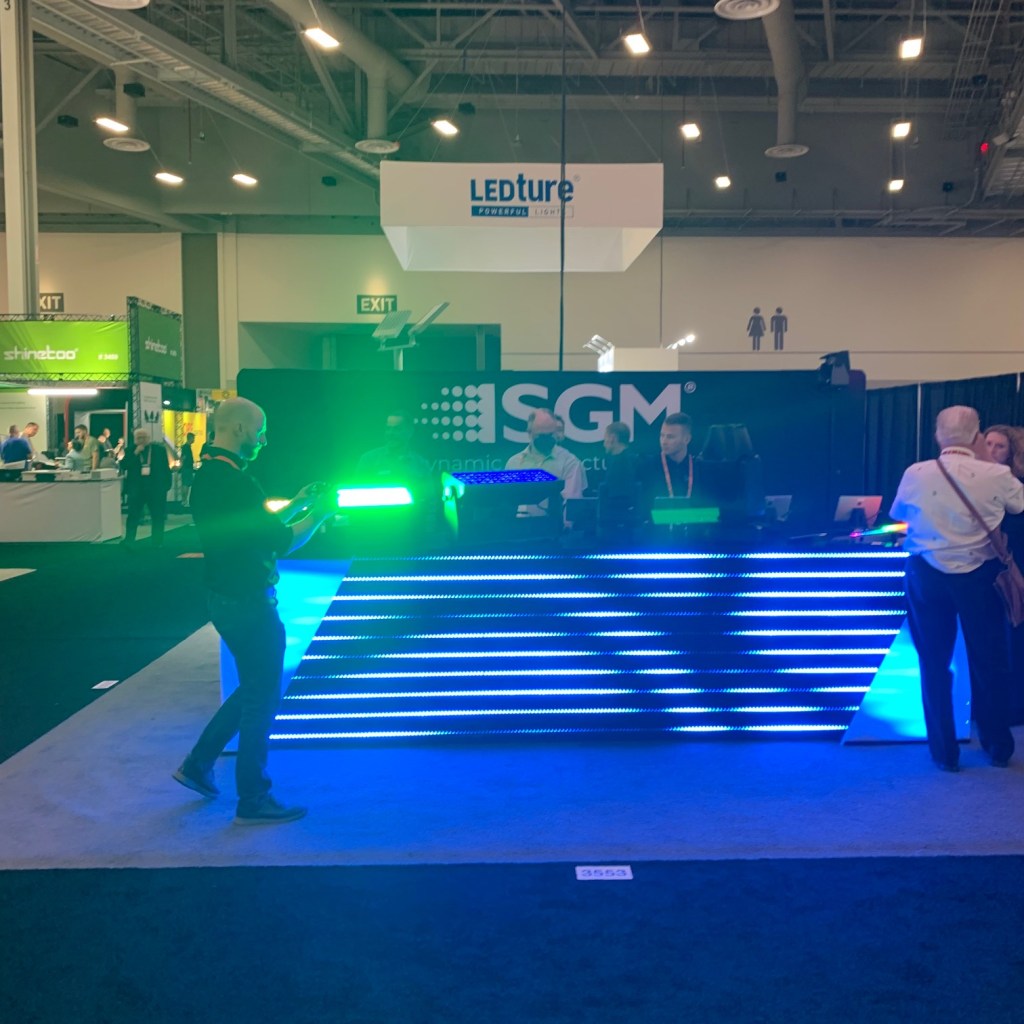
Seriously people. We’re supposed to be lighting experts. That being said, why are so many booths glare bombs? I passed one booth with 10,000 lumens of light poking me in the eye. From beyond the blinding glare, a voice, “May I help you?” I couldn’t see if it was Mephistopheles or an exhibitor. In an effort to avoid permanent retinal damage, or eternal damnation, I ran away.
Check out these blinding examples of poor, uninviting light.
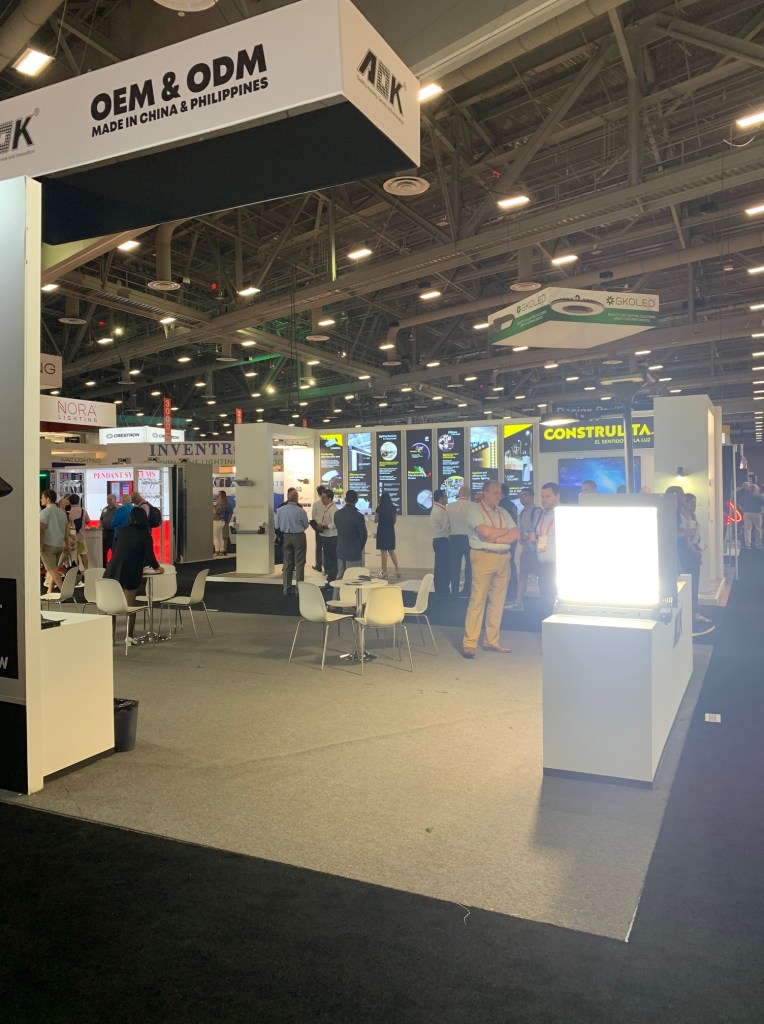
Now, look at this image. The booth was filled with light, but none of it was blinding. There was a crowd almost every time I passed. Good lighting means good business! It is time for exhibitors to do better!
LightFair – A pleasantly lit, glare-free booth. What a shocker!!
The Best Booth
RAB devoted two large floor areas to four blocks of ice suspended over acrylic buckets, there to collect the dripping water. Visitors did not know what to make of it, compelling them to interact with the RAB personnel on hand.
LightFair 2022 – RAB – The most meaningful booth in the show.
Each cube was marked with a QR Code that linked to a video on climate change. It was an effective message about RABs intended direction. In the 100° Las Vegas climate with just released news reports on dangerously low levels of water in the Colorado River and the Lake Mead and Lake Powell reservoirs, it reinforces the need for action.
The Funniest Point
LightFair 2022 – LVCC signage confusion – Photo taken while standing in front of room W228 after passing it twice!
A new hall. The first show many people have attended in two years. I’m standing in front of Room 228. Guess how many times I passed the room before checking in? Obviously, there are a few bugs that need to be cleaned up before the new West Hall is ready for prime time!
LightFair 2023
I might indicate here that things can only look up and LightFair 2023 in New York will be better. I’m not sure I believe that. I’ll go, but it could be my last if something doesn’t change. It had a good run. It might be time for retirement.
Perhaps one of the most highly regulated types of lighting is that which is placed in closets. Over a year ago, I wrote a whole blog post on deciphering the nuances of the National Electric Code requirements concerning this rather obscure light placement. https://lightingbyjeffrey.com/2021/03/29/closet-lighting/
At the start of the late 1970s energy crisis, efficiency gurus urged homeowners to add more and more insulation in their attics. That, unfortunately trapped heat in ceiling mounted outlet boxes. The increased temperatures caused wire insulation to melt.
Fabric, stacked against poorly placed electric lighting in closets and disintegrating electrical wire insulation, both resulted in fires. The NEC added stricter requirements for closets and Underwriters Laboratories recognized the root cause of increases in fires and elevated the testing requirements, now performed in insulated ceilings. These are safety measures aided by outside oversight. Are there steps the average homeowner can take to insure safety? Here are a few thoughts.
Obey Wattage Labels
Since many of us are using LED replacement lamps, ignoring wattage labels is becoming more common. Try not to become complacent, especially if you are still using incandescent lamping. Wattage labels are a meaningful part of the safe operation of your light source.
Especially problematic are those applications where the lamp base (the threaded portion of the light bulb) is position in an “up” direction. (Remember your high school science, heat rises!) If a 60W maximum is specified and a 100W light bulb is used, the envelop size is the same, but the temperature created is substantially higher. That means the wire will be exposed to hotter temperature levels and deterioration can result.
My mother had a pole lamp that she could not live without. It was illuminated all evening, she read, did puzzles and knitted using it and when she couldn’t see well, as cataracts took more and more of her visual clarity, she simply increased the light bulb wattage. Of course, eventually it stopped working. I got a call to “fix her light.” My first reaction was replacement. “No! I like this one. You’re a lighting guy. Can’t you fix it?”
After I tore the pole lamp apart, I found barely functioning wire. It was all brown and brittle. The Bakelite sockets fell apart in my hand. Were she not a self-sufficient person, a fire could have easily destroyed her home. I rewired it with heavier wire and porcelain sockets. Go ahead mom, use whatever wattage you need. It is built for maximum wattage now.
Unfortunately, not everyone has a son, who is a lighting guy. Most people can’t teardown a fifty year-old pole lamp, rebuild it for higher temperatures and set it up for another 50 years of use. To avoid that, follow the wattage labeling instructions. (Please don’t call me! Rebuilding pole lamps are a pain in the keister!)
Obey Mounting Labels
Many luminaires are engineered to function in a specific direction. A “mounting direction” label indicates “This End Up” to insure proper operation. I’ve mentioned multiple time my neighbor, who has his porch light mounted upside-down. Were it not for the eave above, the unit would fill with rainwater and electrically-short, causing serious damage. He didn’t pay attention to the mounting instruction. Don’t make the same mistake as my neighbor.
Adequate Kitchen Lighting
How often would you walk through a dark room with a sharp object ¼” from your carotid artery? Unless you share some character traits with the Marquis de Sade, this adventure is unlikely. Why then would you cut carrots on a poorly lit countertop? When we bought our current home, there was a single light on a fan in the middle of the kitchen. When we cleaned the room prior to moving-in, I was surprised there were no finger segments that accidentally fell behind the refrigerator! To avoid parasuicide, install proper lighting. General kitchen lighting should be of a recommended level with supplemental under-cabinet lighting a must.
Nighttime Navigation
Attempting to walk from the bed to bathroom at night continues to cause numerous injuries that accelerate with age. Regardless of our familiarity with the surroundings, we still need the aid of light to traverse this short distance. Consider one of the following:
A motion activated light under the bed. Once your feet touch the floor, a sensor detects their presence and turns on a light.
Include a switch next to each side of the bed, connected to a light that travels the distance between bed and toilet. I recently recommended this idea to a client. The bed was centered in the bedroom with entrance to the bathroom from two directions, one on each side, for each of the sleeping partners. We connected the switch to a few junction box-mounted, aisle lights in the hall and a strip of LED Tape under the vanity counter. On the opposite side, the second switch illuminated different hall lights, but the same under-vanity light. The owners were extremely satisfied.
Remember that all nighttime lighting should be aimed downward and indirect. The reduction of glare will be easier to use with sensitive night vision in place.
Stairs
If nighttime navigation is the number one fall risk in a home, stairs are second, again, especially egregious for seniors. Find those areas where steps and staircases reside in the dark and add some light. Look for landings and step treads that are the same color. Consider steps used regularly at night. Solve the problem with step and aisle lights on the adjacent wall, or use strips of LED Tape under each tread. Railing is also sold with an embed strip of LED Tape, or it can be easily added to an existing rail. Regardless of the method, light the stairs!
Safe
When we think of safety in a home, our mind snaps to bathtub falls, silent CO2 gases and errant fireplace cinders. We might not automatically think about eliminating some of the other, more popular incidents with correctly placed light. Light can help avoid incidents, but we should avoid lighting misuse incidents, as well. Paying attention to both will make the home a much safer place in which to live.
Sure, I’m a “Lighting Guy” but it is impossible to visit showrooms, galleries, design show floors and window-shop without seeing things outside of lighting that attract attention and ultimately will interact with lighting in the residential environment. While exploring the International Contemporary Furniture Fair and the streets of New York, the following items could not be ignored.
A New Finish Direction?
I immediately fell in love with the new Umber finish show by THG called simply “Umber”. If you’ve been around metallic finishes for a while, you might remember the Burnished Umber or Umbered Brass finish popular in the late 1990s. It was created by oxidizing brass and polishing off the oxidization into a sheen, rather than the matte found in antiqued finishes. The oxidization was brownish. The new THG Umber has more black with red undertones. Darker than the brass now used, this could be a nice brass/bronze finish alternative, or next-gen brass direction. The same finish is also available in a matte version, equally interesting.
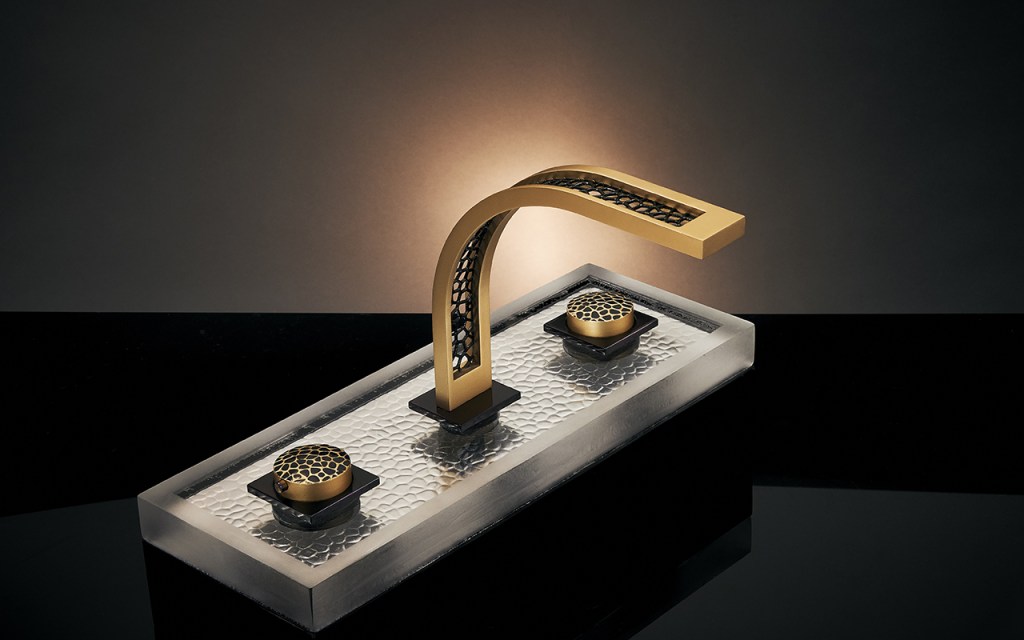
I was struck by the addition of textural elements in some new plumbing products. Brizo showed the new Tulham faucet with a glossy faceted ring on the end of a matte ensemble. This small ring detail was a nice way to extend the idea that some accessories are indeed, the “jewelry of the home.”
ICFF 2022 – Brizo Tulham faucet set with faceted trim ring
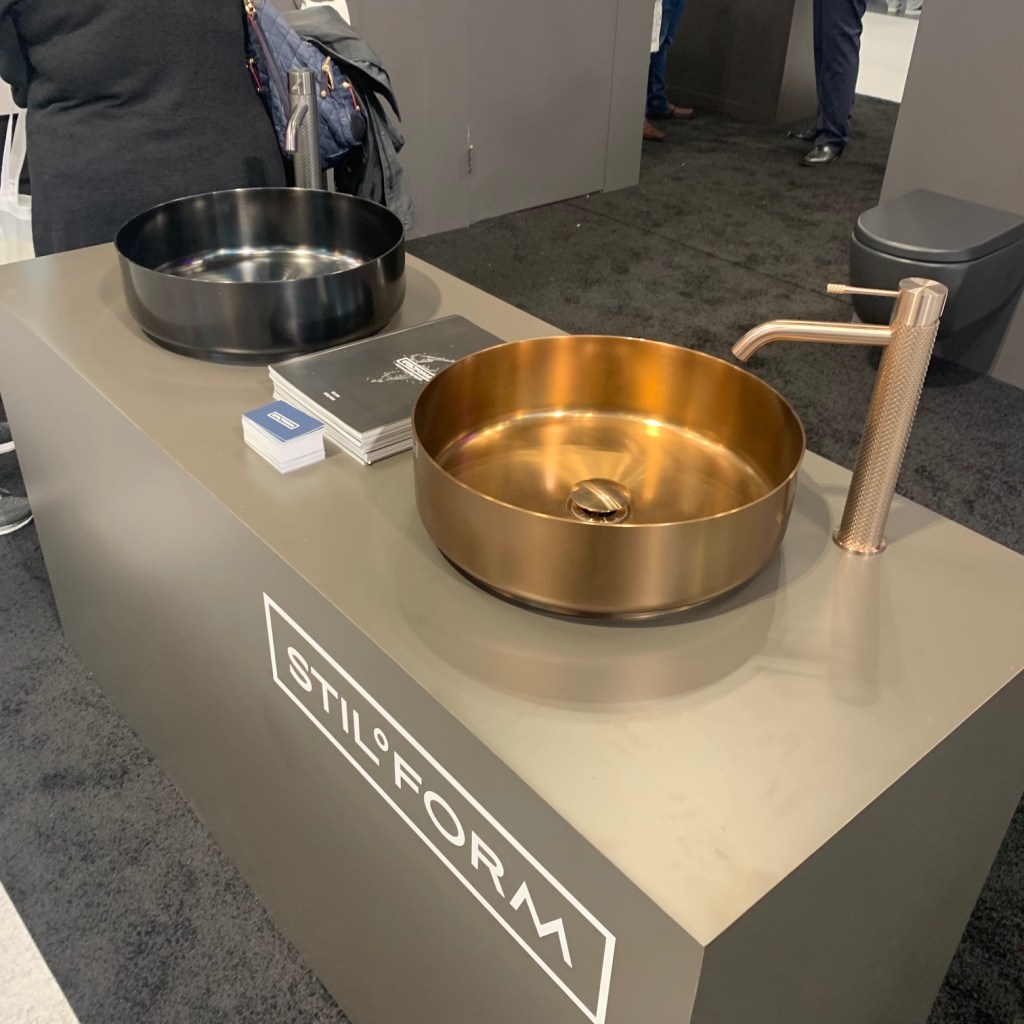
Similarly, Samuel Heath, the British “tap” manufacturer used a faceted ring around the handles of their One Hundred Collection. Stiloform, an Austrian company displayed a faucet with a knurled shaft that extended the texture idea into new areas.
ICFF 2022 – Samuel Heath One Hundred CollectionICFF 2022 – Stiloform
Perhaps some of the most interesting and amazing faucets in the whole show were on view at Uniq-e! an Italian concern that appears to be reinventing all of the known parameters surrounding faucets. A quick look through their website information will provide an idea of their creativity.
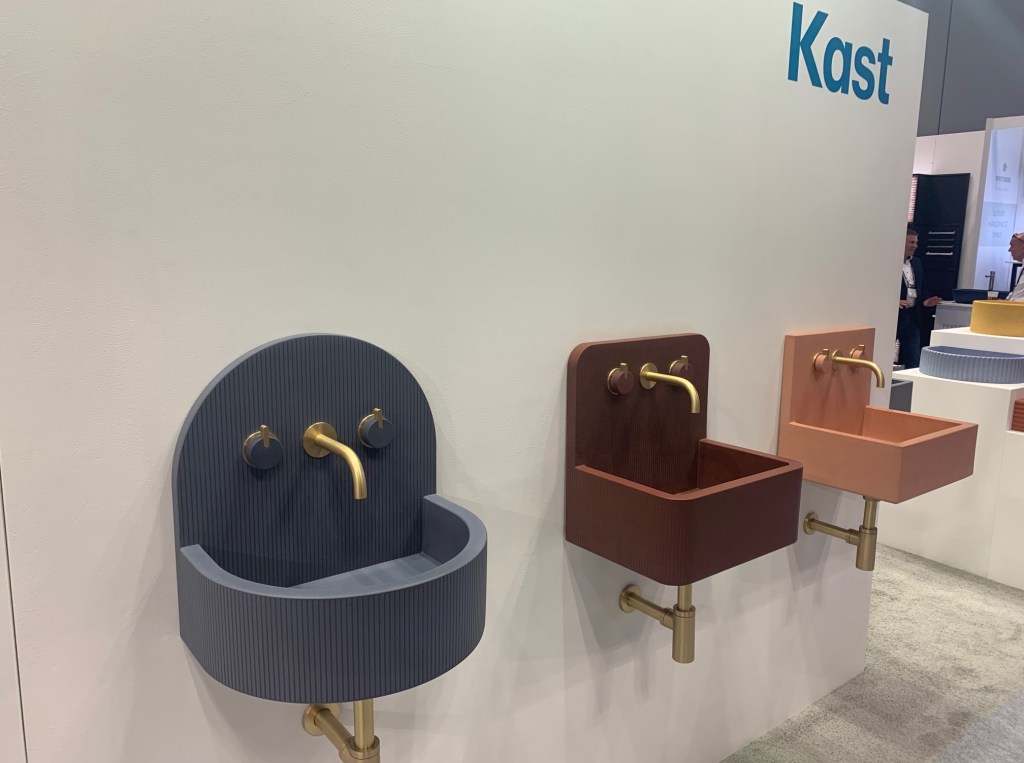
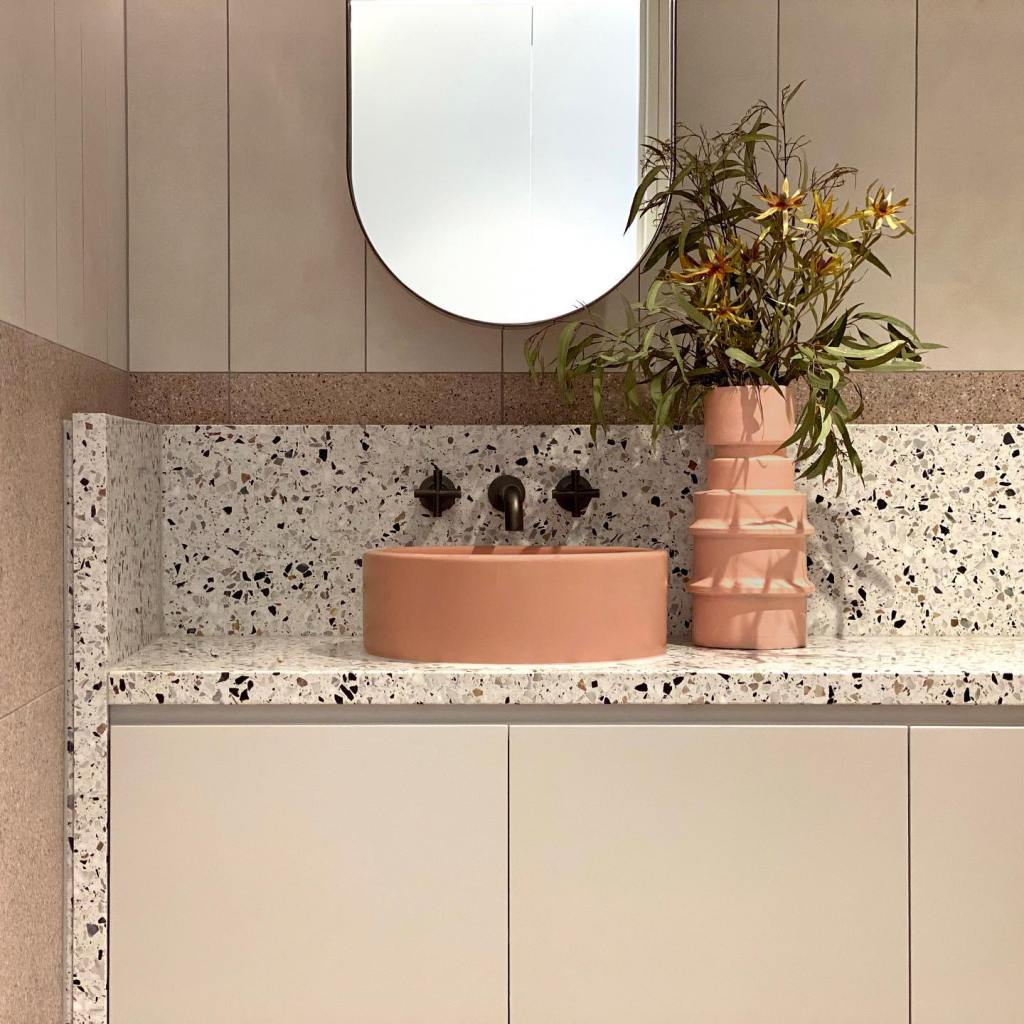
For the last couple of decades, vessel sinks have been sucking up all most all of the creative air in the bathroom space. Thankfully, that era is at an end. Placing the proverbial nail in the coffin, a number of manufacturers were helping designers to ease out of their reliance to these ubiquitous sink options. Perhaps the most engaging and “fun” were the cast concrete sinks shown by Kast. In fresh colors and interesting shapes, these will quickly allow a homeowner to forget they ever hear of a vessel. They can read as modern, deco, mid-century or slightly retro. These are exciting options for the progressive home.
The LaCava Linea sink has reinvented the vanity and enclosed it within an invisible frame of square tubing. Add to the mix a delightful collection of colors and it immediately ups the appearance of any bathroom. There is also a wide variety of frame configurations available. I like this look.
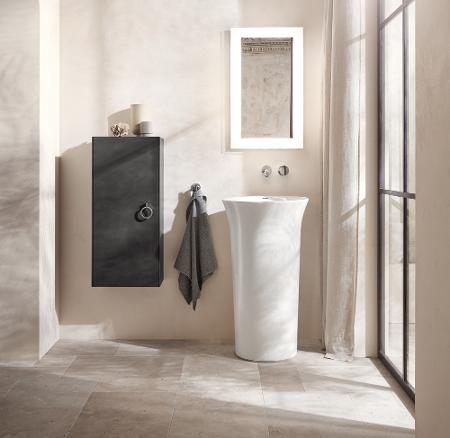
I am a sucker for almost anything Philippe Starck does and his White Tulip collection for Duravit is no exception. With just the gentlest of curves, the standing sink opens at the top to serve as a beautifully sculpted tower sink. The tub and surface mounted sink feature the same appealing curve. This is a stunning bathroom suite.
ICFF 2022 – Duravit White Tulip collection by Philippe Starck
On the opposite end of the aesthetic spectrum are the handmade sinks from Whitebirk. Made in England, these sinks are beautifully crafted, but lean a touch more traditional. Again, color is being used to better differentiate what is available from a high-quality supplier and that which is purchased through mass-retailers.
ICFF 2022 – Whitebirk
Outdoor Living
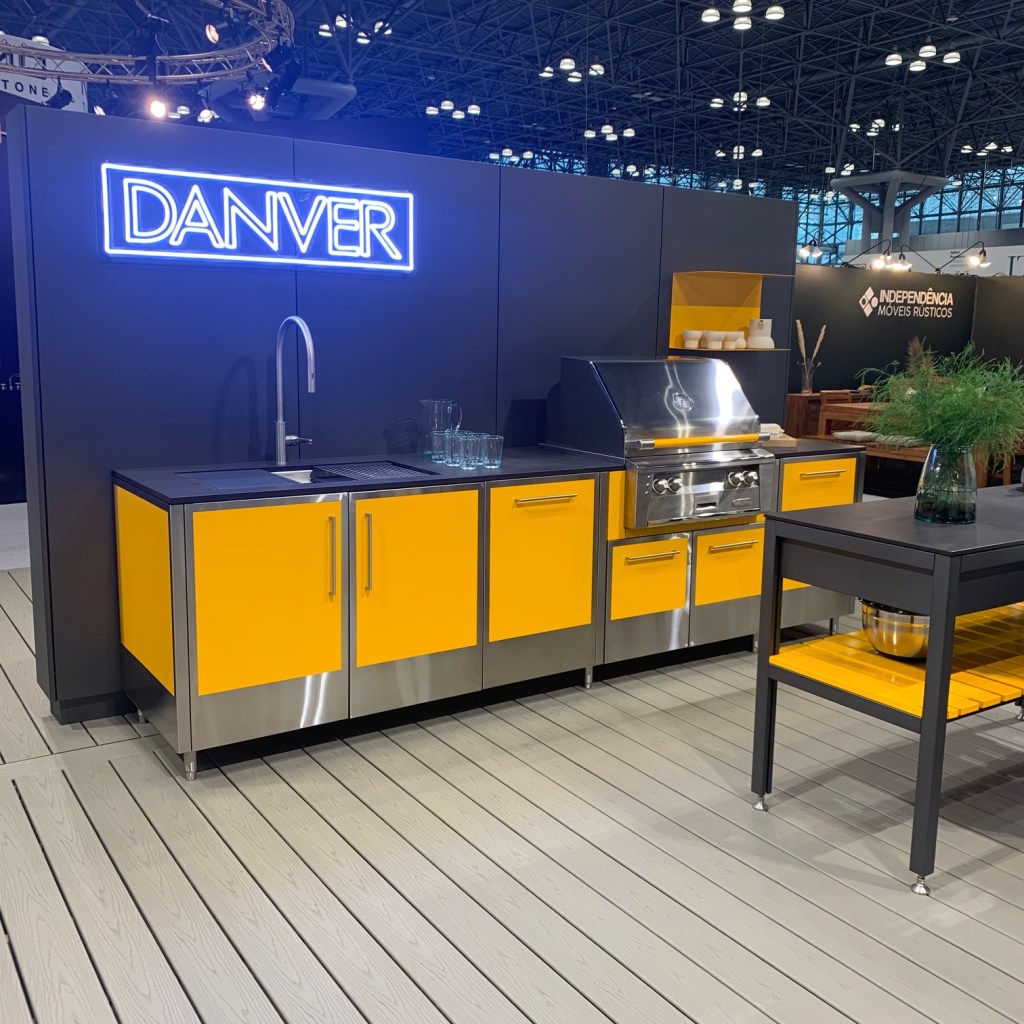
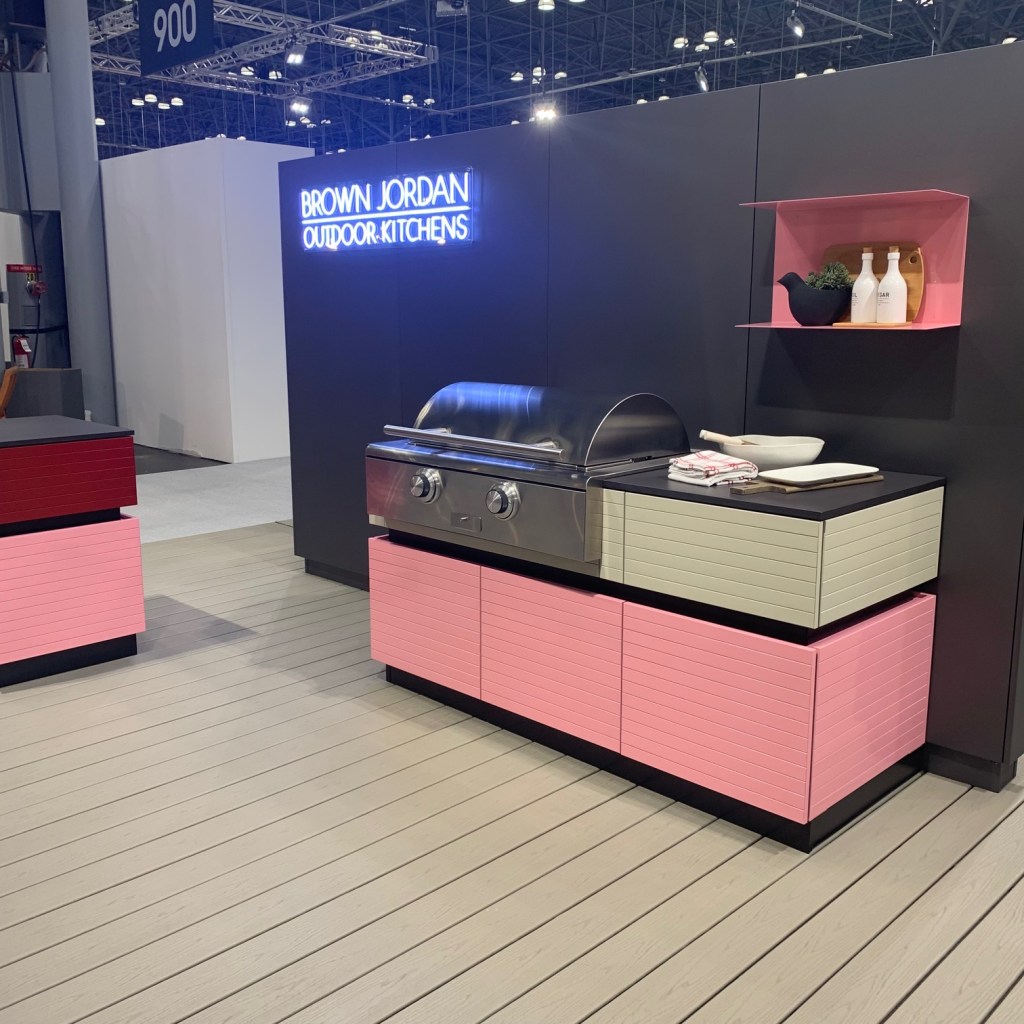
The partnership between Danver and Brown Jordan has produced exciting outdoor kitchens in bold, unusual colors (notice a pattern here?) Danver showed an electric yellow outdoor kitchen and a contemporary pink option. The acceptance of colored laundry room appliances, then high-end ranges (or was the progression reversed?) has allowed consumers to feel comfortable using big ticket items in something other than stainless steel. I think this is a wonderful step forward. We can never have too much color in a home.
ICFF 2022 Danver outdoor kitchen for Brown JordanICFF 2022 – Danver outdoor kitchen for Brown Jordan
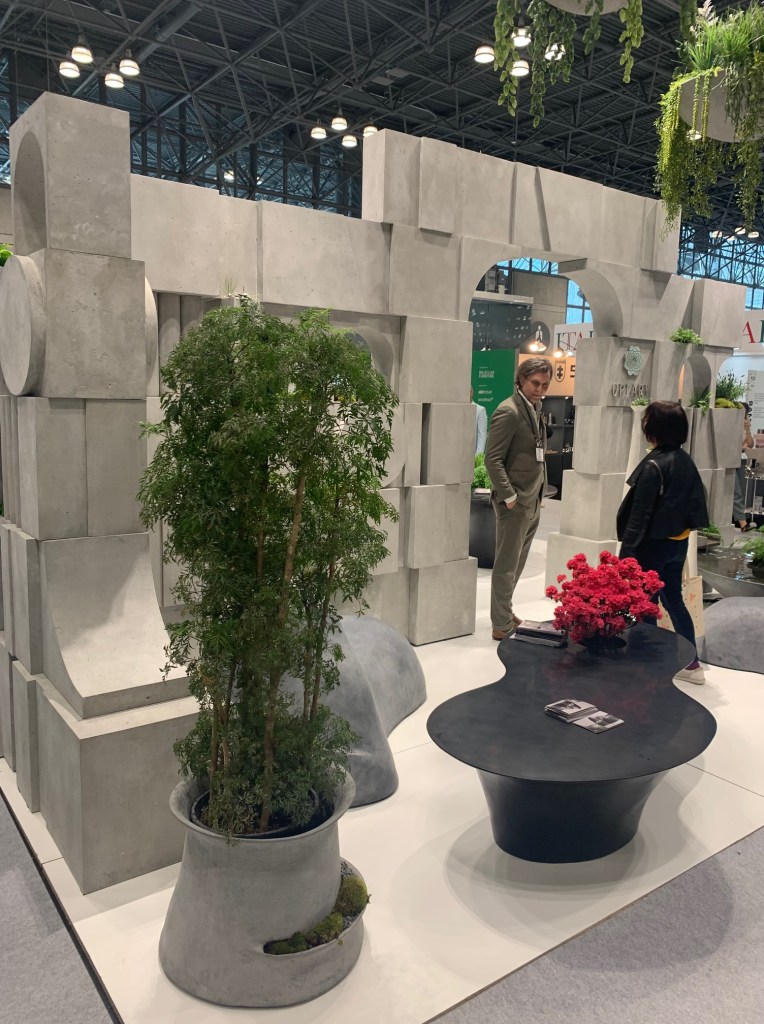
Opiary is a Brooklyn creator of concrete outdoor furnishings. The product is so fluid and organic that it belies the tough material employed in fabrication. Seating, water features, tables, planters and surrounds are all built for an unyielding outdoor reality, but look as if they are delicate and born of the earth.
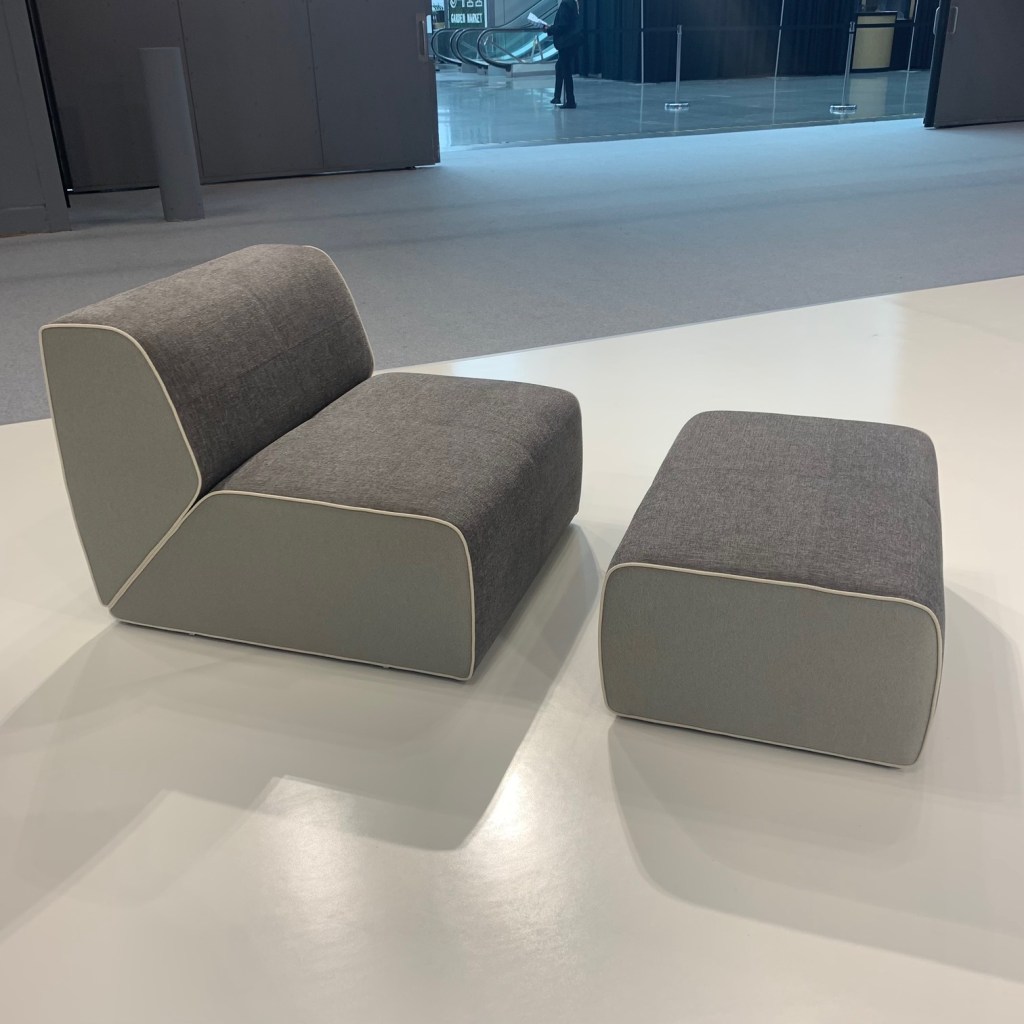
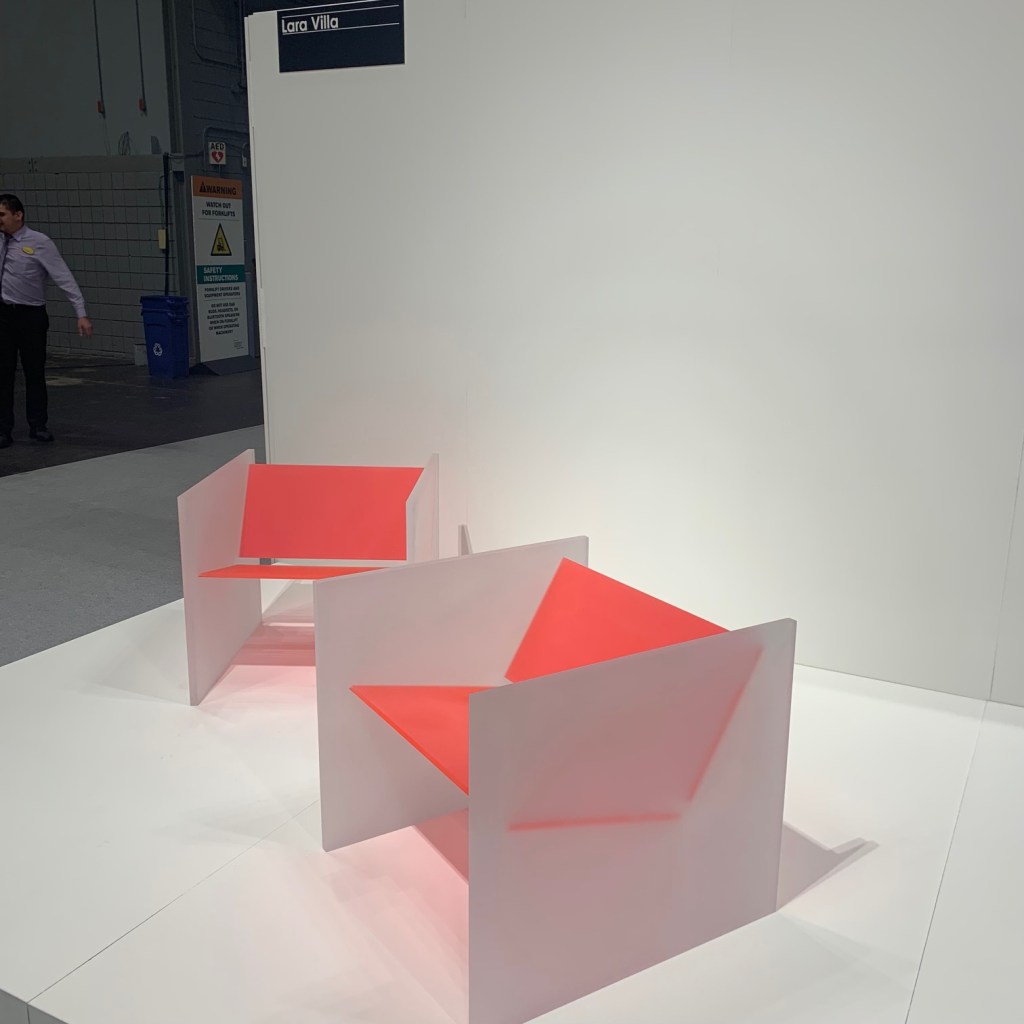
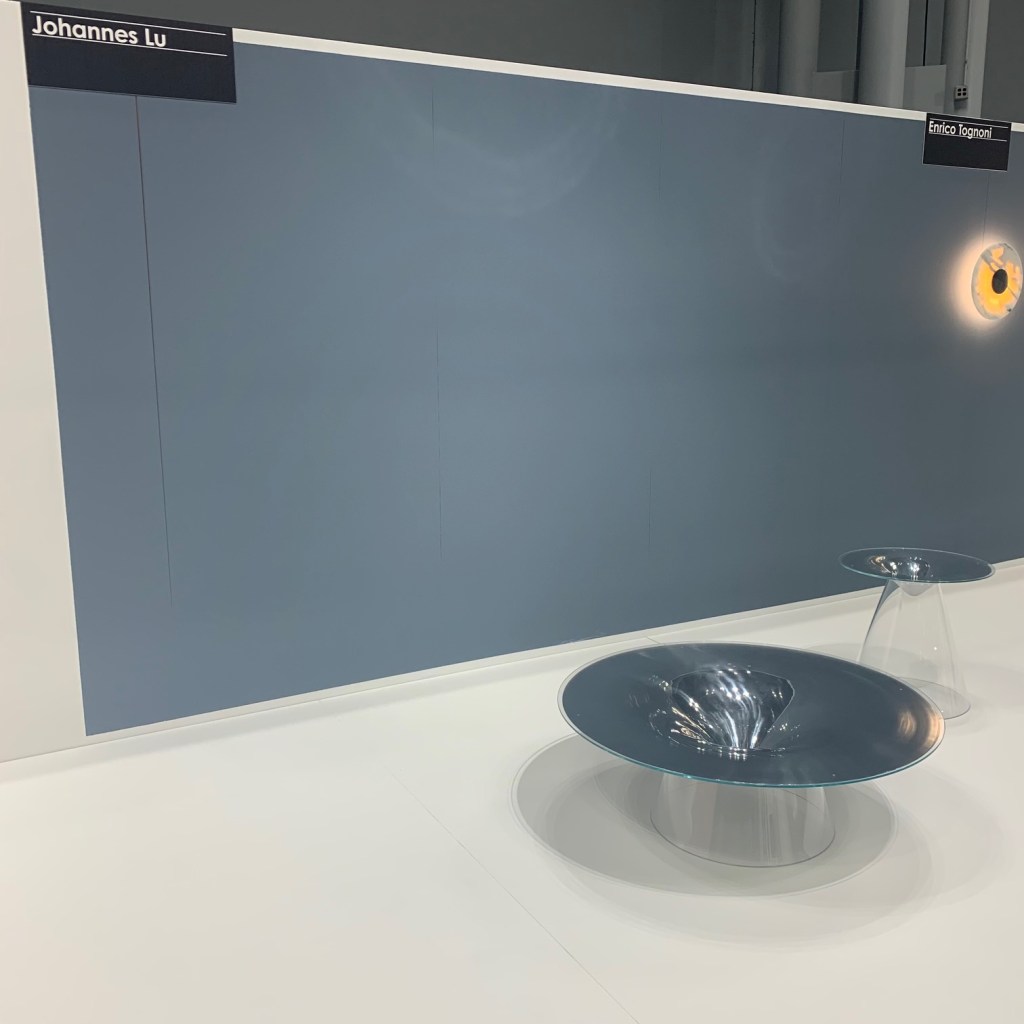
Interestingly, I’m seeing fewer and fewer new and exciting things in furniture. Yes, I liked the Bernhardt seating and I loved the joint between leg and top of the Ethnicraft PI tables. I also loved the student presentations of a table (Johannes Lu) and chair (Lara Villa) in the ICFF Studio. Despite that, I’m just not seeing the next “big thing” beyond the reemergence of beige I discussed in the 2021 report.
ICFF 2022 – Ethnocraft – PI leg-top jointICFF 2022 – Studio – Chair by Lara VillaICFF 2022 – Studio – Table by Johannes Lu
Wallpaper
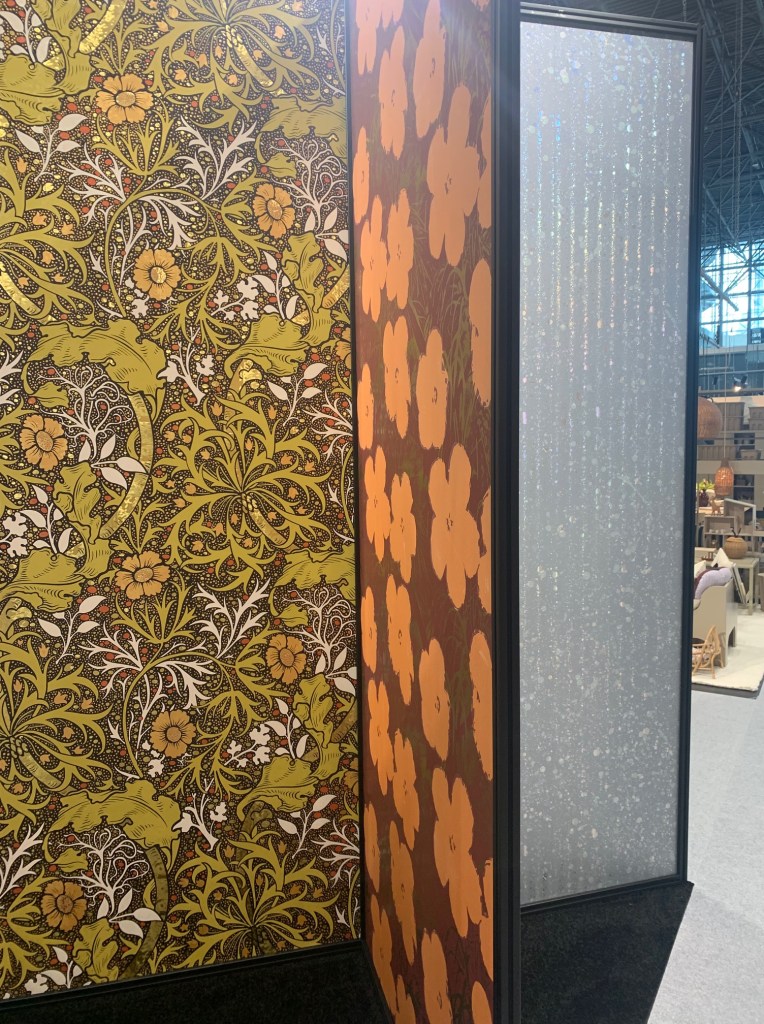
Wallpaper continues to be BIG, BOLD and exciting. A quick review of the options available from Wow Papers reveals an explosion of color and patterns. Even the staff manning the booth were dressed commensurately. The patterns replicated illuminated surfaces with blasts of neon and lighted tubes. Flavor Paper options were tame in comparison, but not when set aside toile versions of the past. Both of these companies believe that if a wall is going to be covered, it may as well be for a reason…a very bold reason. I love these extreme wall covering options!
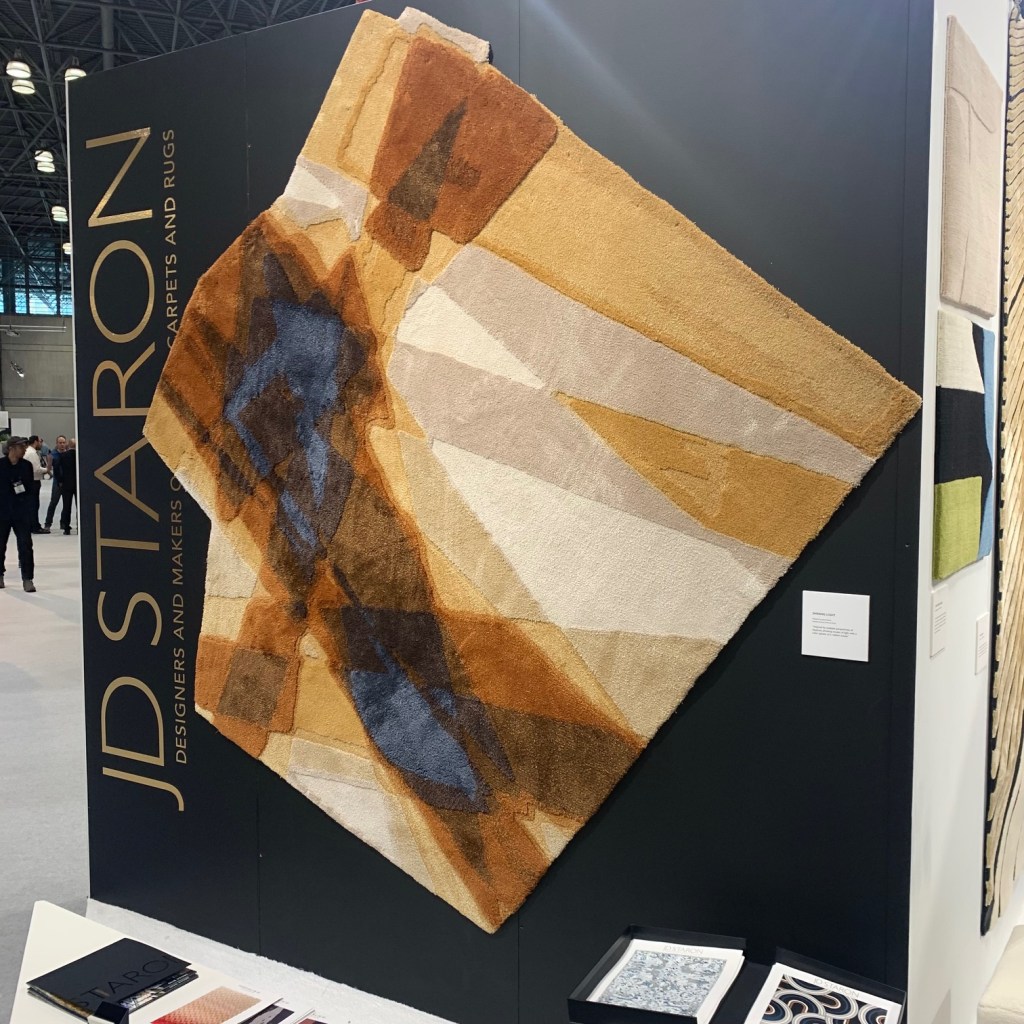
Two different accessories stood out to me. JD Staron creates rugs like Flavor and Wow create wallpaper, big and bold. This bespoke creator can deliver a variety of custom handwoven rug options. Each is more beautiful than the next.
Equally interesting were the mirrors shown by Zieta. One might initially believe these are fabricated from blown glass, but instead they are metal formed in Poland using the internal pressure, FiDU process. This involves welding thin plates of metal together at the edge, then inflating the assembly to create the interesting shapes. Sort of like a balloon made of metal! Construction process aside, what really matters is the amazing result. Airy mirrors, “blow-up” tables and ice cube columns. Really amazing stuff. I encourage you to follow the link below and check out some of their other projects.
ICFF 2022 – Zieta inflated metal
Fashion
I’m always challenged to understand how personal fashion connects with home furnishings. Window shopping New York revealed light, feminine colors and fabrics and dainty jewelry for women and a wider color palette of equally light materials for men. The dichotomy here is the shoes. Sure, there is an occasional spike heal and slim brogue, but most women’s shoes were heavy, clunky and dark, while men are being sold heavy sports sneakers. What does this mean? Do we want a carefree life of fun and excitement, but our feet must be firmly planted on the ground to do so? Is the weight a counterbalance to the fluff we encounter daily? Are we both serious and goofy at the same time? The differences certainly make for an interesting conversation starter.
Faith Ringgold – The New Museum
Perhaps the single more interesting thing I experienced in New York this spring was the Faith Ringgold retrospective at The New Museum. This was a fascinating review of a 50+ year career that explores and attempt to understand the life of a Black, female artist in a world that is primarily centered on white European men.
She supplants herself in classic European cultural environments, places where no African descendants were likely to be found. It forces one to ask, “But, why not?” why wasn’t a Black artist, or simply a female amongst the masters in Arles? Shouldn’t a Black artist or writer have been involved in the roundtable conversations at Gertrude Stein’s Paris salons? While not invited and not expected, her art forced the viewer to see her image there and ask, why this is not a reality. Why would she have been relegated to Alice B Toklas’ separate room each Saturday evening?
Her artistic questions do not stop there. She brought the same perplexing questions into her later work. Women and Black individuals are missing from so many of our cultural milestones. Today we see images of Kamala Harris, Nancy Pelosi and Ketanji Brown Jackson, but we are well into the 21st Century. Ringgold’s art forced the point decades prior. Is it possible her work established a path to these “firsts?”
Ms. Ringgold remains an active artist, now well into her 90s. She continues to force everyone to recon with the failings of an American society to include ALL of its citizens. By doing so, through her art, Faith Ringgold explains the losses and missed opportunities we all face.
New York
No, I did not spend all of my time working in New York! I caught some exciting new shows on Broadway. A Strange Loop and POTUS should be on your list! I also ate at some dynamic new restaurants. Consider a visit to the inventive, Ernesto’s, Kimika and The Commerce Inn. By considering all a city has to offer, a better idea of where we are going can be imagined. I can’t wait to go back and see what is next!
The pandemic has disrupted many things in our lives, trade shows being among the most noticeable, especially for older people like me. As I’ve indicated previously, I believe these shows have one foot on a roller skate and the other on a banana peel. COVID just oiled the surface. I think the way industry responds in 2023 will provide a good indication of whether they are down for the count. This, of course, depends on a virus-free 12-months. Additional variants of Mr. C and all bets are off.
Even though the 2021 version of the International Contemporary Furniture Fair (ICFF) was just six months ago, to hop back into their typical mid-May schedule, another edition just occurred. Because if lacked the BDNY “half” featured in the fall of 2021, the 2022 outing was smaller. There also appeared to be fewer people. The shops, showrooms and galleries of New York showed minimal change as well. Nonetheless, there were new things and items that forced notice. This post discusses just the lighting. A future post will talk about the “non-lighting” items of interest.
Tom Dixon
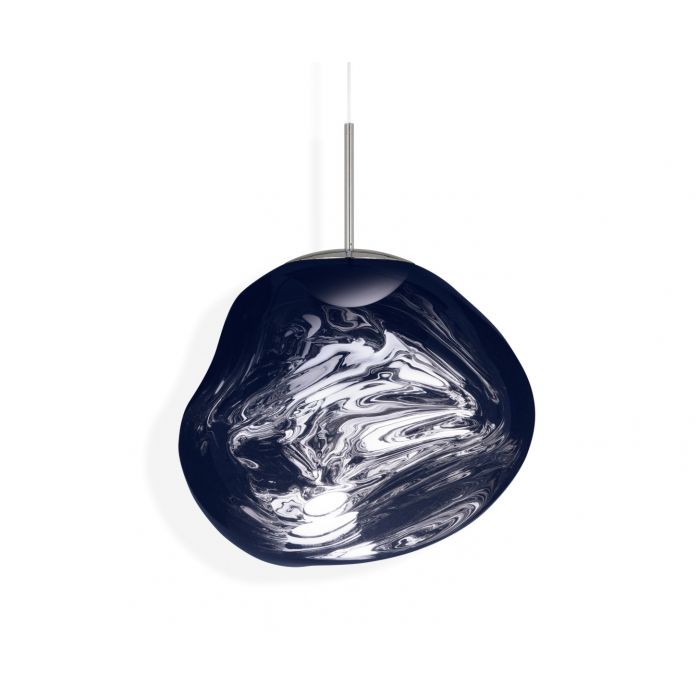
First, Tom Dixon taught us copper was ok, then he told us gold/brass is coming. He moved from simple shaped metal shades to blown glass orbs and now the blown glass has taken on a distorted, amorphous “melted” shape. The Melt shades are huge, or small and multiples are pulled into chandeliers. The exciting option this year is a polished, black nickel, or metallic black option that carries a subtle purple tint. An LED disc/module tucked up into the shade provides illumination.
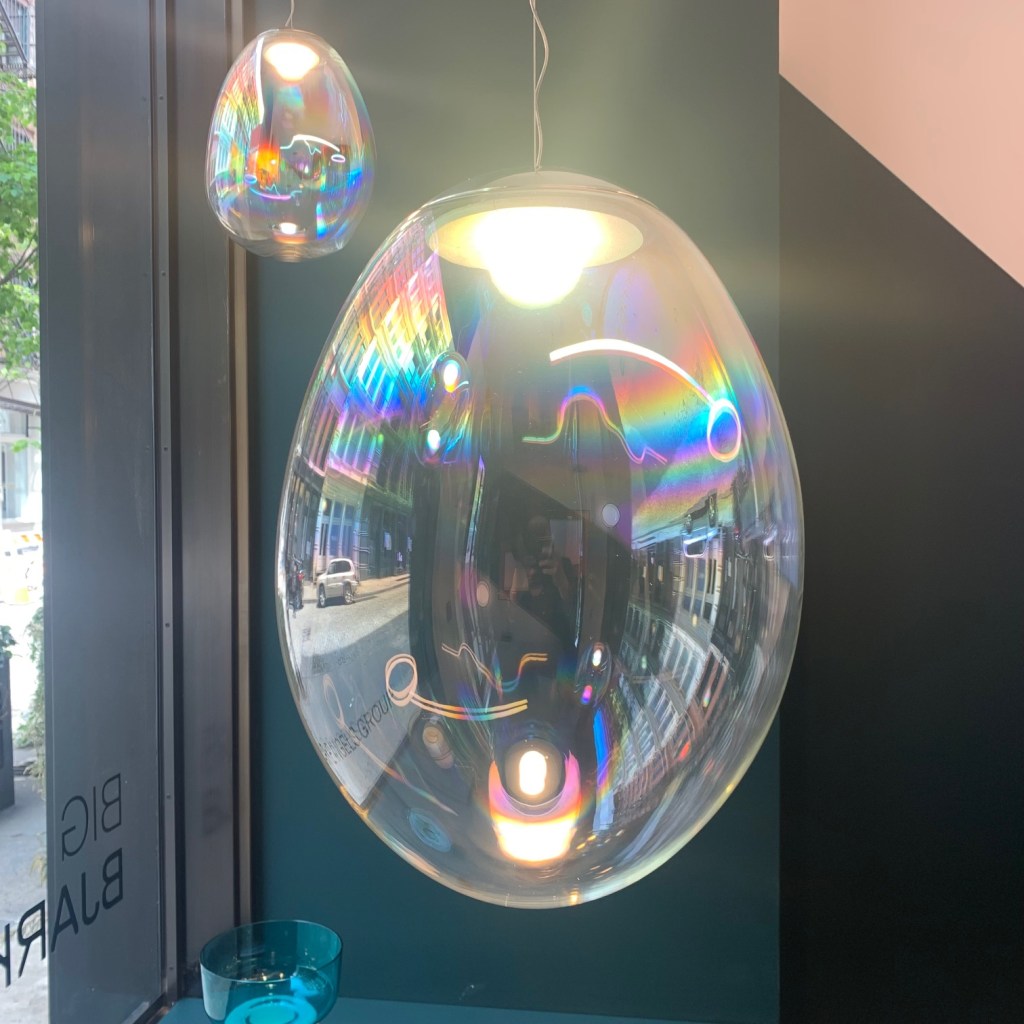
Artemide appears to have gotten the message from Tom Dixon and has produced Stellar Nebular, a collection of quasi-symmetrical, dichromatic clear glass pendants that appear simple, but alter in appearance and color as you move around them.
Arrival borrows similar amorphous shapes, but relegates them to a tripod frames. The skeletal outlines feature LED built into the rails. Table lamps, floor lamps and semi-flush ceiling units have been created. I love the extremely long semi-flush. This size is needed and should be more popular than it is currently. These are not yet available in the US and still a few weeks away in Europe, but I feel they will be worth the wait.
NYC – Artemide – Arrival – 2022
Foscarini
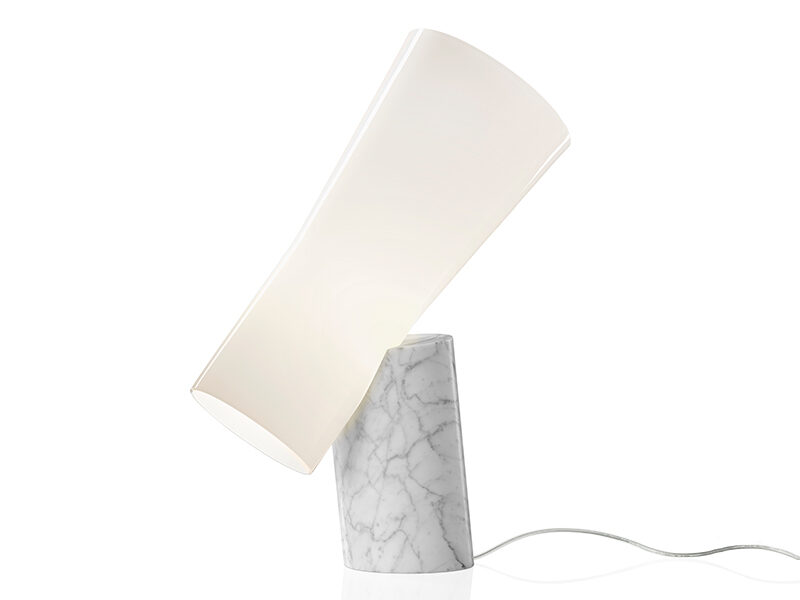
A fun additions to their line this year. Based on the monumental bust of Nefertiti, the Nile lamp diffuser resembles her head and crown, while the lamp base is shaped like her neck and shoulder.
NYC – Foscarini – Nile Lamp 2022
Juniper
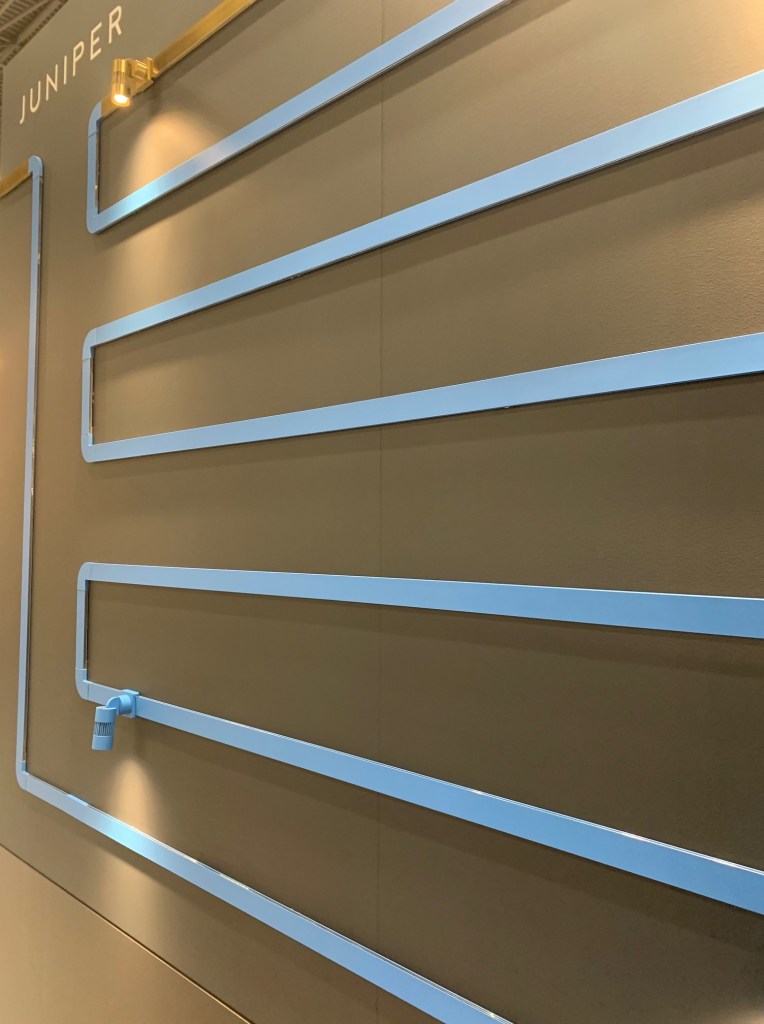
In all of the ICFF show floor, I was most impressed with a new approach to track lighting. The Multiverse is an extremely thin track. Endcaps are available flat and rounded. They can transition from ceiling to wall mounting. The adjustable heads have a magnetic feature that allows them to be momentarily set in place, before a collar is then tightened into position. The track is paintable and available in a wide variety of finishes. This is a substantially more appealing track system and should be considered for a different answer to a common lighting solution.
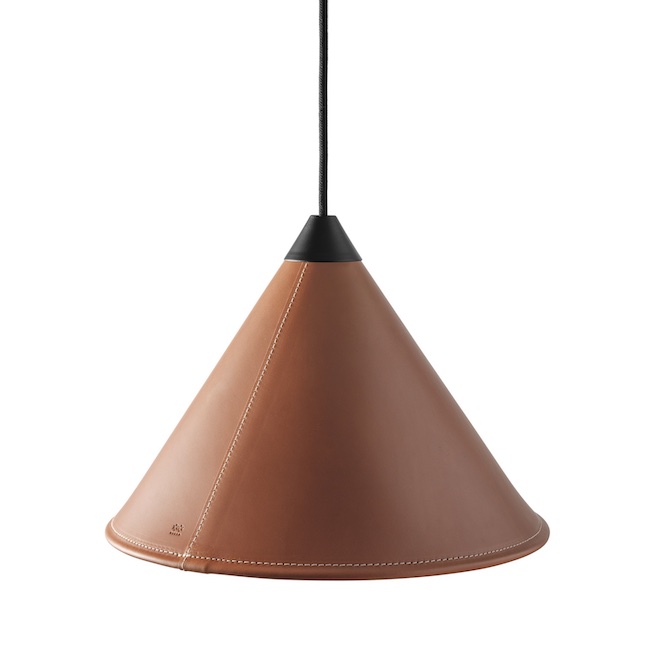
Perhaps not new or earthshattering, but the leather cone pendants from Cuero Design were beautiful. The variety of natural, vegetable dye finishes was also appealing. As we transition to more beige interiors, these colors and simple shapes will fit in nicely.
ICFF 2022 – Cuero Design leather pendant
Sharon Marston
You might have thought, fiber optics have had their day and it is time to move on to the next technological trend. Certainly, LED and laser lighting is more exciting. Sharon Marston has created a collection of ethereal, phantasy-based luminaires that when shown, collectively stopped the show traffic. Employing the thin fiber strands, tiny crystal figures and miniature glass diffusers, you were immediately relaxed and brought into a new plane of existence. These were beautiful pieces.
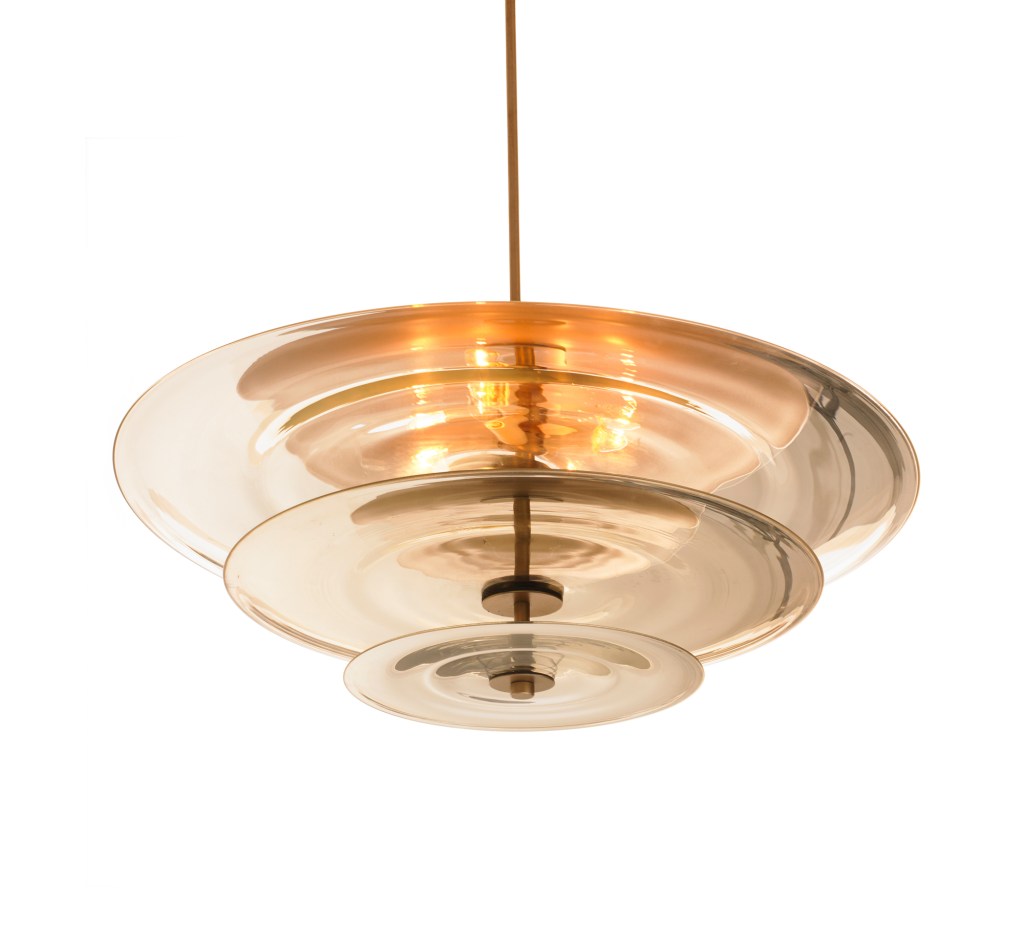
Jamie Harris is a Brooklyn glass blower and he has shown products at a number of New York venues over the years. The stacked discs pendants and ceiling units are appealing. They expand across large areas and the individual disc is smooth, polished and alive with color.
ICFF 2022 – Jamie Harris – stacked plates of glass
Parachilna
This is an Australian company with a modern version of Moroccan lighting. The Ma-Rock is an all metal pendant collection, pierced to allow light movement. It is a dominant piece that will command a space, just like its classic predecessors.
ICFF 2022 – Parachilna – Ma-Rock pendant
The Gweilo collection takes acrylic panels and melts or distorts them into floor lamps whereby the LED edge lights the contorted shape. Despite the clear material, like their Ma-Rock brother, these would demand a central point in a room and cannot not be ignored.
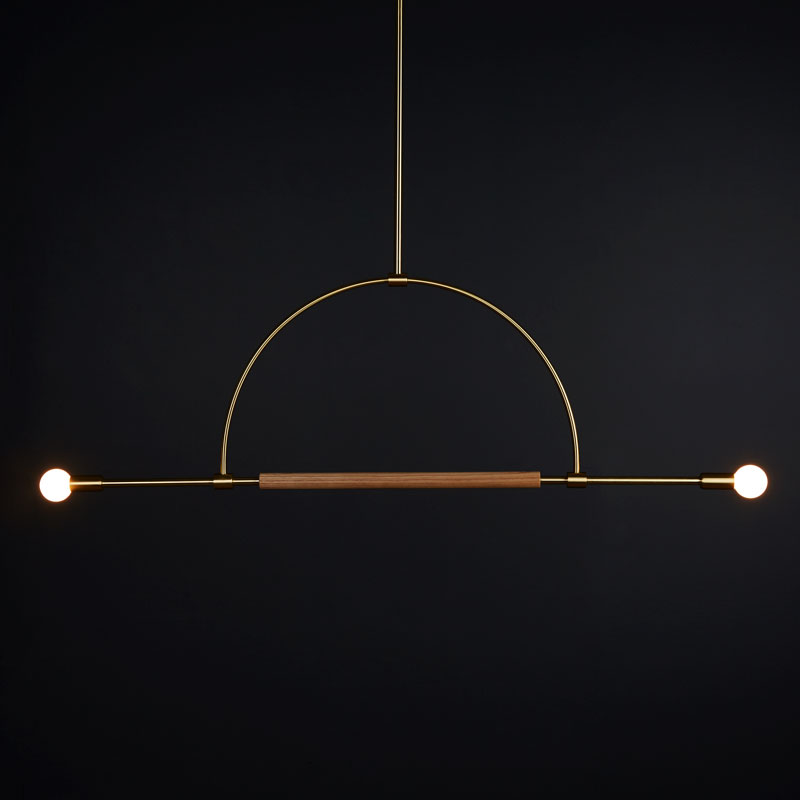
This Georgia based lighting designer has developed a line of simple, clean and unassuming products. They almost have a light, “trapeze” feel with a heightened sense of construction and a deep understanding of the way in which the units are connected to the building.
ICFF 2022 – Katy Skelton linear pendant
Tom Kirk Lighting
As with Katy Skelton, the simple quasi-teardrop shape of the Cintola collection appears unassuming, but with multiple colors and configurations, the core design element bubbles up into a useful luminaire baseline.
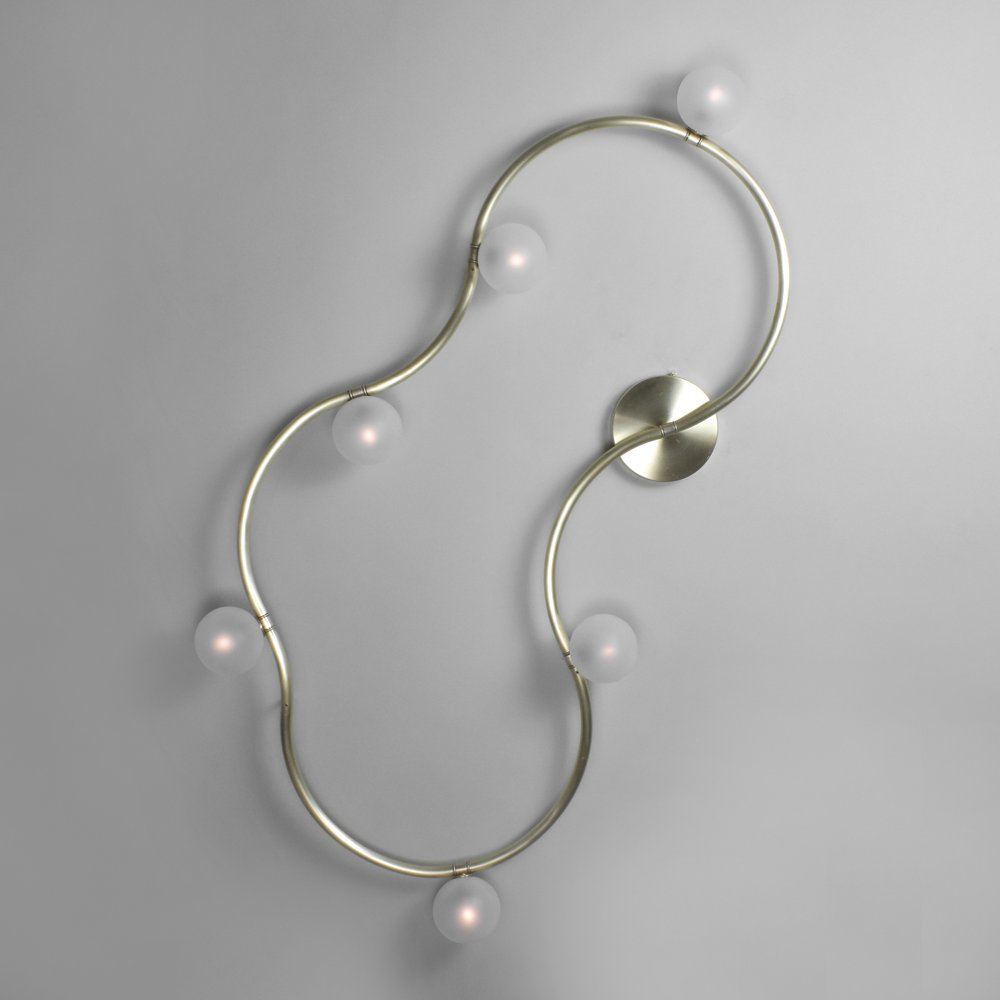
Their Loop Light is an easy concept with which to create unique and customizable wall art lighting. By piecing together bent segments of tube with a ball lampholder, an endless trail of lights and curves can be presented on a wall.
Some of the science of light is telling us we may need more light delivered from vertical surfaces. Adding that light via an artistic approach such as this will make the clinical necessity much more palatable.
In the United States, there is no more unique city than New Orleans, so it makes sense that Swadoh, the byproduct of a French designer who has relocated there, would be creating such unique lighting options. They have a very feminine feel made of papers, fabric, guilt accents and some conventional materials. Their different approach is worth a quick review of their website. They could be an interesting addition to many interiors.
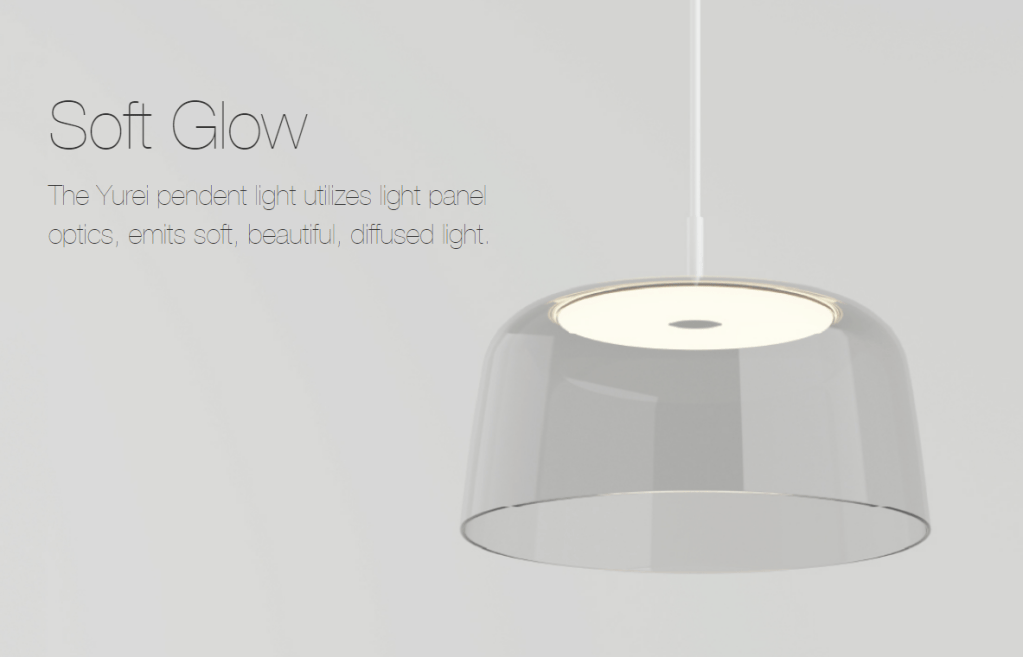
Koncept always shows a new idea that answers a current lighting problem. This year, Yurei is a shallow pendant shade realized in glass (teal tint, clear, copper-bronze and black smoke) and metal (white and black). The illumination comes from a disc of LED that sits against the inside top surface. I like the size of these pieces. They have not yet been released to the market, but if interested, Koncept will notify those who sign-up on their website.
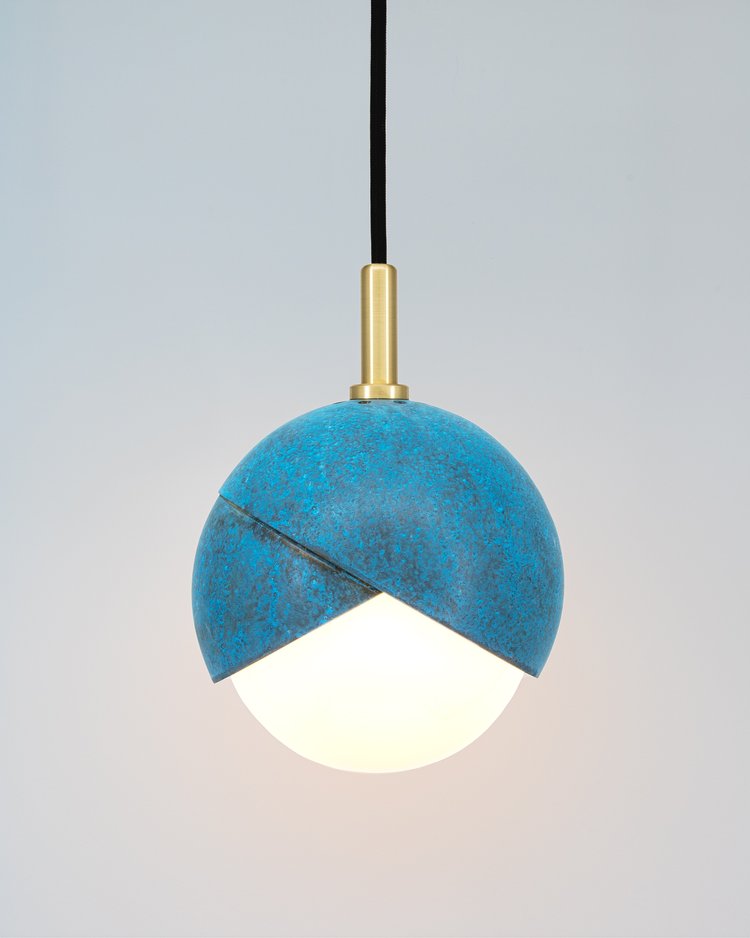
The new Benedict collection starts with two nested spheres that surround a glass globe. This module is then used in a couple of sizes and singularly, as a pendant and in multiples as a chandelier. Because they are handmade, many customizable options are available.
Of the many new products created each year, it is sometimes difficult to get a grasp on them all. While I worry about the validity of shows like ICFF and even the retail establishments that are slowly dwindling in SOHO, lower Park Avenue and the Flatiron District, I still appreciate their existence. Speaking for people my age, I need these physical entities to exist a few more years. Younger folks, apparently, have found better, more efficient ways to track new goods. A transition is now in place. Until that is complete, I’ll continue to record trend shifts coming to me in the only way I understand.
Each month, I deliver an educational lecture to hundreds of talented designers and architects from across the United States and Canada. A recent event centered on the color of light, a subject that has leapfrogged in importance exponentially since the introduction of LED and which I have spent a fair amount of time studying. In the Q&A section, for the first time, in a long time, I was stumped by a question. One of the designers wanted to know what I understood about those with tetrachromatic vision. Like a teenage boy being asked to define onomatopoeia and differentiate between a gerund and a noun, I mumbled, “Ahhh, I don’t know.”
Days after my Rick Perry, “Duhhh?” moment, a friend, who knows of and understands my interest in all things color, sent me an article from the Wall Street Journal discussing the research of tetrachromatic sight. (The Rare Gift of Seeing Extra Color – Jackie Higgins, February 22, 2022) The world was telling me it is time for some additional study.
Human color perception is delivered through tri-stimulus values. In other words, we have three photoreceptors in our eyes, one with peak sensitivity for blue, one with more highly refined sensitive to green and the third with heightened sensitivity for red. Images enter our eyes, the colors are separated into three “buckets” (R,G&B) and the information is sent to our brains for processing the understanding of the color of an object. (If you’re an ophthalmologist reading this, I apologize for that simplistic explanation!) If a person has some sort of color-blindness, one, or more of those photoreceptors does not work properly. If a person has tetrachromatic vision, they have a fourth photoreceptor. This fourth receptor allows that person to perceive higher gradations of color.
What Does Tetrachromatic Vision Do?
Explaining this is akin to developing an orthographic projection of an M. C. Escher drawing. How do we understand a higher level of color perception, when we, or the researchers can never experience it?
Imagine two paint samples. The average person sees the same color. In his research on color perception at Kodak, David MacAdams found that 90% of the population had average color comprehension, but about 10% had some level of elevated ability. They are able to hone in on the nuances and discern a difference. Those folks are likely my audience of designers, but also printers, photographers, artists, paint store specialists and even a few like MacAdams, a Physicists and Color Scientists. To understand persons with tetrachromatic vision, they see multiples of differences even in color samples perceived to be the same, by the rarified 10%.
Hourly and salaried wage-earners are the 90%, the 10% with better color perception are millionaires and those with tetrachromatic vison are the multi-billionaires of the world. Just a few, with overabundant powers.
So How Do We Respond to These Talents?
Unless the designer is equally gifted, it is near impossible to design to the demands of a tetrachromatic client. From comments provide by those with tetrachromatic vision, they also have no way of perceiving a life of color in any other way. How does one understand what one does not possess?
Recruiting people with tetrachromatic vision into the field of LED technology would be very helpful. Their superior color perception could help in the development of better products. If it passes muster with them, the rest of us will be well served with lighting of perfect quality. Wage-earners, millionaires or billionaires will all have great light. That egalitarian color solution sounds pretty good to me!
Since moving into her first home, my niece has undertaken a beautiful renovation of her charming house. Upon her request, I suggested some appropriate lighting fixtures months ago and recommended a local supplier who could help her. (We’re in different states.)
Jump ahead nine months. She sent photos of her completed bathroom renovation, with a “thank-you” included. It took a few minutes to register the fact I had anything, albeit minor to do with this fresh new space. I completely forgot because, unfortunately, she was caught up in this crazy “supply chain” mess that has remained a news story for almost one year.
Shortly thereafter, the New York Times published an article, “4 Bed, 3 Bath, No Garage Door: The Unlikely Woes Holding Up Home Building,” https://www.nytimes.com/2022/02/15/upshot/homes-garage-door-shortage.html?referringSource=article The article dug into the complicated reality of building a home in a global economy. While the story spotlighted garage doors, as I dug deeper I learned that lighting fixtures have an even more complex supply chain than the doors featured in the headline. They were in fact in first place! I guess, “4 Bed, 3 Bath, No Lighting” didn’t have the punch needed to grab readers!
Why Lighting?
Prior to retirement, I spent 35 of my 47 working years in the development of residential lighting fixtures. I had been responsible for the drawing, engineering and product management of hundreds (OK, I’m old, thousands!) of luminaires. While this supply chain information might come as a surprise to many, I’m not one of them. Over the years I spent weeks and months in factories all over Asia. When not in another country, each day, emails, faxes prior to that and telex message before that arrived on my desk, asking for answers to unexpected issues. Today it is supply chain, fifteen years ago it was plating in China. (At that time, due to newly installed EPA-like regulations.) Like Roseanne Roseannadanna used to say, “…If it’s not one thing, it’s another.”
Humans
If you have observed lighting for any period of time, you will likely note that there are tens of thousands of different designs in the market. With that massive quantity of products, it might not surprise you to know that many of the components have far less automation involved in the production than you might imagine. There is NO automation in the assembly of lighting. Each piece is hand-built. Sales quantities of even the best sellers do not warrant robotic or automated assembly. Because of this, lighting is desperately reliant on humans. When humans disappear from the equation there is slowdown.
While the numbers continue to mount, COVID has taken a massive toll on the human population. Laborers have been much more vulnerable to acquiring the disease and dying because of that contact. Add to that number, the amount of “baby-boomers” who decided, or were “invited” to retire early and you have a massive chunk of the functioning human supply chain simply out of the picture. These are numbers that cannot easily be rebuilt.
Chinese New Year
To most Americans, Chinese New Year (actually, the lunar new year) is a time to visit your favorite restaurant and perhaps watch a small dragon dance in their parking lot. For companies, it is a HUGE annual business interrupter. It is no exaggeration to state that the “entire” country shuts down, reconnects with family, relaxes and celebrates. If you have not seen the documentary film, “Last Train Home” you may not realize the magnitude of disruption the Lunar New Year has on factories. Somewhere between 10% and 25% of workers do not return to the company after the holiday. To prepare, American companies order and Chinese factories build extra inventory to cover a six to eight week interruption. When added to an already strained system, there is no other way to go, than down. Training a large, new quadrant of employees every spring, also slows the restart process.
Cheap, Please!
Americans, over the last twenty years have been on a toboggan ride to the bottom of price; the price on everything and anything. To provide customers the cheap they expect, manufacturers have had no choice but to run, pell-mell into Asia (next stop, Africa!) for inexpensive goods. What is the weak link in that shift? Everything must be boxed up and shipped, via container, in the hull of massive cargo ships. Ships have become the funnel, the weak link in the chain. Ships are also expensive and take long to build, so you just can’t go to “ocean-freighter.com” and order a new one. With a waning pandemic, a good economy and record-high employment, there is pent-up demand and plenty of money for everything. That “everything” must now pass through the funnel of a freight container.
USA Manufacturing
Making goods in America can surely help, IF customers will pay a bit more. When I started in the lighting world, around the time of the Coolidge administration, every lighting fixture was made in the US. Same with the components. Some glass was produced in Mexico. A lot of glass came from France, Spain and Greece, but the majority was manufactured in America. That was great until the largest manufacturer of US lighting glass experienced a devastating fire. The industry was decimated for almost two months. There wasn’t a container, or container of dollars that could help.
Et Al
Supply chain disruption can happen at any time and for a number of reasons. While I am intimately familiar with the problems of lighting, you can take the above factors, adjust and apply them to appliances, windows and garage doors to understand the reason why things are not now available when they are needed. Keep that in mind next time you watch the national news.
The Wall Street Journal asked the question, “Are Massive Lights the Next Big Thing?” in a January 8, 2022 article. In the story, radically oversized lighting was discussed, such as a 90” sisal pendant that oddly enough was dwarfed in the accompanying photo, by a huge room with 11’-0” ceiling heights. Personally, I think this was a case of a reporter jumping on a unique situation and turning it into a trend. It did, however raise the very real question of lighting size.
A quick search on the internet will deliver some very solid and consistent size recommendations for lighting size.
Add the two lengths of the room together to arrive at a minimum diameter (in inches) for a dining room chandelier.
Linear chandeliers should be between 1/3 and ½ the length of the table below.
Front porch lights should be between 1/5 and 1/6 of the door size.
I use these numbers, too…as a starting point. I then typically ignore them and think about the whole room, the size of the table and the height of the humans who occupy the space.
With those parameters understood, let’s unpack this reporter’s perception for a moment and think about when “big” (or bigger) could actually work in a design.
Dining Room
I always lean toward a larger chandelier than any calculation suggests. Most dining room tables are 30” wide, but if a larger one is used, that becomes a visual excuse to go bigger. 36” wide? Use a 36” diameter chandelier. A room that can hold a wider table can surely accept a larger chandelier. A 5’-0” to 6’-0” diameter or square table can also easily accommodate a larger chandelier.
Consider too, the ceiling height. Larger should be considered in the verticality as well. 12’-0” ceiling demand some vertical attention. Fill that space with stretched and elongated chandelier designs.
Squares contain more actual area than a round, so simply choosing a 32” square luminaire over a 32” diameter alternative will give you more mass and a bigger presence.
Dining rooms remain a showplace in a home. Allow them to earn that regard with majestically sized lighting.
Foyer
As we move away from two-story entrance foyers, we still need a dynamic introduction to the home. A one-story home with 10’-0” or even 12’-0” ceilings cannot accommodate a hanging chandelier, but a huge semi-flush, stretched across the ceiling can elevate that space. Unfortunately, not a lot of luminaire manufacturers build oversized semi-flush units. I suspect, if no one asks for one, and they can’t sell the ones they’ve made, there is a good reason for the void. I’d love to see a reverse of that trend.
Until more are made available, I suggest installing a chandelier without the chain or stem, tucked up to the ceiling. We can always find a wide variety of large chandeliers. Pay attention to the height. A chandelier with a body height of 18” will work on a foyer with ceilings as low as 9’-0”, 30” works on 10’-0” and 54” body heights will fit in spaces with 12’-0” ceilings. Not all designs will work hung in this manor, so attention must be paid to the view from below. Once the right piece is unearthed, you might ask why anyone would ever hang it from a chain or stem!
Consider the same thing with sconces. Forego the ceiling lights altogether and use a collection of TALL sconces around the perimeter. A 36” tall sconce will fit nicely in rooms with 9’-0” and 10’-0” rooms. Go longer in 12’-0” ceiling heights.
Islands
In the March 2022 edition of Architectural Digest, one of the featured homes used a 36” diameter wicker shade over a 5’-0” Square Island. This is probably larger than most of us would consider, but I think it works. The ceiling was exposed, the space was open and the light cane and whitewashed island material created an airy feel. Square, or oversized islands can be a great place to consider larger than average lighting. They are big and fill a lot of space in the room so, commensurately sized accessories work. The additional lesson here is to understand how the colors will impact the visual proportionality.
With conventional islands, we all know to stay away from the petite pieces that were popular over a decade ago. There is strong evidence we are moving in the correct direction. Larger and especially taller pendants are being used. Continue that trend, stretch the envelope. This is the right direction. The open floor plans of living can readily accept larger island pendant lighting.
Great Room
If you are not already using massive chandeliers, ceiling fans and wall sconces in the great room, start now and disown any previous installations. These rooms are called “great” for a reason! They are big spaces and anything less is a huge mistake. Seek out those 96” fans, 72” tall chandeliers and 36” tall sconces. This room should be the easiest of all to adapt to larger sizing options, especially if you are currently using Lilliputian-sized luminaires.
Big
You may never be responsible for a home that can comfortably embrace a 96” diameter pendant or a 10’-0” tall chandelier. Stretching common norms a few inches is however, a real possibility and should definitely be considered in more “typical” residences. That small difference can deliver a big impact.
In an episode of the “Revisionist History” podcast (“The Dog Will See You Now” Revisionist History, Season 6, Episode 10) host, Malcolm Gladwell dug into the fact that different species rely more heavily on one of the five primary senses. In the story he tells of the amazing success dogs have had detecting the presence of diseases and viruses in humans. This is primarily due to the superiority of the dog’s nose. A dog’s nose is hundreds, perhaps thousands of times more powerful than a human’s, so they can pick up the subtleties of scents that humans cannot even comprehend. Dogs can and do easily sniff out weapons in airports and have been proven to detect the presence of colorectal cancer, prostate cancer, COVID and hundreds of other disease. They are 99% accurate, far superior to human-created methodologies.
Humans, on the other hand, are sighted beings, hence, we rely primarily on our sight. Because of that, we develop medical tests that allow us to see evidence of the physiological problem. An x-ray is taken, a doctor reviews the x-ray and when an issue is seen, the diagnosis is established. Because of the narcissistic nature of humans, we assume dominance of our intelligence. Dogs are unfamiliar with egalitarian structures. They understand a trainer seeking out a particular smell. Their superior nose can easily provide that information. A pat on the head and a doggie-treat and they are on to the next exam.
Dogs don’t understand the excellence of their nose, it’s just their nose and sniffing is what dogs do. Humans could come to terms with the hierarchical relevance of their scents, but don’t. Our inability to prioritize the right light, in the correct location, at needed times of the day is within our grasp, but we ignore it.
It is time for humans to pay more attention to the needs of their dominant sense. We rely more heavily on sight, but we don’t act like it. We accept light glare knowingly, we contort our bodies into odd configuration to grab a touch more of the light that has been poorly positioned and we pay little attention to the color, despite our bodies needs and wants. We then complain, unable to connect cause and effect.
Dogs don’t ask for “more scents” they simply push their head out of the window when they are lucky enough to enter a car, knowing a rush of interesting, life-affirming smells will be coming their way. Humans are smarter than dogs, but we don’t necessarily act like it all the time. Especially, when it comes to lighting.
A few posts ago, I talked about using linear LED extrusion luminaires. Almost as ubiquitous are LED rings. A wedding cake of them are stacked in halls, dining rooms and commercial spaces. Sizes at 5’-0” and beyond are not uncommon. Some are plain, in black or white. Others are finished in the popular metallic colors and even wrapped in leather or bejeweled in crystal. With this avalanche of options, what new options are possible? I think application offers a great amount of new possibilities. Like the linear pieces, let’s explore some alternate hanging scenarios.
Multiple Single Rings
A stack of rings has been a pretty reliable use of this luminaire type, but when faced with a shorter ceiling, or if in quest of something different, it might be time to consider an alternative.
Think about four or five smaller rings dancing over a dining room table. How about a ring at each corner of a large, square island? Three or five rings placed in the center of a bedroom tray ceiling will certainly add a look that departs from the norm. We already use multiples over countertops. Rings could be a nice variant, especially if combined with some of the ideas listed next.
Replacing one large ring chandelier with multiple smaller ring pendants can be a great way to differentiate a space.
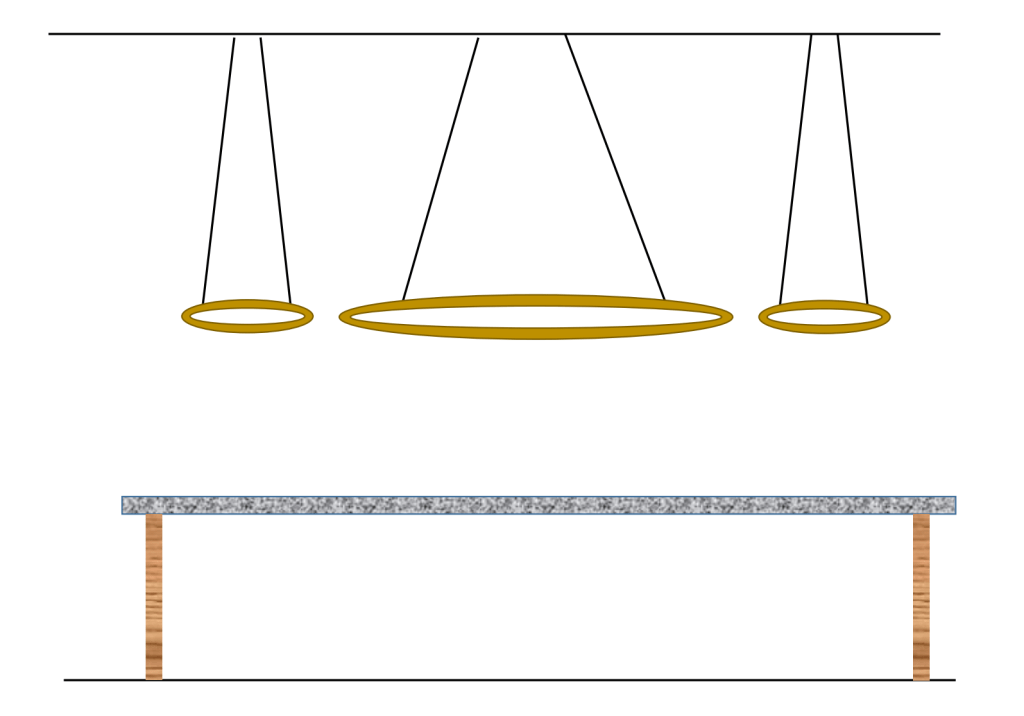
Different Sizes/Colors
Is there a reason to have all the rings the same size? No! Try a variety instead. Are multiple finishes used in the room? Are two-toned elements used? Why not try three rings in one color and two in the other?
If using multiple rings, consider going one step farther and altering the size as well. A mix of sizes can create added visual interest. In rooms where it might work, consider using multiple finishes as well.
Varying Elevations
A collection of rings hung at different heights can be as interesting as size differences.
Angles
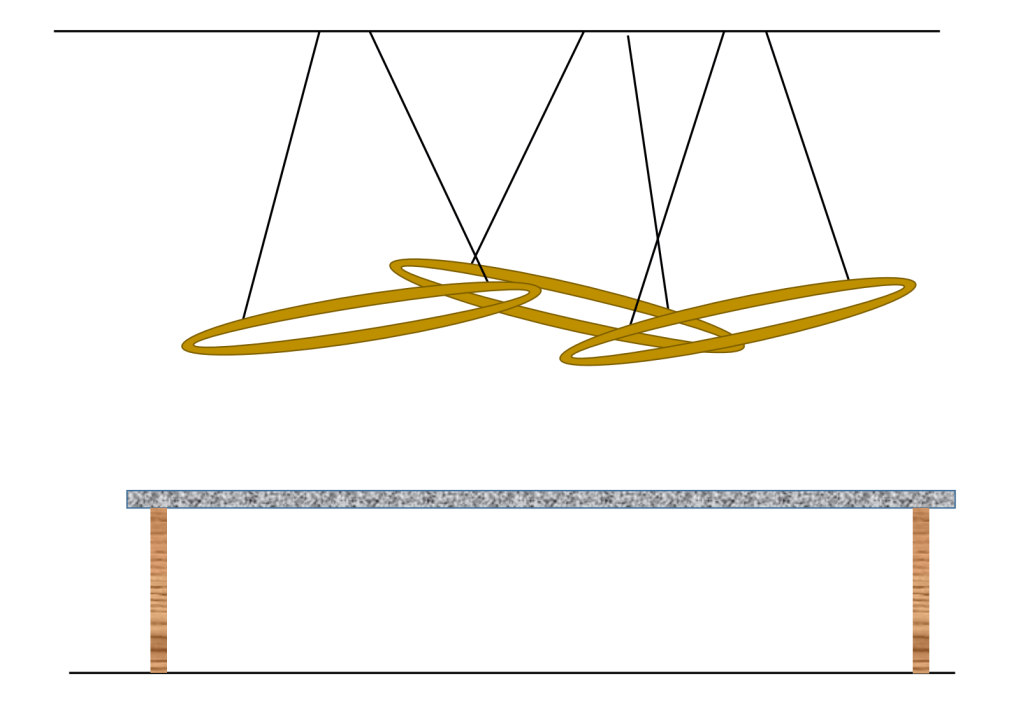
Rings are all aircraft cable suspended. Adjusting one cable can deliver a quirky angle for the ring. Repeat that with all of the suspended rings and the result will be a fun look. Don’t like it? The adjustment back to plumb, is easier than any of the other suggestions!
Adjusting the cable that suspends each ring can provide an interesting visual presentation that elevates the look and differentiates the space.
Placement
Pendants do not need to be on the centerline of the table or countertop below. Adjusting them closer to one edge will add yet another level of interest. Remember, if this is done, hanging heights may need some adjustments to avoid contact with the humans who occupy the space. You may also need to visually balance the space if doing this, unless an intentional asymmetry is the goal.
Shape Shifting
Take everything I just wrote here and replace rings with squares. Now take half of the rings and replace them with squares. You’ve just duplicated all of the possibilities! Black rings and Natural Brass squares. Chrome squares and White rings.
Exceeding Expectations
There is nothing wrong with simply using the ring as initially intended. Simple geometric shapes are classic elements of design and the rings (or squares) will look just fine. Consider moving beyond “just fine.” Experiment, explore and try something different. It might be exactly what is needed to elevate a room design and create something special.






















 Lighting by Jeffrey