I recently read that Germicidal UV Lighting (GUV) has not produced the sales manufacturers had expected. The amount of available products has quickly plummeted and there is some thought that with the retreat of COVID, people are no longer worrying about airborne particulates and how to protect their family. With the pushback against common-sense vaccines, even in the face of overwhelming scientific evidence, it might not be surprising. Still, the use of light to help combat germs and viruses remains in play. The method of delivery might shift and change as new ideas arise and research becomes more pointed.
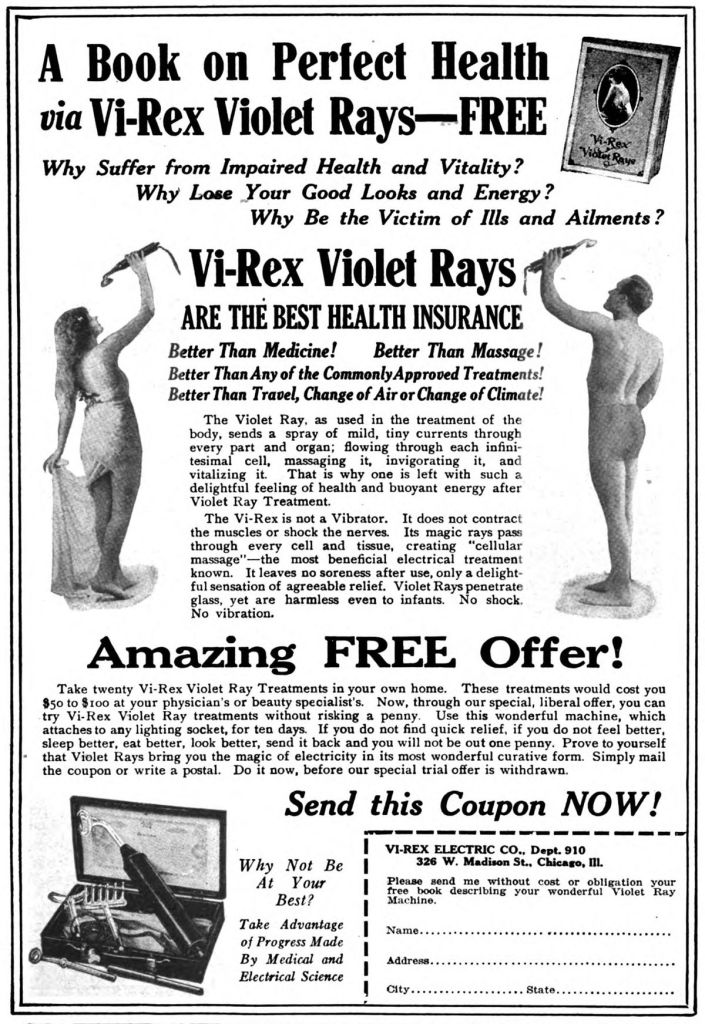
Using UV is nothing new. The sun is often considered the ultimate cure-all and of course, it delivers plenty of light in the UV spectrum. In the 1920s, capitalizing on this understanding, Vi-Rex devices were sold to plenty of vulnerable people based on their promise that the electric shocks of UV would make one, “vital, compelling and magnetic.” I’m hoping that was figuratively magnetic, not literal. SAD lights provide a blast of bright UV-filled light for those who are effected by Seasonal Affective Disorder. This more current application is an equally suspicious solution. Does it really work, or is this the 2020s version of wearing a copper bracelet to cure arthritis?
Essentially, viruses are vulnerable to light in certain areas of the electromagnetic spectrum. By adding that type of light to typical luminaires, we can include an effective germ cleanser. The problem is us. Humans have negative reactions to light in this area of the spectrum. When we stay in the sun too long, our skin becomes sunburnt. This is one, very simple, easy to understand reaction to UV. Science-fiction movies remind us of the many other harmful effects of UV and infrared light. Specific spectrum can be VERY damaging. Some areas are deemed safe, but I still read research papers where the exact specifics of “safe” wavelengths is debated. For that reason, care must be employed when considering this option.
I however remain bullish on GUV. The science is still young, but the results are narrowing toward some very specific results. I expect better scientific direction to arrive soon. Coupled with the constant increase in immune resistant antibiotic bacteria (basically, bacteria and fungi that have developed an ability to defeat the drugs designed to kill them) it appears to me that use is inevitable.
As we enter this New Year to growing reports of increases in childhood hospitalization due to viral infections, added help will be required. If GUV employing better research results can help, we should all be receptive. If the germs can improve their defense against antibiotics, then humans should happily add light to their side of the battlefield. In doing so, we must use them knowingly and with greater and greater understanding of the direction of use provided by carefully derived research.
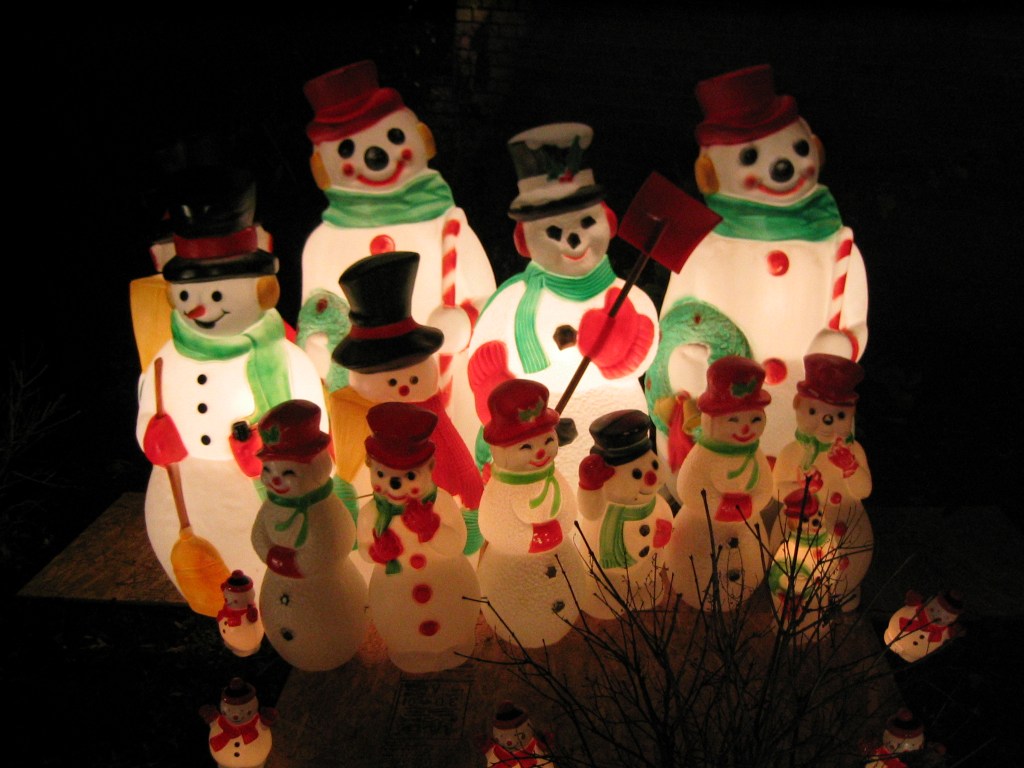
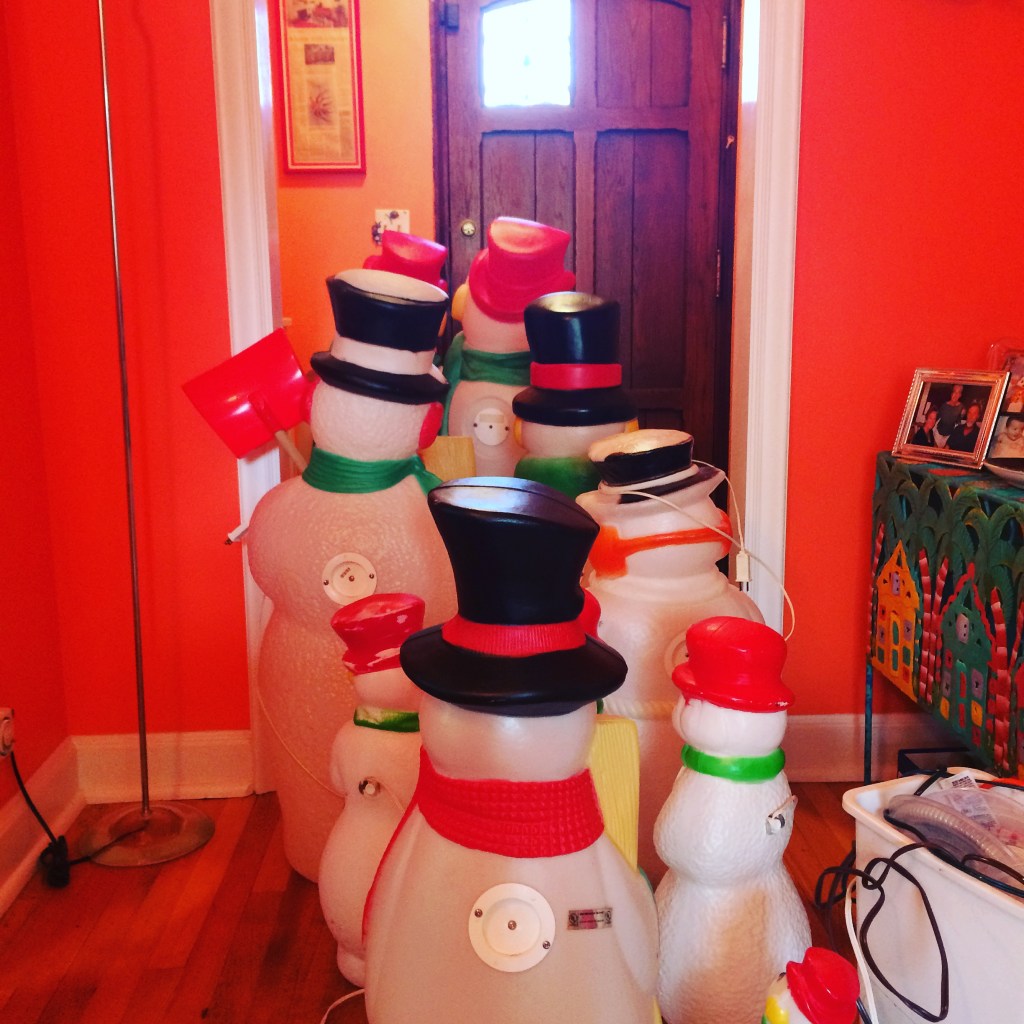
About twenty-five years ago my wife and I started to collect blow-mold lighted snowmen. We bought them at garage sales and end-of-season closeout sales. Before long, friends would call from their own estate sales adventures and ask, “There’s a 4’-0” snowman here. Do you want it?”
In the previous house, we arranged them on the porch in a chorus. When we moved to the current porch-less home, we set them in the flowerbed alongside the front path. On the porch, they were pretty well protected, but in the newer house, they became fodder for vandals. A 10’-0” blow-up snowman, compliments of another garage sale attending friend was dragged across the lawn before the “genius” teen-vandals realized it was tethered to the ground and the heavy blower unit had torn a hole in the sagging white giant’s base. It lay on the sidewalk, exhausted and deflated. No more holiday greetings for this guy.
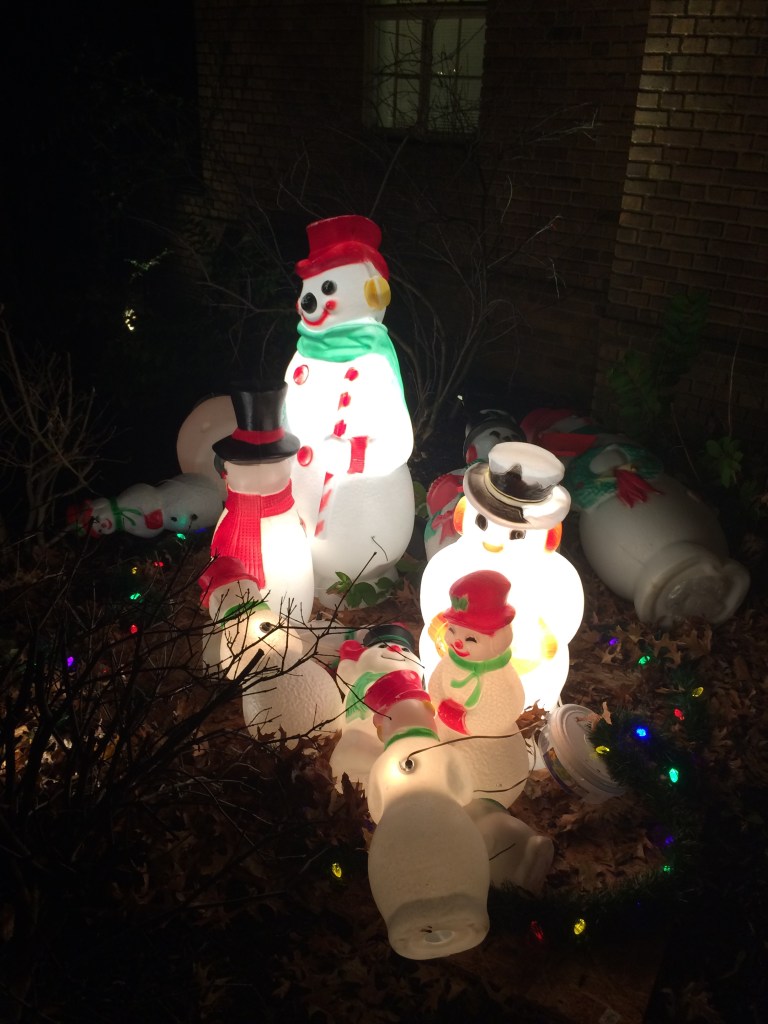
The last time I set them up, a year ago, another collection of vandals decided it would be fun to knock over the chorus, bowling pin-like. When they fell, of course, some of the incandescent lamps broke.
After the vandals, some of the lighted snowmen were not as illuminating as before! Incandescent filaments are very sensitive.
So why this tale of snowmen and vandals in a lighting blog? The last sentence. “…some of the incandescent lamps broke.” They broke, because of impact. Had I placed LED lamping in the snowmen, it is likely my repair task would have been easier. Stand them back up and I would have been back inside with a hot cup of cocoa ten minutes later. Instead, I had to open them all and replace all of the lamps…and it was COLD! LED are much more resilient to vibration and impact. The fragile filament could not handle being thrashed to the ground. LED, like the blow mold snowmen themselves bounce back, unharmed.
There is another reason to consider using LED lamping in your lightened holiday menagerie. Heat. I was reminded of this by a friend when he began setting up his holiday decorations. Most of these items came equipped with a very low wattage maximum. The large 4’-6” snowmen have labels warning against anything over 40-watts of incandescent light. That warning is not there for illumination maximization, but instead, because of heat. If too much heat was generated, the plastic snowman, might begin to look like the blow-up version the kids destroyed a few years back, all melted into a puddle, or at the very least deformed in some way.
A 40-watt incandescent lamp delivers 450 lumens of light, but creates a fair amount of heat at the same time. Because the LED lamps create a fraction of the heat, increasing the lumen output is now possible. My friend called because his decorations appeared “dark and gloomy.’ He wondered if he could increase the lumen amount to brighten them by switching to LED. A jump to 800 lumens (a 60 watt incandescent equivalent) consumes about 11 watts of power and will be cooler than the 40 watt incandescent, despite an almost doubling of light output.
This year, as you bring the holiday décor down from the attic, remember that re-lamping with LED will save you some money on electricity, but it also could invigorate your gloomy lighted treasures and make them that much more festive.
To everyone, have a great, well-lit holiday season and stay tuned for more tips and information on lighting, from your friendly neighborhood lighting geek, as we move into 2023!
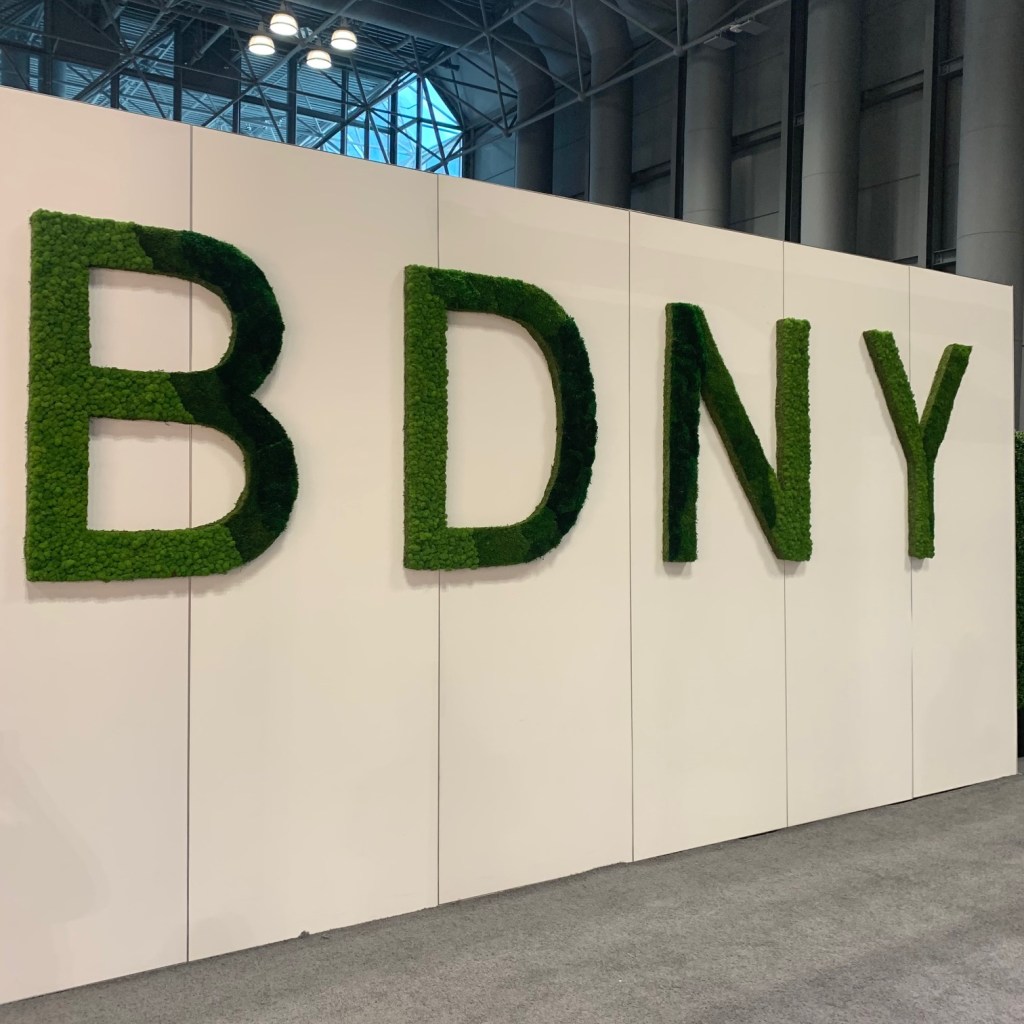
The first time I attended BDNY I found it a waste of time. It was small and there was very little of value to draw me back. I never went again. Jump ahead to a post-pandemic world and one of my favorite shows, the International Contemporary Furniture Fair (ICFF) combined with BDNY in 2021 to put on a better-than-expected presentation. The subsequent solo ICFF, earlier this year, was a bit of a letdown which led me to wonder if BDNY had become a more valuable asset. I decided to attend the solo BDNY and while not as powerful as the combined 2021 effort, it was worth the trip.
A similar thing occurred at the first LightFair I attended. A few years later, Energy Efficiency and LED jumped into the public conscience and the industry enjoyed a decade of relevant, informative and engaging shows. Now, with LED aging into “old news” the value of the show is shrinking.
My first KBIS was a revelation. I learned so much and experienced so many things, I could not wait for the next year. Unfortunately, the value has been reduced every year since. Whole categories of goods disappeared, major manufacturers dropped out and new products and ideas were eliminated for fear of being “knocked-off” by budget-priced competitors and trolling attendees with newfangled phone-cameras.
By contrast, the European shows have somehow been able to maintain their value. Shows are bigger and longer, spaces are not a collection of boilerplate “popup” displays that all look the same. New ideas have been shown consistently and the staff has remained at a high professional level (Suits and dresses [remember them?] are worn, a very minimal amount of faces are buried in mobile phones.) They remain attend-worthy and younger professionals as well as old vets are very much present, unlike the boomer-centric shows of America.
This is the perfect time to toss the whole concept in the air and allow the pieces to land in a newly configured way. I am aware that many groups derive much of their financial base from the shows they sponsor and are reluctant to change. Change, nonetheless will be required, because attendance is and will continue to dwindle. As the great actor, Yaphet Kotto says in the 1975 movie, “Sharks’ Treasure,” “Fifty percent of nothin’ is nothing, man!” They can continue to own all of a shrinking extant, or less of a growing alternative.
As the world attempts to recapture two years of lost trade shows, some major rethinking must be undertaken. When the International Builder’s Show (IBS) combined with the Kitchen & Bath Show (KBIS) they bought themselves an additional decade of relevance. I’m sure, even they are starting to consider where they head now. Huge pockets of their relevant industries are still missing from the combination. Are there other shows that can be corralled to present an even bigger bang? LightFair is moving to a biennial schedule, similar to many major European shows. This should make it more of an “event” and grab a few more people. That might help for a few years. It is time for BDNY, ICFF and perhaps a handful of other smaller shows (the un-resurrected ADHDS, NY Now?) to coalesce and present a show that creative professionals can really use. Continuing to deliver halfhearted efforts will result in a continuation of attendees forgoing them completely.
I know I have written about the need for trade show change before. I have no “dog in this fight” other than twenty-five years of experience. For years, I was paid to attend these shows and relate the observations. As I see less and less to report, attendance becomes less and less important. It is harder and harder for me to recommend attendance. Deep down inside, I want them to be better with continued relevance. The vibe in a room filled with creative people cannot be replicated online. Even with poor results, I still feel somewhat more energized when I return to work.
Perhaps, we are destine to watch these shows melt. The deck is stacked. The internet, online catalogs, online visual influencers, a “stay-at-home” pandemic, work from home employment and a new generation of workers with slight face-to-face socialization skills may be too overwhelming for this old-school concept to survive. We baby-boomers have only a few years or relevance left. If that is the case, I wonder what is next. I suspect we’ll all need to stay tuned.
I’ll have more to say about the actual show in my next blog post. For now, let me share the interesting things I saw at this year’s installment of Boutique Design New York (BDNY) a trade show created to serve the hospitality design community.
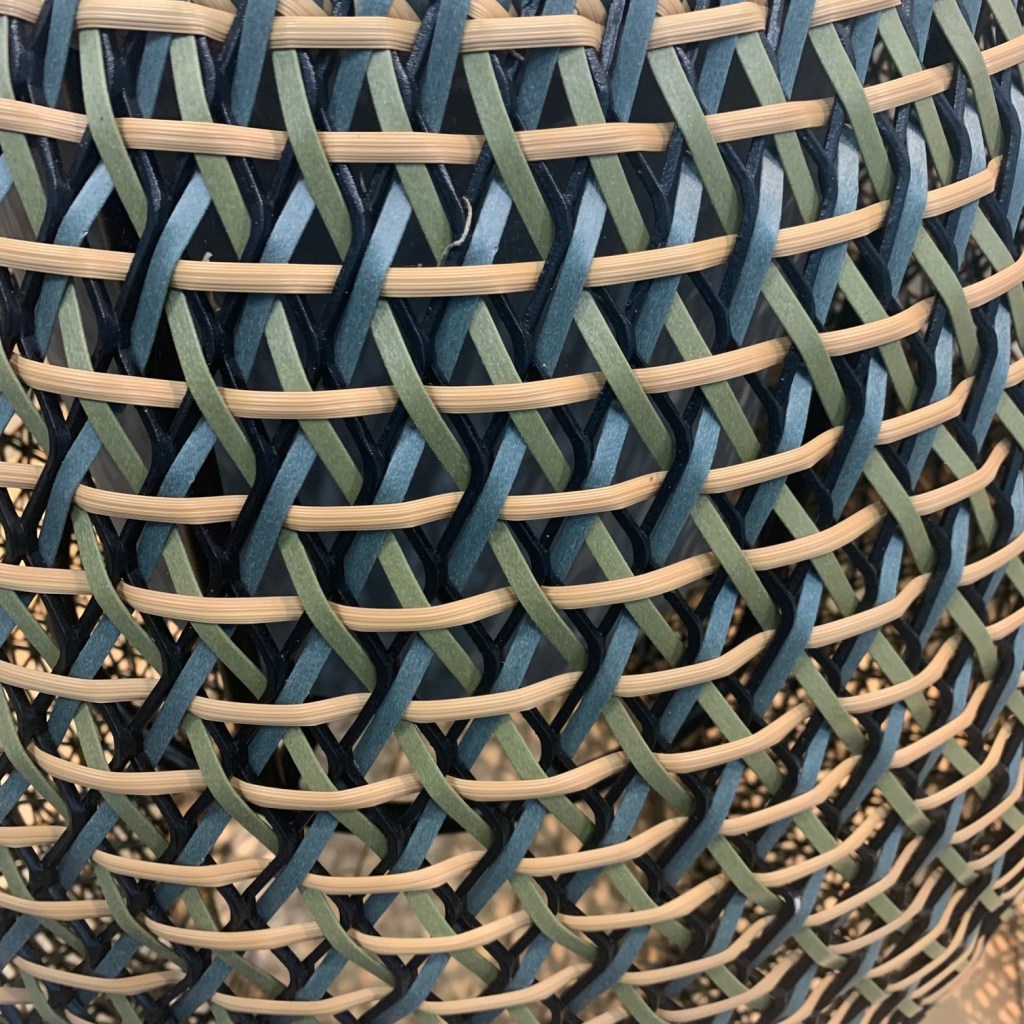
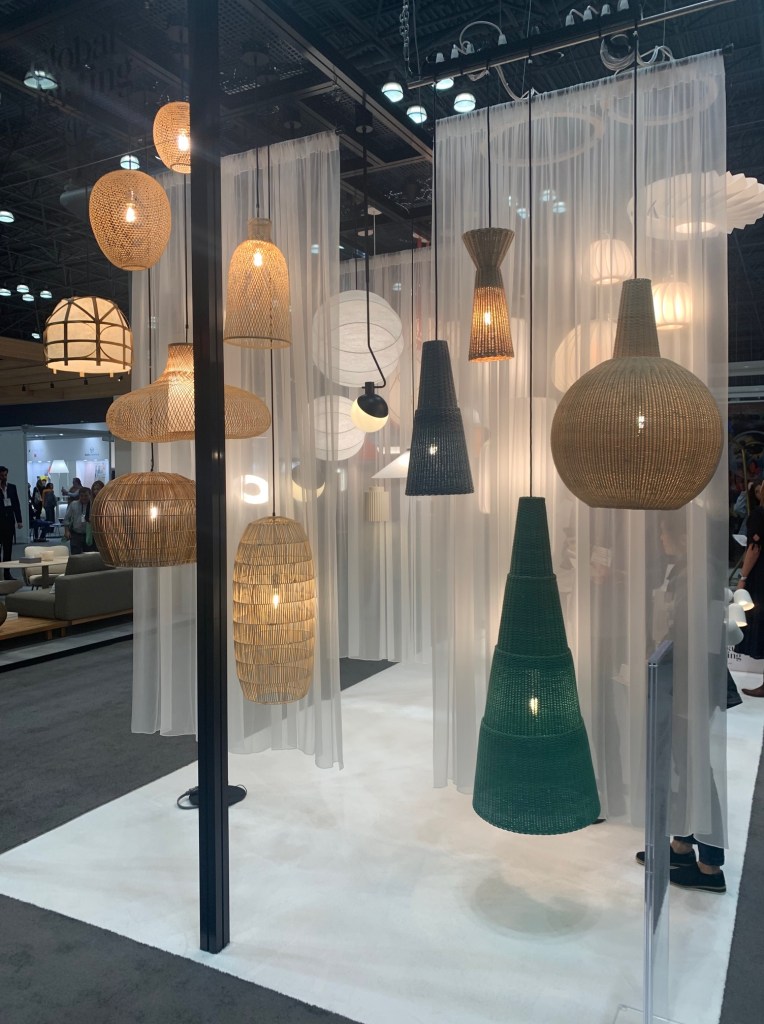
Wicker/Cane/Reed/Woven
There are two noticeable trends that permeated the show. Neither are surprising, I guess I was simply surprised by their dominance.
BDNY 2022 – Deadon woven patternBDNY 2022 – Global Lighting – Wicker and Cane Oversized Pendants
LED Mirrors
As I prepared to attend the show Sunday morning, I commented to myself how horrible the hotel lighting was at the sink. In this particular room, a spotlight was aimed at my hair from overhead and no light anywhere near my face. I moved about like an indecisive fly until an adequate amount of illumination fell on my face. That preface was a telltale reminder when the second overarching trend became noticeable.
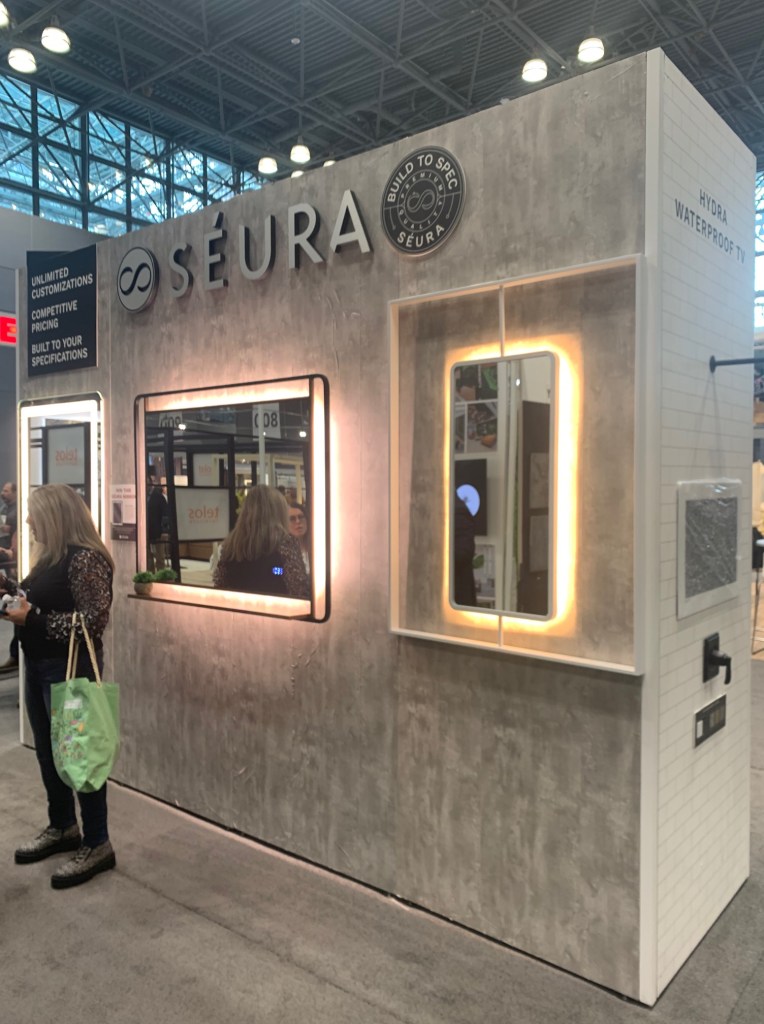
Seeing LED lighted mirrors in such abundance made me optimistic. Some, of course are glare-bombs with light aimed at blinding the user, but many of the pieces on display were making an honest attempt to deliver decent light for personal grooming. Seura, https://www.seura.com/products/lighted-mirrors?loggedIn=false has a very professional collection with much attention paid to color and luminance levels. Artline Group and Mirror Imagehttps://mirrorimageinc.com/ also showed a few interesting options with attention to aesthetics and light delivery. While I’m sure I should know better, I’m keeping my fingers crossed that better lighting in hotels is around the corner.
BDNY 2022 – Seura – LED Lighted Mirrors
Lighting
Of course I gravitate to lighting. After working 49 years in this industry, I can’t, not look at lighting!
Cerno lighting showed an interesting assortment of products. Very “smart” modern and using some edgy colors and finishes, I found myself surprised. I have either ignored or forgot about this company. I think I will pay attention in the future.
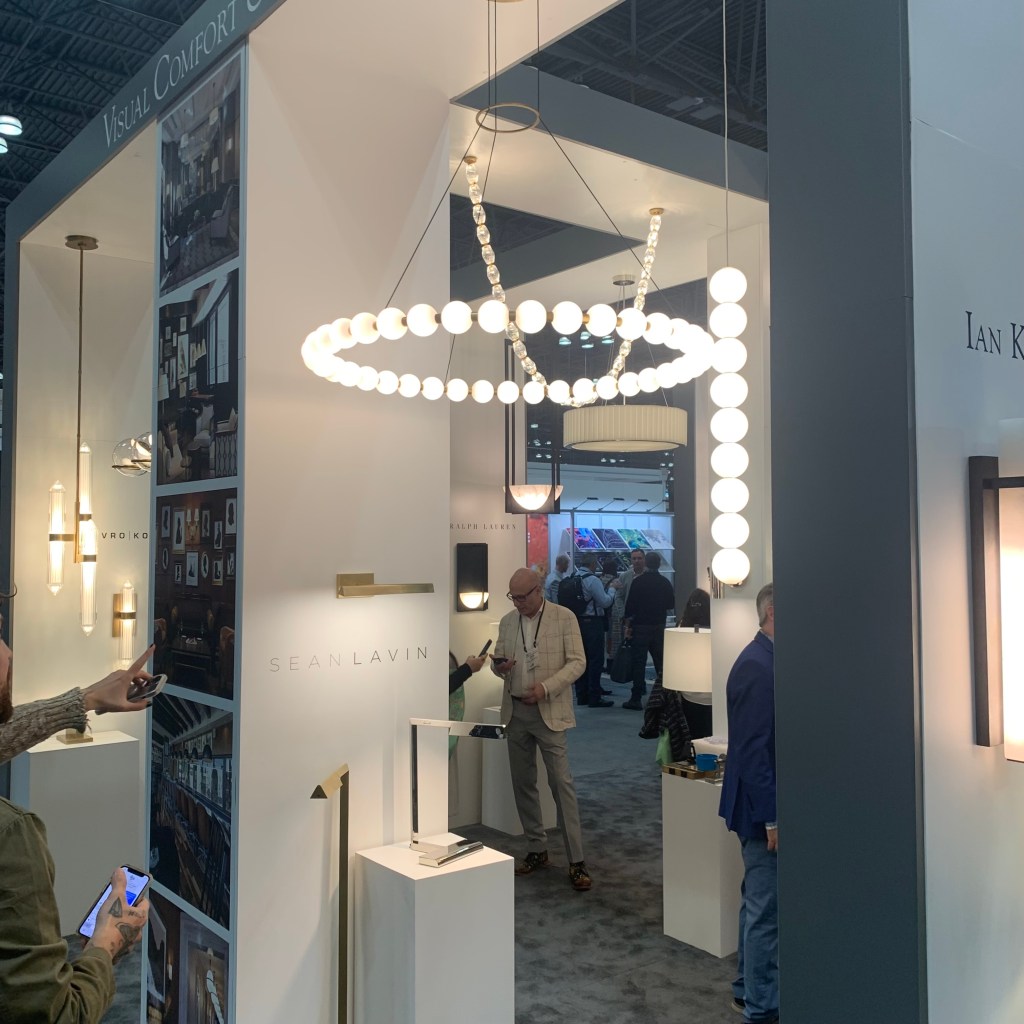
Loved two pieces shown at the Visual Comfort booth. The Comtesse by Paloma Contreras is a very shallow spherical sector of metal, all the light is indirect and sizes are grand. The Orsay Pendant, also by Contreras stacks a small metal cone atop a larger for a clean simple look. The Sean Lavin designed Orbet pendant is a strings of white glass balls in a single drop, almost serving as a simple string of pearls against a black dress for the home, which of course, is always in fashion.
BDNY 2022 – Visual Comfort – Orbet Chandelier and Pendant
I do not believe I have ever come across Bover Barcelona Lightinghttps://www.bover.es/en/ while I was drawn in with their display, a quick review of their website and I found many interesting items. It might be worth a look!
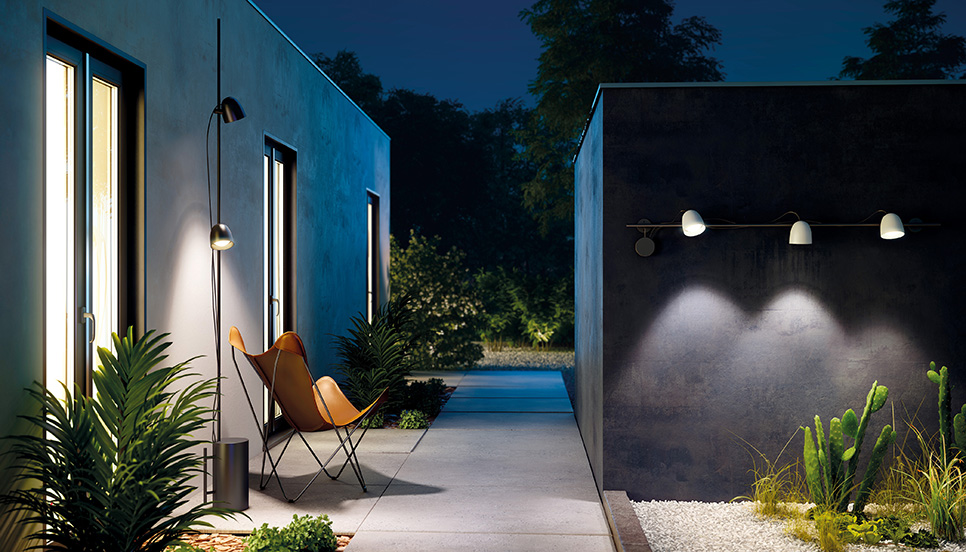
Conversely, I have run across B.Luxhttps://www.grupoblux.com/en/ many times in the past. Their new outdoor solutions are completely different. Track lighting and pole lamps for the outdoors? Wow! Exciting.
b.Lux Outdoor track and pole lamp
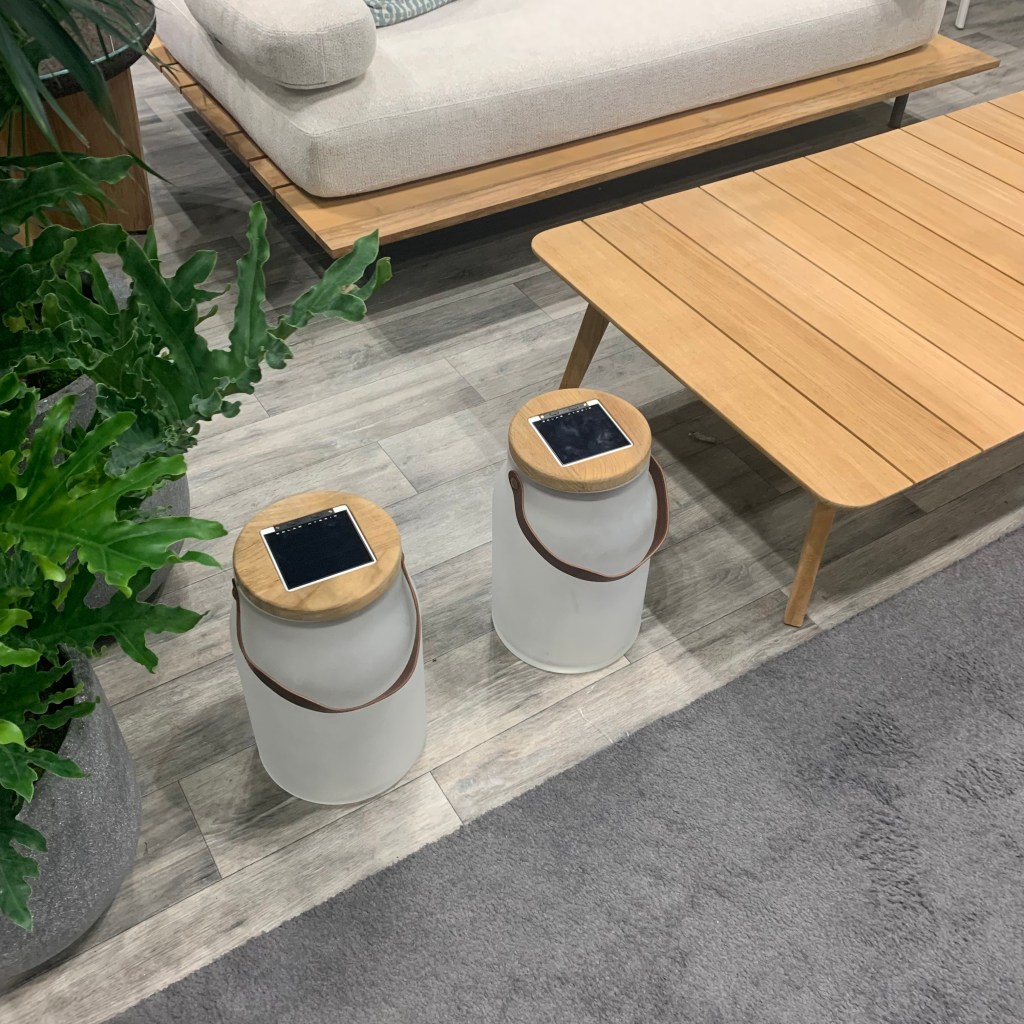
Ethimohttps://www.ethimo.com/en looked again at solar lights, this time, they were porch portables in the shape of milk jugs, obviously called Milk. I still wonder if anyone will crack the code for solar longevity and power retention. These guys are nonetheless cute and would work nicely in most every patio setting. Longevity is however always the key with solar.
BDNY 2022 – Ethimo – Solar portable porch lamps
Sort of Lighting
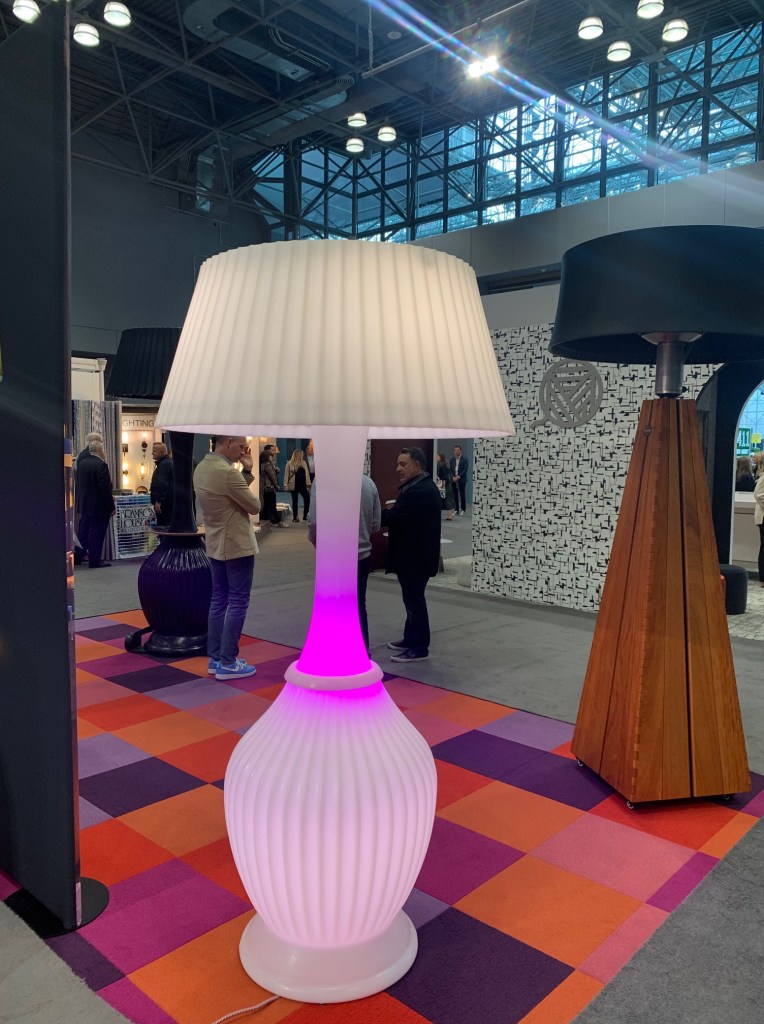
Perhaps a result of the pandemic and the desire for outdoor eating deep into autumn and early in the spring, Kindle Living has developed a deep line of “Heat & Light” outdoor heating units that now include a lighting element. What is nice is the varied style. Some are clearly “outdoor” aimed, but traditional and mission styling is also available. These are nice solutions for any exterior look.
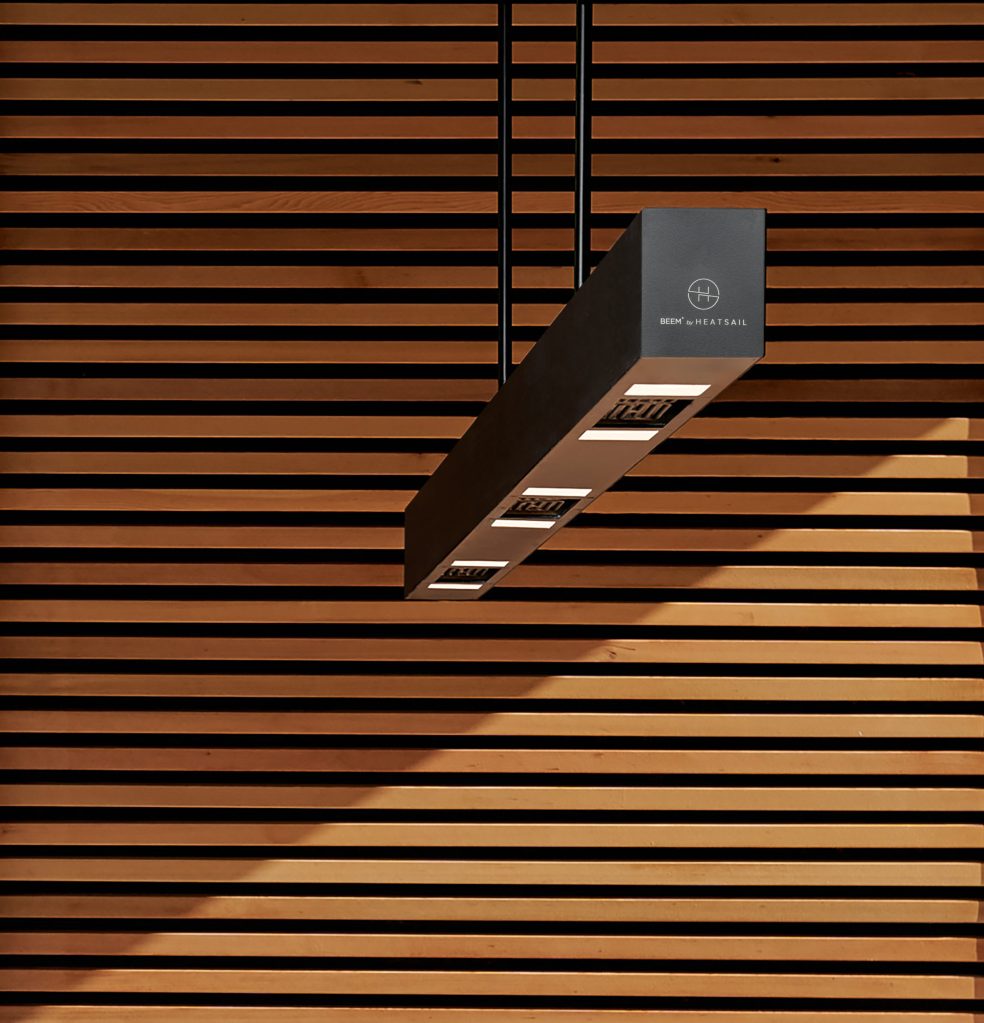
Beem by Belgian manufacturer, Heatsail is a unique product. This is an outdoor lighting unit that includes a heating and misting option all in a compact, contemporary package. One product that solves three problems, heat, light and cooling, must certainly be of value for patio living.
Heatsail – Beem lighting-heating-misting all-in-one, over table unit
Not Lighting
Make no mistake, this show is filled with minibar suppliers and room safe providers. (I’m not sure I could make a career out of providing keycard access equipment to the industry, but that’s probably just me!) Stepping over all of the boilerplate, there was some interesting non-lighting things worth mentioning.
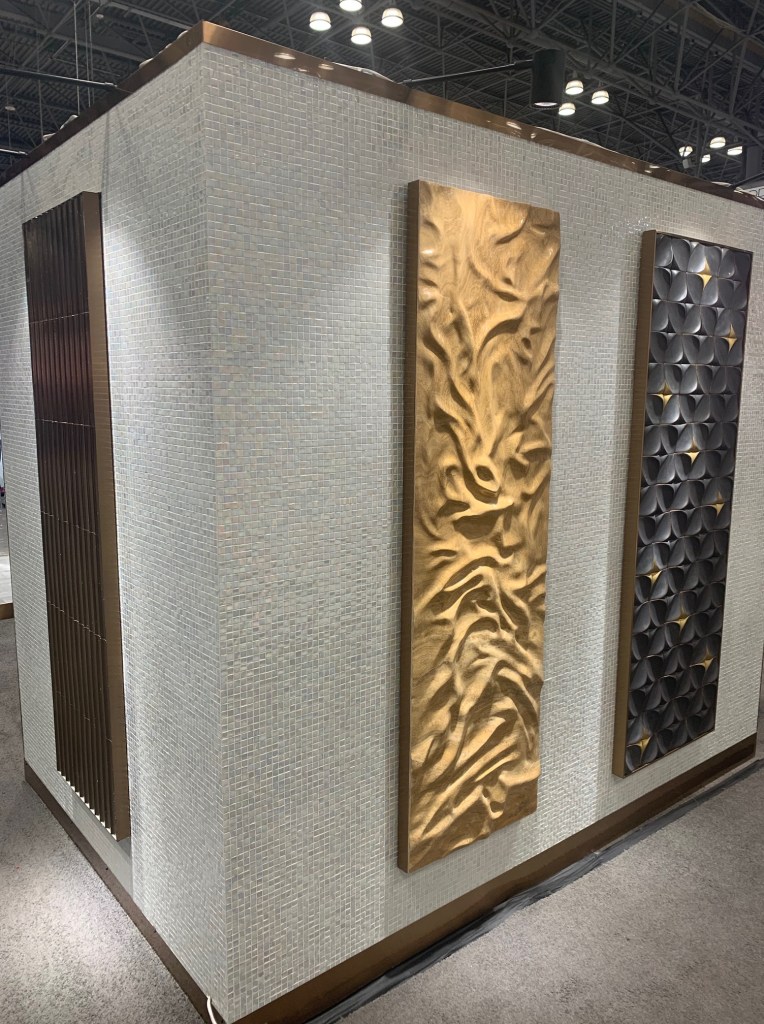
At most shows, there is always one wallcovering supplier that catches my eye. This time, Innovations displayed a textured collection that felt like cork and featured metallic veining that would nicely compliment the rise of warm brass use today.
BDNY 2022 – Innovations – wallcovering with metallic veining
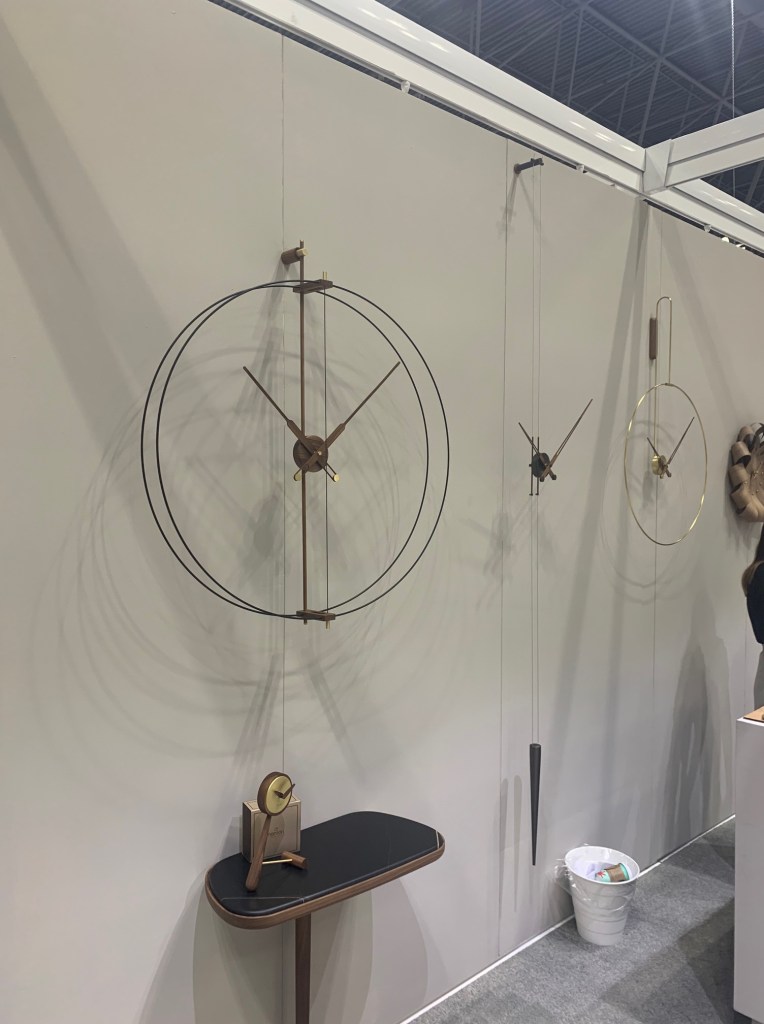
I’m not sure I have thought much about wall clocks lately, if I have ever! That changed at the Noman booth. Rather than the massive blobs of white with schoolhouse numbers placed 30° apart, this company has created products that disappear into the architecture with wisps of metal and minimalist mechanics. These designs have turned functional necessities into beautiful wall accessories. Quite a feat.
BDNY 2022 – Noman – Subtle wall clocks that disappear into the surface
While they advertise their product “for island living” Teaki Tiles could have a much wider application, as long as imagination is used. Rather than ceramic, these tiles are fabricated from teak wood. Teak is an excellent hardwood that has been used around water for decades, so It might seem obvious to use it on floors and walls in patterns. That said, I don’t think I’ve seen it used before in these applications. Their offering could enliven almost any design. I felt sunnier after having seen it!
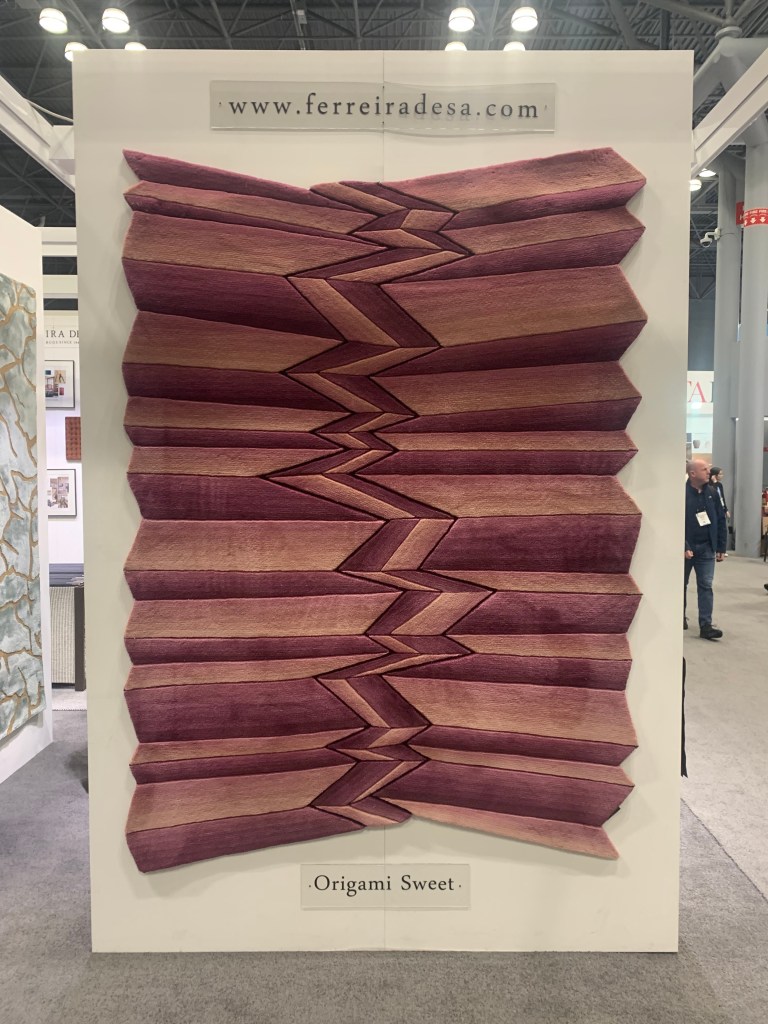
As I took this photo of a very creative rug shown at Portuguese weaver, Ferreira, I overheard a passing designer ask her friend, “Is someone going to trip while walking over that?” I don’t know if that would occur, but it sure will cause one to pause for a moment. These were beautiful textured and tufted floorcoverings.
BDNY 2022 – Ferreia – creative sculpted rugs from Portugal
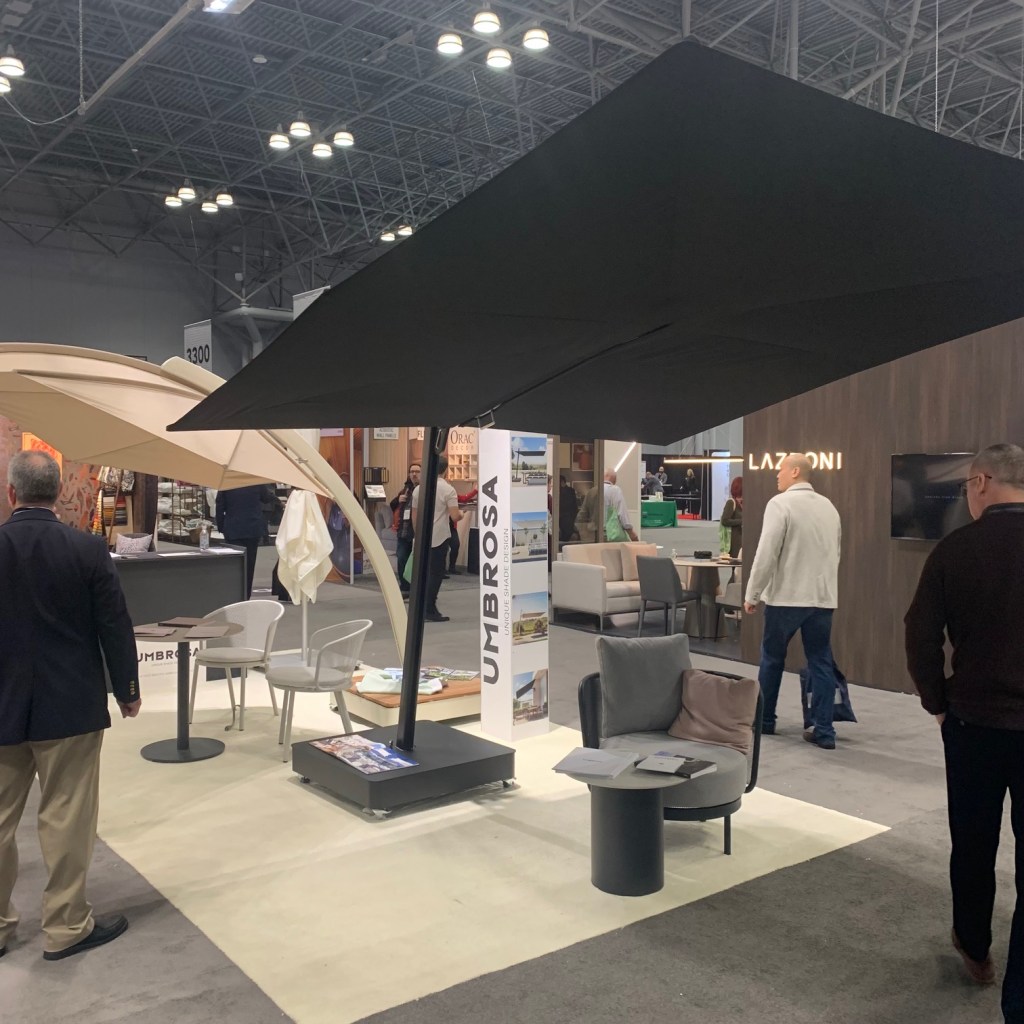
Yes, we’ve all seen outdoor shade umbrellas. There were three or four manufacturers at the show. Only one made me stop and look. Umbrosa were much more interesting and based on the salesperson demonstration, very easy to manage. A quick look at their website and even more variation is available. I wish I had a place for one!
This was a neat idea. Kenco Hospitality showed a collection of double window coverings tucked into an illuminated valance. The front drape was sheer, allowing sight onto the photo-realistic scene printed on the back drape panel, giving you the illusion of a much more interesting exterior. As I opened my hotel window onto the stone wall of an adjoining structure, it appeared to me how valuable this could be in urban hospitality settings.
BDNY 2022 – Kenco Hospitality – Lighted valance with two drapes allowing for the creation of alternate window views.
The idea of printed surfaces heretofore left plain was again mentioned when an old friend showed me printed shower stall environs at ABG Hospitality. Printing on glass added a level of excitement and style to these surfaces. While created for the hospitality industry, I wondered if applications could be found for residential spaces. Something to consider.
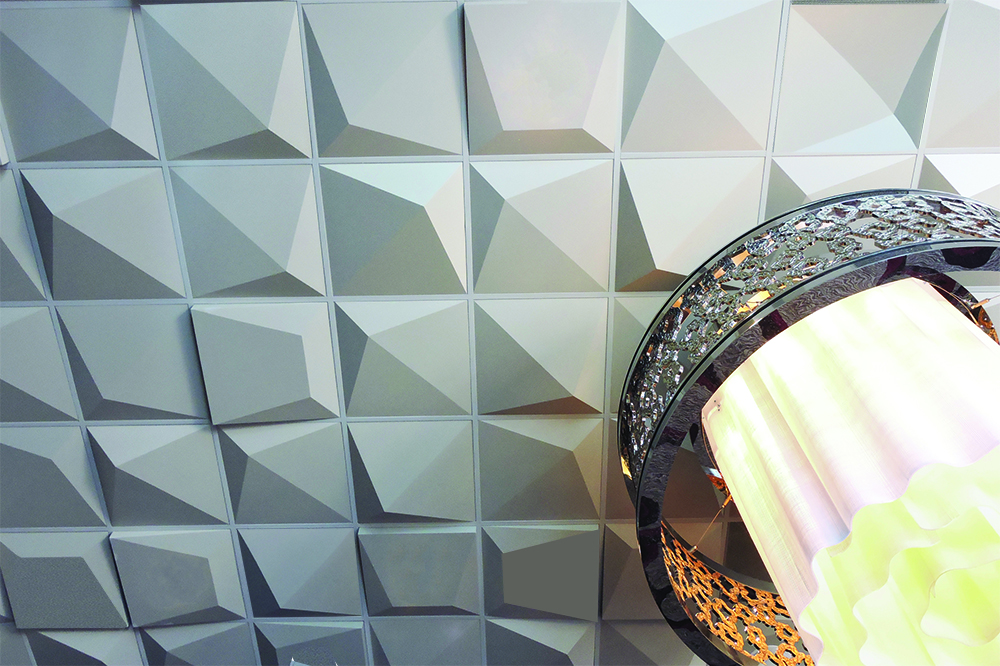
Finally, why shouldn’t the sixth wall be interesting? Above View wants designers to think about the ceiling with creative artisan ceiling tiles. Geometric, textures, patterned and completely different ideas. I liked the idea that this product forced a conversation that stretched the idea of design.
Above View – creative ceiling tiles that bring interest to areas previously left blank.
BDNY & NY
Despite the fact that I found only a few visually excited things at the show, it is always nice to reconnect with friends and immerse oneself in a creative space. A few days in New York also allowed me to sample a few new restaurants, (Try Cadence and The Musket Room!) see some shows (I highly recommend Ohio State Murders & Kimberly Akimbo.) and check out some museum exhibitions. (Loved the Alex Katz retrospective at the Guggenheim.) Refreshed and energized, I’m ready to handle a cold and snowy winter while I hold my breath for Spring.
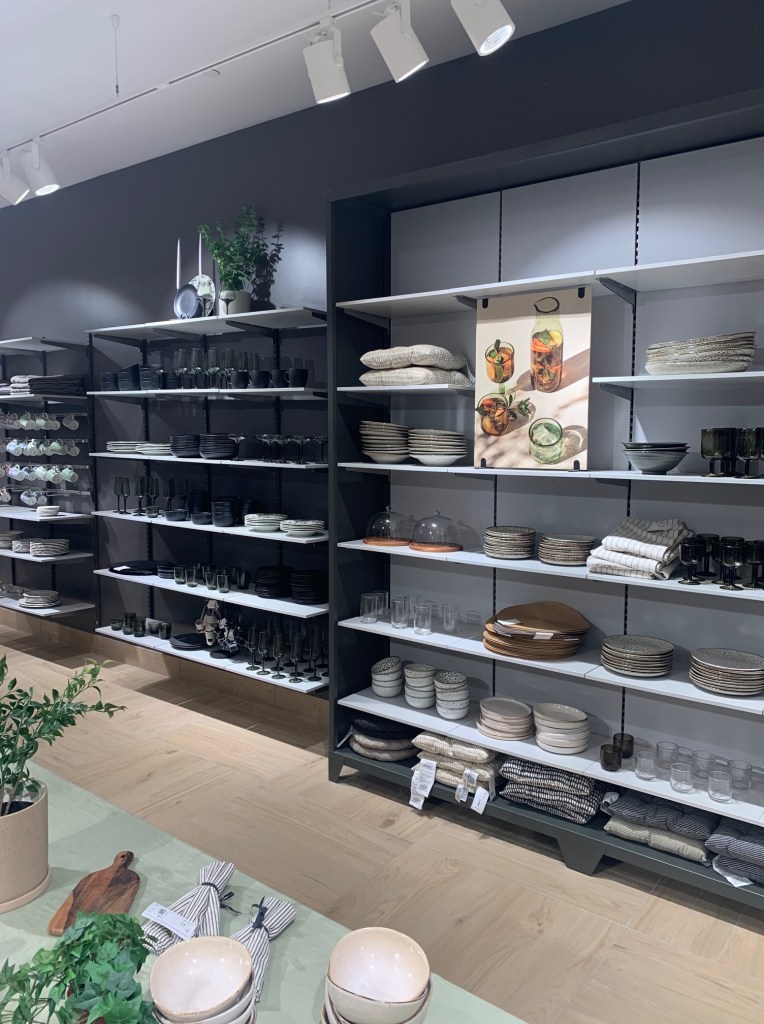
When my wife and I are shopping in a multi-department retail store, she always knows where to find me when we get separated. Inevitably, I am wandering the aisles in the Housewares section. What sheets, dinnerware, appliances, cooking equipment and household accessories are on the racks, on sale, sold out or in the clearance section? What colors are low in supply and what finishes are in the discount section? Has the “latest trend” been reduced in price?
A recently opened H&M Home featured a prominent “SALE” rack. What is that telling us about Teal and Dark Blue home accessories?
Initially, we all want to know what is new. If we shop a store, or flip through a mail-order catalog or browse an online website, we do so to see the latest options. Understanding what is waning is of equal importance.
The same H&M Home with regular priced merchandise, not a blue or teal accessory to be seen!
I wander retail aisles to try and understand the impact on the look and trends of home interiors. One retailer selling orange, bunny motif accessories is just a funky idea. After the initial sighting, that observation is filed someplace in my brain. I move on. When I then notice the fifth or tenth retailer selling a variety of goods with orange bunnies it is likely becoming a fad or possibly a trend. An idea with which some reckoning is needed. Orange bunnies will now apparently be a factor.
Of course, orange bunny motifs are deceptively simple. They are most likely going to end up in the sale rack during the next season and in the “dollar store” six months later. Paying as much attention to the closeout racks as the new merchandise will help in the understanding of the trend cycle. One orange bunny at 50% off is a sale. Every retailer with all of their orange bunnies at 50% to 75% off and orange bunnies aplenty at the “Dollars Are US” store means they are no longer relevant.
I remember the first time I questioned the continuing viability of Oil-Rubbed Bronze. The finish had been red-hot for about a decade. I knew, the end had to be near, but it remained popular. I toured a new construction home (I’m always touring new construction!) and noticed the oil rubbed faucet in the bathroom. It immediately looked dated. The dark lighting above brought a depressed feel to the room. I knew then, it was on the downslide. A subsequent visits to Home Depot, TJ Maxx and Target confirmed stocked shelves of oil-rubbed bronze. When mass retailers are neck deep in a trend, it is clear, the end is nigh.
When a long-serving trend winds down it means a new option is on the rise. By paying attention to deteriorating trends, it forces observers (and me!) to ask the question of replacement. That in itself is just as loaded a problem. There is almost never a one-for-one swap. What happens after a trend deteriorates is a rebalancing. New ideas come forward and fill in gaps, trends midway through a cycle become more dominate and some other rising trends might accelerate their decline. In short, it turns into an aesthetic game of “Whac-A-Mole.” Balance is usually stabilized when the economy is roaring. Sluggish economies instigate change.
Consciously or subconsciously, we all know trends have a finite lifespan. Our personal methods for digesting them and using the information to our best ability can be supplemented by good observation skills. It is important to comprehend upcoming trends. One way which we can supplement that knowledge is by embracing the information gathered around the discount rack and discount stores.
Since the introduction of fluorescent and LED retrofit lamping designed to take the place of incandescent light bulbs, fit has occasionally been a problem for consumers. Sockets are designed for the shape and contour of incandescent glass envelopes. Because of ignorance or lack of detail, poorly realized retrofits lamps on occasion, do not “fit” or function.
Why?
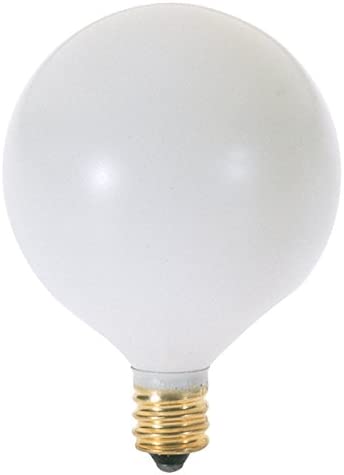
Fit has especially been a concern with “globe” or sphere shaped lamps (“G” type, as ascribed by the industry.) To understand the problem, let’s first look at an incandescent G-16 ½ candelabra based lamp. Many people call these golf ball lamps because of their similar size. Similar issues may occur with larger, medium-based “G” lamps, as well.
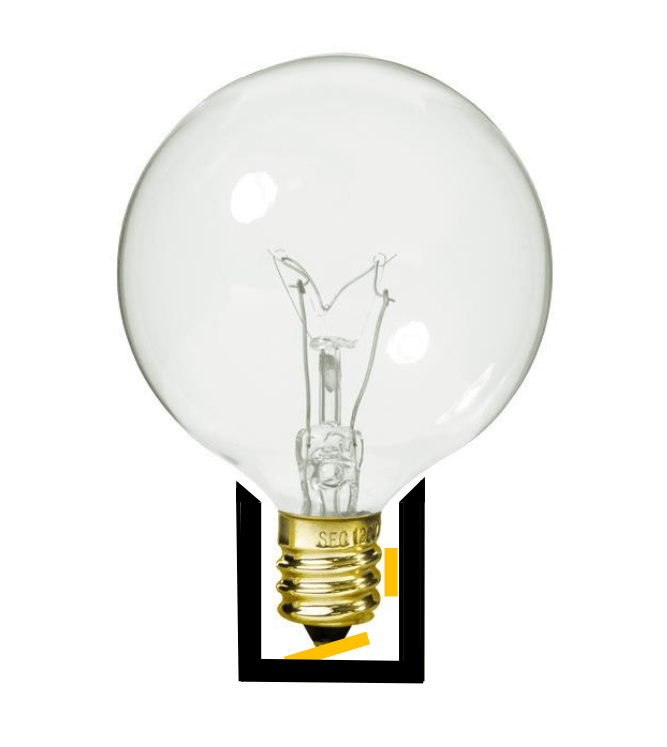
A typical G-16 1/2 Incandescent lamp.
With a full glass envelope on the incandescent product, you can see how the blown glass envelope gently tappers into the screwshell (the threaded portion at the base of a lamp.) The screwshell makes contact with the electricity delivered inside the socket.
A typical incandescent G-16 1/2 lamp installed in a candelabra socket. Note the base touches the copper tab at bottom of the socket and the threaded side touches copper on the side.
When inserted into a socket, the “hot” side of the electric current touches the bottom of the light bulb via a small copper tab at the inside bottom of the socket. The negative, or neutral half of the electric supply is provided to the screwshell on the inside edge of the socket. The positive and negative contacts are represented in the image as gold rectangles.
Also, note how the rolled edge of the glass curves into the screwshell and curves around the tapered inside edge of the socket. This insures the bottom of the light bulb easily touches the contact at the bottom of the socket.
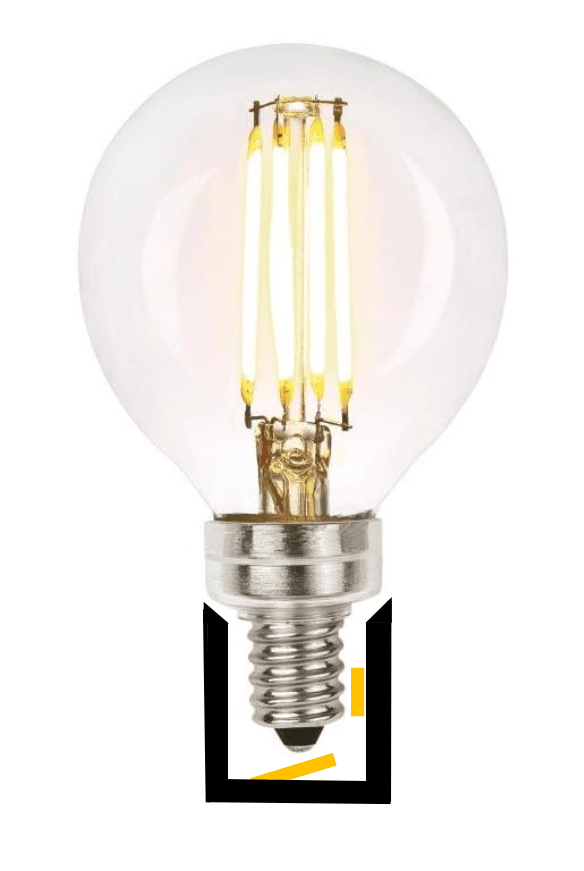
LED retrofit lamps create light with the use of a collection of electronics. Those electronics are located in the area between the glass envelop and the screwshell. In the photo below, the chrome sleeve under the glass houses the electronics.
A LED retrofit G-16 1/2 lamp. One of many styles available in the market.
When we insert the LED retrofit lamp, the chrome sleeve prevents the screwshell from fully turning into the socket. When that occurs, the bottom of the light bulb cannot touch the copper tab and the light bulb will not function.
A LED retrofit G-16 1/2 lamp installed in a candelabra socket. Note: the collar under the glass envelope prevents the base of the lamp from making contact with the copper tab at the bottom of the socket, thus preventing a complete electric connection.
Many people, when experiencing this failure believe it to be a LED lamp malfunction, but it is really a design failure. In instances where the socket is slightly wider, the copper tab is sitting higher or the edge of the socket is shorter, the lamp will work without an issue.
What to Do?
If this is an experience you have, the best thing to do is buy a different brand lamp, one with a better contour between envelope and screwshell. Some screwshells have also been elongated. If an alternative is not possible, there is one other thing you could do, but it must be done with care. Usually, the contact between copper and light bulb is millimeters away from making contact. A gentle lift of the copper tab could be all that is needed. It could also be unusually flattened over years of use. The reason for caution is electricity. We tell children not to shove things into electric outlets for a reason. An electric shock, a short, or worse can happen.
If you’d like to try a solution, shut off the switch on the wall and trip the circuit in the electric panel or unscrew the fuse in the fuse box. BOTH are a MUST!! Do not go any further without completing these steps!! (Seriously, unless you like the feeling of 120 volts of electric power coursing through your body, do not move forward without shutting off the power at the circuit!)
With a long, strong, wood or plastic stick (chopstick, knitting needle or crochets hook,) gently pry the copper tab up EVER SO SLIGHTLY!! As said, the gap is a fraction of an inch. There is no need to exert Hulk-like power! Reenergize the circuit and turn on the switch. If it does not work, it is time to try another brand of replacement lamp.
Expect Things to Get Better
Retrofit lamps are getting better. The electronics are getting smaller and even the least sophisticated manufacturers now understand what could be inhibiting a full electric connection.
I live in a historic home build with a two-car garage in the basement. This was quite an unusual feature for homes in the late 1920s. At the time, cars were substantially narrower and much longer than the average car of today. Consequently, I have no storage at the sides of my garage, but the front is packed solid with all the things we house in our garages. Moving the car in and out of the garage requires skill, with about 2” of room separating the rearview mirrors and the door frame, on each side.
Like newer cars and my garage’s elongated shape, the new light bulbs can and will work on sockets designed for a different era of technology. Just a little skill and patience is required.
Imagine you are Ben Watson. The world of offices has changed and he sits atop the Herman Miller – Knoll merger. Will people return to an office? Will offices disappear completely? Can his company survive? What do you do? What products will be needed in this new world?
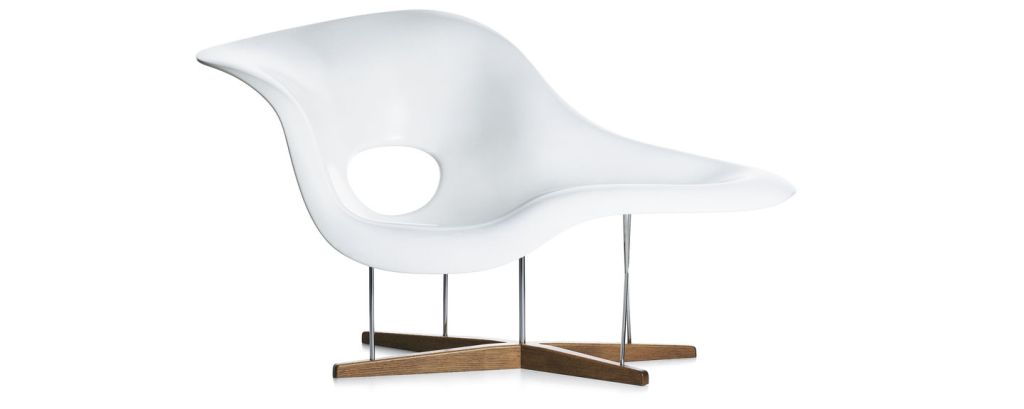
Watson holds a degree in visual and environmental studies from Harvard and spent years in product development and marketing for Knoll. His senior thesis explored La Chaise, the modern-classic chair with a white molded polyurethane seat and crossed wooden feet designed by Charles and Ray Eames. Like all designers, he is uniquely qualified to solve a problem he had not anticipated. It is in fact why we have designers. Designers solve problems that most people find confounding.
Like Watson and office furniture, lighting is now shifting. An increased desire for sustainability is leading to pushback of disposable luminaires. Renewables are overshadowing replacements. As a result, a complete rethinking of how we illuminate our spaces must now occur.
In the first part of this sustainability blog-triumvirate I indicated that fewer decorative lighting products would be employed in the future. In part two, I talked about the ways in which the industry must step up to meet the needs of the new sustainable consumer. Figuring out how to put it all together in a way that is aesthetically pleasing now falls to the designer.
When to Feature Decorative Lighting
If we are going to use less decorative lighting and most of the decorative lighting on the market will deliver fewer lumens, not because of the substandard capabilities of LED, but because of the forms in which the LED is placed, then we must choose wisely. A five light chandelier equipped with five, 60 watt incandescent light bulbs delivered about 4000 lumens of light. Because the diffusers were large enough to cover a medium-based lamp, almost all of that light was usable. 4000 lumens of light was plenty for most dining rooms, dinettes and bedrooms. While many of the newer LED luminaires might promise 4000 lumens, it may be delivered in a slightly different way. It might be more directional, it might be concentrated in an oblique pattern or, it may obscured or simply used as an aesthetic element rather than a functional lighting machine. To make this work, the designer must be more comfortable with the overall lumen demands of a room or space.
With that in mind, the functional lighting must deliver almost all of the needed light in the space. Any illumination provided by the decorative product will likely be icing.
There are guidelines that help us determine optimal light levels for every room in a residence. There are also easy ways to use this information. Below is a chart that provides optimal light levels for each space.
Area / Task
Desired Illuminance Level in Footcandles (Fc)
Hallway/Passageway
5-10
Conversation Area / Entertaining
5-20
Dining
10-20
Reading (General)
20-50
Bathroom / Grooming
20-50
Laundry / Ironing
20-50
Kitchen (General)
20-50
Kitchen (Work Areas)
50-100
Reading (difficult) Study / Hobby / Music
50-100
Hand Sewing / Detail Hobby
100-200
To use this information, simple calculate the room or space area (Length multiplied by width) and multiply it by the desired footcandle level. The result will provide the needed lumens.
Length x width x footcandle = minimum Lumens needed for the room
Let’s assume we have a 12’-0” x 12’-0” dining room. 12 x 12 = 144 x 10 = 1440. 12 x 12 x 20 = 2880. That means the minimum amount of light should produce between 1440 and 2880 lumens.
When you think about that 5-light chandelier at 4000 lumens, or even a classic Williamsburg-type 10-light chandelier with candelabra lamps (280 lumens x 10 = 2800 total lumens.) incandescent provided very usable amounts of light for a dining room. We now need to think about it, just a bit more.
A New Way Forward
Let’s put the chandelier on the back-burner initially. The important thing to understand is decorative lighting will not and likely cannot provide all of the needed light. It should represent a declining percentage of the total demand for a sustainable future. How might that be delivered? Consider this.
Recessed cans around the perimeter might be a starting point. On a smaller room like this, think about one in each corner. Using a typical LED version, 650 lumens each will be provided. Now, consider an illuminated tray, or perhaps cove lighting. Somewhere between 48 linear feet of LED Tape (cove,) or as little as 32 linear feet (tray.) There are many LED Tape options. I’ll use an average of 200 lumens per foot. That will deliver between 6400 (tray) and 9600 (cove) lumens. Keep in mind, this is indirect light, so that might seem high, but will be very usable and acceptable. With the corner lights and tray lighting, the needed amount is met. These are sustainable choices and will have no impact on the style choice of the room, modern or tradition or anything in-between.
Decorative lighting can now be added. The amount of light provided will be unimportant. These then become aesthetic choices. Include them, or don’t. They will add light, but will not bear the bulk of the illuminance burden.
Now, simply repeat this with the other lighting in the other areas of the house.
LED lighting is different light, but it has also allowed designers and engineers to create more interesting and better luminaires. That means as design practitioners, we will need to take a few added steps to insure quality lighting is delivered in the space. As more sustainable environments are demanded, this added step will be needed.
If like me, you always check out trend predictions, wherever and from whomever they emerge, you are seeing a reoccurring mention of sustainable products. I am constantly questioned about sustainability. Designers are hearing the request and like a canary in a coalmine, they are often the first to recognize a shift. As I pointed out in the first part of this series [link] there will be changes in our application of light. Nonetheless, the disposable nature of a heretofore endlessly reusable luminaire, continues to trouble designers, users and sustainability proponents. “There has to be a better way!” is a very common comment.
I realized this is not a problem exclusive to lighting as I read about Golden Goose, a Milan-based manufacturer of high-end casual footwear. [TheNew York Times (August 7, 2022) “Don’t Toss Those Old Sneakers” by Laura Rysman. https://www.nytimes.com/2022/07/09/style/golden-goose-sneaker-repair.html?smid=url-share ] Like lighting, once a pair of sneakers is “worn out” they are unceremoniously tossed and replaced. In an effort to extend the life of the sneaker, they are offering bespoke repairs. The problem, as few as five years ago, is that there was no such thing as sneaker repair. Because of the typical manufacturing process, the sole could not be removed from the top, so an entirely different methodology was required. By considering the classic construction method of formal shoes, a new sneaker assembly process was created that allows for the teardown and repair. While not inexpensive, their sneakers can now be repaired and reused, almost endlessly.
LED longevity makes them the perfect light source for new sustainability demand, but they sit on the edge of some shaky foundations, much like the typical vulcanized rubber sole that encases a sneaker top and precluded disassembly. We discussed aesthetic trends in the previous post. There are three additional problems that must be addressed to increase the sustainability of LED lighting.
Driver Longevity
When a LED luminaire fails, it is most likely because of driver malfunction or some sort of circuit interruption. In the industry’s quest to achieve lower costs, corners have been cut in this all-important, albeit hidden, component. Quite simply, to have a more sustainable product, better built drivers and circuitry components are required.
Proof of Longevity
LED longevity is a predicted “guess” based on calculated performance characteristics. Basically, if the system lasts for X hours, testers feel comfortable projecting that it will last 6X hours. Tests of 10,000 hours (maximum) will allow a manufacture to promise the product will last 60,000 hours. One of the reasons we cannot go much farther is because 10,000 hours is a long time! After 14 months of testing, there is a very good likelihood that a newer, better model of LED is on the market and the cycle must be started anew. Most manufactures test for 6000 hours, allowing a promise of 36,000 hour lifespan and consuming only 8 ½ months of time, still a considerable length. Some sort of accelerated testing and performance affirmation is needed.
Repair
Incandescent luminaires are like a pair of leather brogues, we can change light bulbs as easily as shoelaces. Resoling is however another thing entirely and must be completed by a cobbler. A repair professional is usually needed to replace sockets or broken chandelier arms. LED lighting becomes closer to the conventional sneaker, nearly impossible to rebuild, even by a pro, unless you rethink the entire process. That, I believe is where the luminaire manufactures are today. To meet the sustainability expectations of the near future, they must plot out a path to luminaire repair.
This might be realized in a number of different ways. Perhaps some companies can easily adapt their business to include a repair service. We might also see LED luminaire repair shops popping up around the country. We could also see lighting retailers adding LED repairs to their list of luminaire services. Only real demand will tell the tale.
“It’s Gotta Be the Shoes!”*
To meet the needs of a sustainable future, electronic repairs will need to be more common. We might see the return of TV repairmen, small appliance repairs and people who specialize in fixing our much more technological environment.
By their own admission, Golden Goose is not seeing a positive ROI on repairs. Knowing repairs are possible is however, turning out to be a substantial selling point for this expensive footwear. I think that might turn out to be the case with lighting, too. The lighting will last longer than most people expected. There will be fewer breakdowns than anticipated. The newness of LED will wear-off and failure expectations will be reduced because it is an effortless product. When needed, there will be some avenues available for resolution, even if they are not ultimately used. That may satiate the consumer.
In a 1988 Nike commercial, Mars Blackmon (a comedic avatar of Spike Lee) tried to explain the god-like moves of Michael Jordan on a basketball court. Discounting every other conceivable option, he reached the conclusion, “It’s gotta be the shoes!” despite the objections of Mr. Jordan. (If you’re not a basketball fan, Michael Jordan was an excellent player, probably even in bare feet.) Offering repairs when they might be of minimal real value, just might be the sustainable aspect we’ve convinced ourselves we need, just like the illusion worked for Mars.
*Mars Blackmon – 1988 Nike commercial with Michael Jordan and Spike Lee
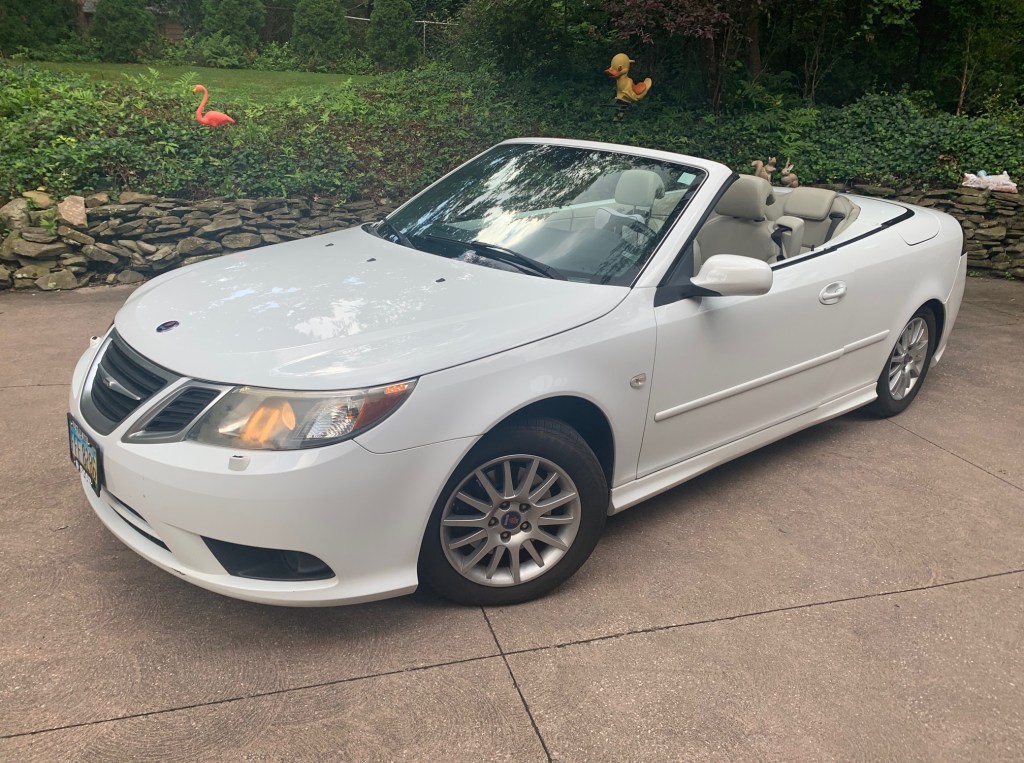
2009 SAAB 9-3 Convertible – The original sustainable vehicle?
I drive a 2009 SAAB 9-3 Convertible. This is, without question the best car I have ever owned and despite its age, still looks great. I purchased this car a few months prior to SAAB exiting the automobile business. I never owned a SAAB prior, but I quickly found out that there is a joyful cult surrounding current and former SAAB owners. When the closure of the manufacturer was announced, fellow SAAB owners would pull up next to me, open their window and ask, “What are we going to do?” I learned that many SAAB owners were SAAB owners for life. Like me, they liked the solid, dependable build and the quirky stylings that made the design impervious to trends, fads and the constant waves of the “next best thing.”
For the last few years, I have been predicting a lighting “future world” where fewer decorative lighting products are used and more (much more) functional lighting products will be installed in residential spaces. We will still have centerpiece items featured in dining rooms, over multiple areas in the kitchen and foyers, but the rest of the home will see lighting hidden in, over, behind, inside and below architectural elements in the room. Like recessed cans, lighting will be indirect, easy to use and impervious to the stylistic shifts that are inevitable in the home furnishings industry. Product that forgoes style fads, like my SAAB will maintain relevance farther into the future than flash-in-the-pan ideas.
Why is This Occurring?
Because of the rapid adoption of LED technology, a couple of things have occurred. First, the LED diode is small. Very small. This has allowed for the development of tiny functional light. LED Tape has, in just a few years, become a ubiquitous method of lighting. It is filling trays, coves, toekicks, cabinets and over-cabinet areas. It is very fairly priced, has proven to last for a long time and the lumen output options are many. Versions of LED Tape are also finding their way into integrated luminaires. Designers are taking advantage of the tiny size and reimagining decorative lighting.
LED diodes are expected to last between 40,000 to 50,000 hours. Operating six hours a day, that calculates to somewhere between 18 and 24 years! When the average luminaire is replaced every 7-10 years, it is easy to see that the viability is not matching demand. We can and will use functional products longer, because they have no impact on aesthetics. They will last over three or four home remodels before replacement is needed.
Sustainability is of growing concern to the consumer. It is more important right now to the younger buyer, but those customers will be around for many more years and their peak spending years on home furnishings are starting now and will rise as we move into the future. As this group mature and younger people age into home ownership, it is predicted their demand for sustainability will NOT disappear. Products removed and replaced long before their end of life will not jell with a sustainably conscious consumer. Knowing that 75% to 90% of the lighting could last longer and perhaps only one or two luminaires would need to be replaced due to a dated appearance, will be much more palatable. These new realities will change how designers interact with customers and together how they interact with lighting.
Meanwhile, Back On the Road
A constant question or comment shouted from other drivers to me centers around longevity.
“How many miles does your car have?”
“What year is that?”
“I drove my [fill in the year and/or model of their SAAB] for [fill-in a HUGE quantity of miles]”
SAAB owners know that timeless design allows them to ignore trends. They will receive the benefit of great performance and extended years of use because the engineering is solid. LED is earning the same reputation. Early on, people worried about what would happen when the LED “burned out.” They are finding that it just doesn’t happen that often. My “ALL LED” kitchen has been humming along for fourteenth year with nary a problem. It is not an anomaly.
To fully take advantage of this longevity, a shift is occurring. More indirect light, more functional light. More utilitarian light. A greater reliance on recessed lighting. Fewer decorative pieces. This change makes sense for the room, the ecologically sensitive consumer and perhaps more importantly, the planet. As designers, we need to make this work aesthetically. Trust me. That is the easy part. Reducing landfill. That’s the tough one.
I have been talking about the relationship between light and health for a decade. It was probably a lecture at a distant LightFair that set my curiosity running. I started seeking out articles, research reports and other documentation to fill in my information gap. While not a doctor, I eventually developed a continually-evolving lecture on the topic. New information arrives. Science discovers more nuance to its initial findings. Better studies are conducted. More concise data is shared and made available. Ten years (perhaps more) since I sat in a cold conference room at a LightFair convention, science is still not ready to make definitive decrees about rock-solid solutions, but as many posts have indicated, the mounting evidence supports better lighting leads to healthier people.
I thought of my message and my journey and the stones in the road as I read an amazing article in TheNew York Times Magazine. (July 10, 2022) “The Time of Your Life” (also entitled, “The Quest by Circadian Medicine to Make the Most of Our Body Clocks”) by Kim Tingley. https://www.nytimes.com/2022/07/06/magazine/circadian-medicine.html?searchResultPosition=1 Initially, I felt this was a very easy to understand description of the internal “clocks” that help our body function. If for no other reason, I suggest reading this article. The author goes a bit deeper than I do, but it still is easy to comprehend.
Farther into the article, we are introduced to a doctor who is attempting to change the medical community because of this unearthed information. The cycles in out body create peaks and low periods over the 24 hour day. For example, we typically have the highest blood pressure at 6:30PM and the lowest blood pressure right before a huge jump at 6:30AM. Our body is warmest at 7:00PM and coolest at 4:30AM. We are most alert at 10:00AM and have the best coordination at 2:30PM. These and other swings are very predictable and they impact about half of the roughly 20,000 genes we have in our body.
Early in the scientific discovery process, this doctor found that medication, when taken in sync with specific aspects of the systemic oscillation delivered optimal results. The drugs were more effective and more impactful when compared with administration at any other time of the day. By simply altering the specific time medication is brought into our bodies, we could enjoy better, perhaps optimal results!
You’d think the medical community would leap onto these findings. Better results with virtually no downside? Even if, after five years of added study, they determined that timing was not the thing that accelerated performance, there is no downside. The patient is still taking the same medicine and the results are the same results. It should have been a win-win. Yet he met with a less than receptive medical community.
I feel his pain. I talk about lighting and have talked about lighting for almost 20 years. I’m not alone. There are many lighting professionals who are trying to help people move toward better lighting. Initially, the goal was better functioning spaces and now, an effort to increase healthy results. Some larger corporations have embraced the idea, but the concept has largely been ignored, even at health care facilities. Because good lighting is “different” than the lighting currently used and because the timing of drug intake is “different” than normal medication distribution, change is a bit like Lloyd Bridges’ command to turn an aircraft carrier around to pick up his blown-off hat in the movie “Hot Shots!,” possible, but unlikely…and very difficult.
In the future, we will be using light that is more sensitive to the circadian (and other) cycles in our body and hospitals and prescription instructions will time the intake of drugs to coincide with the optimal cycle movement. In-hospital med-pass efficiency will likely take a back seat. The reason is the preponderance of evidence. Healthy lighting will probably be more complicated. Some will acquiesce and others will treat it like smoking warnings and COVID immunization shots. The majority will heed the advice, but a percentage will ignore their doctor and lighting pros. You can take a horse to water, but you can’t make him drink.








 Lighting by Jeffrey