I love to have my shoes shined at the airport. In a world where most people are wearing sneakers and air-travel clothing has skidded on, beyond casual, I realize I am an anomaly. Having this service performed has increasingly been a challenge. The Cleveland Hopkins Airport shoeshine stand is essentially closed until long after the morning flights are gone and prior to the return of evening flights, so an open and inviting stand in the Denver airport was a welcome sight.
I was wearing a pair of olive green, Spanish made Mezlan slip-ons. I asked the gentleman if he felt he could do something with the odd color. The woman at the next chair, delivering a killer shine to a pair of tan boots owned by another customer, could not help diverting her eyes from my green shoes. The supervisor, who escorted me to the chair, also gathered around my odd shoes. Whispers abound. With a lifetime of wearing “odd” shoes, I did not find this attention unusual. People typically appreciate and admire my unusual shoes, even if they are unwilling to wear the same.
After giving my temporary neighbor a few last-minute tips on caring for his newly refurbished boots, the other shoeshine artist placed herself at my feet. She immediately took control of the shine while the supervisor and other shiner looked on. She asked the others if they had green polish. A feverish search ensued. Not finding what she wanted, she told the first guy to deal with my soles while she ran to the other shoeshine stand to grab green polish.
Upon her return, she got to work, but she did not leave her coworker or supervisor in the dust. She explained that she was mixing the green with a dot of brown to achieve the right tone. She defined how she applied the mix, how she buffed the polish and how to properly finish-buff the softer Mezlan leather. She conducted a master class on shoe shining, but she did not do it in a vacuum. At each step, she narrated her efforts. Amidst our casual chit-chat, she said, “We can all learn with each new challenge.”
Over the last two weeks I traveled to the American Lighting Association (ALA) and the Interior Design Society (IDS) annual conferences to deliver educational presentations and I hope I was as effective a teacher as this young woman. Her summation was very similar to the goal of each conference. Yes, there was talk about family, vacations and golf scores, but the crux of the conversation revolved around design and lighting. Ideas were shared, challenges were aired, problems were solved and “doing better” was the takeaway. Like the trio of shoeshine professionals, when information is shared it raises the level of excellence for the entire organizations.
If I owned a company, I would have hired this woman straightaway. She would and will be an asset wherever she works, or whatever company she forms, but that is not the point here. She could have easily buried her head and performed her task. Instead, she talked through the process and checked to insure each step was understood. Head nodding confirmed her efforts. Her messaging was the goals of each conference. Gather likeminded people, pull them into groups and teach them something that will raise their value to their consumers. The ALA and IDS Conferences achieved those goals and were worth attending for these very reasons. Attendance should be considered at both in 2025.
Next time I pass through DEN, I plan on wearing my red or purple shoes and hope there is no flight delay! I await a new lesson.
My wife and I current live in a home that is listed on the US Department of the Interior, National Register of Historic Places. We have both served on the board of the local historic preservation society and remain active members of the Cleveland Restoration Society. It is safe to assume we like the look and feel of older architecture…of any generation. That last part is becoming important, now that we have reached “old age.” Our current home features LOTS of stairs and living with them increases mobility difficulty. We are both very healthy, but my wife has the cumulative effect of having stood in a surgery theater for most of her career and I have a degenerative joint disorder that has impacted my wrists and already eliminated one of the discs in my spine. Who knows what will be next for us?
Luckily, there are a number of one-story homes in our neighborhood. These are classic mid-century ranches build in the 50s that feature some very “cool” attributes, such as real hardwood paneling, under-counter vertical refrigerators and front doors with the doorknob in the center. For the last few (five?) years, we have been looking for a home with great bones that has seen better days. We have finally found, what will ultimately be our retirement home. To get to that point will require months (and months) of repairs and restoration.
It is our intent to bring in as many elements of home automation as possible. We are also providing for accessibility needs that might be required as we age and deteriorate. Of course, the lighting must be right and there are hundreds of other things we want to do, so we won’t have to worry about them when we’re 90 years old. All of that will of course be wrapped around our desire to be sensitive to the mid-century roots of the building design.
To remain cognizant of energy consumption, we talked about added insulation, but what of solar panels? That is where our two desires have collided.
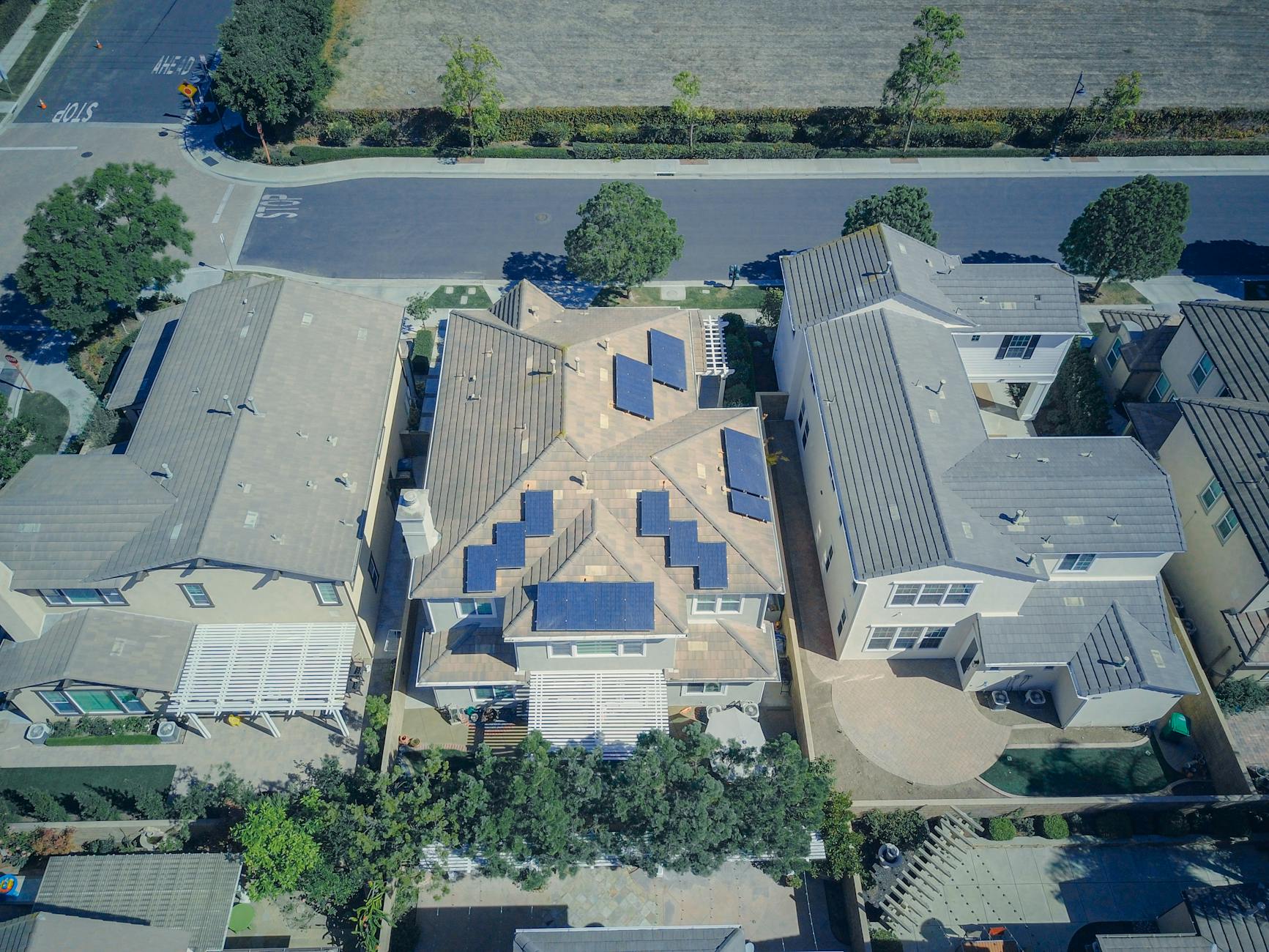
If you drive around new neighborhoods in the south and southwestern US, you will immediately see solar panels slapped on roof in whatever pattern and manner possible. Most new construction has only a marginal concern for exterior aesthetics, so a couple of big black plates on the roof are no more a deterrent to style than the plastic faux shutters, veneered brick façade and vinyl siding. That they are arranged on the roof in no particular pattern and with no regard to appearance probably isn’t a concern. Plopping these panels on a piece of classic mid-century architecture that includes an old-growth, cedar shake roof is.
This is where my active, dual, right-side/left-side brain gets me in trouble. I love the confluence of design and space and visuals, but I also see the statistical importance of energy savings and the mounting cost per kilowatt hour of electricity. I could easily create a spreadsheet that details the month and year when I would break-even on the solar panel investment. I also know it will never happen, because that pesky “other-side” of my brain won’t allow it.
My plea to the solar panel world remains the same and has remained the same for years. Design a panel or panels that include some aesthetic finesse. Come to terms with the fact that your product is big and highly visible. Do something to ameliorate the appearance of big, black blobs glued on a roof.
A few years ago, someone developed an individual solar shingle that interlocked with the adjoining shingles to form a solar roof that delivered the appearance of typical roofing material. They were shaped as slate, tile, shingle, shake, etc. I assumed the look and benefits would quicken their adoption. Perhaps they were cost prohibitive, but I never saw them again.
I have also heard of growing complaints with solar panels, not the performance, but instead, with installation. Solar installers are typically not roofers, but installation requires hole drilled into the roof of a home or building. The solution to roof holes is often caulk. To a roofer, caulk is a supplement to proper installation technique, not a solution. Their advice; select a roofer who installs solar panels, not a solar specialist who will install a panel anywhere you need, including a roof. You want an installer who knows how to properly flash around every hole added to a roof. Failure will result in a leaky roof.
A renovated mid-century ranch can have the latest home automation, it can be equipped with integrated LED luminaires throughout, the garage can feature electrical plugs and capacity to charge an electric vehicle and it can be packed with insulation to control HVAC energy consumption. In my case, it will not include solar collection panels on the roof, until the solar panel industry makes a product that can live in visual concert with the architecture of a home. That is where I draw the line.
The Wirecutter feature of the New York Times was added a little while ago to provide product assessments across a wide variety of categories. A quick look at the internet and it is easy to see that “Top 10” and “Best of…” lists abound. It seems natural that The Times would jump into the fray. Honestly, I haven’t found this feature as good as the news coverage. The few analyses I read have been a mixed bag. I have found a few brands of gin that have improved the occasional Martini and Negroni I drink, but the other “bests” they promoted have been ok, at best. In general I ignore the section while I’m reading the news online.
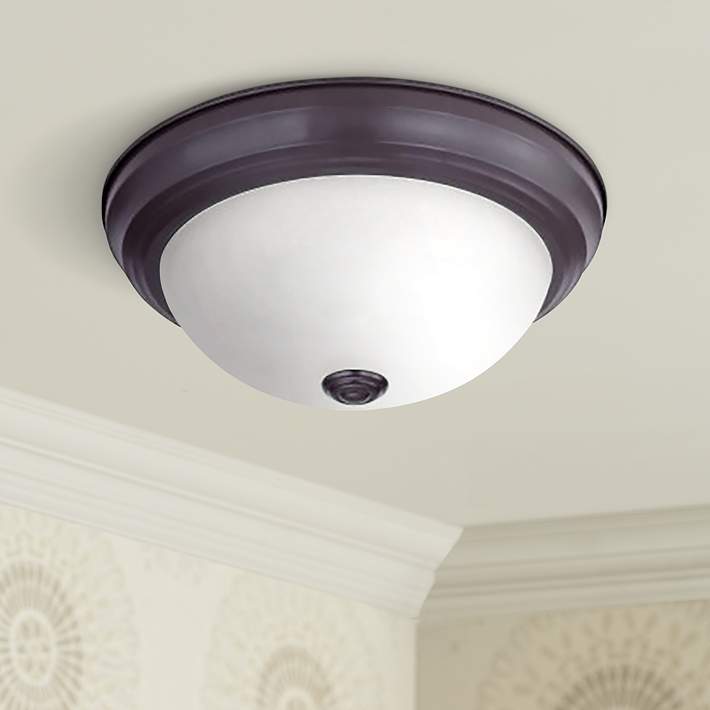
When the NYT email arrived announcing their next Wirecutter finding, I was a bit taken aback with their use of a rude, perhaps sexist trope. “We Tested Tulip’s Renter-Friendly Boob-Light Cover in 3 of Our Own Homes” https://www.nytimes.com/wirecutter/reviews/tulip-shade-review/?searchResultPosition=1 Because it concerned lighting, I did reread the title to be certain I understood their intent. After I realized they were talking about flush pan luminaires, I shook my head and deleted the email.
A few days later, a friend forwarded his email to me, knowing I spent a career in lighting. He indicated that he always disliked this crude colloquialism. I jotted a note back telling him, while I have of course heard of the reference, it was rarely used by most of the people I know in the industry. Flush ceiling light, ceiling pans, ceiling mushroom and just plain “ceiling” are much more common.
Interior aesthetics is overwhelmingly populated by female professionals. As a guy talking about design, trends, color, tone, shape and the nuances of space, I have always tried to be respectful of the audience. Even if every design pro was a man, I don’t think I’d use this definer. It just seemed too much like salacious jargon for me. I wouldn’t want anyone to be uncomfortable with something I’ve said. I am very surprised its use got past the NY Times editorial staff.
Both my friend and I stumbled over a poorly employed phrase, but we ignored the reviewed product. I thought that was interesting. These types of ceiling flush units are quickly becoming dated. I remember their mass introduction over 25 years ago. Much nicer options are now available. However, if you have limited funds, or if you are a renter (as the article concentrates) can anything be done? A magnetic rimmed-fabric shade could be a solution, but I didn’t think much of the look they created. Kind of a sloppy Noguchi paper lantern pendant stuck on the ceiling. Interesting concept, but poor implementation. Did the headline writer make a mistake by alienating a population sector with a poorly chosen word?
The headline writer should have been more sensitive to their audience. I’d like to believe that most people in the industry he discussed already are.
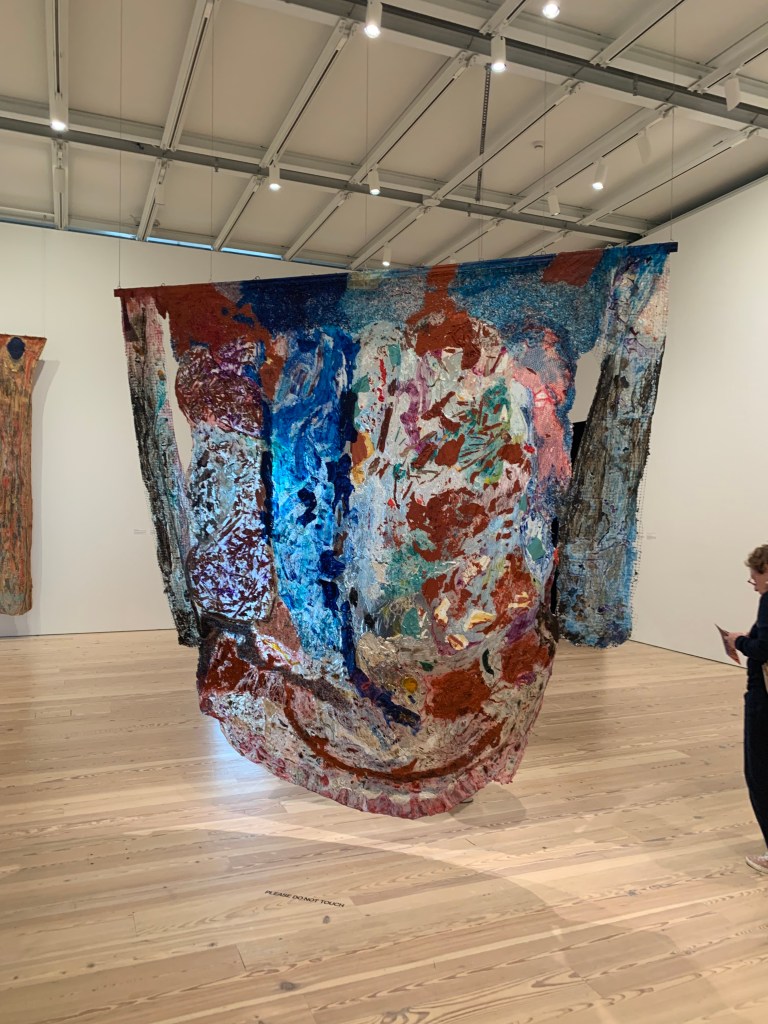
While in New York two months ago, I had a few unused hours, so I took the opportunity to check out the Whitney Biennial. Over the years, I have walked a number of editions of this thought provoking show. Some were good, some a waste of time, but I was fully taken aback by this year’s offering. By definition, the show is designed to be a showcase of the most relevant art of the time. What we forget is that artists are trained to think differently, so while we are commiserating over the impending technological leaps, artists are exploring them and working out ways to employ them in their work. By using 3-D printing and AI technology, these creative people are blazing a path which the rest of us can use in our more pedestrian endeavors. Following are a few works that force me to consider how it might change non-art products.
There have been countless editorials and a generous amount of handwringing over Artificial Intelligence (AI.) Accordingly, artists, writers, designers and composers will no longer be needed. All of their efforts can easily and cheaply be repeated as AI matures and naturally improves. Holly Herndon, a musician who has worked with AI in its most primitive form and continues to create inventive music supported by AI, understands the reality of the technology. Her preferred term is Collective Human Intelligence because AI is simply digesting all of the currently available data (created by humans) and reconfiguring it into new forms. For the Biennial, Herndon and her partner, Mat Dryhurst focus on this core data to essentially “game” the AI system to create false results. By infusing the systems with key data points of “female, red hair, white skin, blue eyes, straight bangs” to equal “Holly Herndon,” text-to-image” AI models of “Holly Herndon” have produced an odd collection of results that distort reality, essentially resulting in consistently “wrong” AI output. Basically, we are not forced to accept the intended reality of AI. Like all technology, it should support the human work, not supplant human ideas.
Holly Herndon – as imagined by AI
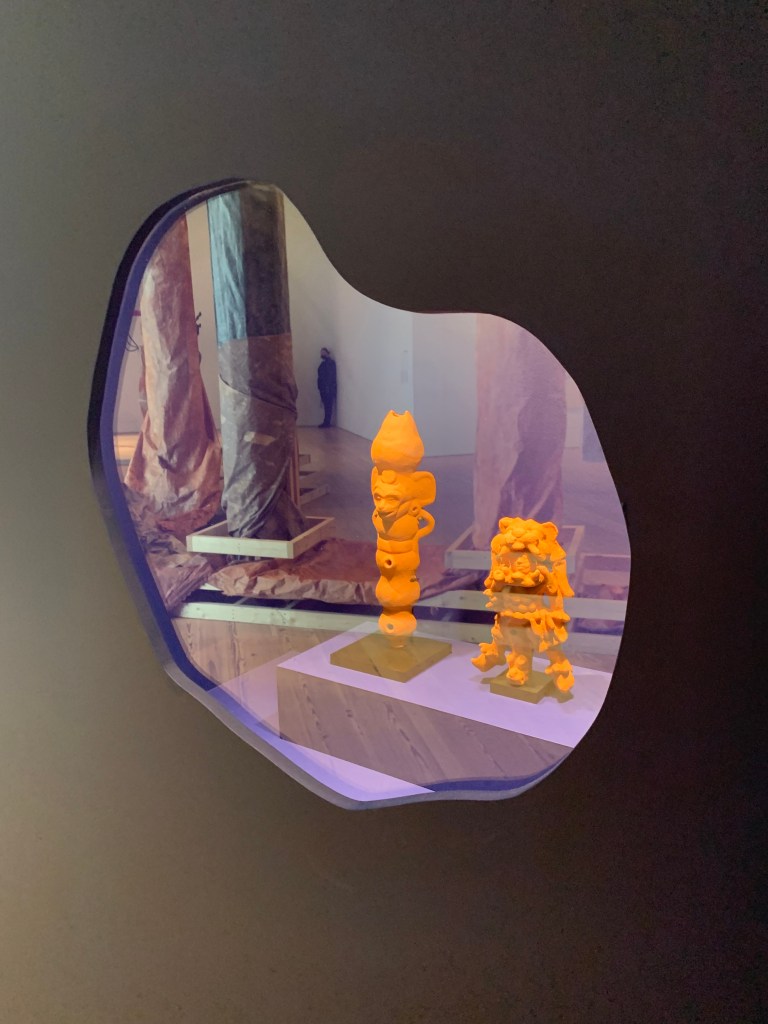
Who among us hasn’t looked in wonder at Pre-Columbian earthenware? Clarissa Tossin has recreated Pre-Columbian musical instruments using 3-D printing. She then had musicians play the instruments so that, for the first time, modern museumgoers could experience the sound in addition to the beauty of the ceramic pieces. Yes, today, these are precious pieces of art. When created, they were simply tools for making music. She is hoping to return these pieces to their proper functional perspective.
Clarissa Tossin – 3D printed replicas of Pre-Columbian musical instruments that can now be played and heard
A piano is designed solely to convey sounds input by a musician. The combined human action and mechanical reaction of the instruments delivers music. What would happen if the musicality of the piano were extricated? There are still piano keys being pushed and piano hammers striking and those action do deliver visual movement and sound, just not music. Nikita Gale shared just that scenario in “Tempo Rubato.” In a quiet space a “player piano” keys and pedals moved, hammers struck and sound was heard, just not the sound you’d expect. Siting and listening for a couple of minutes was a delightfully contemplative time in a busy museum floor. Not music, but rhythmic sound and movement.
Nikita Gale – “Tempo Rubato” – A piano without human intervention and the expected music, but nonetheless, sound and motion
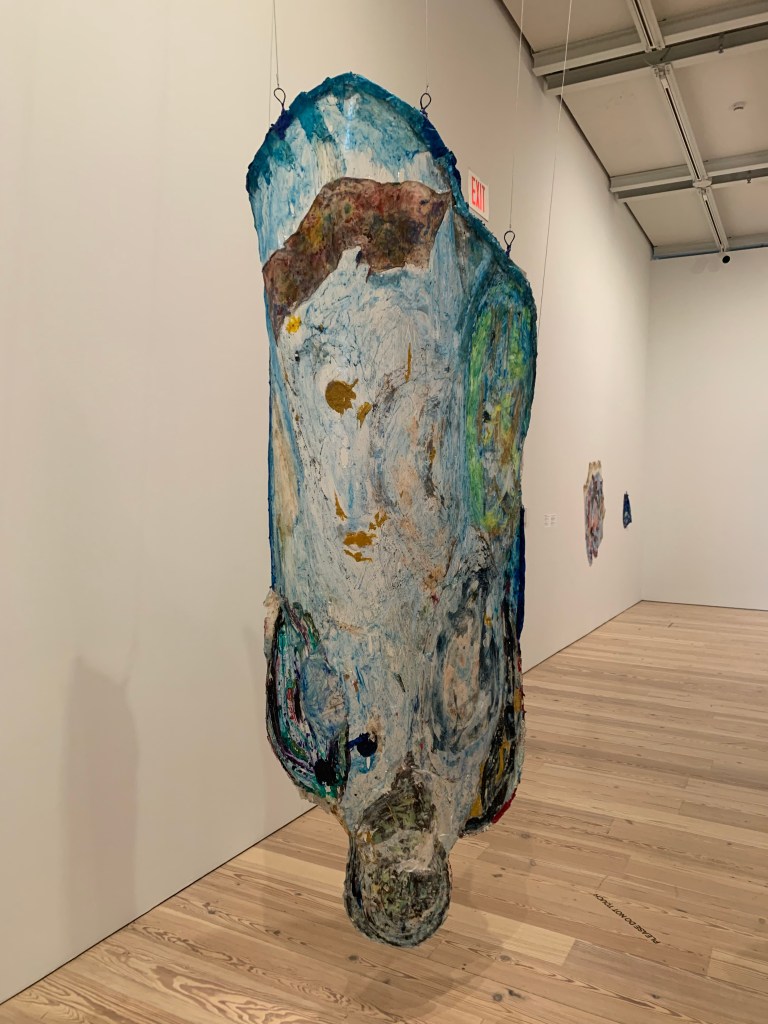
Can we imagine an artist making a painting without canvas? Suzanne Jackson uses acrylic paint as the medium to created suspended paintings. The acrylic and gel are mixed with natural objects to form translucent shields of amorphous forms and color. This is simply a different way to create a piece of art without the use of a predefined substructure.
Susan Jackson – canvas-less paintingSuzanne Jackson – canvas-less paintings
Artist, Jes Fan used 3-D printed CAT scans of his body to create a series of sculptures. Because they are personal CAT scans, the work is very intimate, but the result has no visual reference to human form owning to his duplication and manipulation. Again, we have a tool, 3-D printing thought to produce a series of repeatable units, instead being used and configured into unique art.
Jes Fan – Artist manipulated 3D printed CAT scans of his body parts
Using video and five screens, Isaac Julien asks us to rethink the connection of Black Americans to African art and African-American cultural heritage. It forces the question why the art is honored within the halls of venerable institutions while the creators are/were often ignored or dismissed, especially during the era of thinker, Alain Locke, who is used as a voice here. This piece asks a lot of tough questions.
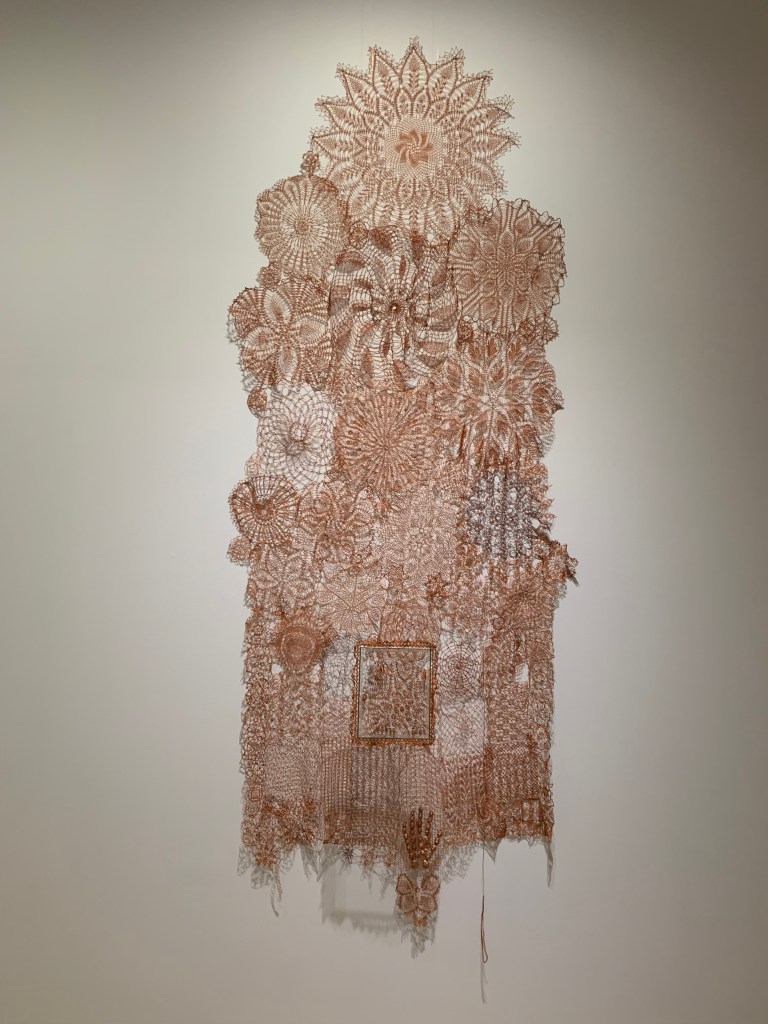
Some artists provide an inexplicable artist bio with a complicated raison d’être that belies their work. Even after reading it again, I don’t understand Ektor Garcia mission statement, (other than learning the crochet craft from family elders) but the work is detailed and remarkable fiber sculptures.
Ektor Garcia – Crocheted fiber sculpture
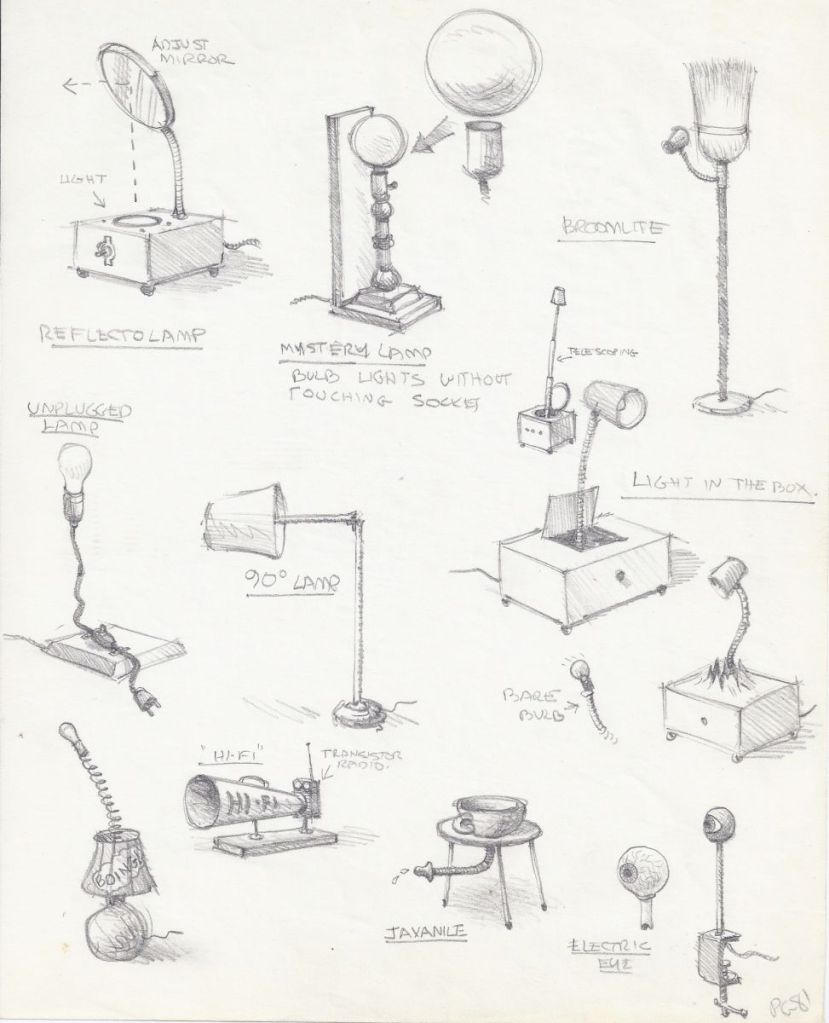
Just for pure fun, I want to live in the world of Pippa Garner. Her wall of inventive and wholly impractical consumer goods (called “Impossible Inventions”) should make any industrial designer smile. What is does do is remind us all that the creative process is filled with “bad ideas” and it takes a bunch of them to arrive at the one idea that is good.
Pippa Gardner – “Impossible Inventions” – Not sure any of these designs would be picked up by a major luminaire manufacturer.
So What Does All This Have to Do With Lighting?
More than once, I have heard designers express concern over the possible ramifications of AI. Manufacturers have grown concerned about where 3-D printing might leave them. As sustainability drives so much of the trend conversations, new materials are almost inevitable. These challenges are being met head-on by artists and the paths they are blazing should help everyone else. By viewing complex art accomplishments, we should feel more comfortable approaching these tasks for consumer goods. Change can be scary, but change is inevitable. The quicker we adopt new ideas, the more valuable we become as professionals. Artists can be the gatekeepers, ushers and guides that make our journey easier.
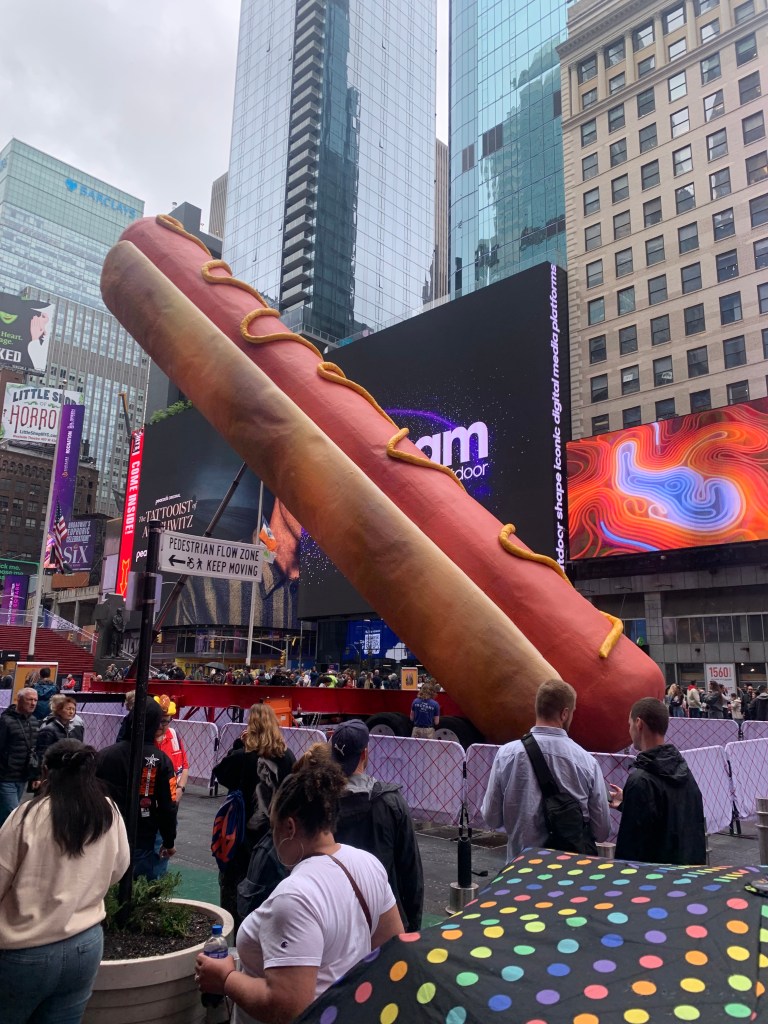
The “infamous” NY Times Square Hot Dog art installation, moments prior to its noon daily explosion
Early in the development of LED I realized that light would no longer be in the sole possession of luminaire creators and lighting designers. LED made it easy for non-lighting entities to confiscate the responsibility. Cabinet manufacturers and cabinet accessory providers offered built-in lighting. Plug-molding concerns included light in their strips. Bathroom mirrors build light directly into the mirrors and supported cabinets. Bluetooth speakers included light and light became an accent on a variety of other products. LED meant light would be embraced and in some cases abused by other concerns trying to sell their consumer goods.
At the International Contemporary Furniture Fair (ICFF) 2024 and in my visits to showrooms, galleries and storefronts across New York, this blurring of lines between lighting and “other” products was stronger than ever. Sustainability remains top of mind as well. No survey of new lighting would be complete without the recognition of exciting new designs. Following, those categories are explored and detailed.
Light + [fill-in the blank]
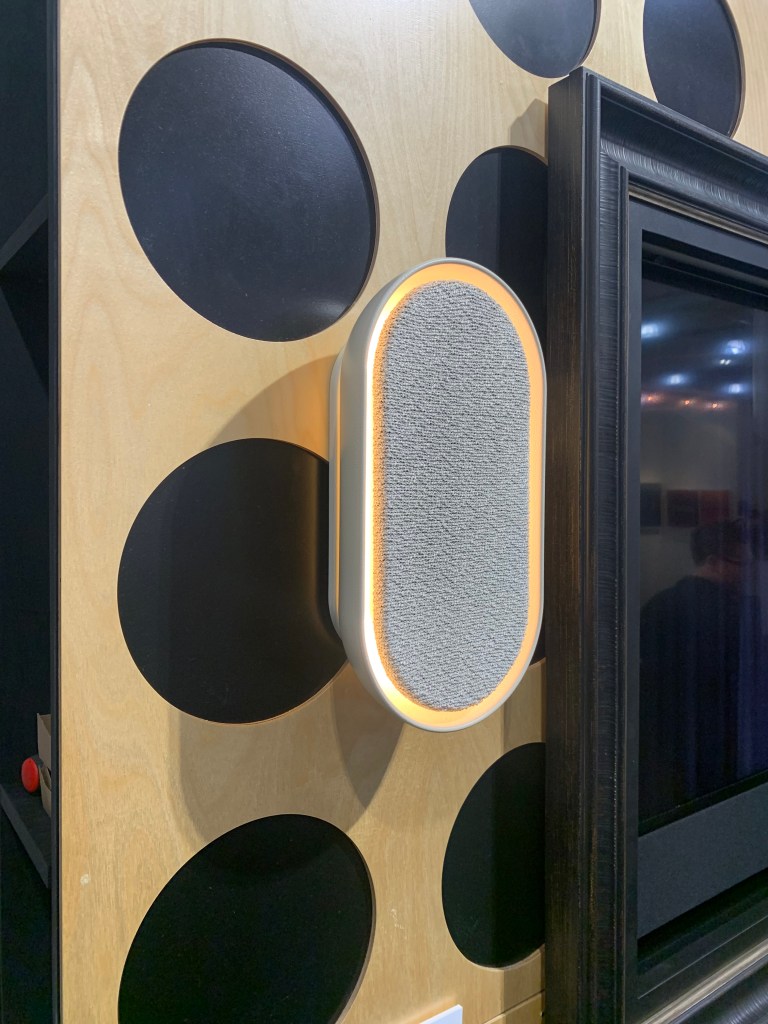
ICFF 2024 – Leon “Sound Sconce”
High quality musical sound continues to be an important aspect of homes. Many people are however, uncomfortable with the visual presentation of speakers. Speaker manufacturers have spent countless dollars improving the appearance of their product. Others have tried to find ways to hide the speaker in walls, ceilings, behind drywall and inside cabinetry. Leon builds speakers in the US and hides the functional tools behind custom screens that masquerade as artwork. They have also created a “Sound Sconce” that adds light to a wall mounted speaker. These were a nice combinations of dimmable light surrounding the linen needed to transmit sound built within a solid cast unit.
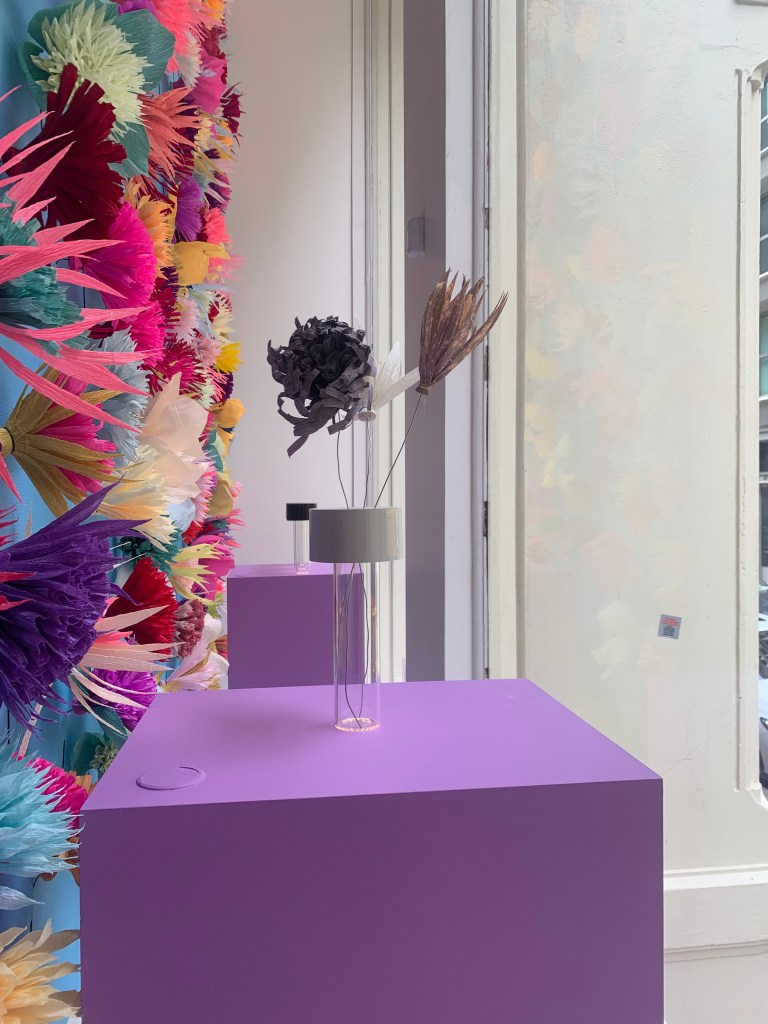
NY 2024 – Foscarini – FleurNY 2024 – Foscarini Intervallo
The new Foscarini lamp “Fleur” also wants to be a vase. The size makes it perfect for bedside, patio and restaurant use. The light plays against the tube of water and is directed downward to avoid glare.
“Intervallo,” also by Foscarini takes a fine porcelain bas relief sculpture of Madonna and Child and frames it with strips of light giving and depth to this familiar shape. In the past, light wanted to be art, now art want to be light.
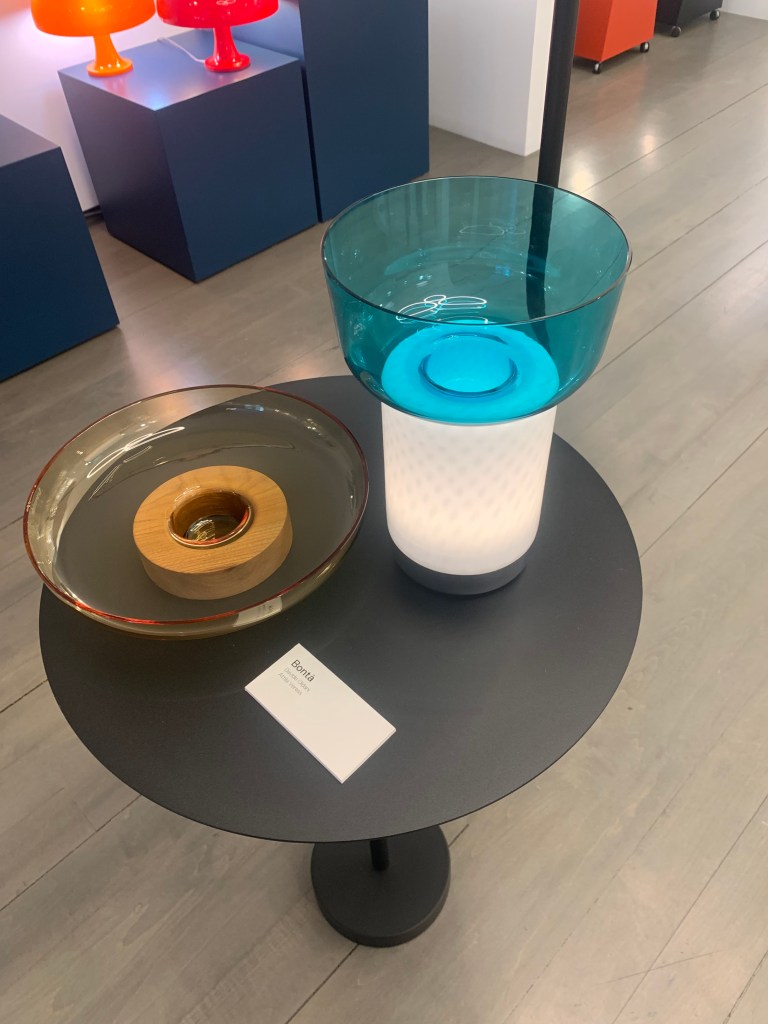
Similar to “Fleur” Artemide has developed “Bonita” as a collection of plates, bowls and bases that can also be illuminated as a lamp. The idea here is to keep a cohesive look at table settings with a mix and match approach.
This one is more complicated to explain. Arca has developed a flexible wood skin “Woowood” that “stretches” and allows light, positioned behind, to shine through. Woowood has been placed on the surface of cabinetry and walls, Slits in the material serve as pockets. The material, combined with the backlighting provides a look I’m not sure I’ve ever seen before. It was truly unique.
The line between art and lighting is increasingly being blurred, especially since the introduction of LED. LED can be hid in the smallest of spaces and used to supplement rather than undermine the work. Umbra & Lux allows light to play amongst the mobiles they designed. Who says a chandelier must be stationary? Why not a kinetic luminaire?
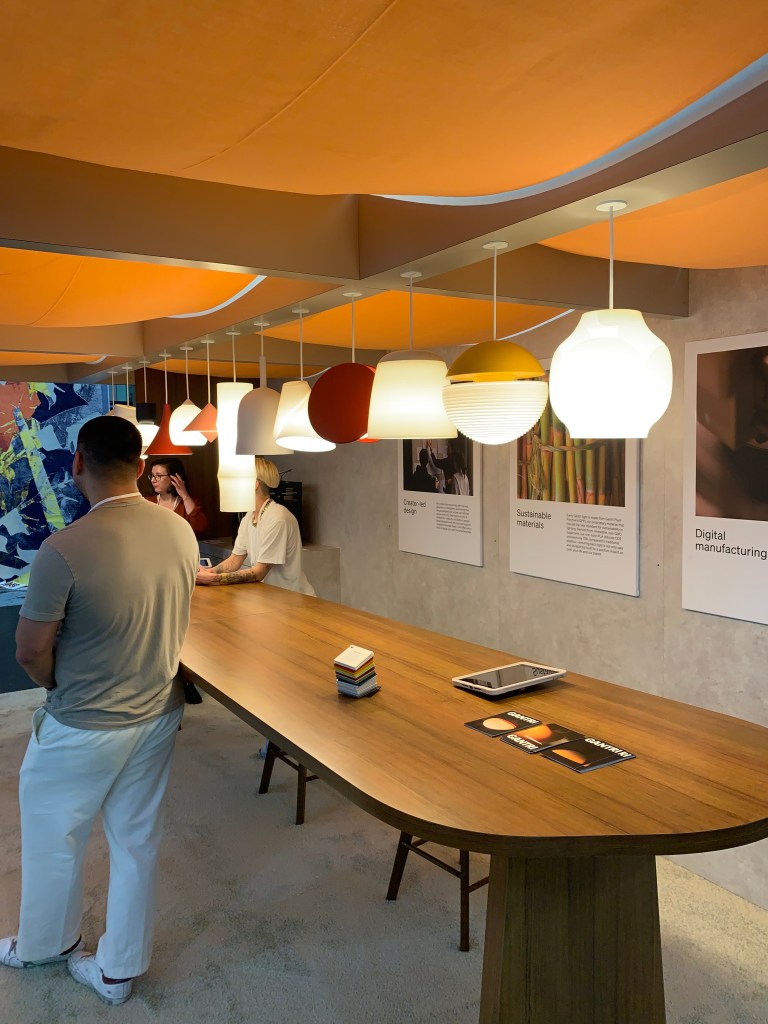
Gantri showed a row of pendants fabricated from a plant-based polymer. What made them interesting were the designs. They were a cut above the typically offered “sustainable” products. In conversation with the staff, they told me they prided themselves on their relationship with their designers. The biodegradable product is 3-D printed in California and customization is available. There are lots of interesting things to see here. I encourage you to scan their website.
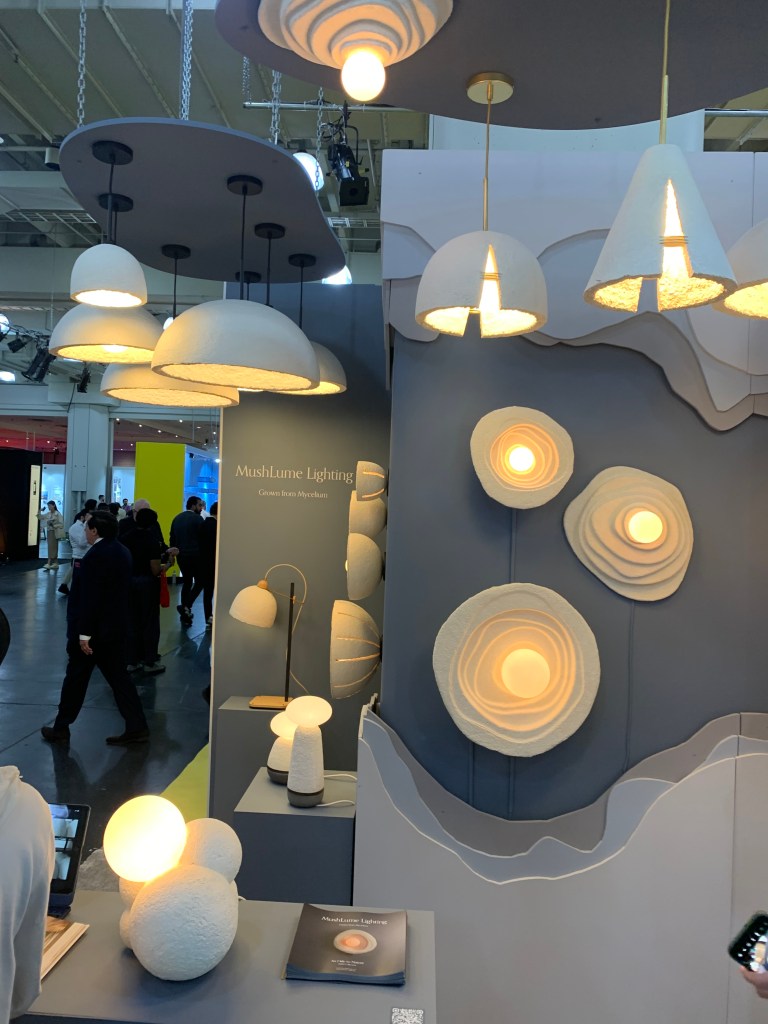
Taking a similar plant-based approach, MushLume actually grows their shades with a combination of live mycelium and sustainable hemp. The shade grows within a mold and binds to the hemp to create a solid form. Once grown, shades are dried and heated into a fully biodegradable product. These are a good look that will fit nicely into the shift toward beige neutrals we are now experiencing.
NY 2024 – New soft contemporary pendantNY 2024 – Roll & Hill – Well formed metal accents
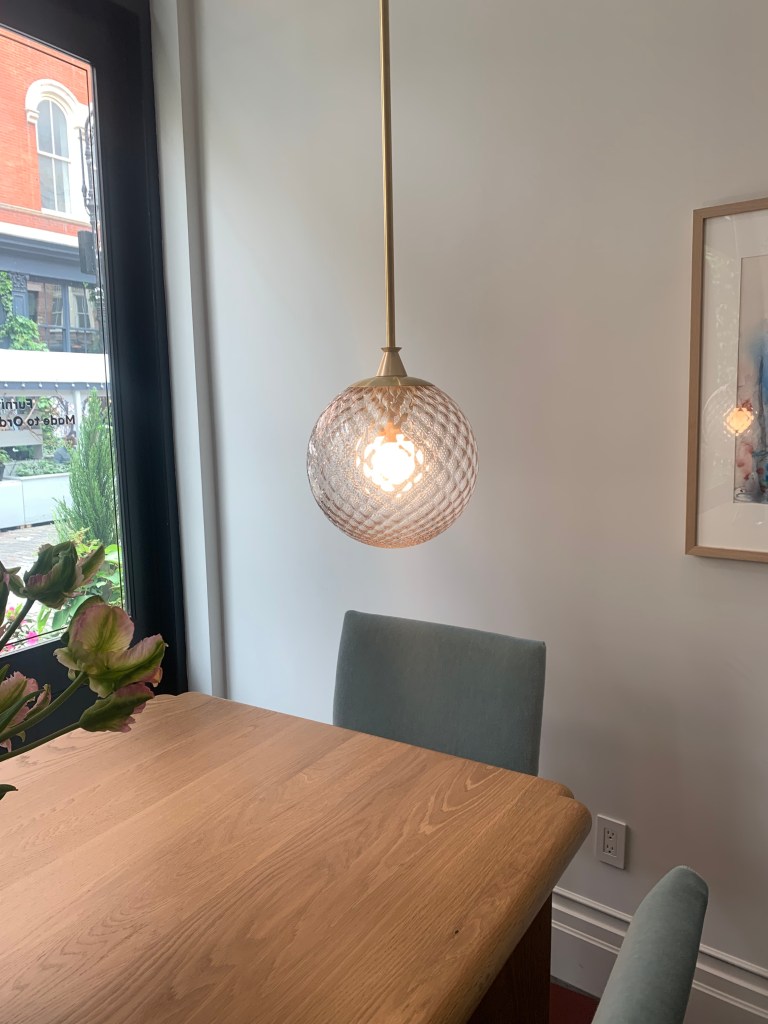
The new Roll & Hill items are neo-classic pendants that slip away, ever so slightly from their core soft contemporary design motifs. Round and Tulip shaped in smooth, ribbed and crosscut surfaces in White, Smoke or Champagne finished glass. What sets these apart are the subtle metal accents that nicely compliment the glassware.
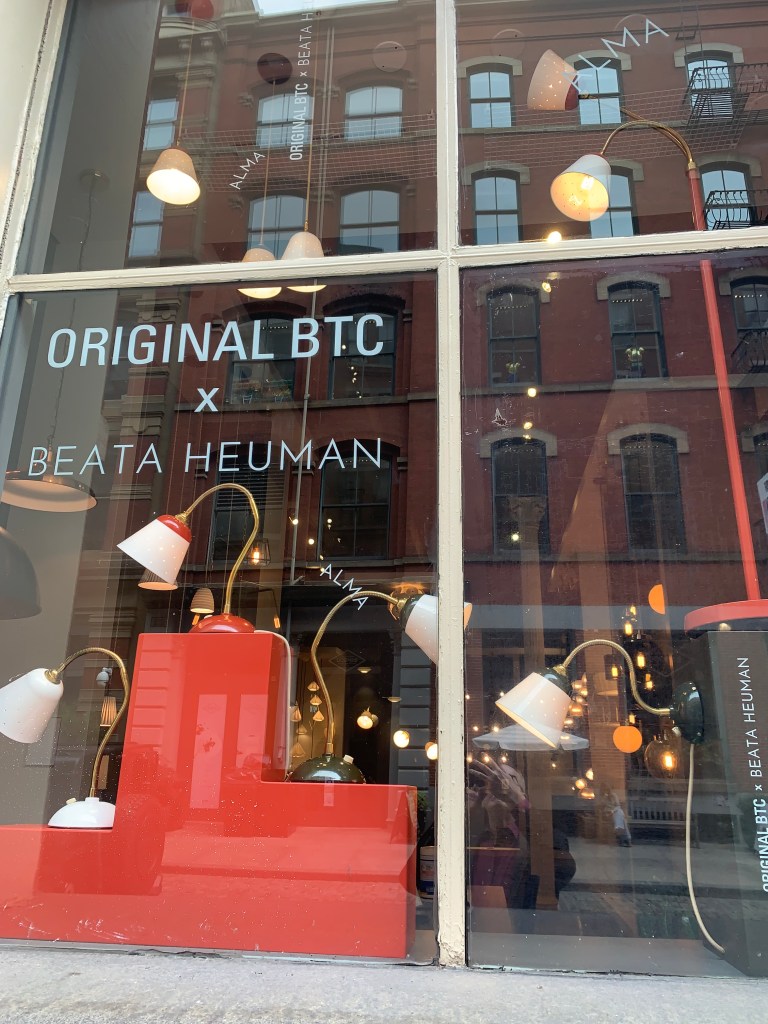
The window of The Original BTC featured the new Alma collection with a pin dot accented bone china shade. While it is a striking look, I wonder if it is a bit too dated retro feel. Much of this style has already passed us. I’ll be watching the closeout section to see if I’m right here.
The front window of the Flos showroom is filled with an all-white, bare bones (light bulb + carrier) chandelier by Gino Safatti. When I saw it, I again wondered if this type of look had already run its course. As I checked the website to insert a URL, I found the group already discounted 20%. Not a good sign.
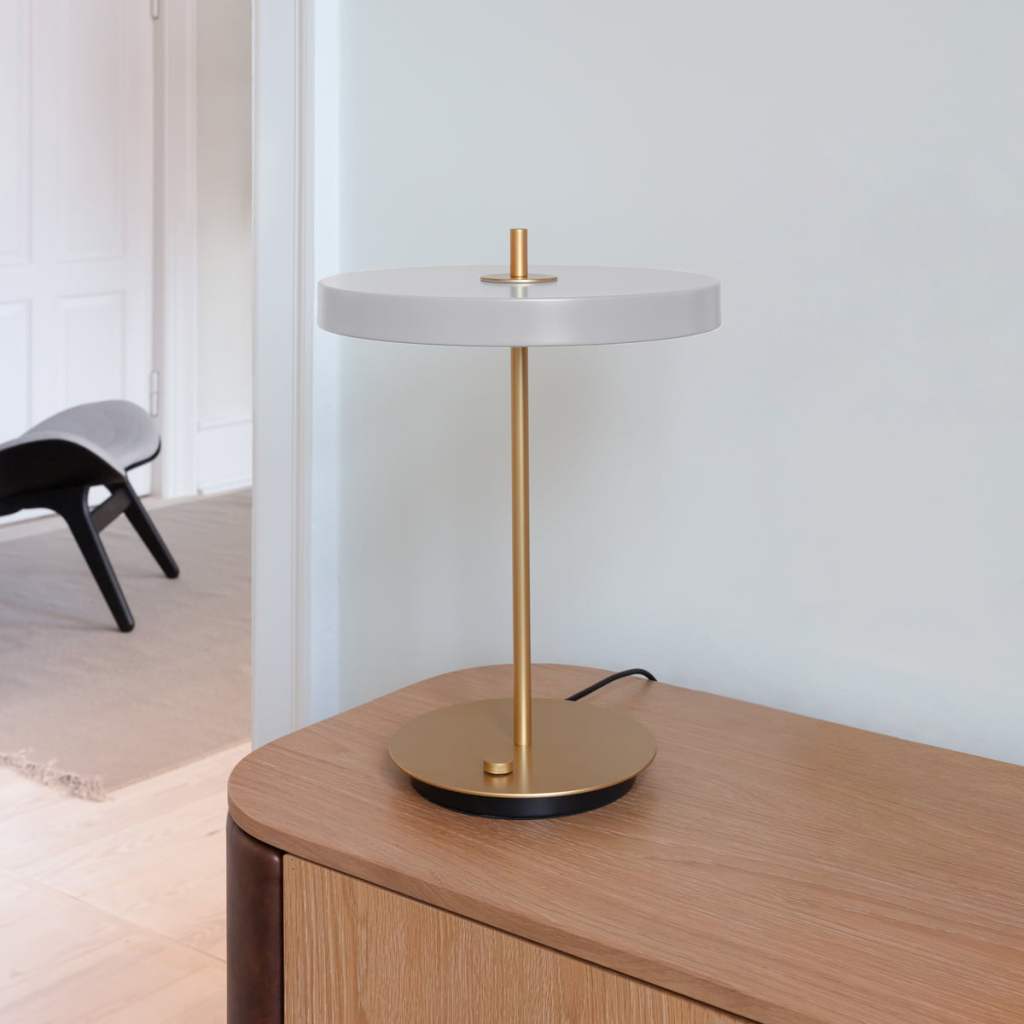
I loved the proportions of the Umage Asteria collection. A large diameter, but thin depth balances on small center column that passes through to form a finial. There are many colors and many configurations all using the same basic profile.
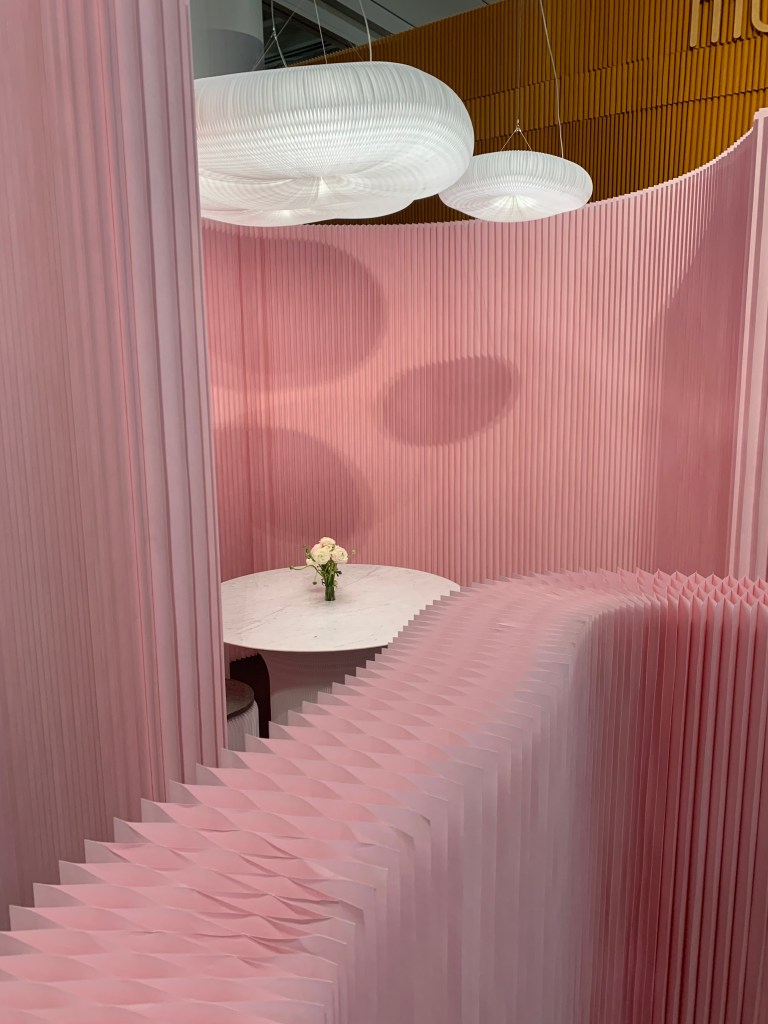
Molo has been at ICFF for many years showing their corrugated space partitions. These are beautiful honeycomb forms that sinuously wrap around and provide acoustical assistance to the created space. Using some of the same material, a collection of ethereal “cloud” pendants have been created. Like the walls, they are large, but appear surprisingly light and airy.
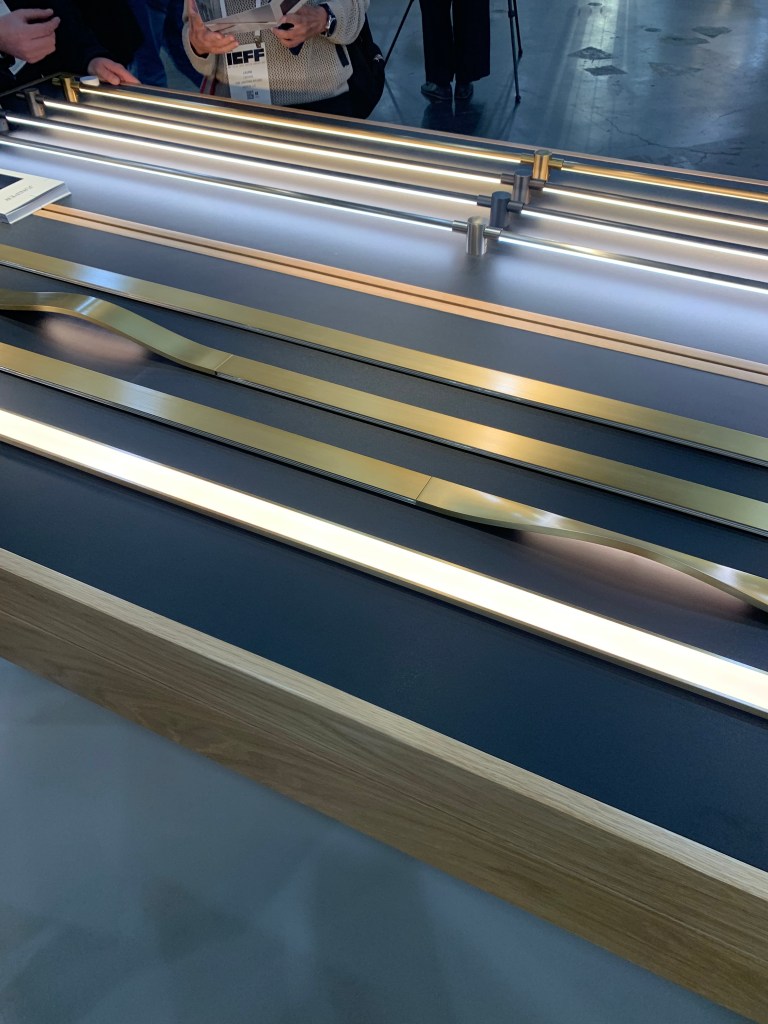
ICFF 2024 – Juniper alternate “X” track connection with illumination on the underside of the track illuminating the second trackICFF 2024 – Juniper illuminated track
Since first seeing Juniper, I have liked this brand of track lighting. The ribbon track is quite small, the magnetic element makes positioning easy and the design is top notch. This year, they have added a few additions that make employing their product much more creative. By adding light to the track, a whole new aspect of illumination is possible. Raised track sections can defy the typical “cross” installation and raised, illuminated ends allow for the addition of some whimsy. Yes, I’m a fan.
New for Pablo this year is the Stella design whereby LED is backlit on a crosshatched shade members, much like the Skynest by Flos introduced last year. Playing with the placement of LED has allowed designers to create very interesting objects.
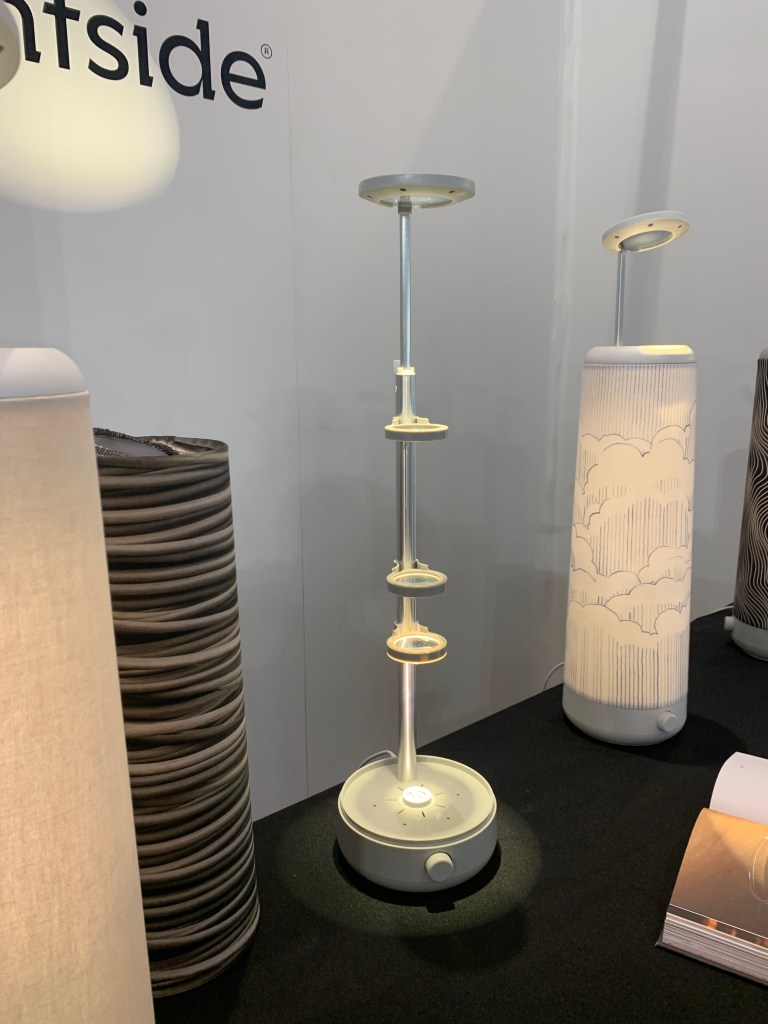
ICFF 2024 – Nightside – shade removed exposing the LED and magnifying elements hidden inside
Why not a better bedside lamp? So many lamps ignore the fact that a sleeping partner might not want the area illuminated. Many lighting designers forget that two people have two needs. The folks at Nightside have solved that problem, much like cross-lit recessed cans. The unassuming lamp features a “pop-up” reflector that allows for a pointed, unobtrusive beam of light aimed by the reader and unseen by the partner. These US made lamps consume a miniscule one-watt of energy with a clean, simple aesthetic.
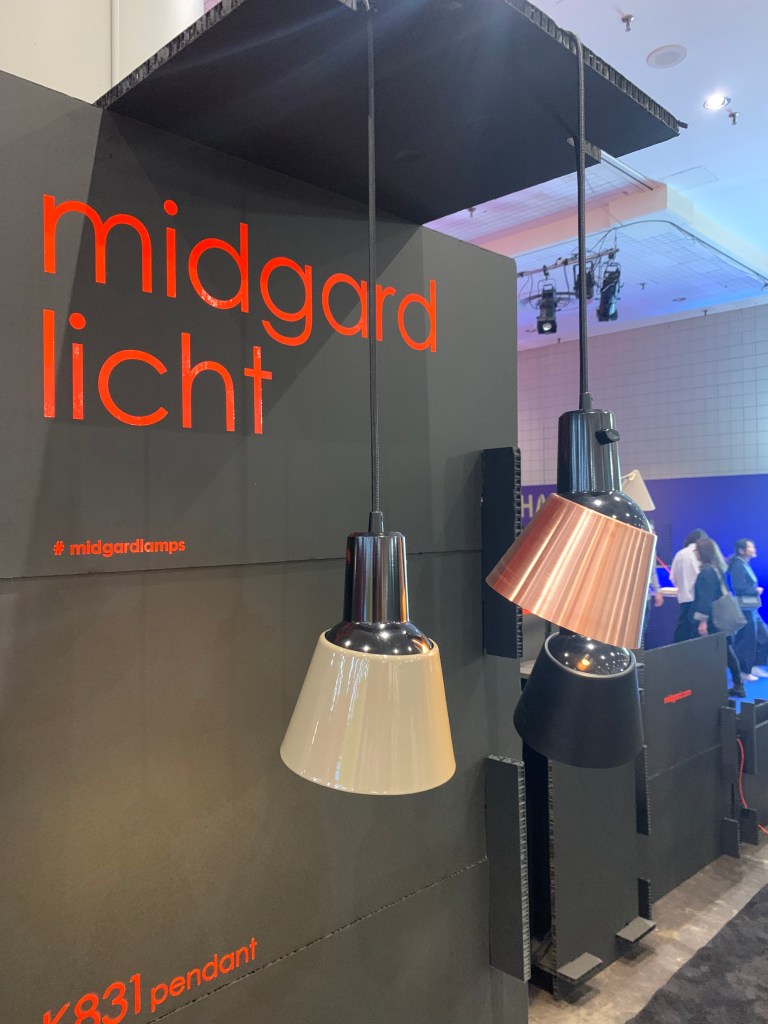
I loved the simple functionality of the swiveling lampshade on the Midgard Licht pendants and sconces. Light can be easily aimed in any direction with minimal effort, as the shade balances on a rounded carrier.
I liked the assortment of shapes and textures on the diffusers of Bright Block Studio glass. By reprocessing glass blocks they create custom output that is beautiful and usable, rather than landfill.
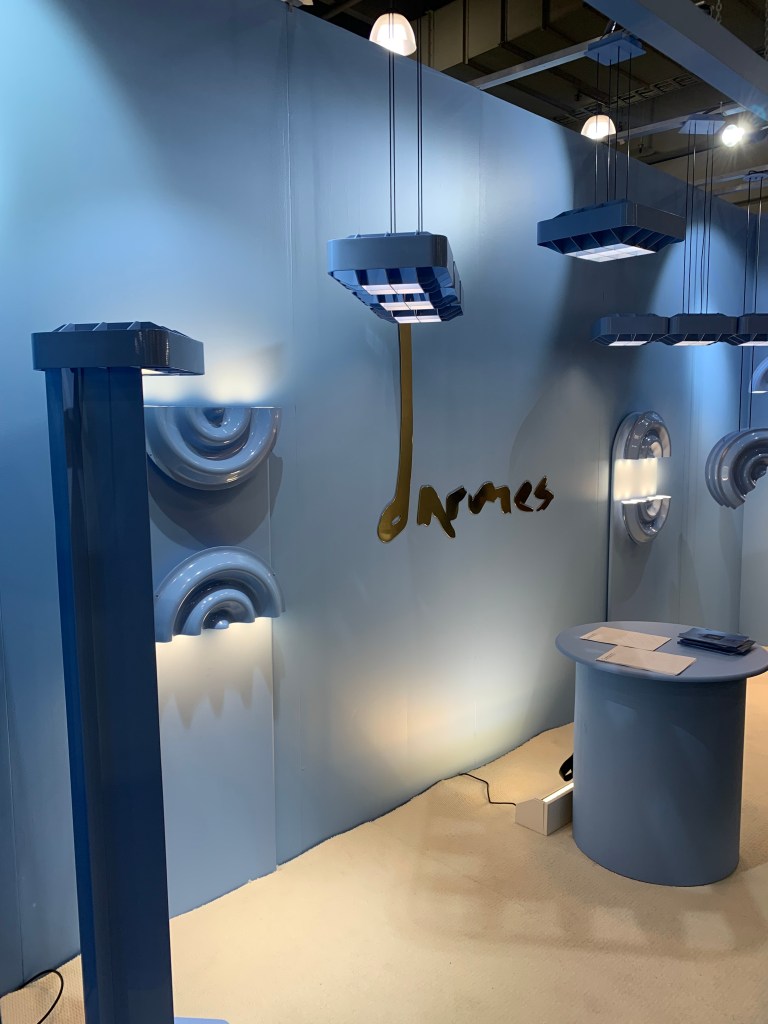
d’Armes a Quebec based manufacturer,must be given points for display creativity. Rather than trying to show all of everything they do, they elected to finish everything in their booth in the same lush blue glossy color. Because their work is available in multiple iterations, why not simply draw attention with an elegant presentation?
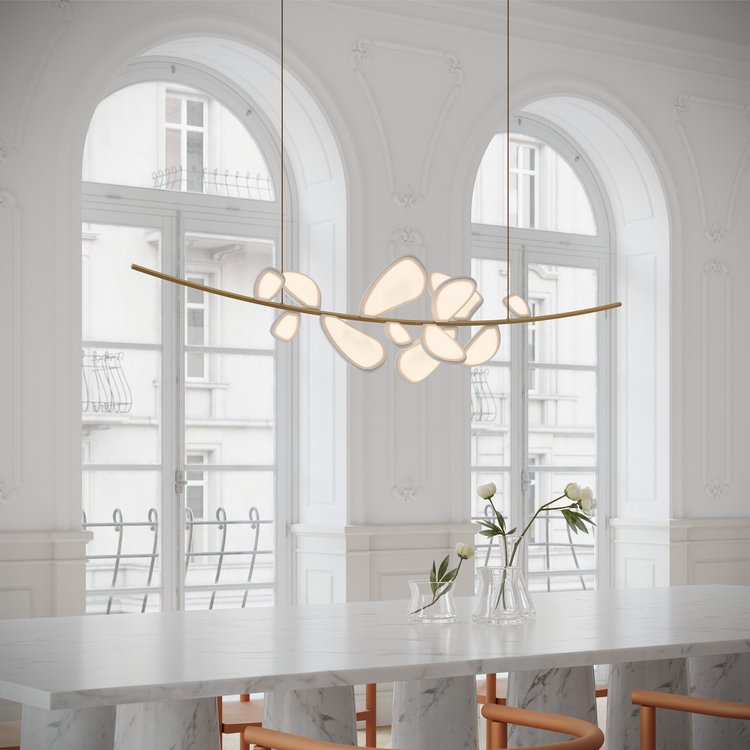
Like d’Armes, Tibo is also based in Quebec but their approach to lighting is slightly different. The light modules look like they could be OLED panel placed artistically across carriers and frames. This is a very “feminine” soft look that is much needed in many interiors.
By combining macramé with lighting, Ariel Zuckerman has developed a softer, more approachable contemporary. The dropped lights reminded me of an overstuffed crocheted shopping bag used by the Eastern European bubbas of my youth. Admittedly, this is a niche product and I’m not so sure I like them, but they are different and they do speak to the softening of contemporary style.
I like the blending of clean slats of aluminum, organic, geological décor and the raw glass diffusers used by Simon Johns. The glass is fired in a way to make it appear as still molten. The warmth against the polished metal is very appealing.
NY 2024 – Visual Comfort showroom under construction on Wooster Street in SOHO
During my walk through SOHO, I noticed work continuing on the Visual Comfort showroom on Wooster. This appears to be a reversal of the trend toward more online, less brick & mortar in the lighting business. It also upsets the retail distributor model to fit more in line with what the European and boutique brands are doing. (Roll & Hill, Flos, Artemide, etc.) It will be interesting to see how this works out for a major US lighting distributor.
As you can see, lighting is alive and well. The availability of exciting ideas continues to flow from the minds of creative people and companies. In addition, aesthetic trends are coalescing around a softer, more approachable contemporary look. All of this is good news as lighting continues ever-changing and maturing.
A friend sent me an article from the Wall Street Journal about confusing hotel light switches. (The Latest Traveler Kvetch: Hotel Lights Are Confusing by Dawn Glbertson 4-24-2024) A few sentences into the article and I knew exactly what the writer was discussing. I spent a fair amount of time traveling in China at the end of the 1990s and early 2000s. Hundreds of new hotels were being built to service the Americans who were arriving to facilitate Chinese production. Each new hotel came equipped with a newfangled feature, as yet unseen in the US. Keycard control of the suite’s AC and electricity, TV screens embed in the bathroom mirror and yes, a dashboard of light switches to control scores of luminaires were included. Each new hotel room meant an introductory ten to fifteen minutes spent trying to figure out how to shut off the alcove spot light and turn on the bathroom toekick lighting. It was always a joy walking into an old hotel with recognizable toggles. My daily tutorial could be avoided.
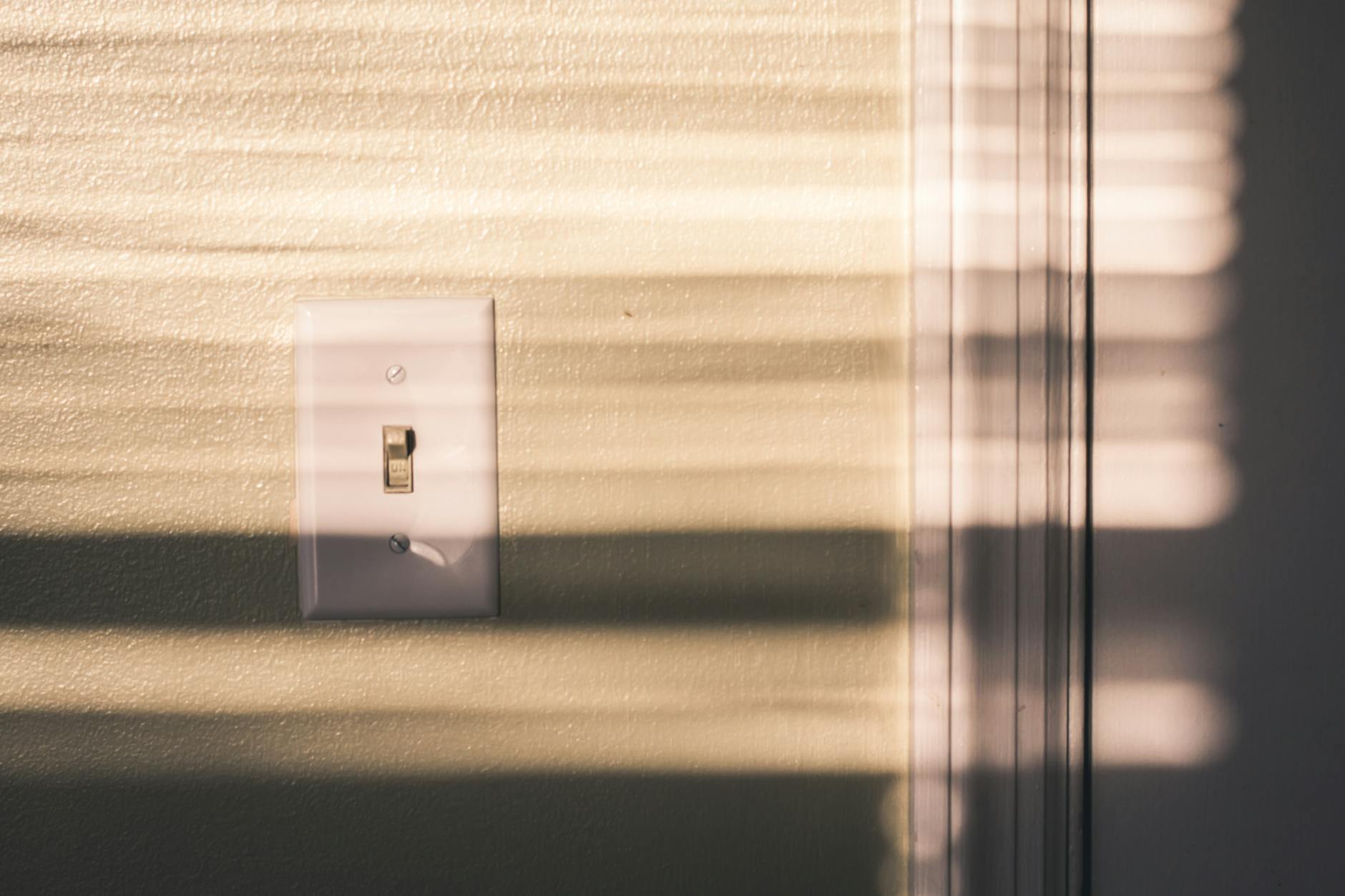
The article allowed me to reminisce about my days/weeks/months in China, but it also brought up the question I have asked before, multiple times, “Why do we even need light switches today?”
Whenever I ask this question, I am greeted with the same askew face and puzzled reaction. “Well, dumbbell, to turn the light in a room, on and off. Duh?”
Most people fail to get my point. We have an evolving tech industry that is intermingling with most building support equipment. They are allowing Alexa and Google Home voice-activated systems to control those products. Light bulbs are now offered that can be controlled by voice and a number of luminaires are on the market that include the same feature. What is missing is control of the “average” luminaire.
By average, I do not mean substandard, I just mean the chandelier in virtually every dining room in North America, the flush mounted piece in hallways and bedrooms and the lights at every bathroom mirror in every house. These products are not “Smart.” Because they are so “normal” most consumers do not expect them to be voice-control compliant. They expect control to be handled by a separate switch, as they have since Thomas Edison.
The easier control would be a “node” wired between the luminaire and the house wires. It could be included with the luminaire or sold separate. Its job would be to communicate with the voice system.
“But Why Bother, Jeff?”
The WSJ article explains that many hotels do not always use a panel of controls because older hospitality rehabs would require too extensive a teardown to run wires from control panel to luminaire.
Think about the labor and cost required for a light switch. A switchbox must be assembled to a structural stud. Wire must be run from that box to the luminaire outlet box. If this is a three-way assembly, tracer wire must be run from switch number one to the second switch. More would be required if 4-way or 5-way configurations are planned. As the article intimated, lots of wires would need to converge at a bank of toggles, bedside.
A hole must be cut into the drywall to accommodate this box. When the walls are painted, trim painting around the box takes longer than simply rolling or spraying a flat, straight wall. The electrician must wire the control switch. A decorative plate must be screwed onto the switchbox. There are material costs, labor costs and time to facilitate lighting control. Multiply this by every room and the dollars add quickly. Frankly, I’m surprised production home builders haven’t pushed this in their constant effort to reduced costs. A home-wide voice system would be less expensive than the box, wire and switch material costs, plus the labor saved by electricians, drywall installers and painters (even further savings would be had if the wall were tiled or papered.)
So What is Stopping Jeffrey’s “Brave New World?”
Two major factors seem to be the stumbling block for a quicker adaptation of switch removal.
Whenever I mention this to other lighting folks, I’m told the “node” exists, but I’ve not seen one, if it is, it is not widely distributed. Perhaps it is not small enough to fit in every luminaire canopy or outlet box. I’m waiting for the theoretical, “Apple iVoice” module to be mass-marketed. Then perhaps, we’ll start to cook.
Including the voice-control with the luminaire might not yet be financially feasible, but manufacturers will need to watch and react quickly. Again, builders could drive this demand. There will be a tipping point, much like we experienced with LED, where the cost and availability of a connected luminaire will make far more sense than a luminaire and switch.
“But, But, What If…?”
Many people cannot envision a world where switches would disappear from their walls. Whenever I mention this, the “what-ifs” start pouring from people’s lips. “What if the internet goes down?” “What if the electric fails?” “What if the “node” dies?” and on and on.
Yes, things may happen. Everyone has a mobile phone, in some cases it is their ONLY phone. Sometimes the supporting cellular network fails. How often? Rarely, but it happens. How often does your home internet fail? Occasionally. That has not stopped most people from using home computers and even transitioning to “work from home” employment, totally reliant on technology at a much more substantive level than a light switch. There are countless other examples where we abandoned one old system and replaced it with a more technologically streamlined method. Who among us, of a certain age, did not initially serve as our parent’s personal television “remote control” before it was actually a stock feature of even the least expensive flat screen on the market. We only need to think in broader terms. How many people still have a telephone hanging from the wall in their kitchen? Fewer and fewer.
Challenges
Perhaps the biggest challenge with greater voice activation is naming. When we had a single luminaire in each room, the voice control naming would have been easy. “Turn on bedroom light.” “Turn on bathroom light.” With a wider variety of lighting options, more succinct naming will be required…and remembered. Expect to see hundreds of magazine and online articles with naming convention suggestions.
If we go back to the hotel analysis, hospitality suites might come equipped with a posted naming “cheat sheet” so each guest will understand the exact name for the lights under a vanity or the recessed can in the shower. Hospitality managers might also be well served in setting an assorted of typical scenes, such as “Nighttime” which might shut off all lights except the bathroom toekick lighting. As users, we will grow accustomed to the new concept, just as we acclimated to automobile seat belt warnings and legally turning right at an intersection, when the traffic light is red.
Sure, many will simply want to avoid all of this. That’s ok, it doesn’t make them Narendra Modi voters. Like the old electricians who didn’t want to bother with LED, they will disappear and be replaced with a larger population who currently interact with their automobile and most customer service bots via voice commands. Illuminating a room can be as easy as saying, “Dining room chandelier, on!”
Photo by u0415u0432u0433u0435u043du0438u044f u0415u0433u043eu0440u043eu0432u0430 on Pexels.com
I regularly read a newsletter about lighting, Light Now published by my friend David Shiller and his consulting organization, Lighting Solution Development. I urge you to do the same. (https://www.lightnowblog.com/ ) There is always great information and insight. Often times, it is research you didn’t know you need to know. In a recent post, Light Now pointed to new research on “why flying insects gather at artificial light.”
When LED was new I delivered hundreds of educational talks about this newfangled technology. As people learned more about it, better, more pointed questions would be posed. Through one of these queries, I was compelled to understand an insect’s attraction to light and laissez faire reaction to LED light. Why? I quickly learned that bugs are not actually attracted to light, but instead the infrared glow of a heated incandescent light bulb and the hot metal surroundings of the luminaire. LED do not emit any light in the infrared spectrum and the low heat produced by LED barely warms the surrounding lighting fixture. If you were the moth’s version of SNL’s Stefon, pointing out the “hottest new club” in the neighborhood, it would not be located at the newly installed LED outdoor wall bracket. All of the “cool moths” are of course, still hang around the IR rich, incandescent lamps.
That explained the attraction, but not the kinetic action of the flying insects. This new report finds that when the insect “sees” the artificial light, it assumes it to be natural light. In their world, light is overhead and dark is below. The movement is the insect’s natural reaction to place the light in the right relative location, at their backside. Flying bugs are actually backing into the vertically installed luminaire and erratically circling the light with rises and dips.
I’ve written a few posts about sustainability and our responsibility as lighting professionals to “do the right thing” with light. The way we add light to the human environment has a tremendous impact on the animal population. This scientific research points out that even an insect as simple as a moth understands the proper position of the moon and the darkened land at night. Their hysteric dystonia is an effort to correct something which in their mind must be of their doing, not the peculiar humans who cohabit their neighborhood.
Artificial light has been around for as long as humans have employed fire and will remain for as long as humans exist. We could simply ignore the problem, but the natural balance of life will be tipped. When adding light to the nighttime, think about neighboring wildlife, plant life and aquatic life as well as the human client. While small, we shouldn’t forget bugs, either. Mother Nature will thank you.
The Mantis Shrimp and their dozen photoreceptors Photo by William Warby on Pexels.com
I recently finished reading An Immense World by Ed Yong. The book covers an overview of how animals use their senses in substantially different ways from humans. Some of the information is well known. Dogs have a sense of smell that is somewhere between 10,000 to 100,000 time better than humans. Bats use an echolocation “sense” to navigate at high speeds in the dark to locate miniscule flying game. Birds of prey (eagles, falcons, etc.) have superior eyesight that allows them to see forward and sideways to best home in on a meal. The book however goes deeper and helps the reader understand that most every “superiority” is balanced.
The dog has a remarkable sense of smell, but their eyes have only two color photoreceptors, so their world looks different than what humans see. Humans have three photoreceptors, a handful are tetrachromats with the benefit of four (I wrote about this phenomenon in a previous post: “Tetrachromatic Vision” https://lightingbyjeffrey.com/2022/05/09/tetrachromatic-vision/ ) but the mantis shrimp has TWELVE photoreceptors! Wow! You’d think their sight was miraculous, but alas, they have a tiny brain (brain size and functional capacity is a crucial piece of data in these analyses) so rather than witnessing colors beyond our imagination, they use the twelve photoreceptors as a type of binary coding system. If, for example photoreceptor one, three and eleven are triggered, they know prey is within reach. If photoreceptor two, eight and nine send feedback to the brain, it is time to move, an enemy is near. All benefits are balanced by Mother Nature.
Humans are sighted creatures and we regard the world based on sighted preferences. (I wrote about this in yet another post: “Eyes, Light and Sometimes, Brain” https://wordpress.com/post/lightingbyjeffrey.com/684 ) When we do that, we ignore the needs and demands of the other animals who occupy the planet. Even other animals who enjoy sight as their primary sense, do not use it in the same way as humans. Owls need dark nights to survive. The lack of light and their ability to see in it, sustains them. Bees have three photoreceptors, but because they can see UV light, the three receptors read different information and feed that back to the brain, so their color palette is radically different from ours.
Humans have risen to the top of the community of earth’s animals and our single-minded concern with human need is unfortunately harming the greater animal community. This summation ended the book. The human need to illuminate “everything” is doing irreparable harm to other animals. It is only getting worse, despite an avalanche of data on animals and their worlds. We read books like An Immense World and still increase street lighting, parking lot lights and high-rise building illumination. After becoming enamored with the content of the book, his plea to the reader is for some kind of action.
As a lighting community, we can do better. I’ve just looked at a wide variety of new luminaires released at the January Dallas Market and still we offer light aimed up into the sky where it does no good and only delivers harm to plants and animal. We use lumen levels way beyond what is necessary and that color of light is often blue, not only bad for humans, but many in the animal community are likewise impacted.
Can we help? We are in a unique situation to do just that. We can’t help much directly with pollution, micro-plastics in the oceans or noise levels that also impact, confuse and confound animals, but we can control light. That’s what we do as lighting professionals. Could we start to include concern outside of our genetic spectrum in addition to the color spectrum?
Lighting for Tomorrow was a new product competition that sought to highlight inventive uses of energy efficient lighting. When started, fluorescent lighting was considered pedestrian and good for only the most functional of lighting chores. America installed fluorescent lighting into garages, basement workshop areas and MAYBE the laundry room. Why not other areas? The competition encouraged manufacturers to reimagine fluorescent use in decorative products.
As a Product Manager of a luminaire manufacturer at the time, I readily accepted this opportunity. I asked the talented design staff to create products that would ameliorate the undesirable aspects of fluorescent light. While fluorescent lamping was the only energy efficient option, we received recognition for multiple products. Once LED entered the scene we again enjoyed awards in different categories. Our product was recognized and displayed at many trade shows, countless publications and industry events.
When the competition accomplished its goals, the adoption of energy efficient lighting across the luminaire spectrum, Lighting for Tomorrow was retired. A new goal was then established. Controls. Many consumption researchers found that the next “big” reduction in energy could be achieved through the use of intelligent controls. The most far reaching predictions were an additional 25% savings of electric consumption simply by better controlling light use.
At the same time, other areas outside lighting were going through their own efforts to reduce energy consumption. What if all of this were combined? When people leave their home they shut off lights, reduce the heat, turn on a security system, lock a door, close a garage and start a car. Electric power is plentiful throughout the night, why not run the dishwasher, clothes washer and dryer when demand is at its lowest? Lighting for Tomorrow was transitioned into the Integrated Home Competition.
The Integrated Home Competition seeks to find high efficiency products that easily integrate with home control systems and other like-minded products, are well built, easy to install and set up and provide the consumer with perceived value and security. Among the categories is lighting.
Manufacturers
Do you have a product that, in addition to saving money on energy, also easily links with home control systems (Alexa, Google Home, Apple Home) and perhaps, interacts with HVAC systems, security systems and/or utility data sharing apps? Is it a product that works beyond the simple wall switch control? If so, consider submitting it for consideration.
Sales Representatives and Design Practitioners
You see new products every day. Does something you’ve seen recently break new ground? Does it make installation and set-up easier? Does it facilitate easy transition between other consumers of energy in the home? Urge the manufacturer to submit the product for consideration.
Winners
I was honored to be asked to judge the submitted products entered into lighting and ceiling fan 2023 competition category. A group of us with decades of experience in lighting and controls installed, set-up, operated and tested each submitted item. We read the included instructions (I know that sounds unusual!) and watched online installation videos to determine if the product functioned as promised. We paired products with smart phones, Alexa and Google Home and tested functionality. Via conversation and a genial exchange of view, we unanimously agreed upon the products that deserved a year’s worth of recognition.
While testing and talking we wondered if there were other products that should have been submitted. We all agreed to do what we could to encourage additional submissions, hence my inclusion of this information in the blog. Every one of us will benefit from reduced energy consumption. Let’s work to recognize those who are creating products to meet that end.
I remember this quote from about a decade back while attending a lecture. It is attributed to Chris Harrison – Future Interface Group.
If you showed Thomas Edison the Hue light bulb he’d say, “All you did in 120 years was make it change colors?”
For the next couple of weeks, we’ll see a lot of colored light. There will be trees decorated with light, homes decorated with light and even a few Santa caps will be illuminated. There is a good chance, every one of these applications will use LED. (Especially, the cap!) Unless you have one of those retro-holiday friends who scour flea markets for old school light bulbs, holidays are now made festive with LED light. We probably don’t think about it, but the energy savings is substantial. Your utility company has definitely thought about it. Power use always accelerates during our end-of-year celebrations. LED has helped to make that less daunting for the power producers.
Think about the changes in holiday light that are brought about by LED, then consider this is technology we had relegated to audio-video equipment on-off buttons and wristwatches until about fifteen years ago. Sure, it took 120 years to extract ourselves from the incandescent light bulb, but since that unhinging, I believe we’ve made up for a lot of lost time. More will occur and change will continue, but inventors and consumers deserve a pat on the back. Well done, all.
As you drive to visit family and friends this month, check out the now ubiquitous icicles hanging from gutters, the whole-home façade light displays and inflatable yard toys, all lit with LED. We all did this. Congratulations!
As for your ample-bellied Uncle wearing an oversized sweater emblazoned with a flashing red reindeer nose, I’m sorry. You know people will always find a way to mess with new technology.
Have a wonderful holiday and an even better 2024. I’ll have more to say about light in the New Year…as always, but you already know that!