While in New York two months ago, I had a few unused hours, so I took the opportunity to check out the Whitney Biennial. Over the years, I have walked a number of editions of this thought provoking show. Some were good, some a waste of time, but I was fully taken aback by this year’s offering. By definition, the show is designed to be a showcase of the most relevant art of the time. What we forget is that artists are trained to think differently, so while we are commiserating over the impending technological leaps, artists are exploring them and working out ways to employ them in their work. By using 3-D printing and AI technology, these creative people are blazing a path which the rest of us can use in our more pedestrian endeavors. Following are a few works that force me to consider how it might change non-art products.
There have been countless editorials and a generous amount of handwringing over Artificial Intelligence (AI.) Accordingly, artists, writers, designers and composers will no longer be needed. All of their efforts can easily and cheaply be repeated as AI matures and naturally improves. Holly Herndon, a musician who has worked with AI in its most primitive form and continues to create inventive music supported by AI, understands the reality of the technology. Her preferred term is Collective Human Intelligence because AI is simply digesting all of the currently available data (created by humans) and reconfiguring it into new forms. For the Biennial, Herndon and her partner, Mat Dryhurst focus on this core data to essentially “game” the AI system to create false results. By infusing the systems with key data points of “female, red hair, white skin, blue eyes, straight bangs” to equal “Holly Herndon,” text-to-image” AI models of “Holly Herndon” have produced an odd collection of results that distort reality, essentially resulting in consistently “wrong” AI output. Basically, we are not forced to accept the intended reality of AI. Like all technology, it should support the human work, not supplant human ideas.
Holly Herndon – as imagined by AI
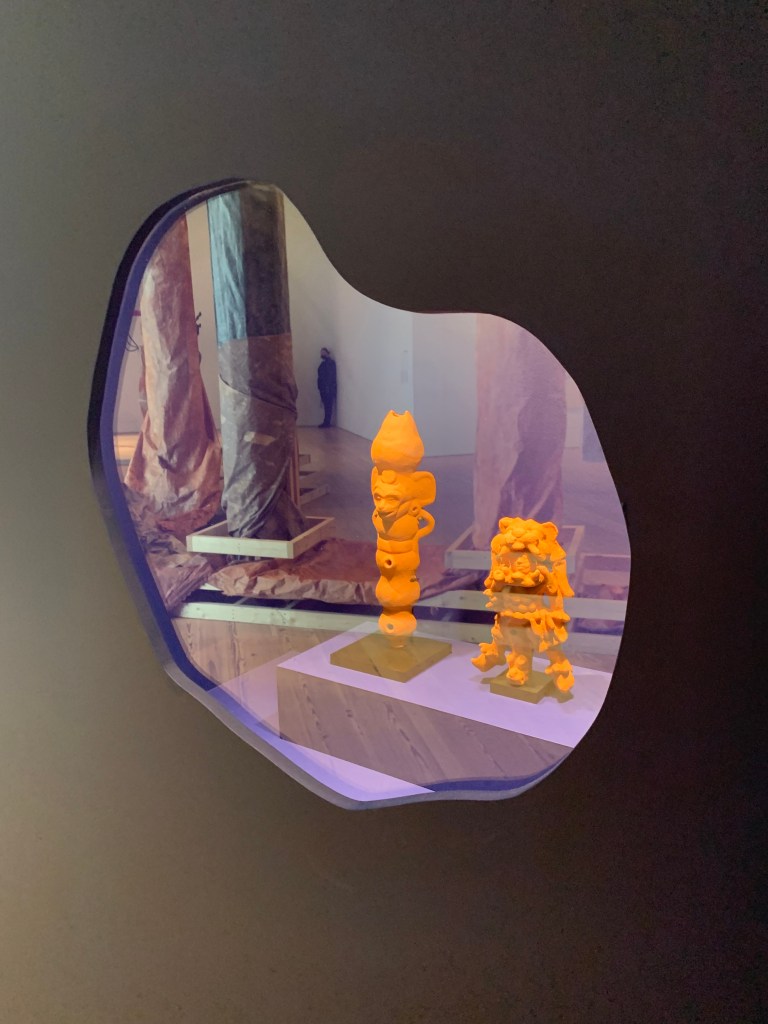
Who among us hasn’t looked in wonder at Pre-Columbian earthenware? Clarissa Tossin has recreated Pre-Columbian musical instruments using 3-D printing. She then had musicians play the instruments so that, for the first time, modern museumgoers could experience the sound in addition to the beauty of the ceramic pieces. Yes, today, these are precious pieces of art. When created, they were simply tools for making music. She is hoping to return these pieces to their proper functional perspective.
Clarissa Tossin – 3D printed replicas of Pre-Columbian musical instruments that can now be played and heard
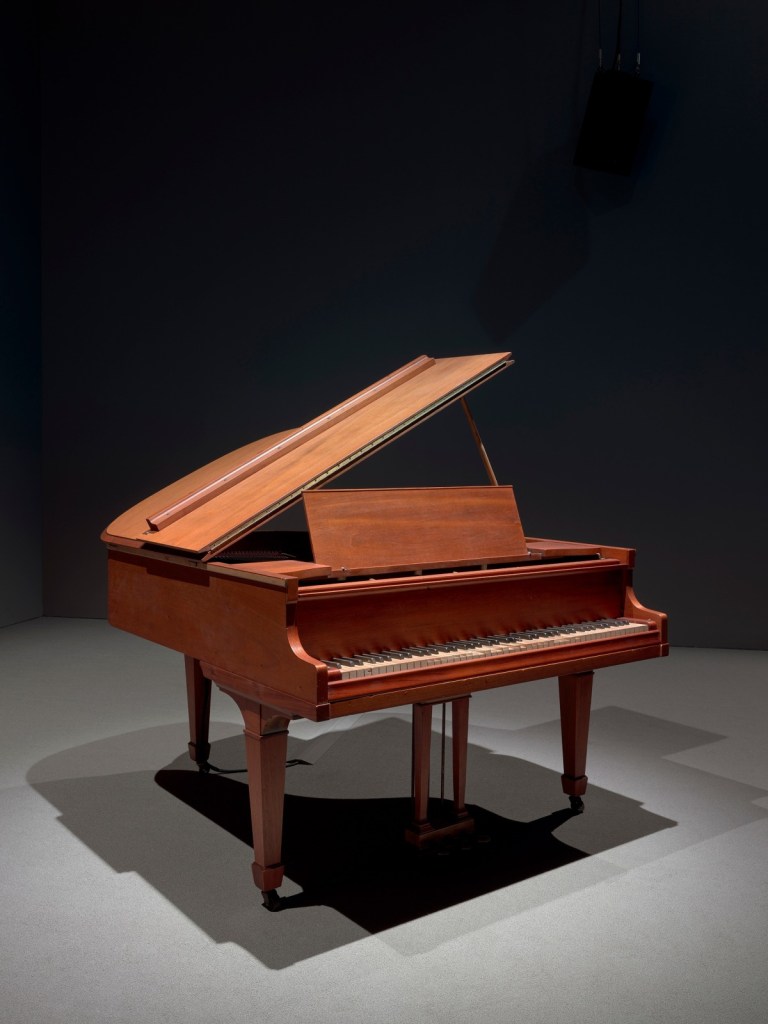
A piano is designed solely to convey sounds input by a musician. The combined human action and mechanical reaction of the instruments delivers music. What would happen if the musicality of the piano were extricated? There are still piano keys being pushed and piano hammers striking and those action do deliver visual movement and sound, just not music. Nikita Gale shared just that scenario in “Tempo Rubato.” In a quiet space a “player piano” keys and pedals moved, hammers struck and sound was heard, just not the sound you’d expect. Siting and listening for a couple of minutes was a delightfully contemplative time in a busy museum floor. Not music, but rhythmic sound and movement.
Nikita Gale – “Tempo Rubato” – A piano without human intervention and the expected music, but nonetheless, sound and motion
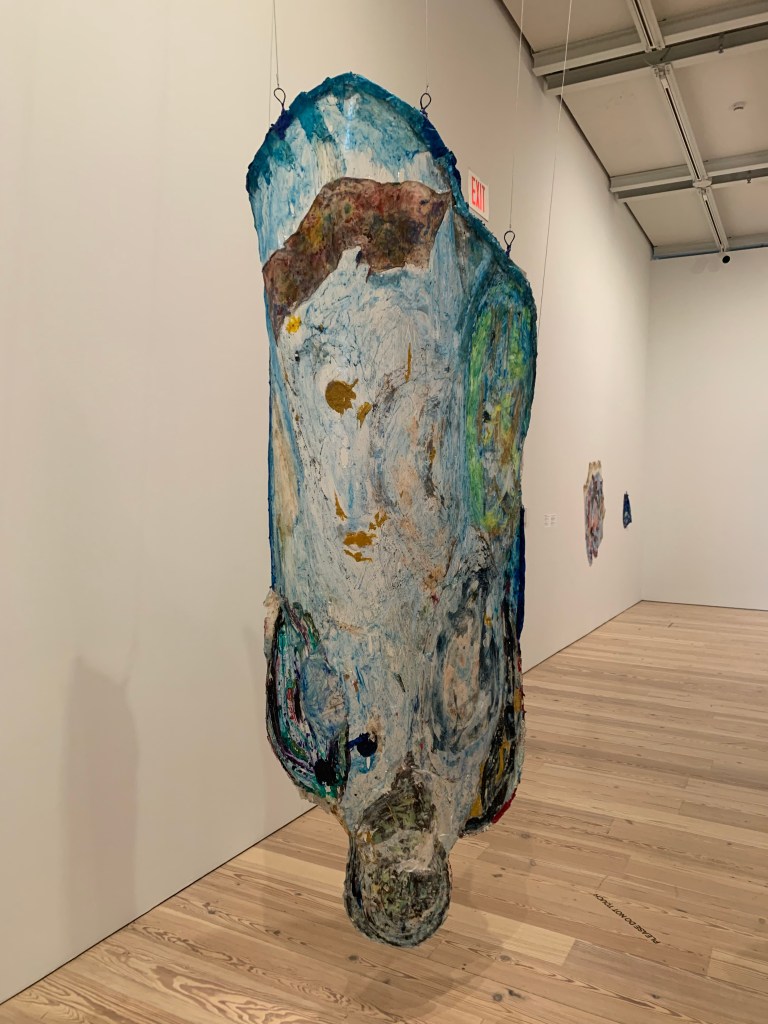
Can we imagine an artist making a painting without canvas? Suzanne Jackson uses acrylic paint as the medium to created suspended paintings. The acrylic and gel are mixed with natural objects to form translucent shields of amorphous forms and color. This is simply a different way to create a piece of art without the use of a predefined substructure.
Susan Jackson – canvas-less paintingSuzanne Jackson – canvas-less paintings
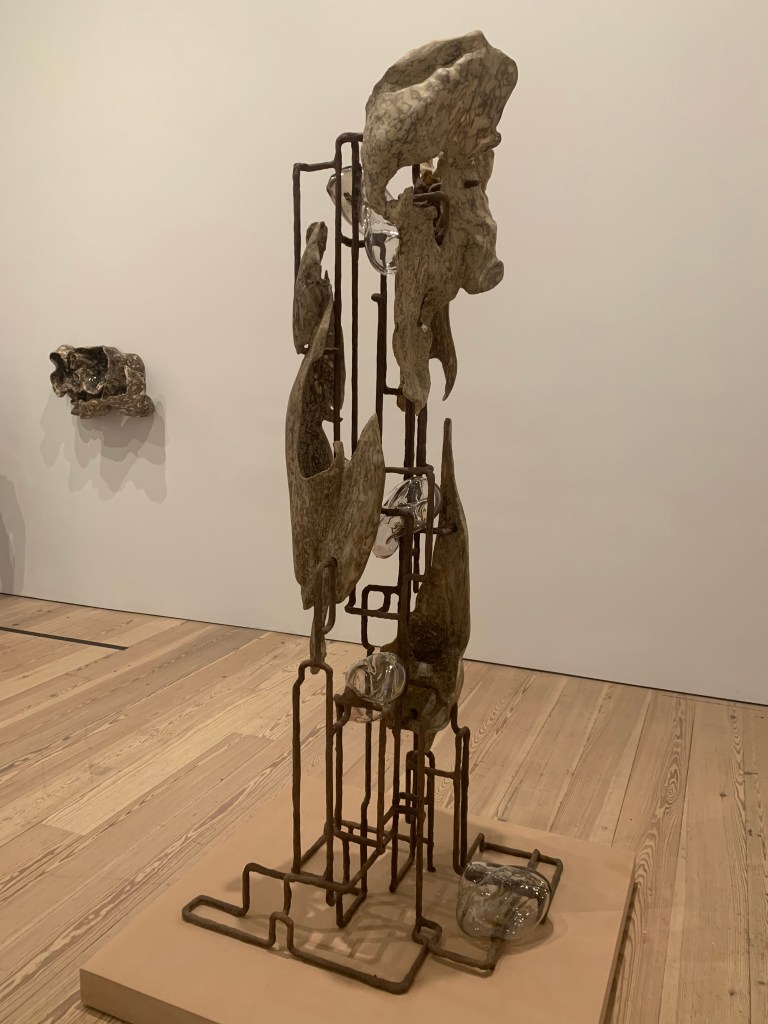
Artist, Jes Fan used 3-D printed CAT scans of his body to create a series of sculptures. Because they are personal CAT scans, the work is very intimate, but the result has no visual reference to human form owning to his duplication and manipulation. Again, we have a tool, 3-D printing thought to produce a series of repeatable units, instead being used and configured into unique art.
Jes Fan – Artist manipulated 3D printed CAT scans of his body parts
Using video and five screens, Isaac Julien asks us to rethink the connection of Black Americans to African art and African-American cultural heritage. It forces the question why the art is honored within the halls of venerable institutions while the creators are/were often ignored or dismissed, especially during the era of thinker, Alain Locke, who is used as a voice here. This piece asks a lot of tough questions.
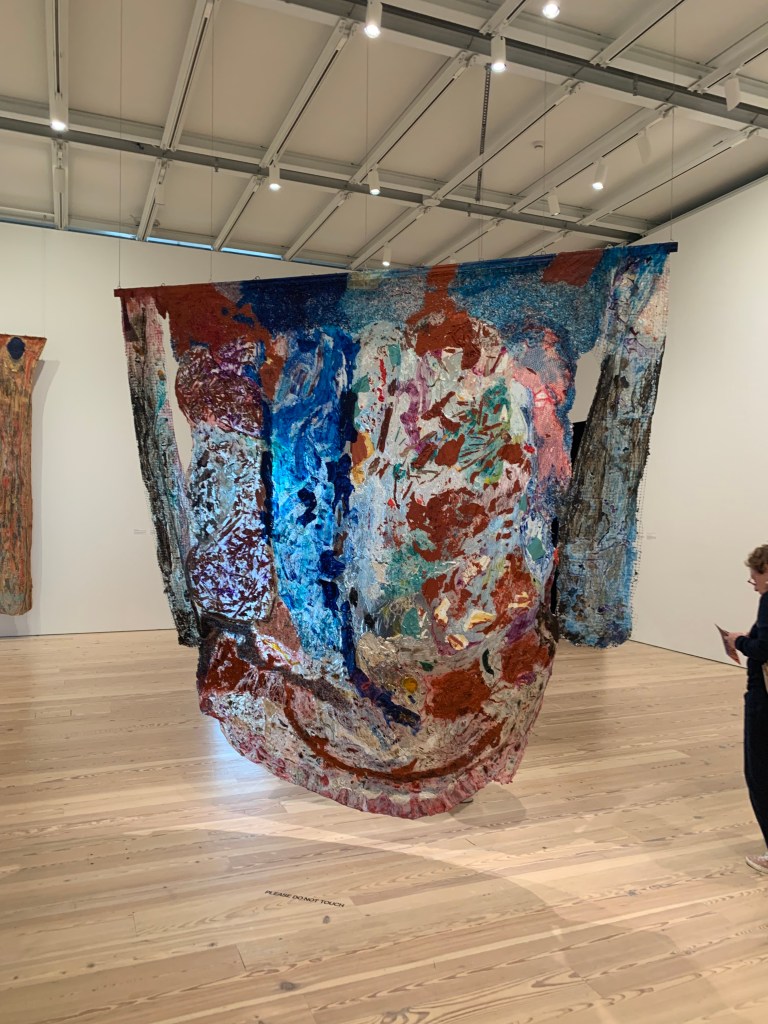
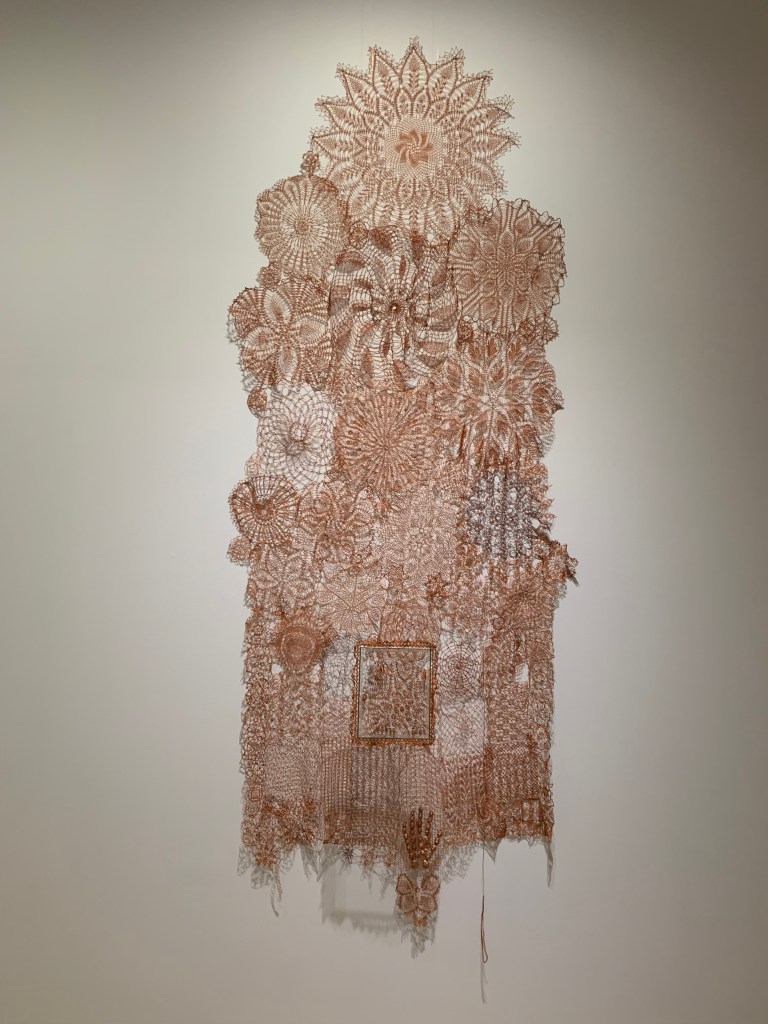
Some artists provide an inexplicable artist bio with a complicated raison d’être that belies their work. Even after reading it again, I don’t understand Ektor Garcia mission statement, (other than learning the crochet craft from family elders) but the work is detailed and remarkable fiber sculptures.
Ektor Garcia – Crocheted fiber sculpture
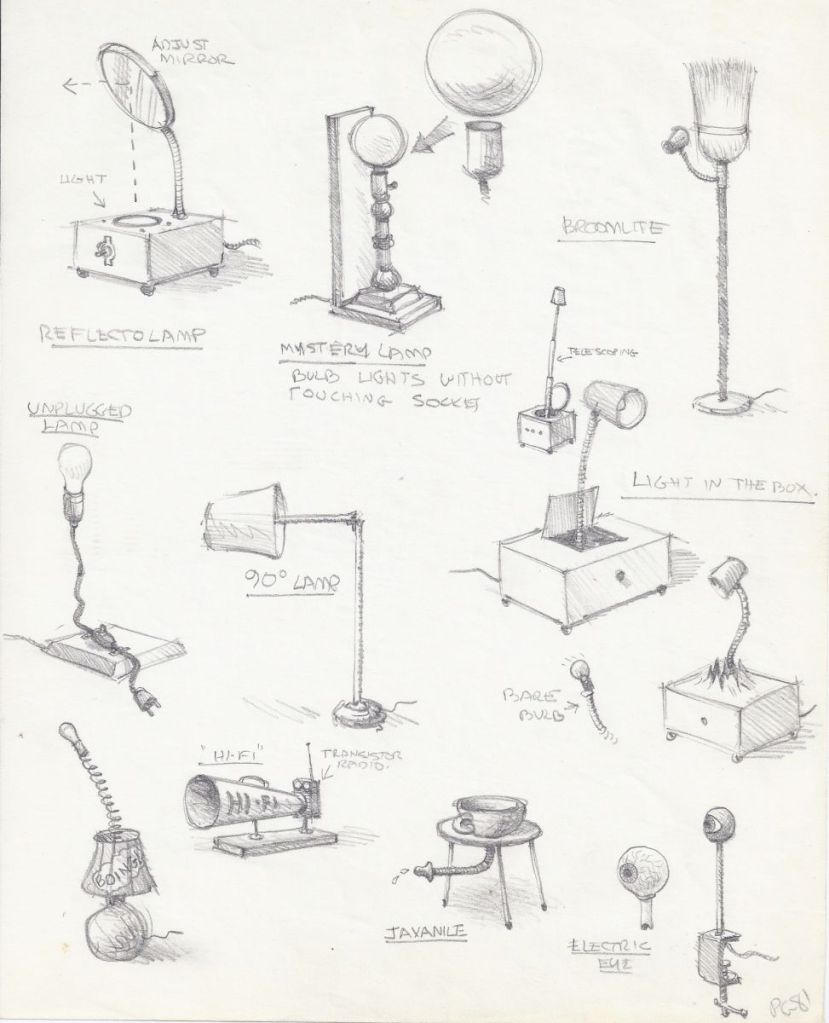
Just for pure fun, I want to live in the world of Pippa Garner. Her wall of inventive and wholly impractical consumer goods (called “Impossible Inventions”) should make any industrial designer smile. What is does do is remind us all that the creative process is filled with “bad ideas” and it takes a bunch of them to arrive at the one idea that is good.
Pippa Gardner – “Impossible Inventions” – Not sure any of these designs would be picked up by a major luminaire manufacturer.
So What Does All This Have to Do With Lighting?
More than once, I have heard designers express concern over the possible ramifications of AI. Manufacturers have grown concerned about where 3-D printing might leave them. As sustainability drives so much of the trend conversations, new materials are almost inevitable. These challenges are being met head-on by artists and the paths they are blazing should help everyone else. By viewing complex art accomplishments, we should feel more comfortable approaching these tasks for consumer goods. Change can be scary, but change is inevitable. The quicker we adopt new ideas, the more valuable we become as professionals. Artists can be the gatekeepers, ushers and guides that make our journey easier.
Imagine my excitement when I found out the DOE’s, 2020 U.S. Lighting Market Characterization report had been released! This is the forth in a series that attempts to understand the United States consumption of lighting and its commensurate energy use. While I was unaware of the initial 2001 report, by 2012, (the publication date of the 2010 findings) I was deeply enmeshed in energy efficient lighting. That report, along with the oddly named 2012 DOE study, Residential Lighting End-Use Consumption Study: Estimation Framework and Initial Estimates, were heralded as benchmarks of data for their comprehensive approach to understanding where we were in the lighting/energy consumption space. The 2015 report (published in 2017) helped the energy efficient lighting industry see what they had accomplished in five years. Now, ten years after the industry started to take efficient lighting seriously, solid results of a decade of blood, sweat and tears can be shown. In short, this is good news, but there is also more work that can and will be done.
History
Let’s assume you’re not like me (lucky you!) and you have not waited with bated breath for this report. Let’s also assume, you didn’t even know about the three previous editions. That’s OK. That’s why you read this blog. I’ll happily slog through a 70 page government document and extract the valuable nuggets of information. Before I do that, let me give you some background information.
Because of the importance in reduced energy consumption, the US government became involved in a number of energy saving efforts over the years. Adopting the “lowest hanging fruit” parameters, items like refrigeration, industrial motors, AC units and appliances were pushed toward greater efficiency through a combination of incentives and mandates. By the time I became involved in energy efficient lighting, they had reach better, almost optimal performance. Lighting was the “next big thing.” At the time, lighting consumed almost 15% of the typical residential consumer’s expenditure on electricity, bested only by room temperature conditioning. If nothing were done, that number was calculated to reach an incredible 45%, while other equipment became more and more efficient. To determine if the efforts were working, they needed information that no one had. How many light bulbs/luminaires are there in the US? Where are they? What type are they and how much electricity do they really consume? By creating the first, but more importantly, the 2010 report, a baseline was established. This report told us how many lights we had, how much power they consumed and how they were used. To this day, it is information I use regularly.
People will often question the need of government agencies. This information, available to all, is one of the many great reasons.
What Can We Learn From This Report?
There is an installed inventory of 8.1 billion lighting products (light bulbs and/or integrated luminaires.) This represents a 5% increase in residential, but a reduction in commercial lighting when compared with the 2015 report. That commercial reductions is attributed to multi-lamp linear fluorescent troffers being replaced with integrated LED units. Residential units account for an astounding 6.5 billion.
2010
2015
2020
Residential
5.812 billion
6.219 billion
6.506 billion
Commercial
2.069 billion
2.076 billion
1.643 billion
Total
7.881 billion
8.295 billion
8.149 billion
LED has made tremendous inroads in use. LED represented only 1% in the 2010 report, 8% in 2015 and now is responsible for almost 48% of all light sources in 2020. We can assume it to be even larger today, four years after the data collection.
Lamp Type
2020 Percentage of Installed Units
Incandescent
12.6%
Halogen
6.6%
CFLs
24.6%
Linear Fluorescent
8.2%
HID
0.1%
LED
47.6%
Other
0.3%
Miscellaneous
0.3%
Reviewing the installed percentages helps us see that there are a LOT of CFLs still in place, as America’s first foray into energy efficiency. At 12.8% the tiny amount of incandescent is encouraging. I guess it means that the people who were hording light bulbs represented a lot less than were reported.
As a note, I continue to remain skeptical of the fairly large percentage of linear fluorescent used in the home. I raised this point with the DOE in 2012 and still need convincing. If we dig deeper into my concerns, the next tranche of data adds additional fuel to my fire of doubt.
The data below indicates the average quantity of installed units per 1000 sq. ft. I have expanded the LED section so you can see those details. I think they are telling as well.
If we think about an average 2000 sq. ft. home, we’ll need to double these numbers and I believe a lot of this makes sense. Incandescent lamps have burned out and have been replaced, first with CFLs and then later with LED. Because they are longer lasting than the incandescent they replaced, many are still in service.
Lamp Type
2020 Average Number of Installed Units per 1000 sq. ft. of Building Space
Incandescent
6.5
Halogen
3.4
CFLs
12.7
Linear Fluorescent
4.2
HID
0 / negligible
LED – Total
24.5
General Service “A”
14.1
General Service “Decorative”
3.5
Integrated LED Luminaire
1.2
Linear
0.2
Reflector
5.5
Miscellaneous LED
0.1
Other / Miscellaneous
0.36
Here also, I think you can see my concern with the linear fluorescent number. 8 ½ linear fluorescent lamps seems high. I guess a 2000 sq. ft. home could have two shop lights and a 2’-0” x 4’-0” fluorescent in the kitchen, but it seems a stretch, especially because this means EVERY home in America must have this amount. That means many people have MORE! This just does not add up.
I’m also suspicious of the LED integrated luminaires and the reflector numbers. I wonder if there is some confusion with integrated recessed units and retrofit recessed PAR & R lamps. This might just be a transition year, but with integrated recessed, integrated under cabinet lighting, integrated utility lighting, LED integrated into bathroom mirrors, 2 ½ integrated LED luminaires per 2000 sq. ft. home seems low.
The distribution of installed wattage is also telling.
Lamp Type
2020 Percentage of Installed Wattage
Incandescent
32.7%
Halogen
15.9%
CFLs
17.3%
Linear Fluorescent
14.7%
HID
0.1%
LED
18.8%
Other
0.4%
Miscellaneous
0.4%
The installed wattage lets us know that incandescent still consumes 32.7% of our energy for lighting. The good news is that the next highest number is LED at 18.8%, then CFLs at 17.3%. Halogen is 4th at 15.9%, so that means almost half (48.6%) of our energy for lighting is still servicing non-efficient light! There is huge room for more reduction.
The average TOTAL wattage of the installed units has gone down to 21.6 watts in residential installations and down to 26.6 in commercial use.
Also interesting is the daily operating hours of lighting per room.
Room
2020 Average Daily Operating Hours
Basement/Crawlspace
1.4
Bathroom
1.2
Bedroom
1.1
Closet
1.4
Dining Room
1.5
Exterior
3.1
Garage
1.2
Hall/Stair/Entry
0.7
Kitchen
2.5
Living Room / Den
1.6
Office
1.7
Utility Room
1.4
Other
1.4
Unknown
1.6
Average Overall
1.6
As with past surveys, the exterior lighting is used for the longest period of time each day, followed by the kitchen. This is no surprise, except the hours is even higher for exterior lighting than in surveys of the past, meaning we are using outdoor lighting more than ever. Offices are now #3 beating out living rooms, probably because of the increase in “Work from Home” activity, although this is pre-pandemic 2020 data. If this is a trend, expect to see it even higher in the next survey.
The use of controls were also measured for effectiveness. I’m only showing residential use here as commercial use of controls is radically different and much more effective.
No Control
Dimmer
Day- lighting
Occu-pancy Sensor
Timer
EMS
Multi
89%
9%
0%
0%
0%
0%
1%
Controls were only considered if they showed the ability to reduce wattage consumption. Based on their collection of data, 89% of the lighting used in residences is not operated with a control that can reduce energy consumption. (Think of this as the number using a simple on-off switch.) That means, the placement of energy-reducing controls per room is surprisingly low. Dimmers are the most popular and they are most used in dining rooms and living rooms, as expected. Occupancy sensors have some use, again low, primarily in garages, closets, utility rooms and exterior locations.
This is why we are seeing such a push for controls as the next step in reduced energy consumption. They have the capacity to reduce energy almost without impact to the user, but we are not seeing much movement yet, even with the mandates established by California Title 24. I had expected to see a slightly higher adoption here.
Power Consumption is also covered extensively. Remember, the whole goal of the efficiency push in lighting was to reduce overall energy use. Overall power consumption of electricity for residential and commercial lighting is 244 TWh. Overall, lighting consumes 9% of all electricity used. The data below shows the huge reductions delivered since the 2010 report.
2010
2015
2020
Residential
175 TWh
148 TWh
76 TWh
Commercial
349 TWh
237 TWh
168 TWh
Total
524 TWh
386 TWh
244 TWh
Residential lighting represents 80% of the installed base but consumes only 76 TWh or 31% of the total. Conversely, commercial lighting is only 20% of the installed units, but consume 69% of the total.
Digging deeper into the data we see clearly why the change to LED was so important.
2010
78% of electricity for residential lighting was consumed by incandescent
2015
42% of electricity for residential lighting was consumed by incandescent
2% of electricity for residential lighting was consumed by LED
2020
28% of electricity for lighting was consumed by incandescent
20% of electricity for lighting was consumed by LED
In ten years the energy consumed for lighting moved from 78% to 48%. That is quite an achievement. All you lighting people out there have earned a cookie!
(Remember, this was foundational 2012 data and should be used to understand the history and where we were at that point. Nonetheless, some of the stats found in this report are still considered valid and used in the calculations of the new 2020 data.)
If you elect to forgo the entire report, I hope this was a good overview that will help you plan energy efficient actions into the future, or at the very least, provide a “pat on the back” for your past hard work.
Fifty years ago last week, I was hired into my first job in lighting. I was studying Architectural Engineering and my part-time job was coming to an end. I worked as a drafter for a rubber machinery rehab company. (Sort of a used-car lot for rubber machinery.) They needed a full-time person and preferred someone with machine-engineering skills. Gear pitch and key dimensions were not my idea of a life’s work, so I was not too upset. The school readily accepted employment requests from the local business community, so I asked if there were any available options. I was told a local lighting company needed a part-time drafter. I had no more knowledge of lighting than any other nineteen-year old, but it was a job. I requested an interview, met with the General Manager, Department Manager and on a card table in the VP’s office, I filled out an employment test and some required paperwork. I was hired a week, or so later.
My first job was creating a library of every component part used in the factory. Every luminaire was made in-house from hundreds of components and only a few had engineering drawings. (I know. It was a different time.) With a warehouse filled with parts, employees were having a hard time disseminating one socket from another, one screw from the next and recalling a part-number for a less-than-popular lockwasher. I made scaled drawings and some full-sized drawings on 8 ½” x 11” sheets of every component category in the company. As the company grew, these books became indispensable tools for foreman, storage personnel and engineering.
I graduated, but architecture in Cleveland in the 1970s was challenging. There was little work and less construction. The lighting company asked if I would consider taking a full-time job. I accepted, figuring I could do this for a while, until a “real” job in architecture popped-up.
My second assignment, the first as a full-time employee, was the cleansing of each product’s Bill of Material. I pulled a unit out of stock, opened the carton, removed the parts, disassembled, reassembled and hung it to insure each component worked and was accounted for on the B/M. I then restructured the layout of the B/M to better service the costing, parts acquisition and inventory set-up for construction and assembly. In one year’s time, I had broken-down, build and hung hundreds of luminaires. I still can think of no better introduction to lighting, or if similarly structured, any other career.
While I still love architecture and always treat it as my, “what if” career, my life took multiple detours that filled the non-professional half of my vessel. I continued to act in local amateur stage productions, eventually directing. My friend and I wrote five theatrical plays, I learned to sculpt, paint, weld and blow glass. I traveled and ran for local political office. Underpinning all of this was a growing knowledge of lighting.
I began to write all new Bills of Material for the company, handled all of the “change requests,” wrote all of the catalog copy and dove into the layout and orchestrated order of each printed catalog. I spent so much time with printers, I devoted a year of evenings at a local community college to learning the fundamentals of Graphics Arts so I could intelligently communicate with these professionals. A Graphics pro was eventually hired. I was also the Quality Assurance person prior to a professional being hired and I troubleshot production issues before a manufacturing expert was brought onboard. I was becoming a pretty good “generalist.” A career I now know to be very valuable.
The company grew. I no longer actually made drawings; drafters with CAD skills were hired and I was the last person in the company to receive an “official” title beyond employee. I became the Engineering Supervisor. As production transitioned to Asia, I found ways to communicate with people speaking a different language by creating documents filled with sketches that indicated errors, suggestions and changes. Because they did not rely on the one or two people in the company who spoke English, they were widely welcomed. Eventually, I became the Engineering Manager.
When a computer was introduced into the company, (there were no computer when I was hired,) I oversaw the data input. As the Millennium approached, like so many other companies, a computer update was required and I worked on a core team to transition the company to a new ERP system.
As lighting became more complex and new light sources were just peaking their heads around the corner, I realized my mechanical engineering skills were not going to serve the company. It was time for a change. I took an assignment to live on and off in China for a year, the goal being to educate Chinese manufacturers and guide the company staff located in China. What did North American consumers want? What expectations did US consumers have? Incoming quality improved to 99% after my sojourn. I believe vendors and staff were better for the effort.
I eventually was moved to Product Management where, over my years in the department, I directed almost every sector of the company’s many lines. During oversight of the more complex items, LED became a factor and I realized that important product education was missing. I started to develop educational tools for the design-professional user community. That led to yet another career transition.
I was asked to abandon my Product Management responsibilities and concentrate on Education, but also, stay aware of related industry aesthetic trends, serve as corporate spokesperson and keep involved in the emerging “Energy Efficiency” community. That was my concentration until the “pandemic” interrupted the world and I was “invited” to retire.
I thought it a good time to exit. More plays needed to be written. I had arranged a comfortable post-work existence. A funny thing happened on the way to the retirement forum. (Musical theater reference intended!) Somewhat surprising to me, other people outside the company knew who I was and I was asked repeatedly if I could help them with a wide variety of problems.
Sharing information about lighting, using 50 years of experience has been a very rewarding way to slowly move away from full time employment. I am able to spend time writing a new play, but I am continually challenged to reflect on a variety of topics thanks to the large population of design practitioners who listen to my regular educational talks. I have volunteered my time with The Illuminating Engineering Society, restructuring industry “best practices” standards, I have also been asked to help in other facets of the industry and that has been very rewarding. Reports of my death were, apparently, greatly exaggerated.
When I muse about a total exit from lighting, my wife asked me what I would do to stay active. Sure, theater still serves as a siren, but is it enough? Right now, it looks like I will continue until I see my value reduced. I still find myself interested in the transition of an industry that, when I was first hired, had operated for over 100 years with nary a change. The last twenty years have admirably made up for lost time. I can’t wait to see what it will do in the next 25, at which time I will celebrate my diamond anniversary in lighting!
As I try to wrap my thoughts around all of the things I saw in New York and on the ICFF show floor, I wondered if there is a theme, a common thread that might tie new products to birth in 2024. I suspect that might be too easy. There are far too many creative ideas and this is a worldwide showcase. One thing did come up, time and again and it is a movement with which I have had some struggles. Sustainability is something we all know is needed. It is a direction we all know we must follow, but it runs counter to so much of what we do as creators of interesting, unique and personal interiors. I’ve asked this question before and will probably ask it again. “Can design, trends and sustainability coexist?” I’m no closer to an answer, but I have more fuel for the argument.
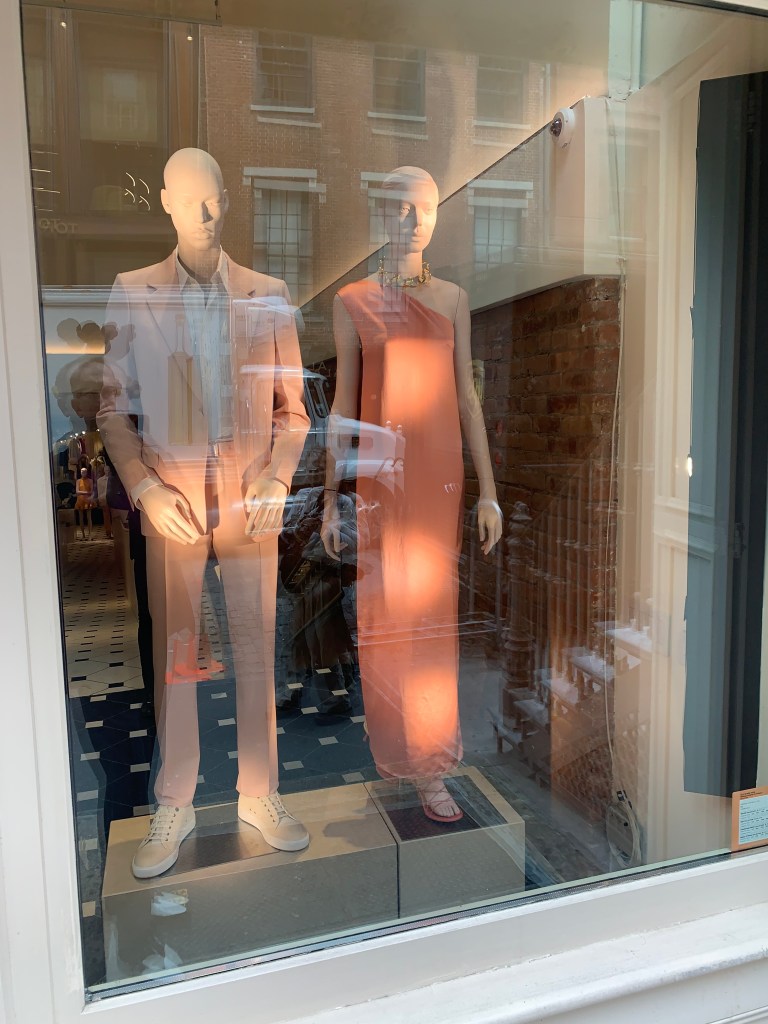
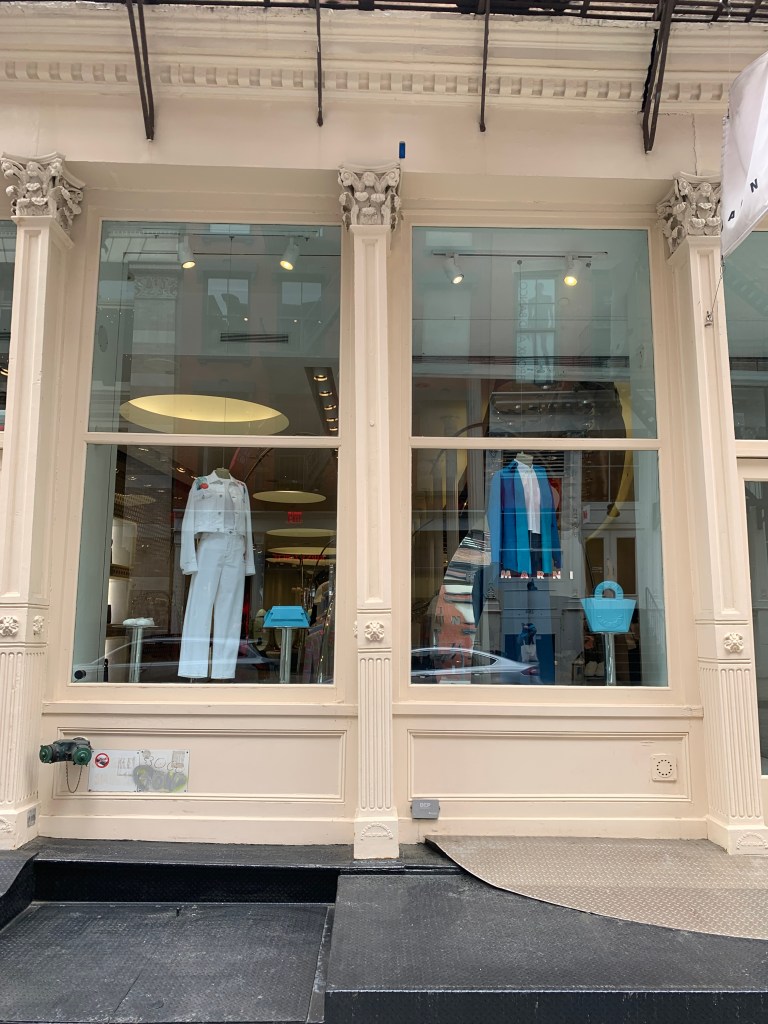
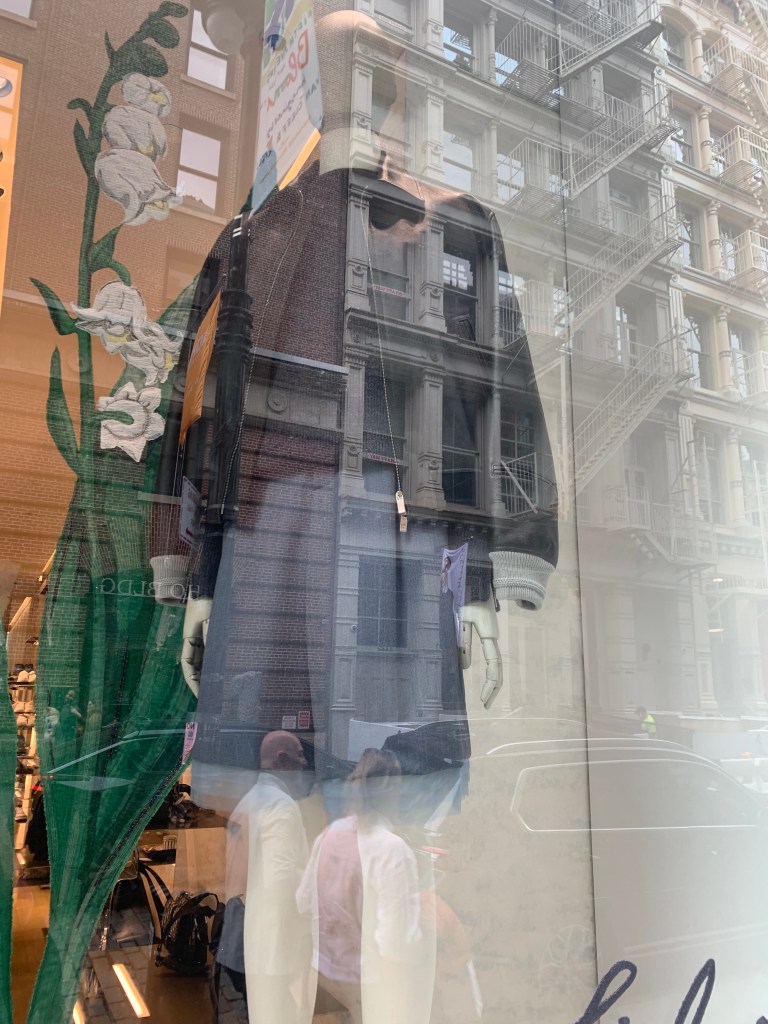
New York 2024 – Kirna Zabete window
Upon seeing the showrooms, stores and galleries of SOHO, the dichotomy couldn’t be stronger. In one short section of a block, the fashion industry was having this same battle. The Kirna Zabete window featured bold, funky “Maxi” dresses that are sure to have a short shelf life, while across the street, the Marni storefront showed simple and clean blue and white suits, designs that could easily transition trends and time. Likewise, the Simkhai showroom next door and Lavin, two-doors down kept it simple and stately. A few more steps and the Mango showroom, a new fast-fashion brand who makes trendy product quickly and offered it for less money pulled us back to a typical merry-go-round of fashion retailer.
New York 2024 – Lanvin windowNew York 2024 – Marni windowNew York 2024 – Simkhai window
I think the fashion industry is wrestling with itself on this topic. For the average consumer who has moved into a type of American Mao Suit of jeans, sneakers and tees, the question is moot. They have already established a de facto sustainability. This further begs the question, “Can fashion survive?” North Americans are, however a much more quantitative based consumer than the rest of the world. Sure, we wear jeans 90% of the time, but we want a closet full of clothes to service the remaining 10%. That, I think is where we get into trouble balancing the need for sustainability. Other geographic areas of the world are emotionally better equipped to handle a smaller closet of well-built clothes. Citizens of the US and Canada, not so much.
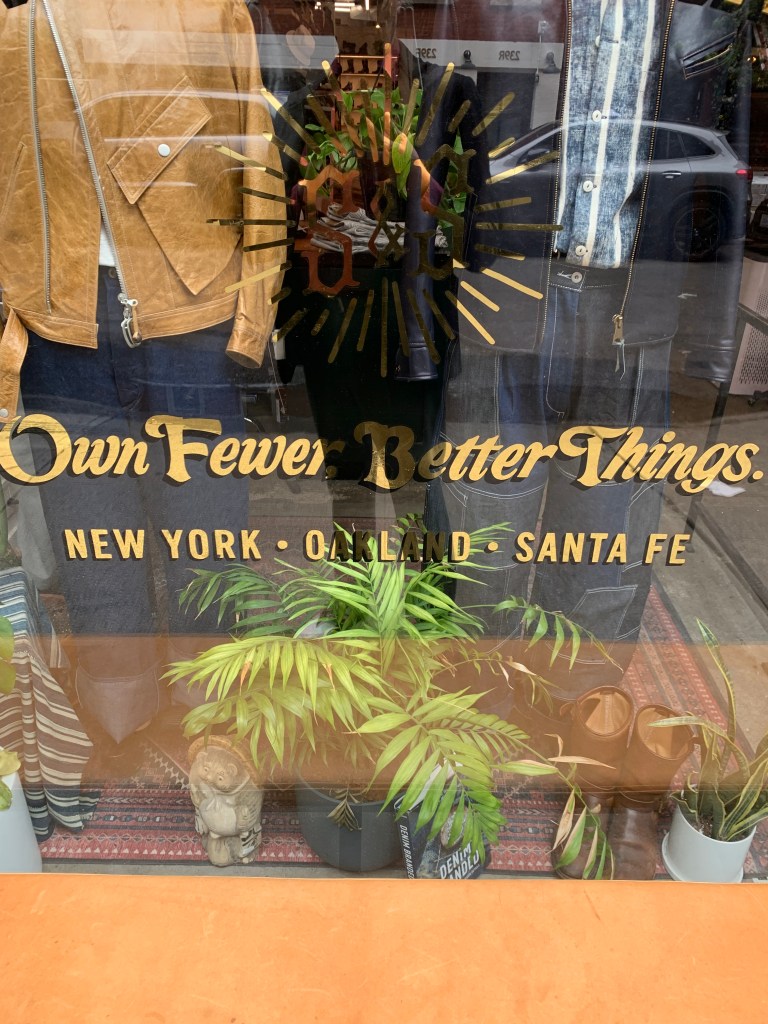
New York 2024 – Standard & Strange window
Retailers are trying. Yet a few more steps down the street is Standard & Strange with their moto. “Own Fewer, Better Things” emblazoned on the window. Will it work? I’m still not sure.
Fashion
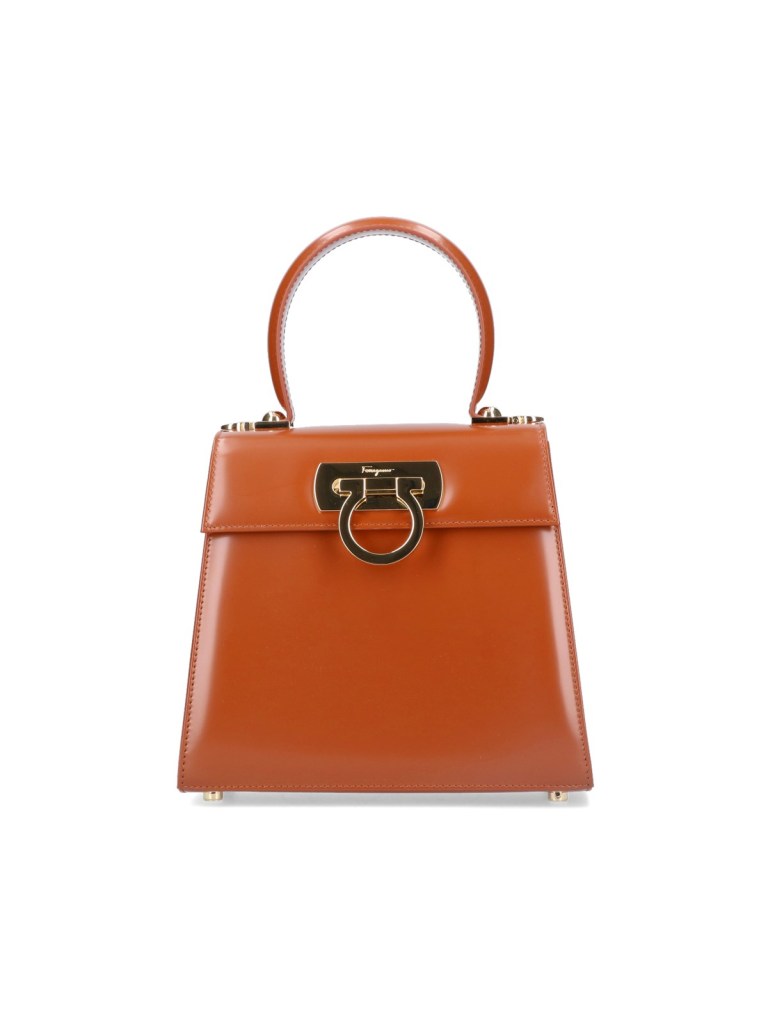
New York 2024 – Fendi handbag
Despite being involved in residential consumer goods, we can learn a lot from trends in fashion. The sustainable battle is only one point on which we can draw inspiration. For example, I’m surprised the short handled trapezoid shaped purse hasn’t inspired some sort of home-related product. This shape is everywhere in woman’s apparel stores and fine leather establishments, but I don’t see the crossover. I’m not sure what I expected, but I had expected something.
New York 2024 – Louis Vuitton / Supreme collaboration
The cobranding of Louis Vuitton and Supreme is an odd one, but it does speak to the need for old brands to stay relevant and new brands to gain some legacy in order to survive. It can benefit both if done well. The challenge will always be in the implementation.
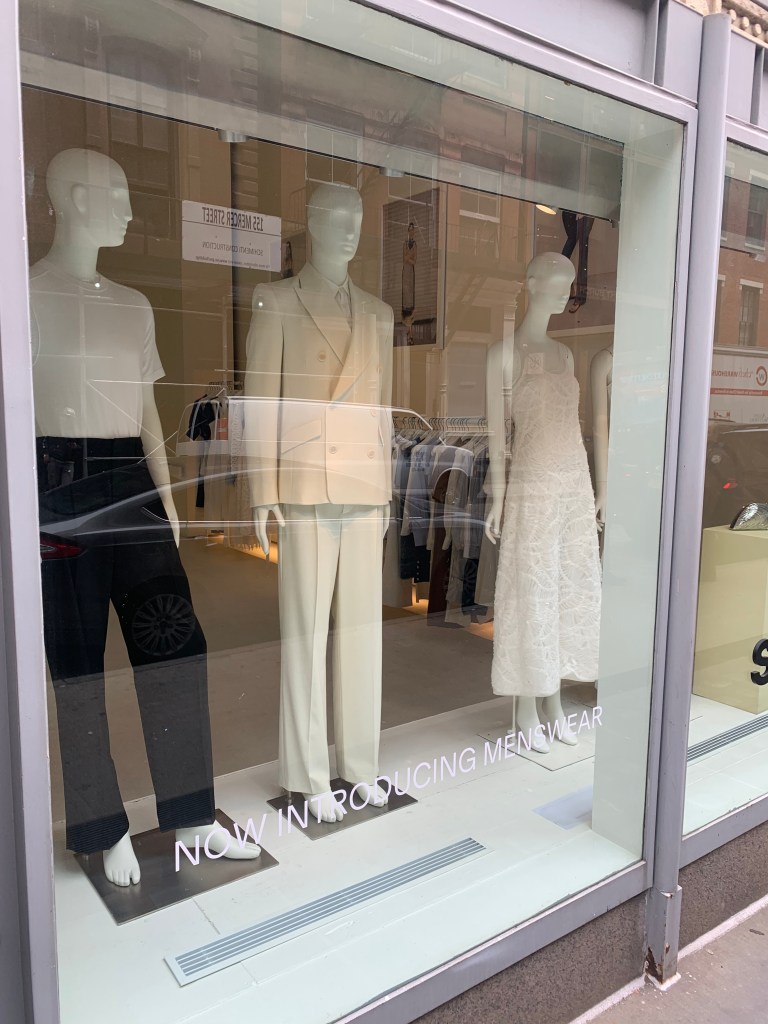
New York 2024 – Dior Men’s window
Men’s pants are of course shifting from ultra-skinny to massive and floppy. Men’s short pants had been minimal for a few years and Dior wants that to continue to the obvious extreme as exemplified by their window display. Men’s shorts so full they appear as a skirt. Yet another step in the gender blurring of clothing.
Floor Covering
I enjoyed a number of conversations with the rug creators at ICFF this year. Why is a lighting guy looking at rugs? In each case, the people staffing the booths pointed out the importance of lighting to handmade rugs. One gentleman even mentioned he will not begin the weave of a custom piece until he understands the placement of light. Fiber has a nap that conversely reflects and absorbs light. If placed in one direction, the rug will look different than positioned in the opposite direction. We also discussed the difficulty with showroom lighting, to say nothing of the 5000K warehouse lighting on the Javits Center show floor. I left these conversations feeling much more positive than I had expected.
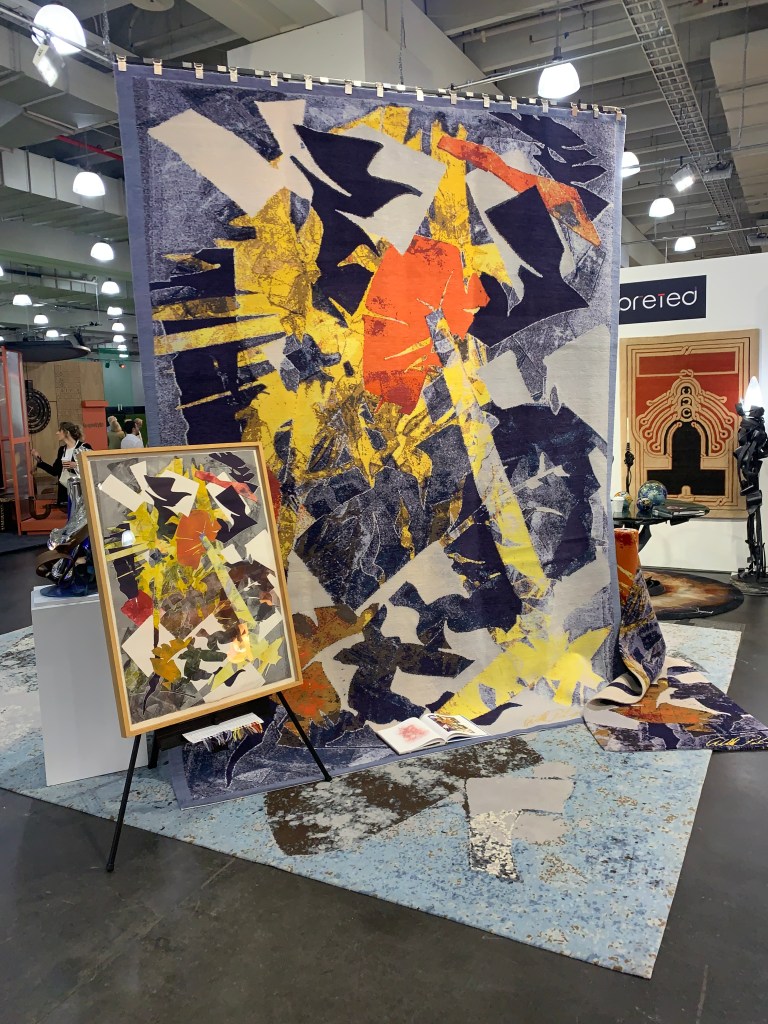
ICFF 2024 – Art Interpreted
Art Interpreted hires artists to create works, then recreates those pieces in fiber. The artist’s signature is prominent in the recreation. Illulian has hired famed Industrial Designer, Karim Rashid to develop designs. Using a different approach, Warp & Weft drew inspiration from organic elements such as birch and earth along with urban topographies simplified into unidimensional planes. JD Staron, a favorite from last year, took a more psychedelic, funky approach. This has to be some sort of renaissance period for rug manufacturers. They are creating interesting, fun and exciting designs that are allowing homes to really shine with the vibrancy they add.
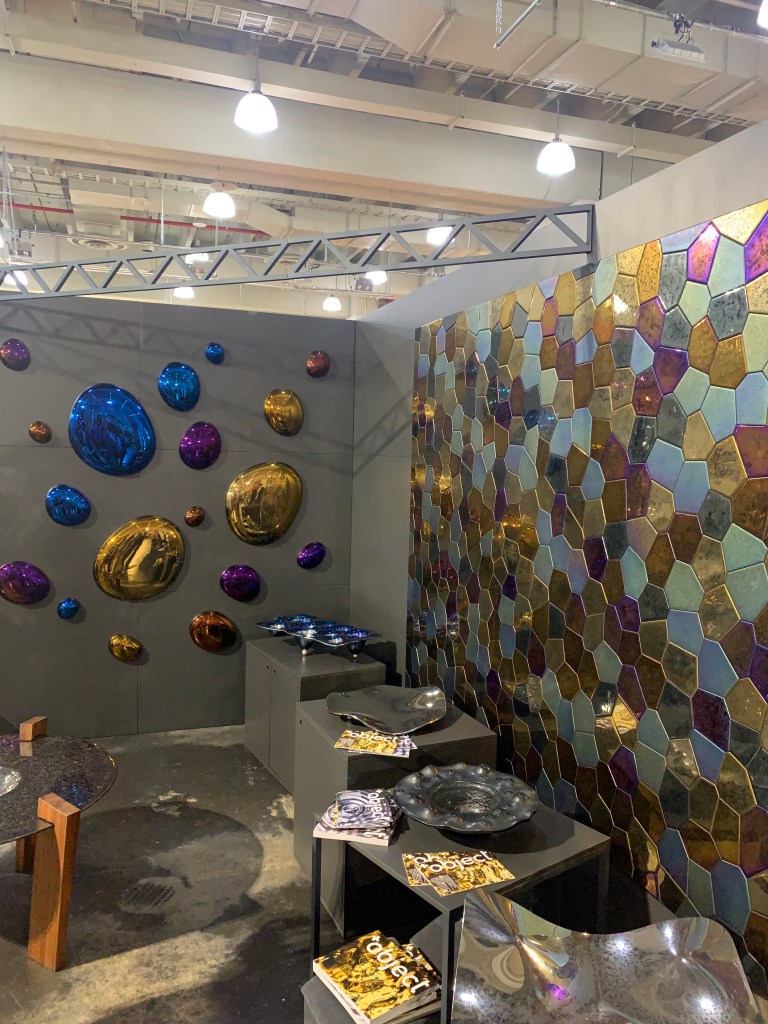
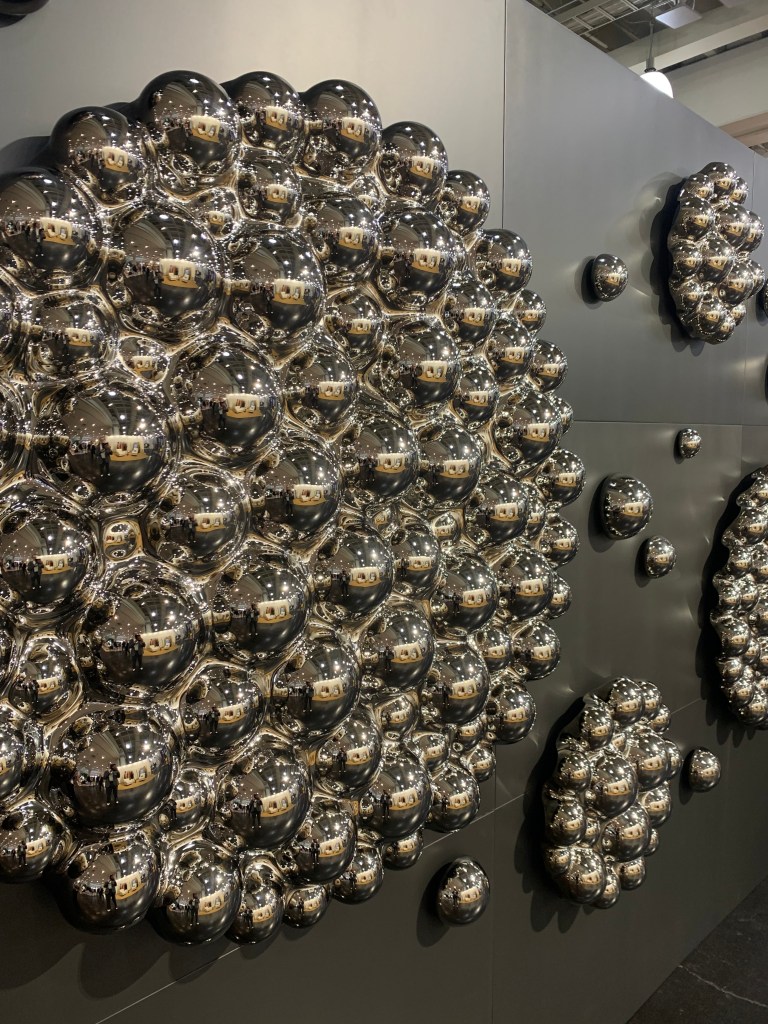
By combining glass and titanium, PlusObject has created some very interesting wall art/wall coverings. They are at once, polished and textural and can easily add a dynamic touch where one is not expected. There are so many ways these could be used. There are also so many other industries that could borrow this concept within their own product lines.
The overall design of a high-end kitchen is not experiencing much movement. A visit to Bulthup, Poggenpohl, Boffi and Scavolini this year could be easily swapped out for a visit in 2022. Kitchens are increasingly minimalist, with clean lines and tailored finishes. The rise of convection stovetops is further smoothing surfaces. With kitchens open to the whole home, they have adopted a higher level of aesthetics than these workplaces ever had in the past. Appliances are hidden, cooking tools are housed and dinnerware is barely tolerated. No wonder there is a rise of “back kitchens” or “dirty kitchens” in higher end homes. Despite the desire for the contrary, food preparations can sometimes make a mess. I wonder if the pendulum is at its turning point and we are about to see a shift. Stay tuned.
I continue to see increased use of glass countertops. A number of these showrooms and related spots include smoked glass, clear glass with etched underside and a number of other variants.
Furniture
New York 2024 – Flou showroom
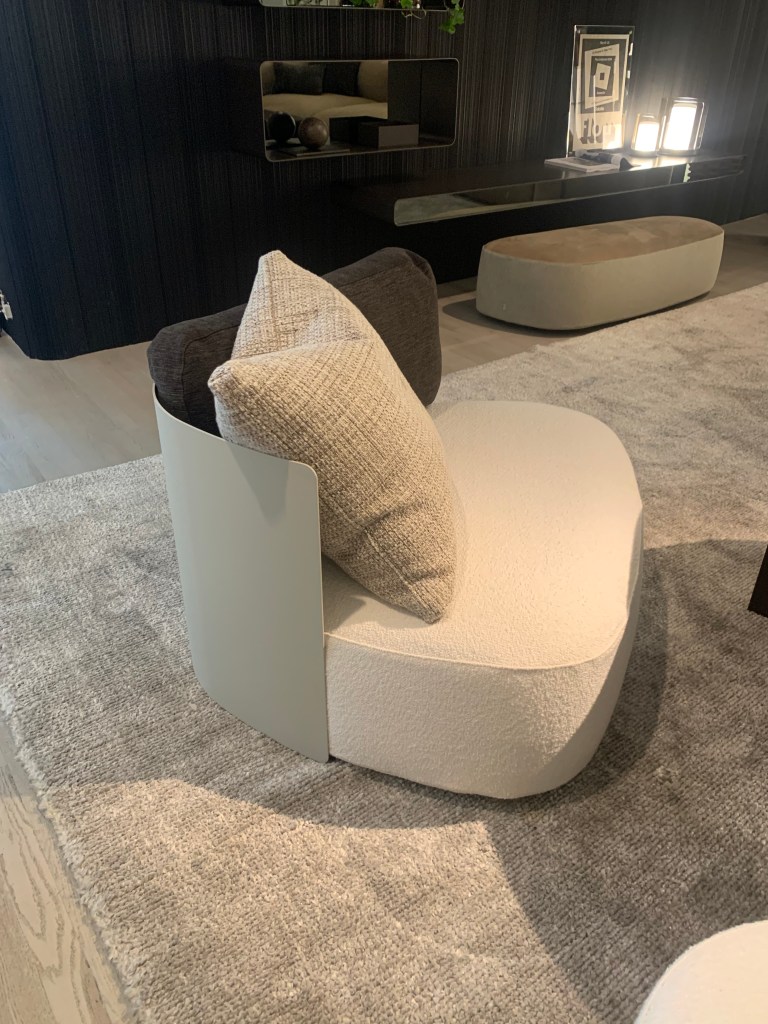
There were a handful of things to note in the Flou showroom this year. Metal-backed chairs really hardened the appearance of what could have been a “cozy” chair. I liked this combination. A huge pouf ottoman was a nice compliment. Also of note was the extra deep sofa seat. This feature can be found in many other brands, likely a result of demand from people who use the seating in a much more casual way than in the past. (feet up, curled up, snoozing, etc.) Even higher-end manufactures are serving a more casual need.
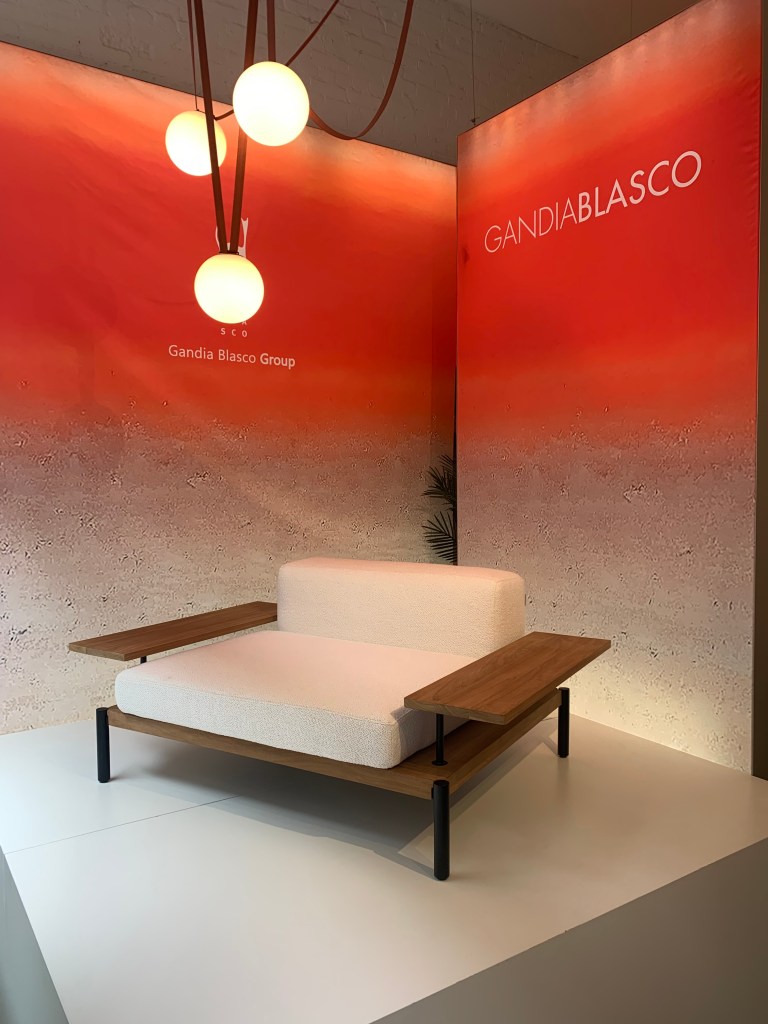
Take the wide arm of an Adirondack chair and plant them on a new lounge chair and you have the new Lademadera seat by Gandia Blasco. The deeper and wider seat is perfect for casual relaxation. It is also available as a sofa and two-person loveseat.
To accommodate people who both sit and stand at a desk, Beflo has developed a desk that easily transitions between the two demands. Couple that with an effective “wire management” system and this desk could become as hardworking as you!
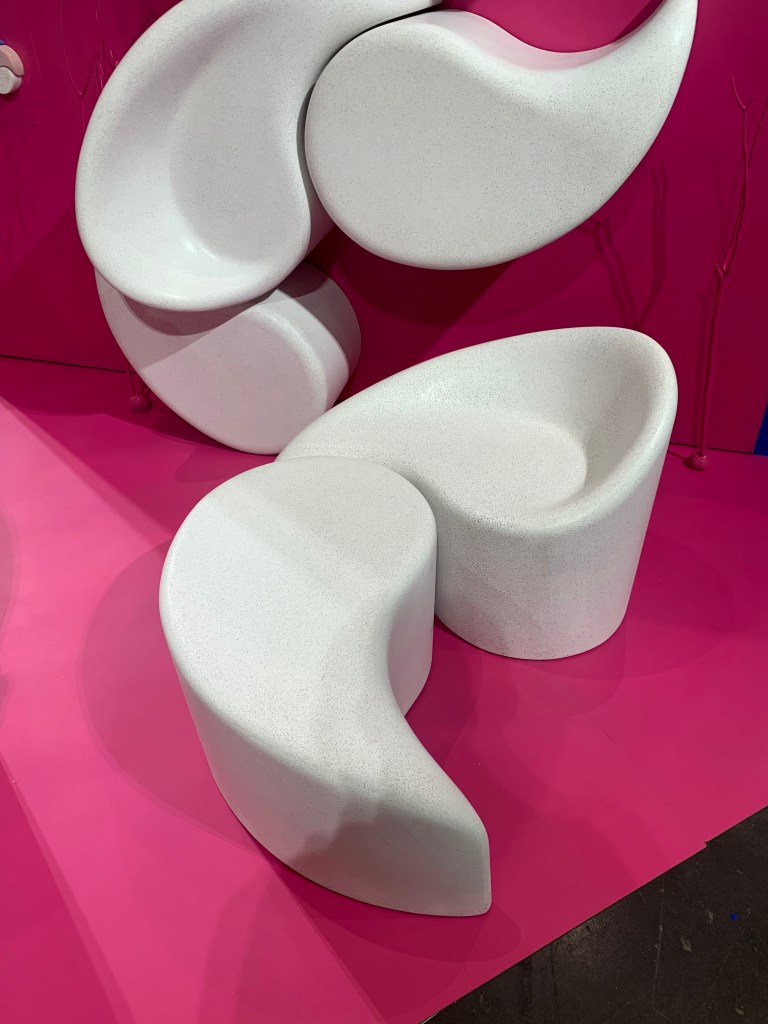
Hand cast in the US from thin wall resin, the Polli collection from Zachary A. Design has a real amorphous look that I felt could quickly adapt to outdoor environments. Luckily, the material can be used indoors and outdoors.
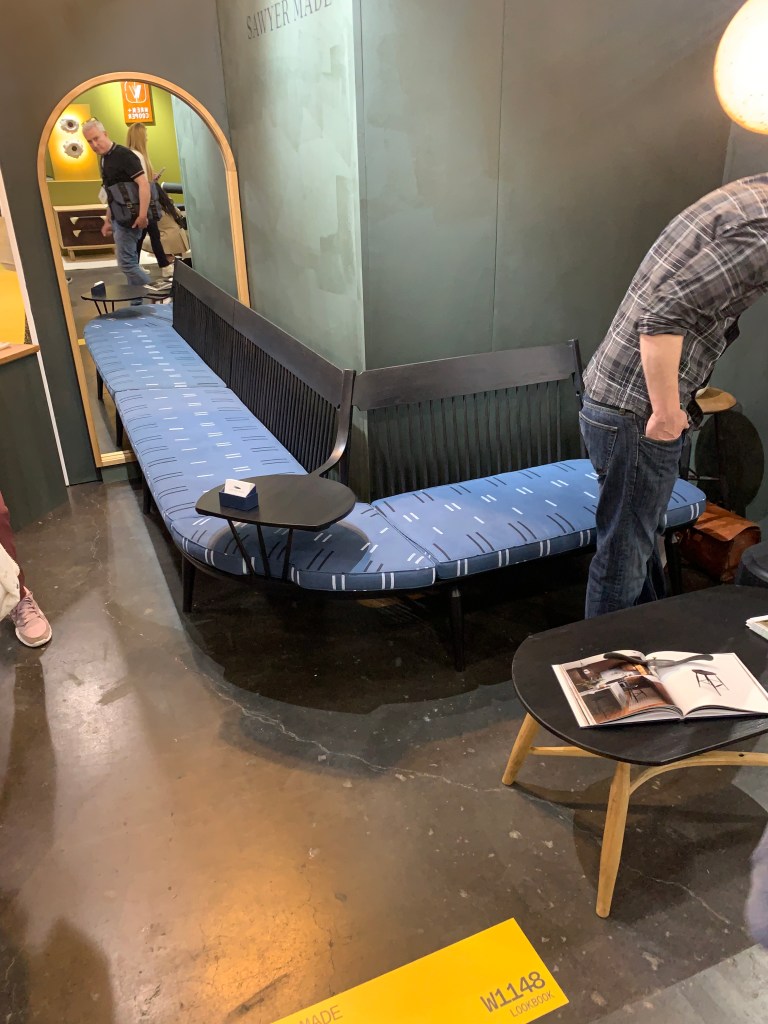
So much at the ICFF is contemporary. It is, after all, right there in the name! When I saw the work at Sawyer Made, the classic traditional shapes and forms were a bit startling. This is beautiful handcrafted work.
There are often items that defy category; where interest is not typically found. A few of those popped up and I could not help but notice.
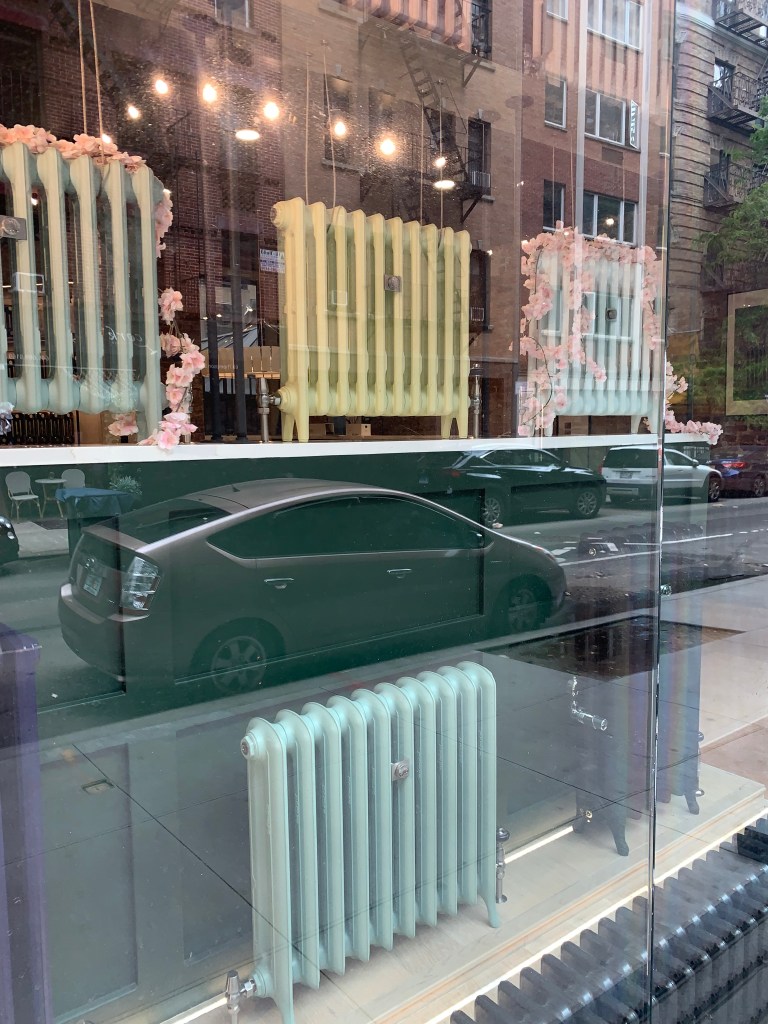
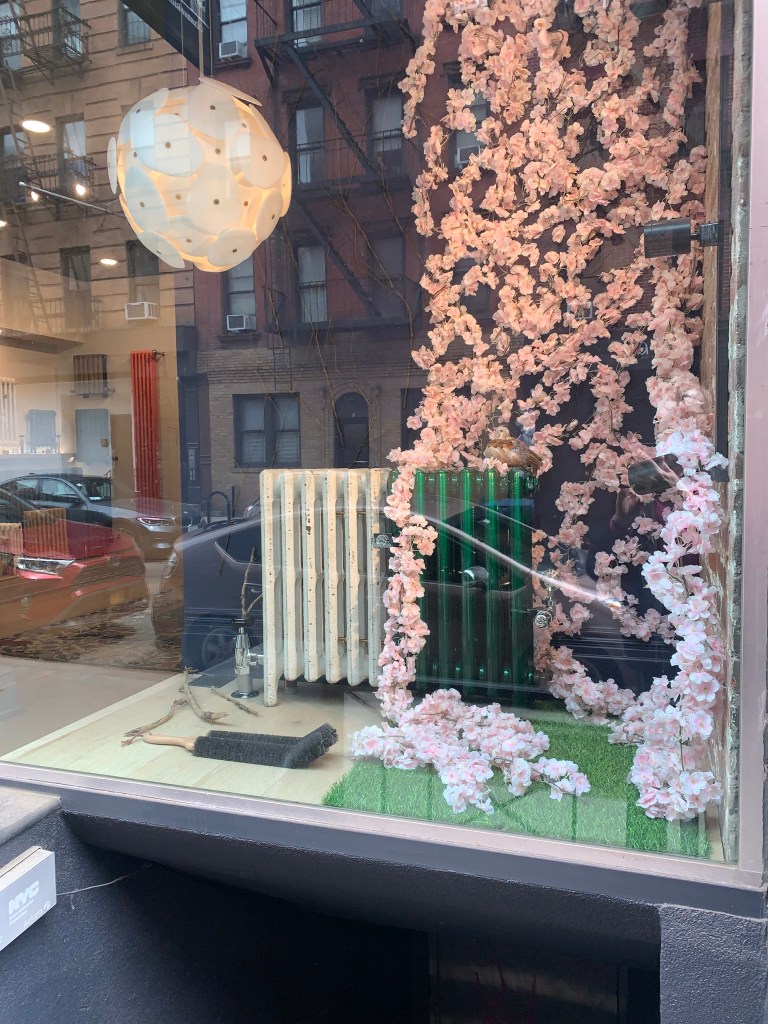
New York 2024 – Castrads radiators New York 2024 – Castrads radiators
If you live in an older home (like me!) and have looked at beaten-up radiators you can imagine the excitement stumbling upon Castrads. They can either create bespoke replacements or refurbish your old, worm unit. Radiators are such a dominant piece of architecture in an older home and very few people know what to do with them, they just sort of “exist” in perpetuity, brown, decaying and hissing. What a refreshing difference new radiators can make to a space.
Equally ignored are fireplace grates. Most of us have probably never replaced one and fewer have thought about them overall. DFA Fire Chair has created a better grate that allows wood to burns better, prevents fire “spitting” and reduces smoke escaping into the living space. That it is a much sexier design is simply icing on the cake.
We might not think of storage as a place for clean and effective design, but Ylisse does. They have developed a collection of beautifully simple, clean storage accessories. Shelves, coat racks, magazine pockets and tables are solid and simple. Made in Canada, they are also well priced. Can we ask for more?
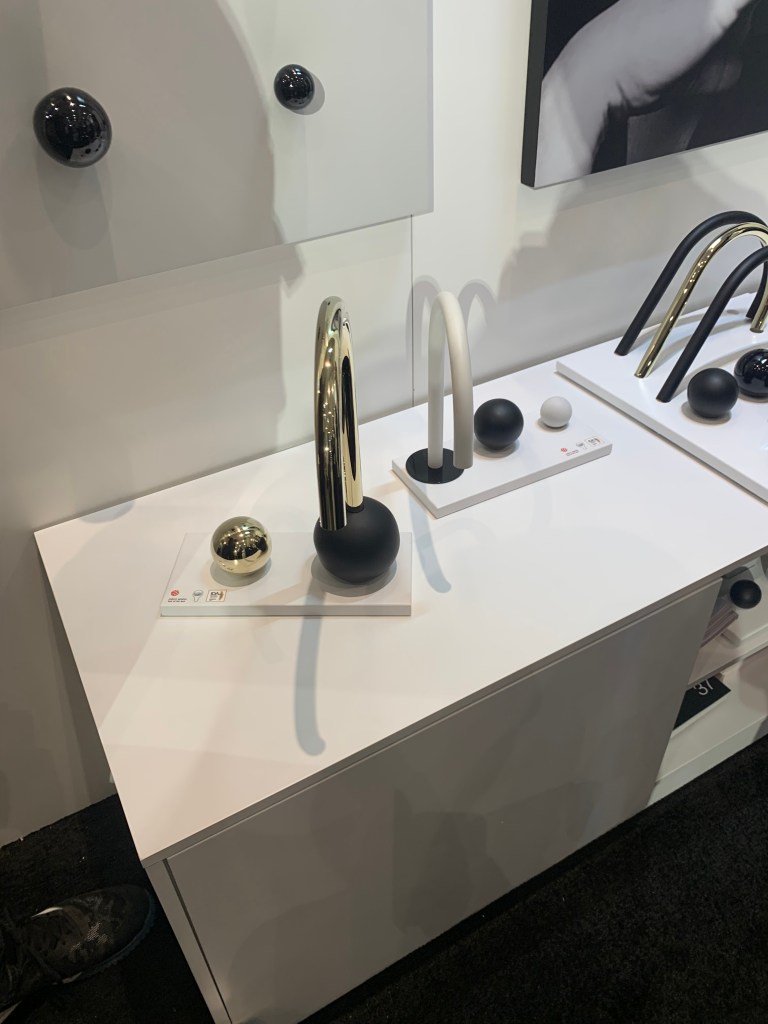
Perhaps the most exciting plumbing I saw this trip was from a Quebec based, family owned plumbing manufacturer, Baril. I’ve never heard of them, but found their new designs, which incorporated spheres into the faucets very creative and exciting.
I haven’t thought much about exterior hardscapes, but the products offered by Prism Hardscapes was interesting. Fire pits, planters and outdoor furniture had a nice clean look.
Prado wants technology to disappear into a home. “Invisible Home Technology” is their slogan. There when you need and invisible (or barely visible) when no longer required. They started with an award winning, round C/O and have moved into recessed lighting that is combined with ventilation. At this point, no information is available online for their lighting. Let’s watch this space. It could be exciting.
While at the hotel gym prior to the show, I noticed that the huge and heavy mirrors affixed to the gym wall were pulling away from their mountings. One of the three mirrors was akimbo, looking very precarious. I thought of this as I walked past Lite Mirror while a person was tossing about a VERY large mirror. To solve this problem of weight, they use a highly reflective optical film to create unbreakable, glassless mirrors. The available sizes are very large, so most applications can be filled. Good news for a particular hotel gym I use.
Reishi is a proprietary name for the mycelium based leather alternative developed by MycoWorks. They promise equal durability, performance and feel. I agree on the feel. If I didn’t know better, I’d have said it was fine calves leather. Of course, I can’t speak to the longevity, but over the years there have been many attempts to find a vegan replacement for leather. While I’m not a fabric expert, I’d say they are getting mighty close.
As you can see, there is much to gather from related industries. Lighting shares the home with all of these things. To understand them is to understand how they will comingle with illumination. We want the very apparent product, such as a chandelier and pendant to work together, but we also need to respect the room as functional lighting is positioned. Mutual respect will deliver excellent results for the overall design of a home.
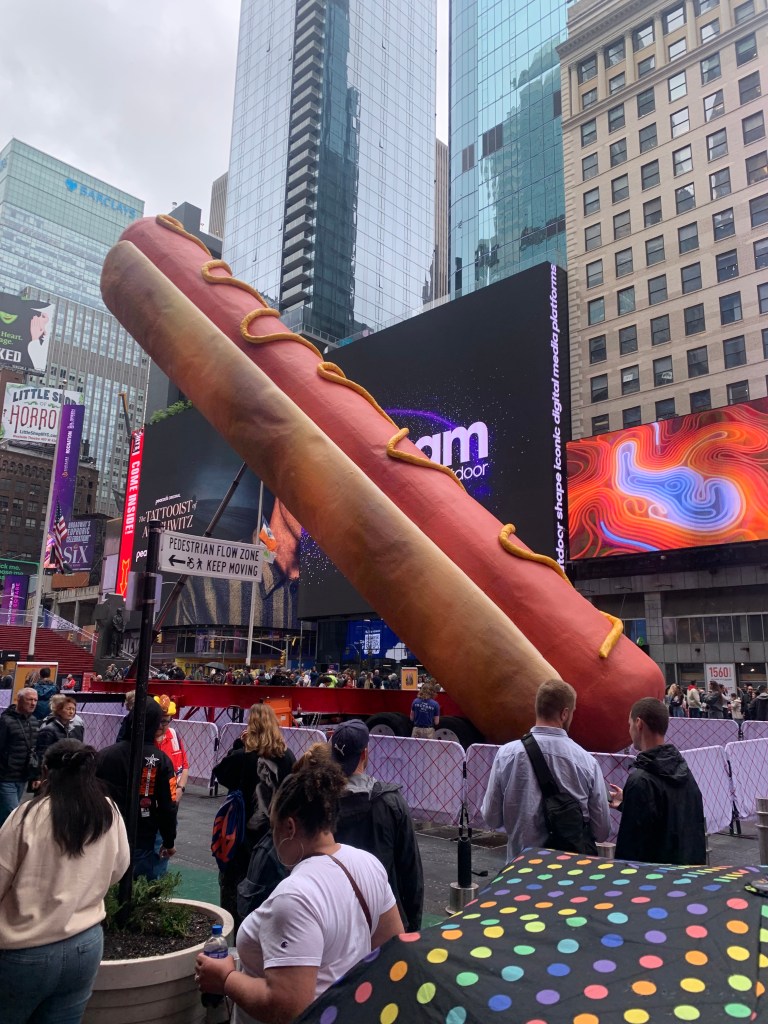
The “infamous” NY Times Square Hot Dog art installation, moments prior to its noon daily explosion
Early in the development of LED I realized that light would no longer be in the sole possession of luminaire creators and lighting designers. LED made it easy for non-lighting entities to confiscate the responsibility. Cabinet manufacturers and cabinet accessory providers offered built-in lighting. Plug-molding concerns included light in their strips. Bathroom mirrors build light directly into the mirrors and supported cabinets. Bluetooth speakers included light and light became an accent on a variety of other products. LED meant light would be embraced and in some cases abused by other concerns trying to sell their consumer goods.
At the International Contemporary Furniture Fair (ICFF) 2024 and in my visits to showrooms, galleries and storefronts across New York, this blurring of lines between lighting and “other” products was stronger than ever. Sustainability remains top of mind as well. No survey of new lighting would be complete without the recognition of exciting new designs. Following, those categories are explored and detailed.
Light + [fill-in the blank]
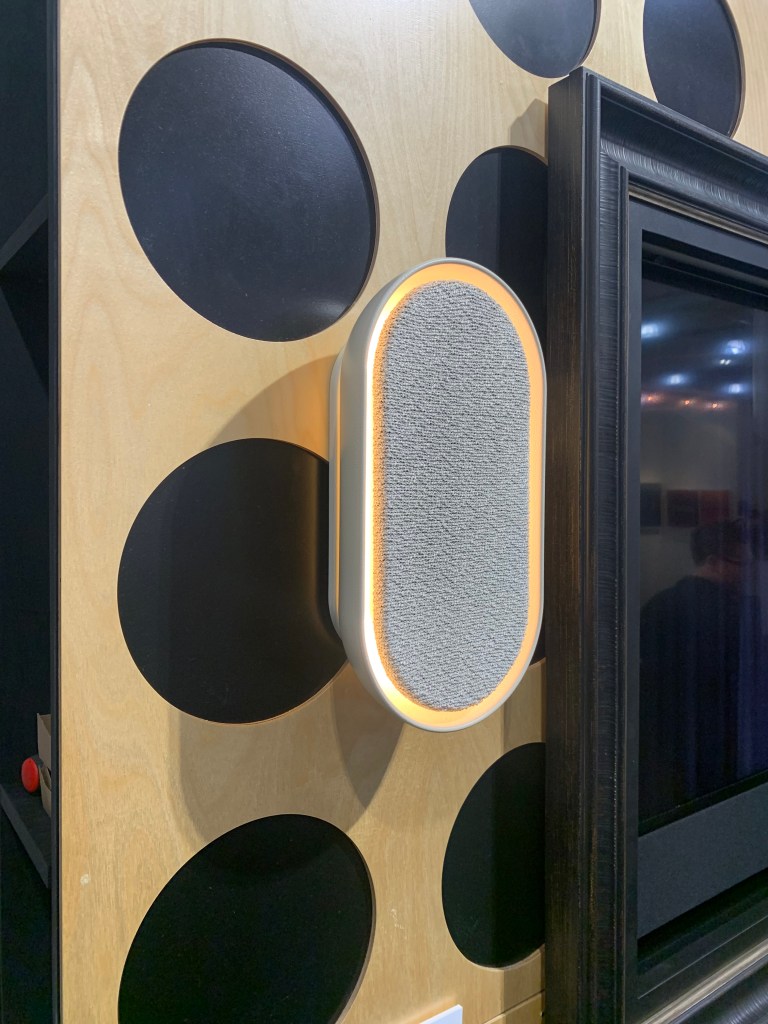
ICFF 2024 – Leon “Sound Sconce”
High quality musical sound continues to be an important aspect of homes. Many people are however, uncomfortable with the visual presentation of speakers. Speaker manufacturers have spent countless dollars improving the appearance of their product. Others have tried to find ways to hide the speaker in walls, ceilings, behind drywall and inside cabinetry. Leon builds speakers in the US and hides the functional tools behind custom screens that masquerade as artwork. They have also created a “Sound Sconce” that adds light to a wall mounted speaker. These were a nice combinations of dimmable light surrounding the linen needed to transmit sound built within a solid cast unit.
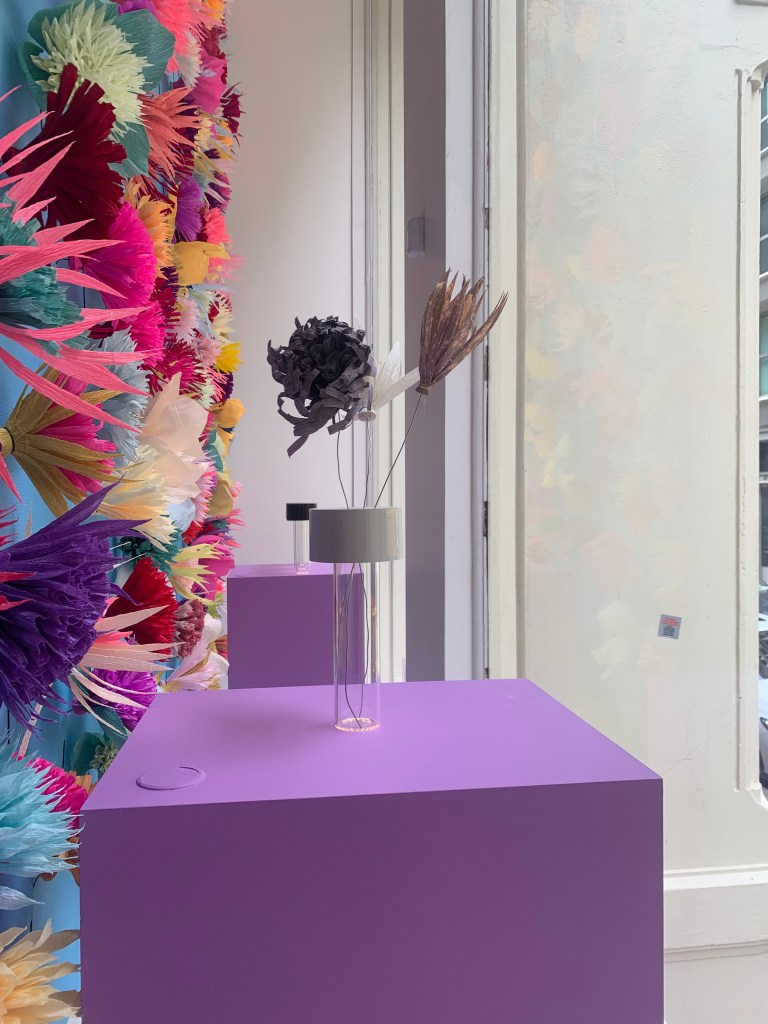
NY 2024 – Foscarini – FleurNY 2024 – Foscarini Intervallo
The new Foscarini lamp “Fleur” also wants to be a vase. The size makes it perfect for bedside, patio and restaurant use. The light plays against the tube of water and is directed downward to avoid glare.
“Intervallo,” also by Foscarini takes a fine porcelain bas relief sculpture of Madonna and Child and frames it with strips of light giving and depth to this familiar shape. In the past, light wanted to be art, now art want to be light.
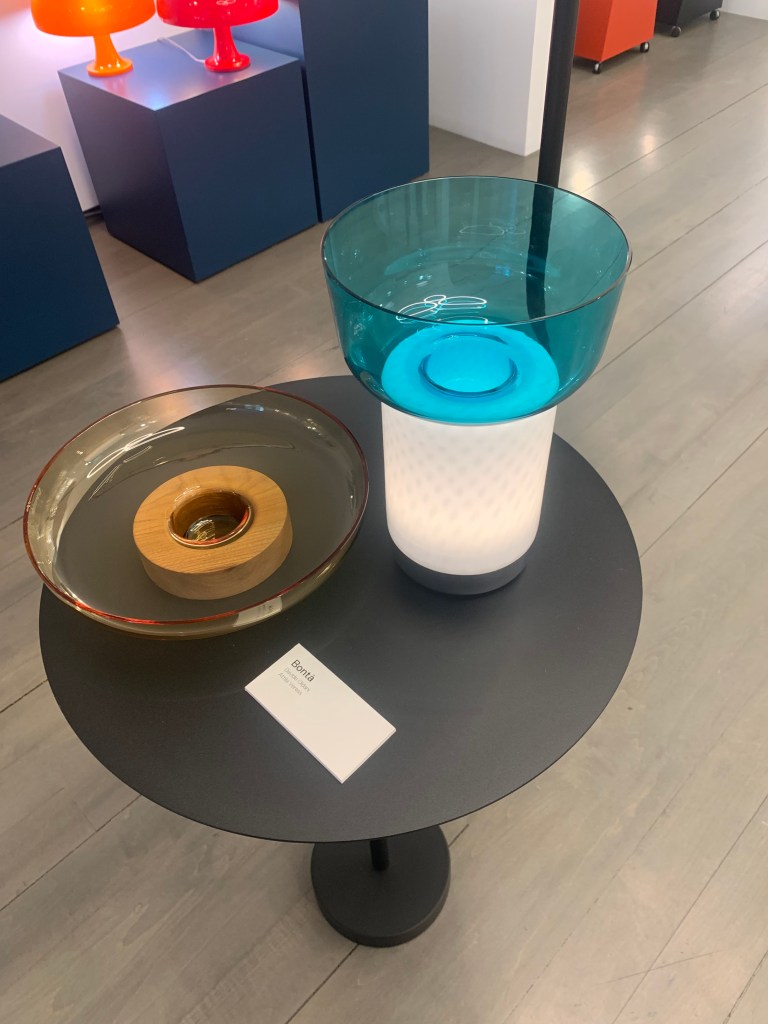
Similar to “Fleur” Artemide has developed “Bonita” as a collection of plates, bowls and bases that can also be illuminated as a lamp. The idea here is to keep a cohesive look at table settings with a mix and match approach.
This one is more complicated to explain. Arca has developed a flexible wood skin “Woowood” that “stretches” and allows light, positioned behind, to shine through. Woowood has been placed on the surface of cabinetry and walls, Slits in the material serve as pockets. The material, combined with the backlighting provides a look I’m not sure I’ve ever seen before. It was truly unique.
The line between art and lighting is increasingly being blurred, especially since the introduction of LED. LED can be hid in the smallest of spaces and used to supplement rather than undermine the work. Umbra & Lux allows light to play amongst the mobiles they designed. Who says a chandelier must be stationary? Why not a kinetic luminaire?
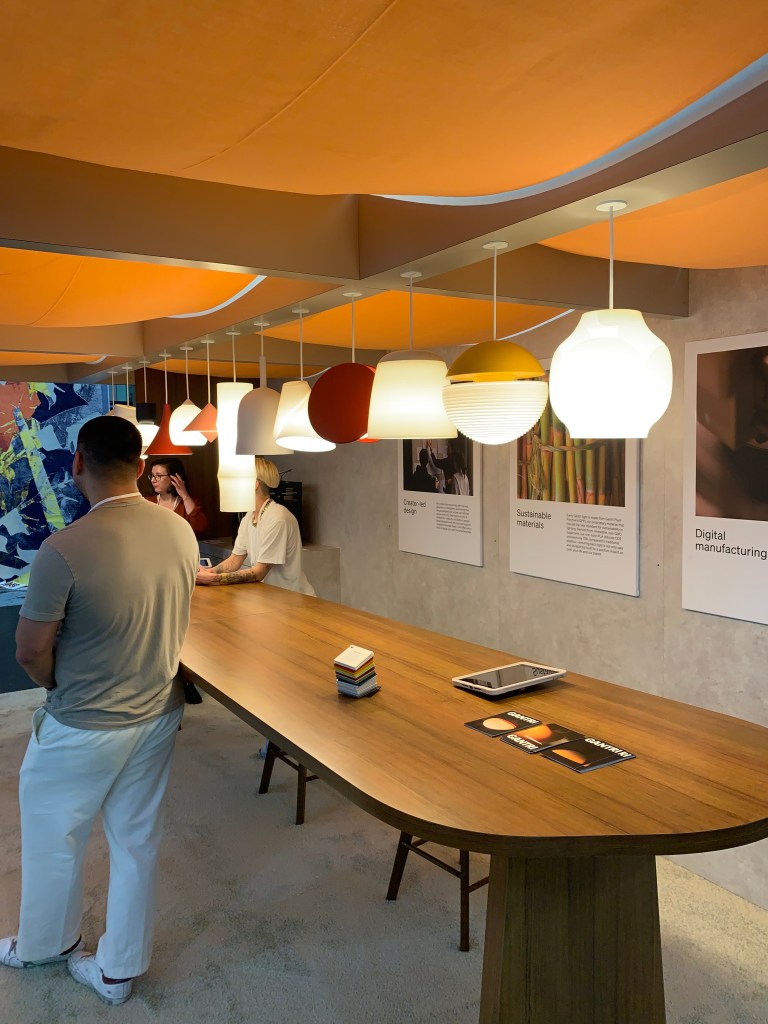
Gantri showed a row of pendants fabricated from a plant-based polymer. What made them interesting were the designs. They were a cut above the typically offered “sustainable” products. In conversation with the staff, they told me they prided themselves on their relationship with their designers. The biodegradable product is 3-D printed in California and customization is available. There are lots of interesting things to see here. I encourage you to scan their website.
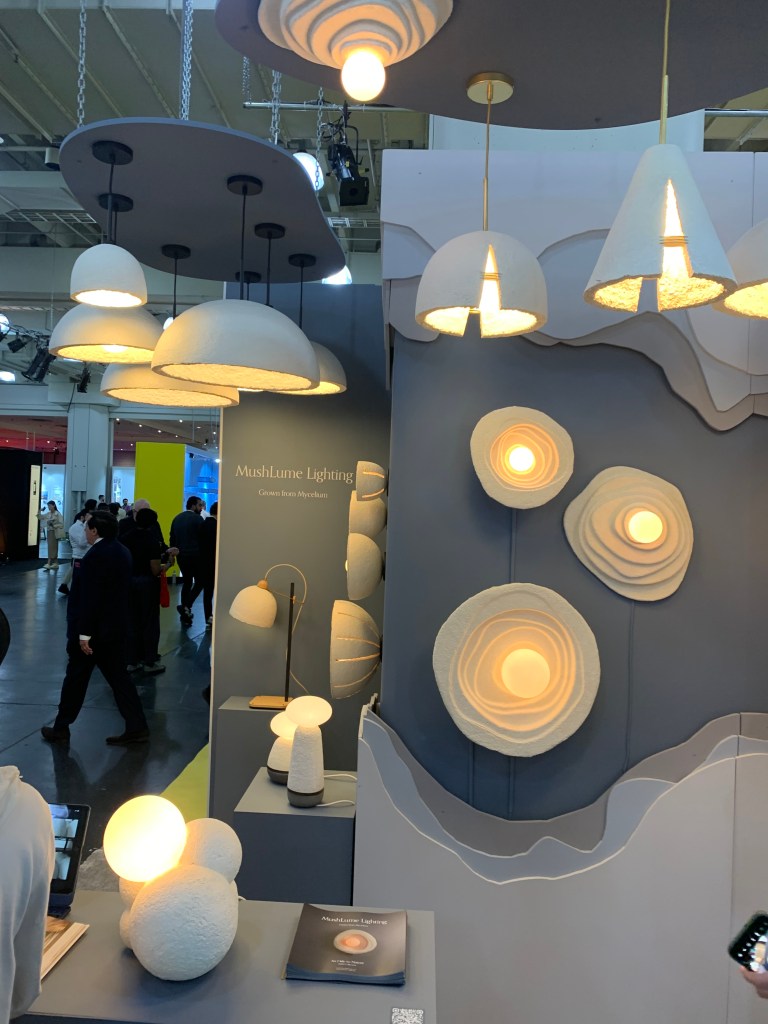
Taking a similar plant-based approach, MushLume actually grows their shades with a combination of live mycelium and sustainable hemp. The shade grows within a mold and binds to the hemp to create a solid form. Once grown, shades are dried and heated into a fully biodegradable product. These are a good look that will fit nicely into the shift toward beige neutrals we are now experiencing.
NY 2024 – New soft contemporary pendantNY 2024 – Roll & Hill – Well formed metal accents
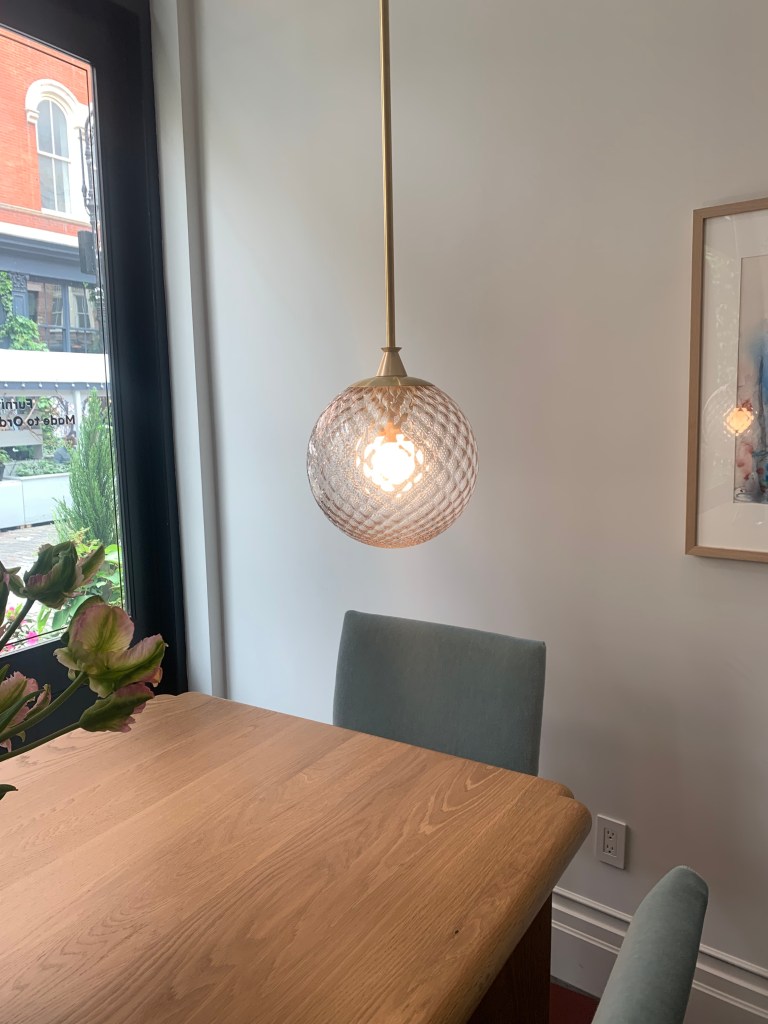
The new Roll & Hill items are neo-classic pendants that slip away, ever so slightly from their core soft contemporary design motifs. Round and Tulip shaped in smooth, ribbed and crosscut surfaces in White, Smoke or Champagne finished glass. What sets these apart are the subtle metal accents that nicely compliment the glassware.
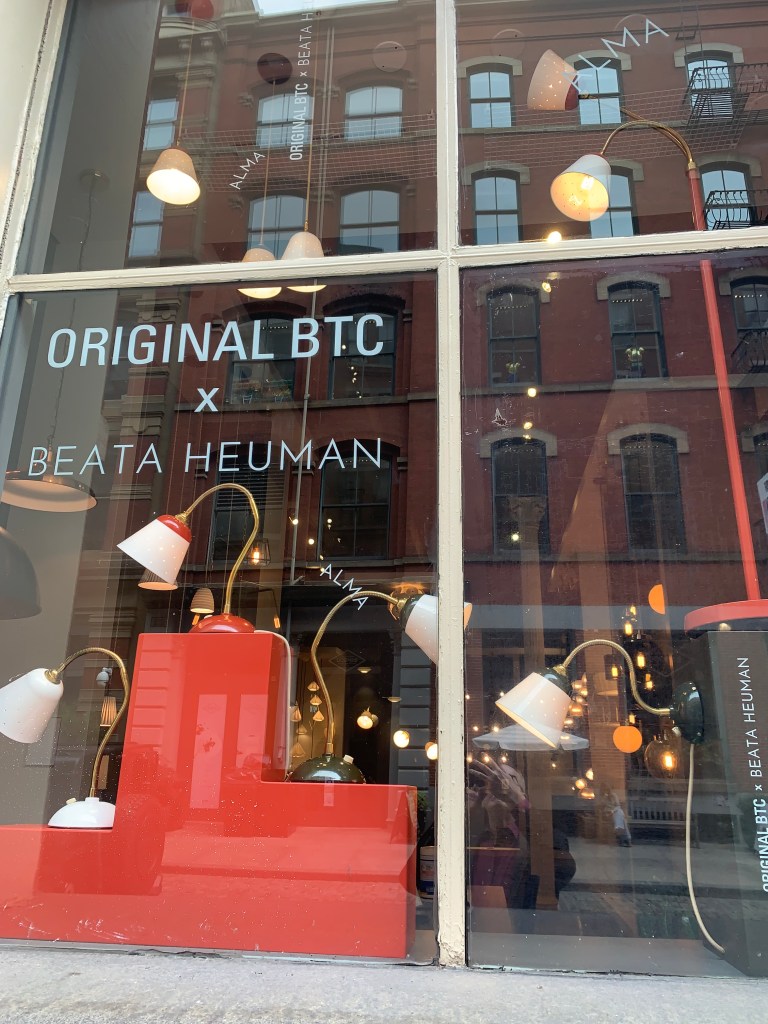
The window of The Original BTC featured the new Alma collection with a pin dot accented bone china shade. While it is a striking look, I wonder if it is a bit too dated retro feel. Much of this style has already passed us. I’ll be watching the closeout section to see if I’m right here.
The front window of the Flos showroom is filled with an all-white, bare bones (light bulb + carrier) chandelier by Gino Safatti. When I saw it, I again wondered if this type of look had already run its course. As I checked the website to insert a URL, I found the group already discounted 20%. Not a good sign.
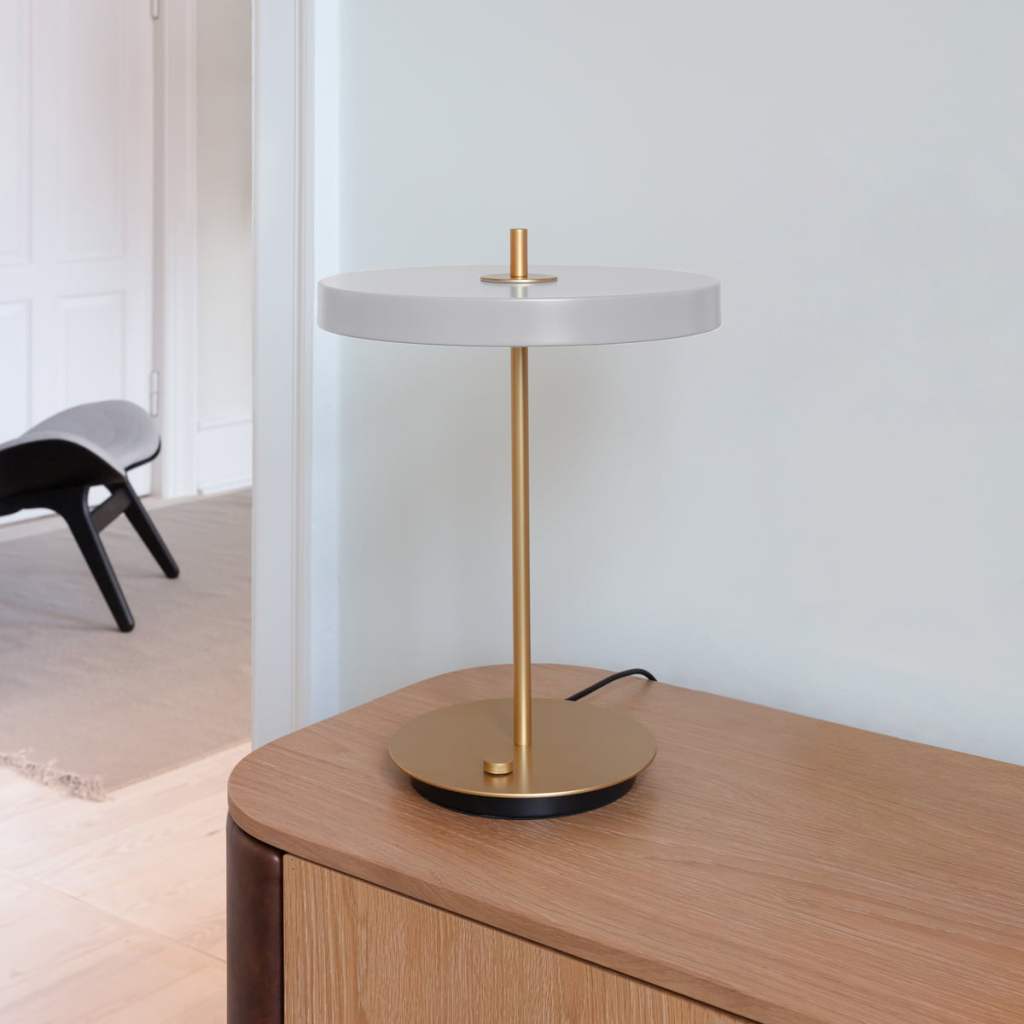
I loved the proportions of the Umage Asteria collection. A large diameter, but thin depth balances on small center column that passes through to form a finial. There are many colors and many configurations all using the same basic profile.
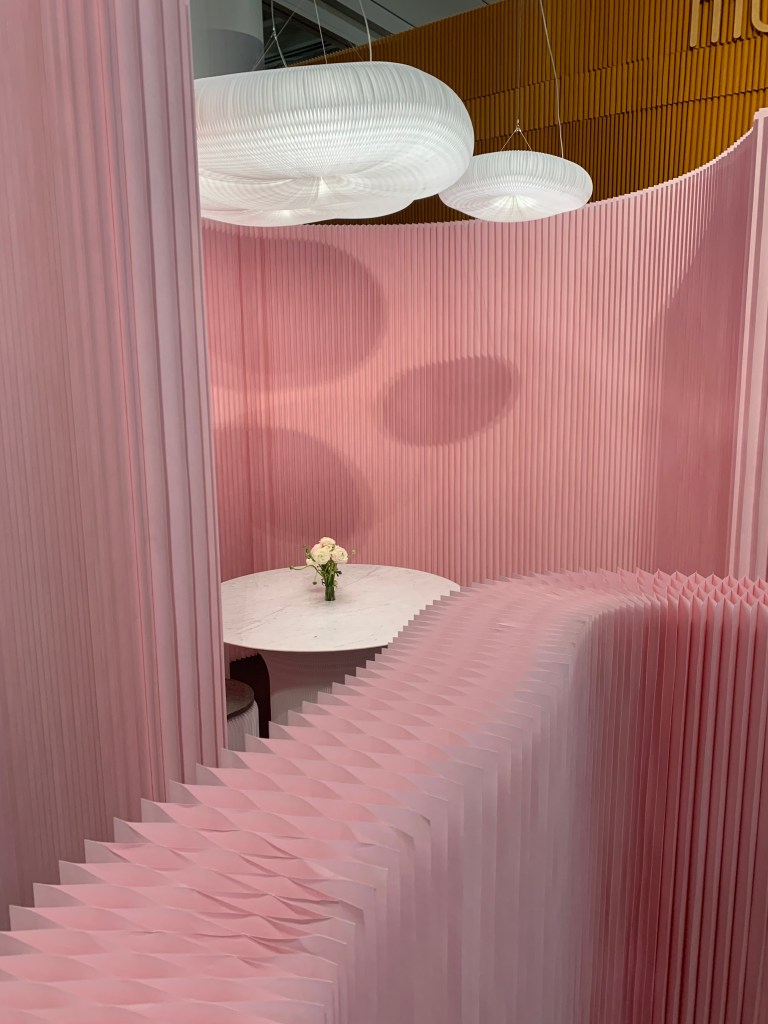
Molo has been at ICFF for many years showing their corrugated space partitions. These are beautiful honeycomb forms that sinuously wrap around and provide acoustical assistance to the created space. Using some of the same material, a collection of ethereal “cloud” pendants have been created. Like the walls, they are large, but appear surprisingly light and airy.
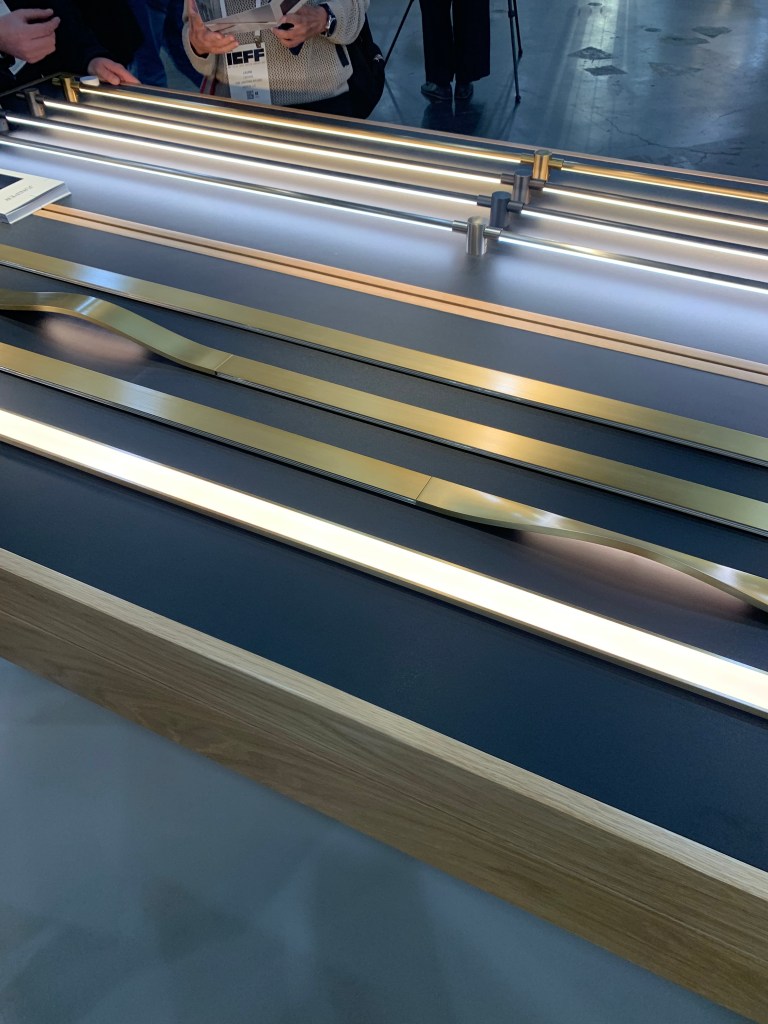
ICFF 2024 – Juniper alternate “X” track connection with illumination on the underside of the track illuminating the second trackICFF 2024 – Juniper illuminated track
Since first seeing Juniper, I have liked this brand of track lighting. The ribbon track is quite small, the magnetic element makes positioning easy and the design is top notch. This year, they have added a few additions that make employing their product much more creative. By adding light to the track, a whole new aspect of illumination is possible. Raised track sections can defy the typical “cross” installation and raised, illuminated ends allow for the addition of some whimsy. Yes, I’m a fan.
New for Pablo this year is the Stella design whereby LED is backlit on a crosshatched shade members, much like the Skynest by Flos introduced last year. Playing with the placement of LED has allowed designers to create very interesting objects.
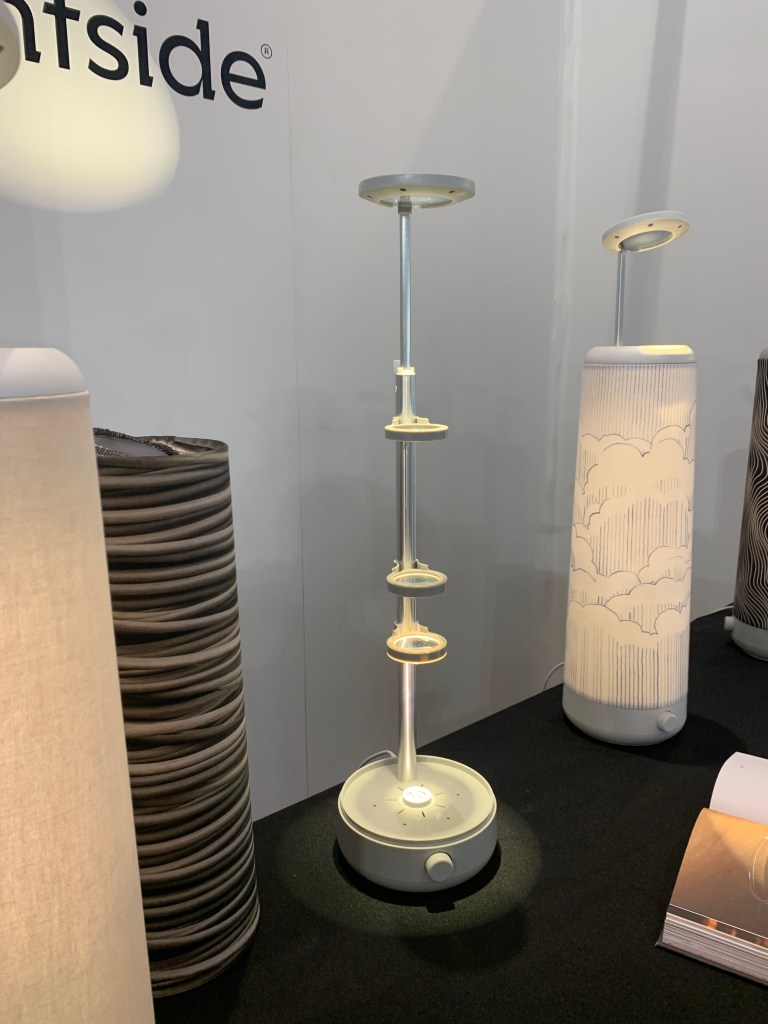
ICFF 2024 – Nightside – shade removed exposing the LED and magnifying elements hidden inside
Why not a better bedside lamp? So many lamps ignore the fact that a sleeping partner might not want the area illuminated. Many lighting designers forget that two people have two needs. The folks at Nightside have solved that problem, much like cross-lit recessed cans. The unassuming lamp features a “pop-up” reflector that allows for a pointed, unobtrusive beam of light aimed by the reader and unseen by the partner. These US made lamps consume a miniscule one-watt of energy with a clean, simple aesthetic.
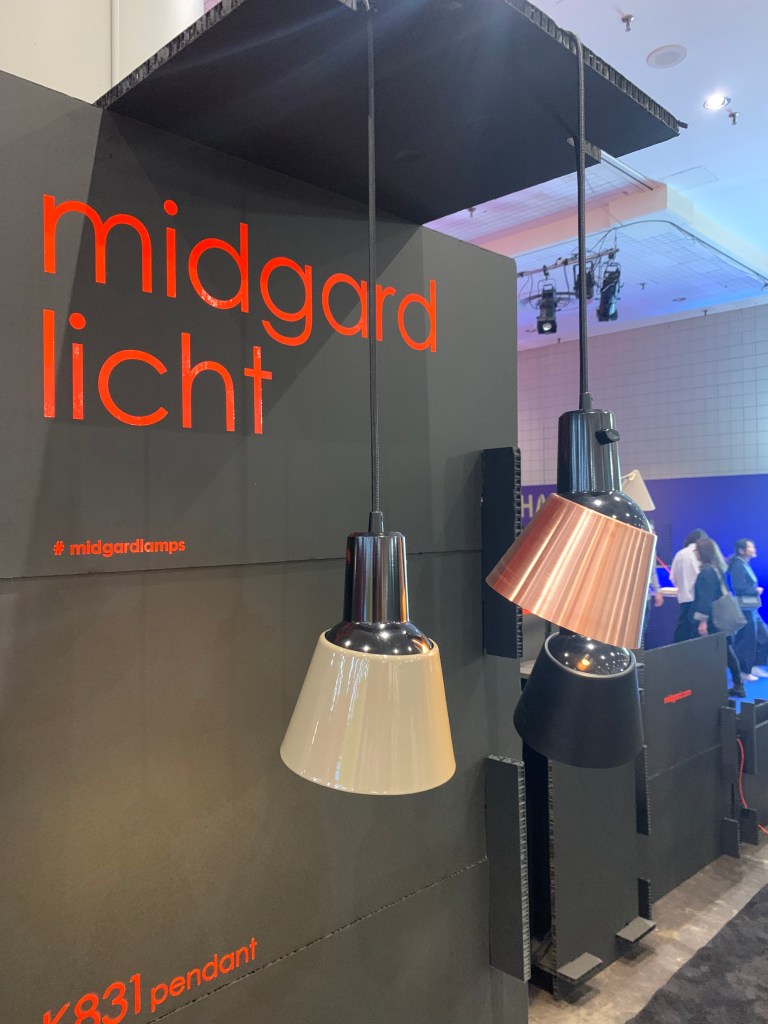
I loved the simple functionality of the swiveling lampshade on the Midgard Licht pendants and sconces. Light can be easily aimed in any direction with minimal effort, as the shade balances on a rounded carrier.
I liked the assortment of shapes and textures on the diffusers of Bright Block Studio glass. By reprocessing glass blocks they create custom output that is beautiful and usable, rather than landfill.
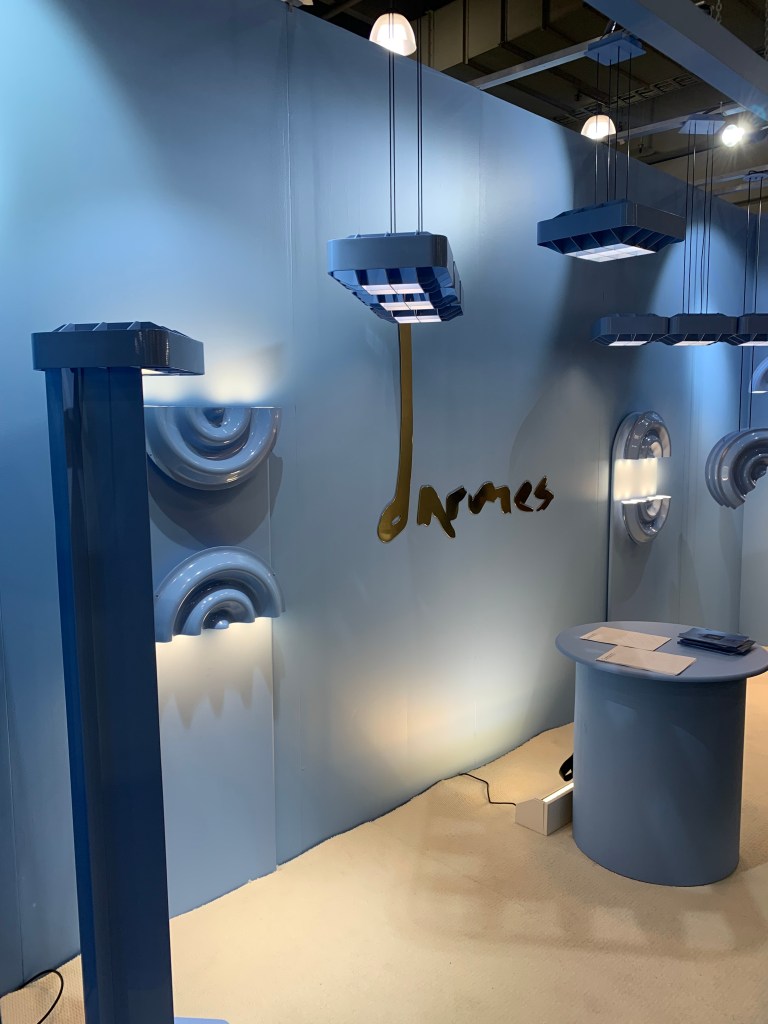
d’Armes a Quebec based manufacturer,must be given points for display creativity. Rather than trying to show all of everything they do, they elected to finish everything in their booth in the same lush blue glossy color. Because their work is available in multiple iterations, why not simply draw attention with an elegant presentation?
Like d’Armes, Tibo is also based in Quebec but their approach to lighting is slightly different. The light modules look like they could be OLED panel placed artistically across carriers and frames. This is a very “feminine” soft look that is much needed in many interiors.
By combining macramé with lighting, Ariel Zuckerman has developed a softer, more approachable contemporary. The dropped lights reminded me of an overstuffed crocheted shopping bag used by the Eastern European bubbas of my youth. Admittedly, this is a niche product and I’m not so sure I like them, but they are different and they do speak to the softening of contemporary style.
I like the blending of clean slats of aluminum, organic, geological décor and the raw glass diffusers used by Simon Johns. The glass is fired in a way to make it appear as still molten. The warmth against the polished metal is very appealing.
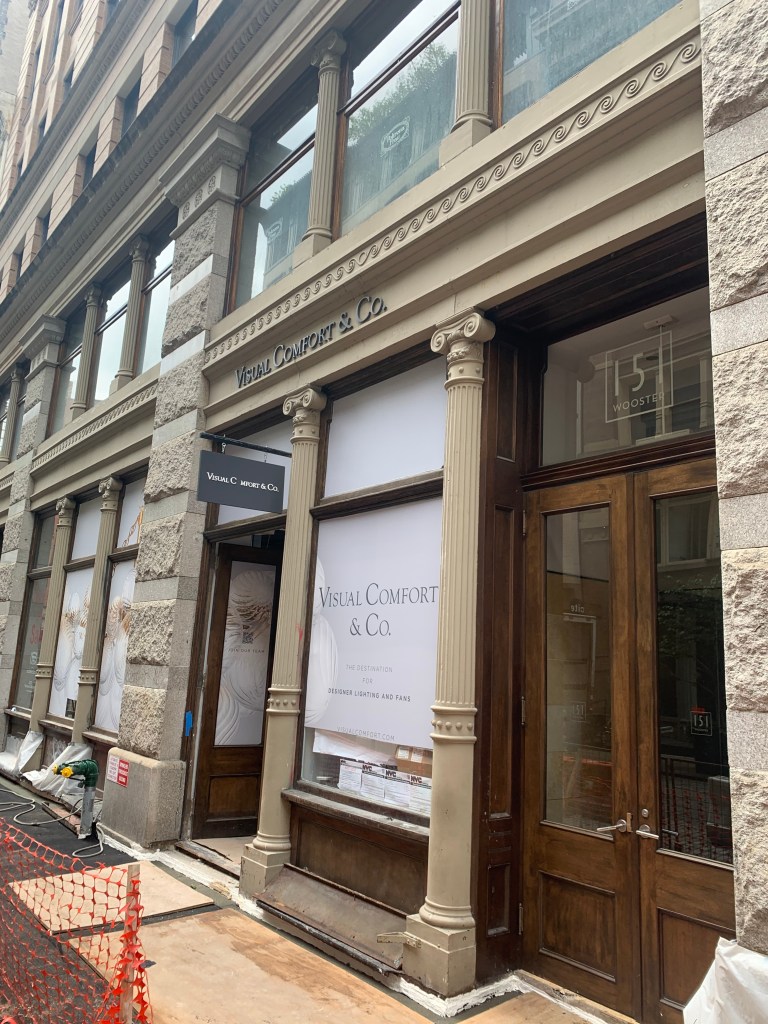
NY 2024 – Visual Comfort showroom under construction on Wooster Street in SOHO
During my walk through SOHO, I noticed work continuing on the Visual Comfort showroom on Wooster. This appears to be a reversal of the trend toward more online, less brick & mortar in the lighting business. It also upsets the retail distributor model to fit more in line with what the European and boutique brands are doing. (Roll & Hill, Flos, Artemide, etc.) It will be interesting to see how this works out for a major US lighting distributor.
As you can see, lighting is alive and well. The availability of exciting ideas continues to flow from the minds of creative people and companies. In addition, aesthetic trends are coalescing around a softer, more approachable contemporary look. All of this is good news as lighting continues ever-changing and maturing.
A friend sent me an article from the Wall Street Journal about confusing hotel light switches. (The Latest Traveler Kvetch: Hotel Lights Are Confusing by Dawn Glbertson 4-24-2024) A few sentences into the article and I knew exactly what the writer was discussing. I spent a fair amount of time traveling in China at the end of the 1990s and early 2000s. Hundreds of new hotels were being built to service the Americans who were arriving to facilitate Chinese production. Each new hotel came equipped with a newfangled feature, as yet unseen in the US. Keycard control of the suite’s AC and electricity, TV screens embed in the bathroom mirror and yes, a dashboard of light switches to control scores of luminaires were included. Each new hotel room meant an introductory ten to fifteen minutes spent trying to figure out how to shut off the alcove spot light and turn on the bathroom toekick lighting. It was always a joy walking into an old hotel with recognizable toggles. My daily tutorial could be avoided.
The article allowed me to reminisce about my days/weeks/months in China, but it also brought up the question I have asked before, multiple times, “Why do we even need light switches today?”
Whenever I ask this question, I am greeted with the same askew face and puzzled reaction. “Well, dumbbell, to turn the light in a room, on and off. Duh?”
Most people fail to get my point. We have an evolving tech industry that is intermingling with most building support equipment. They are allowing Alexa and Google Home voice-activated systems to control those products. Light bulbs are now offered that can be controlled by voice and a number of luminaires are on the market that include the same feature. What is missing is control of the “average” luminaire.
By average, I do not mean substandard, I just mean the chandelier in virtually every dining room in North America, the flush mounted piece in hallways and bedrooms and the lights at every bathroom mirror in every house. These products are not “Smart.” Because they are so “normal” most consumers do not expect them to be voice-control compliant. They expect control to be handled by a separate switch, as they have since Thomas Edison.
The easier control would be a “node” wired between the luminaire and the house wires. It could be included with the luminaire or sold separate. Its job would be to communicate with the voice system.
“But Why Bother, Jeff?”
The WSJ article explains that many hotels do not always use a panel of controls because older hospitality rehabs would require too extensive a teardown to run wires from control panel to luminaire.
Think about the labor and cost required for a light switch. A switchbox must be assembled to a structural stud. Wire must be run from that box to the luminaire outlet box. If this is a three-way assembly, tracer wire must be run from switch number one to the second switch. More would be required if 4-way or 5-way configurations are planned. As the article intimated, lots of wires would need to converge at a bank of toggles, bedside.
A hole must be cut into the drywall to accommodate this box. When the walls are painted, trim painting around the box takes longer than simply rolling or spraying a flat, straight wall. The electrician must wire the control switch. A decorative plate must be screwed onto the switchbox. There are material costs, labor costs and time to facilitate lighting control. Multiply this by every room and the dollars add quickly. Frankly, I’m surprised production home builders haven’t pushed this in their constant effort to reduced costs. A home-wide voice system would be less expensive than the box, wire and switch material costs, plus the labor saved by electricians, drywall installers and painters (even further savings would be had if the wall were tiled or papered.)
So What is Stopping Jeffrey’s “Brave New World?”
Two major factors seem to be the stumbling block for a quicker adaptation of switch removal.
Whenever I mention this to other lighting folks, I’m told the “node” exists, but I’ve not seen one, if it is, it is not widely distributed. Perhaps it is not small enough to fit in every luminaire canopy or outlet box. I’m waiting for the theoretical, “Apple iVoice” module to be mass-marketed. Then perhaps, we’ll start to cook.
Including the voice-control with the luminaire might not yet be financially feasible, but manufacturers will need to watch and react quickly. Again, builders could drive this demand. There will be a tipping point, much like we experienced with LED, where the cost and availability of a connected luminaire will make far more sense than a luminaire and switch.
“But, But, What If…?”
Many people cannot envision a world where switches would disappear from their walls. Whenever I mention this, the “what-ifs” start pouring from people’s lips. “What if the internet goes down?” “What if the electric fails?” “What if the “node” dies?” and on and on.
Yes, things may happen. Everyone has a mobile phone, in some cases it is their ONLY phone. Sometimes the supporting cellular network fails. How often? Rarely, but it happens. How often does your home internet fail? Occasionally. That has not stopped most people from using home computers and even transitioning to “work from home” employment, totally reliant on technology at a much more substantive level than a light switch. There are countless other examples where we abandoned one old system and replaced it with a more technologically streamlined method. Who among us, of a certain age, did not initially serve as our parent’s personal television “remote control” before it was actually a stock feature of even the least expensive flat screen on the market. We only need to think in broader terms. How many people still have a telephone hanging from the wall in their kitchen? Fewer and fewer.
Challenges
Perhaps the biggest challenge with greater voice activation is naming. When we had a single luminaire in each room, the voice control naming would have been easy. “Turn on bedroom light.” “Turn on bathroom light.” With a wider variety of lighting options, more succinct naming will be required…and remembered. Expect to see hundreds of magazine and online articles with naming convention suggestions.
If we go back to the hotel analysis, hospitality suites might come equipped with a posted naming “cheat sheet” so each guest will understand the exact name for the lights under a vanity or the recessed can in the shower. Hospitality managers might also be well served in setting an assorted of typical scenes, such as “Nighttime” which might shut off all lights except the bathroom toekick lighting. As users, we will grow accustomed to the new concept, just as we acclimated to automobile seat belt warnings and legally turning right at an intersection, when the traffic light is red.
Sure, many will simply want to avoid all of this. That’s ok, it doesn’t make them Narendra Modi voters. Like the old electricians who didn’t want to bother with LED, they will disappear and be replaced with a larger population who currently interact with their automobile and most customer service bots via voice commands. Illuminating a room can be as easy as saying, “Dining room chandelier, on!”
Photo by u0415u0432u0433u0435u043du0438u044f u0415u0433u043eu0440u043eu0432u0430 on Pexels.com
I regularly read a newsletter about lighting, Light Now published by my friend David Shiller and his consulting organization, Lighting Solution Development. I urge you to do the same. (https://www.lightnowblog.com/ ) There is always great information and insight. Often times, it is research you didn’t know you need to know. In a recent post, Light Now pointed to new research on “why flying insects gather at artificial light.”
When LED was new I delivered hundreds of educational talks about this newfangled technology. As people learned more about it, better, more pointed questions would be posed. Through one of these queries, I was compelled to understand an insect’s attraction to light and laissez faire reaction to LED light. Why? I quickly learned that bugs are not actually attracted to light, but instead the infrared glow of a heated incandescent light bulb and the hot metal surroundings of the luminaire. LED do not emit any light in the infrared spectrum and the low heat produced by LED barely warms the surrounding lighting fixture. If you were the moth’s version of SNL’s Stefon, pointing out the “hottest new club” in the neighborhood, it would not be located at the newly installed LED outdoor wall bracket. All of the “cool moths” are of course, still hang around the IR rich, incandescent lamps.
That explained the attraction, but not the kinetic action of the flying insects. This new report finds that when the insect “sees” the artificial light, it assumes it to be natural light. In their world, light is overhead and dark is below. The movement is the insect’s natural reaction to place the light in the right relative location, at their backside. Flying bugs are actually backing into the vertically installed luminaire and erratically circling the light with rises and dips.
I’ve written a few posts about sustainability and our responsibility as lighting professionals to “do the right thing” with light. The way we add light to the human environment has a tremendous impact on the animal population. This scientific research points out that even an insect as simple as a moth understands the proper position of the moon and the darkened land at night. Their hysteric dystonia is an effort to correct something which in their mind must be of their doing, not the peculiar humans who cohabit their neighborhood.
Artificial light has been around for as long as humans have employed fire and will remain for as long as humans exist. We could simply ignore the problem, but the natural balance of life will be tipped. When adding light to the nighttime, think about neighboring wildlife, plant life and aquatic life as well as the human client. While small, we shouldn’t forget bugs, either. Mother Nature will thank you.
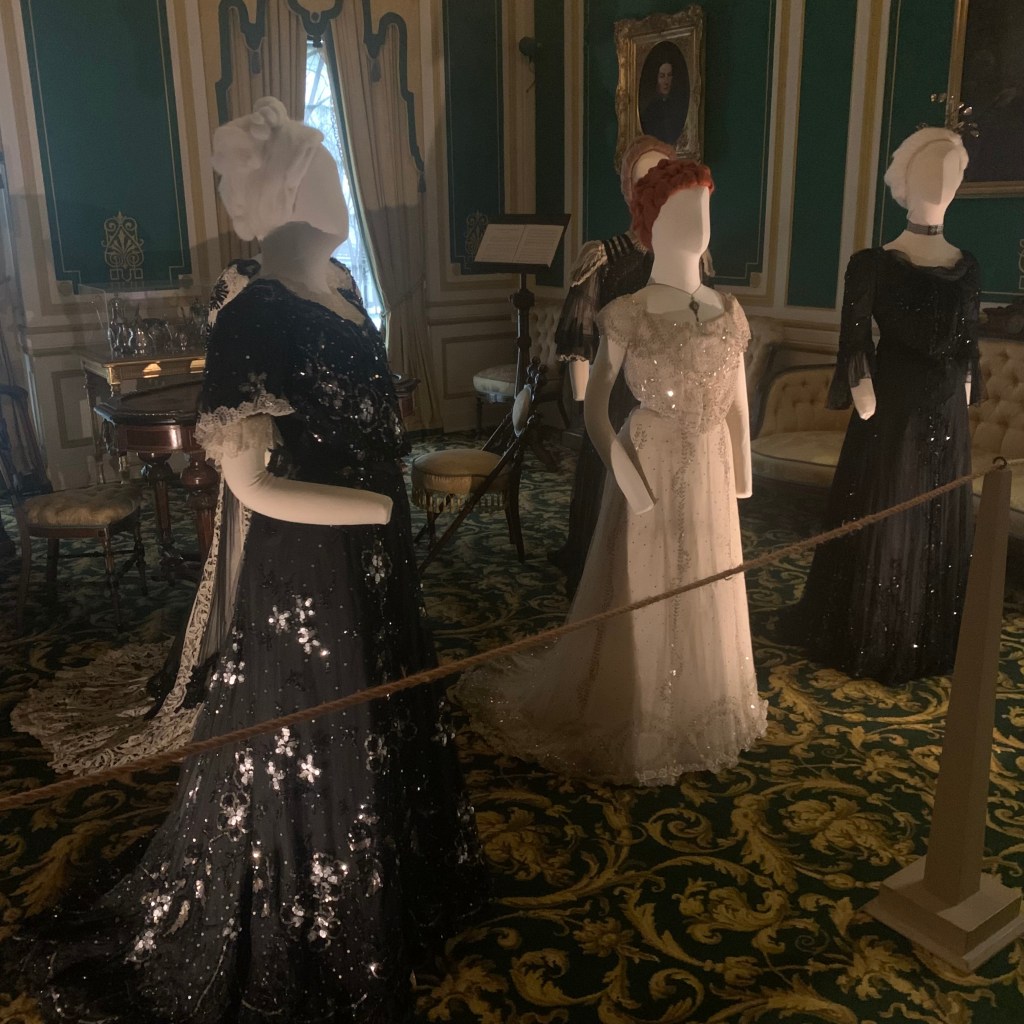
Western Reserve Historical Society – Cleveland History Center – “Fashion After Dark” Exhibit
Viewing the show, “Fashion After Dark” at the Western Reserve Historical Society – Cleveland History Center, forced me to remember the famous (infamous?) dress that “changed colors” a few years ago. Depending on who was asked, a black and blue dress looked gold and white or many shades in-between. While there remains conflicting opinions on “the dress” all of the theories center on human perceptions of color. Through a combination of light and the brain, via the photoreceptors in our eyes, we see color. Most of the time, it works without a hitch. Sometimes we see different things.
In subsequent experiments, when viewed under warm light, most people agreed it was a blue and black dress. Under cooler color light, everyone saw white and gold. Light has a tremendous impact on how we perceive color and that statement was the premise of the museum exhibit.
Beginning in the 1840s, the moneyed class was introducing gas lighting to their homes. Gas light was brighter than candlelight and the flickering variations delivered a unique atmosphere not experienced before. In the 1890s change was again afoot when gas lines were switched to electric and incandescent lamping presented another different illuminance. Outdoors, arc lighting illuminated the porte-cochere entrances of theaters, the orchestra and opera, yet another variant to artificial light.
The couture designers of the day realized they could take advantage of each of these changes in lighting. Fabrics that had been created, but rarely used, were now rising in popularity. Watered Silk (moiré) and taffeta delivered a subtle movement that provided an intriguing shimmer in gaslight. The application of sequins, rhinestones and jet pulled small slices of available light and presented multiplied glints of dazzle that drew attention to the wearer. Lamé fabrics likewise reflected and magnified glistening light across the entire gown.
The problem for the society women of the 1800s is the same one that faces all of us in the new world of LED lighting. The type of light we use impacts our color perception. The best local lighting retailers have “lighting labs” that help the consumer understand what they are buying. Most commercial lighting installations are preceded with a test, or in situ model that proves what the real installation will look like. Dress and fabric shops of the era featured evening hours and artificially darkened rooms so the materials could be best appreciated.
When my wife and I were rehabbing our second house, we used a purple and green theme in the master bedroom and wanted a VERY subtle violet on the wall. We selected the quietest tone we could find among the thousands of paint swatches. When we painted the walls the minimal amounts of daylight and deep purple (no heavy metal implied) carpet magnified the paint to such an extreme that I was forced to have the paint remixed with half the pigment, resulting in the room we had envisioned.
The importance of paint, countertop, tile, cabinet and fabric selection in the planned light and space cannot be overstated. LED light will likely function for the whole time people typically live in a home. It also presents colors in slightly different ways from incandescent, halogen or fluorescent light. The addition of daylight will add yet another element to the discourse. Taking a clue from 1800s couture can be a smart way to insure the maximum impact of an aesthetic choice.
Coda
One additional point about the exhibition must be noted. To replicate the visual fluidity of gaslight, flickering LED light was used in the exhibitions, placed just as they would have in the residential dining rooms, reception halls and ballrooms of the day. Wall sconces, table lamps and chandeliers illuminated the gowns. This was a wonderful way to help curators tell the story. Pumping natural gas into a museum of flammable collectables could never be considered. The breadth of LED continues to amaze me and I know applications will only grow in in the future.
The Mantis Shrimp and their dozen photoreceptors Photo by William Warby on Pexels.com
I recently finished reading An Immense World by Ed Yong. The book covers an overview of how animals use their senses in substantially different ways from humans. Some of the information is well known. Dogs have a sense of smell that is somewhere between 10,000 to 100,000 time better than humans. Bats use an echolocation “sense” to navigate at high speeds in the dark to locate miniscule flying game. Birds of prey (eagles, falcons, etc.) have superior eyesight that allows them to see forward and sideways to best home in on a meal. The book however goes deeper and helps the reader understand that most every “superiority” is balanced.
The dog has a remarkable sense of smell, but their eyes have only two color photoreceptors, so their world looks different than what humans see. Humans have three photoreceptors, a handful are tetrachromats with the benefit of four (I wrote about this phenomenon in a previous post: “Tetrachromatic Vision” https://lightingbyjeffrey.com/2022/05/09/tetrachromatic-vision/ ) but the mantis shrimp has TWELVE photoreceptors! Wow! You’d think their sight was miraculous, but alas, they have a tiny brain (brain size and functional capacity is a crucial piece of data in these analyses) so rather than witnessing colors beyond our imagination, they use the twelve photoreceptors as a type of binary coding system. If, for example photoreceptor one, three and eleven are triggered, they know prey is within reach. If photoreceptor two, eight and nine send feedback to the brain, it is time to move, an enemy is near. All benefits are balanced by Mother Nature.
Humans are sighted creatures and we regard the world based on sighted preferences. (I wrote about this in yet another post: “Eyes, Light and Sometimes, Brain” https://wordpress.com/post/lightingbyjeffrey.com/684 ) When we do that, we ignore the needs and demands of the other animals who occupy the planet. Even other animals who enjoy sight as their primary sense, do not use it in the same way as humans. Owls need dark nights to survive. The lack of light and their ability to see in it, sustains them. Bees have three photoreceptors, but because they can see UV light, the three receptors read different information and feed that back to the brain, so their color palette is radically different from ours.
Humans have risen to the top of the community of earth’s animals and our single-minded concern with human need is unfortunately harming the greater animal community. This summation ended the book. The human need to illuminate “everything” is doing irreparable harm to other animals. It is only getting worse, despite an avalanche of data on animals and their worlds. We read books like An Immense World and still increase street lighting, parking lot lights and high-rise building illumination. After becoming enamored with the content of the book, his plea to the reader is for some kind of action.
As a lighting community, we can do better. I’ve just looked at a wide variety of new luminaires released at the January Dallas Market and still we offer light aimed up into the sky where it does no good and only delivers harm to plants and animal. We use lumen levels way beyond what is necessary and that color of light is often blue, not only bad for humans, but many in the animal community are likewise impacted.
Can we help? We are in a unique situation to do just that. We can’t help much directly with pollution, micro-plastics in the oceans or noise levels that also impact, confuse and confound animals, but we can control light. That’s what we do as lighting professionals. Could we start to include concern outside of our genetic spectrum in addition to the color spectrum?
The Cleveland Museum of Art holds, what most experts believe to be one of the best collections of Asian Art in the world. The post WWII Curator-Director, Sherman E. Lee made important connections throughout the continent while serving there in the military during and after the war. Those connections proved invaluable as the museum ramped up the department. Special Exhibitions of the collection are well attended and always of interest. In the latest, “China’s Southern Paradise: Treasures from the Lower Yangzi Delta,” I saw something I had never seen before.
The lower Yangzi was a crucial center for the trades, craftsmanship and production for centuries. It was close to water, fertile land and necessary raw materials. Unfortunately, working in this era was still difficult and the climate is often humid. To keep the laborer cool, a bamboo “sleeveless garment” was created. That piece, in remarkably good shape was included in the exhibition. Small 1/16” diameter by 1” long segments of bamboo reeds were strung together in a diamond pattern. The undershirt created a layer of air between the skin and fabric, thereby helping to keep the worker cool. I was amazed by this utilitarian object, far more than the decorative ceramic vases, jade carvings and fine scroll paintings.
Keeping cool has always been the goal of LEDs. Like the creation of an elaborate woven undershirt, a fair amount of time (and money) has been spent insuring that the LED is operating at peak performance in lamps and luminaires. But what if we didn’t care? What if we allowed LEDs to “run hot?” What would happen?
The short answer is what we are now seeing in many LED replacement lamps, premature death. In an effort to cut costs, long hours of life have been sacrificed. Rather than the 40,000 to 50,000 hours of expected life, most commonly available light bulbs are now promising 15,000 to 20,000 hours. There is a belief that consumers are “OK” with lower levels of performance. Decisions have been made based on this assumption. To establish lower replacement lamp costs, forgo the “costly” heat protection components and shorten life expectancies.
I worry about what’s next. As we become accustomed to LED light in our homes, will we see lower lumen output next, like the shift from 120V to 130V on budget incandescent lamps a few decades ago? Will lower levels of color rendering be tried? Sure people with higher levels of color sensitivity will see the differences, but almost 85% of the population won’t. That might be worth the gamble.
I believe this is setting the stage for the creation of a “GE Revel-type” LED lamp. If you’re not an old codger like me, in a world of 25¢ light bulbs, GE determined that some people (15% of the population?) would spend more money (four to eight times more!) for better quality light bulbs. I have no way of knowing, but this had to be a profitable decision. Revel lamps were still available last year before the exit of incandescent.
I look forward to longer life, better lumen output and higher, more consistent levels of color across the spectrum in my light. I’d be a customer. For those features, I’ll gladly pay more. Now, swapping out my Banana Republic tees for a bamboo version…maybe not so much!



















 Lighting by Jeffrey