
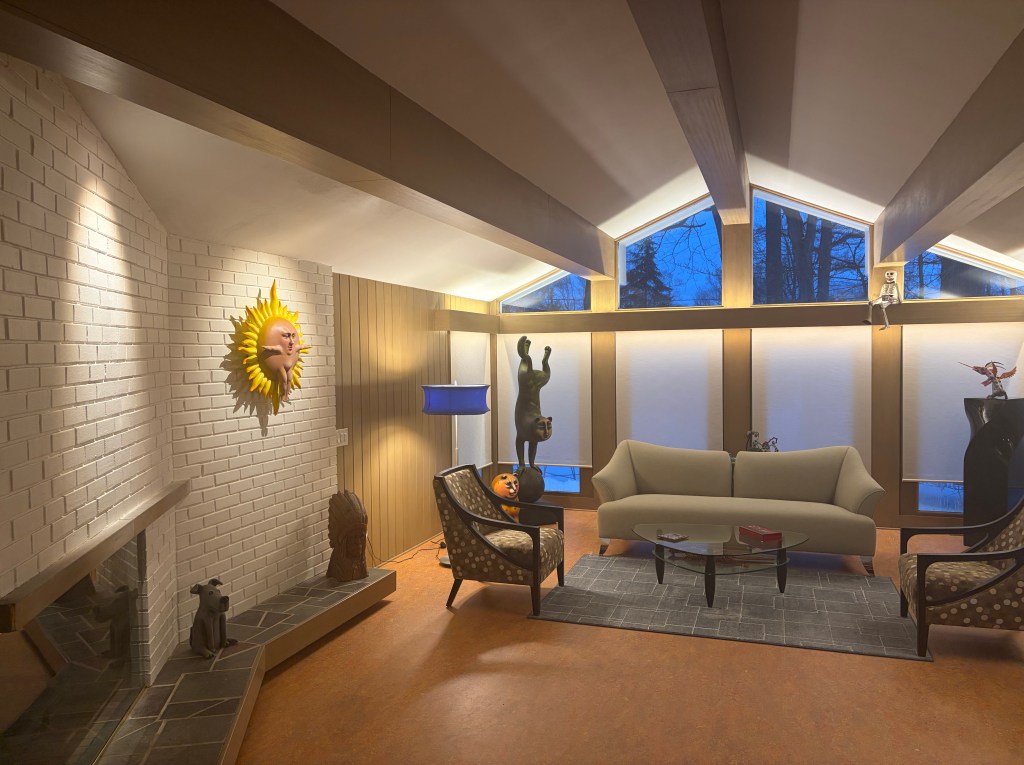
If you’ve read any of my recent blog posts, you’ll know, my wife and I just moved into a new, rehabbed mid-century ranch. The house was rat-infested, filled with mold, had holes in the roof and otherwise, only partially functional. My wife likes to say, “We built a whole new home inside an existing shell.” While that may be true, we were careful to maintain at least 90% of the original character. Walking into the front door, all of the living spaces are exactly as were envisioned in 1957. Sadly, an original bathroom could not be saved as water leakage compromised the supporting floor joists underneath. 1980s era remodeling of the main bathroom and kitchen were not worth the effort to save. We think the house is now a perfect blend of reverence to the past and functionality for today and tomorrow.
Because the lighting and electric was barely viable, up to and including problematic Federal Pacific electric panels, a full rewire with all new lighting was required. This has allowed me to make some observations about the state of residential lighting, at least in this one small instance.
I have been involved in lighting for over fifty years, so I’ll add two provisos. First, I spent more time than the average homeowner thinking about the lighting I wanted and where I wanted it placed. Secondly, I probably used more lighting than most remodelers or designers would typically specify. That said, I believe I have created a nice lighting design for our home and I have solved the consistent lighting complaints we both lived with in our previous homes and their rehabilitation projects. In addition, while our vision is good right now, statically, more and better lighting will be needed as we age. It was easier to add the light at this juncture, rather than later, when we’re less suited to deal with it.
Some Stats
- 26 outlet box mounted luminaires (12 of which are utilitarian flat-panel flush mounted luminaires plus 2 monopoint spots.)
- 52 recessed units and recessed housings
- 223 feet of LED Tape (four different types)
- 32 lighting strips totaling 71’-0” illuminate the clothes closets
- 15 remote power supplies (for tape and lighting strips)
- 14 step lights
- 4 exterior spots
- Scores of cables, connectors & clips, for the assorted lighting systems
Stat Calculations
- 28% of the fixtures purchased were outlet box mounted
- 72% of the lighting was a functional systems, placed in, above, below or behind architectural elements of the structure
- 29.6% of the budget was spent on outlet box mounted lighting
- 70.4 % of the budget was spent on functional lighting
- If we include the utilitarian, surface-mounted items as functional lighting, that number jumps to 76.7%
Project Stats
- 2600 square feet of livable space (includes a basement studio/office/entertainment space) 3105 square feet includes garage, which was also lit.
- 2902.18 watts are consumed if ALL luminaires are engaged
- 0.93 watts of lighting energy per square foot
- 7% – percentage of total budget was dedicated to lighting. If initial cost of the building is included, (this was a rehab) the number falls to 5.6%.
As I look at these numbers, they reflect what I have suspected and mentioned here over the years.
- Functional lighting is heavily outweighing decorative lighting in quantity, dollars and impact to the room at a pretty substantive level.
- As a percentage of new home or remodel budgets, lighting needs to be increased. I suspect my number, at 5-7% is higher than most. Many people believe 10% is a better number. The electricians on the job parroted that, indicating our house was the most involved they had ever done. While there was a room or two in their past, a whole-home of correct lighting hasn’t been normal. That means, there are a lot of poorly illuminated houses out there.
- Despite my large number of lighting options, my watts/square foot umber fell below most averages of 1.0 to 2.5. Not where it needs to be if I wanted LEED, or some other energy saving certification, but pretty low. (More on this point in the next blog post.)
When I started work in this field, well over 90% of lighting used in a home was outlet box mounted decorative. A handful of recessed pieces were used in select spots and undercabinet lighting was, if used, fluorescent strips. 2’-0” x 4’-0” fluorescent boxes in the kitchen were soon replaced with a grid of 6” recessed cans. Bedroom bent glass was replaced with bowls, then ceiling fans. Hallway bowls were swapped for more recessed. Now, many bath strips are being supplanted with illuminated mirrors. Fluorescent undercabient was replaced with Halogen, then Xenon and now LED Tape. The ease of LED Tape, to say nothing of the reduced cost, has made accent lighting much more viable. All of these transitions are visible in my “real world” lighting installation. Are we, as professional lighting people dedicating the correct percentage of our efforts to the right categories? I’m not sure we are. We seem to spend an inordinate amount of time on decorative products and not enough on functional.
I also worry about our failure to push for better lighting. I often play a game when the new issue of Architectural Digest magazine arrives. I count the visible, decorative lighting fixtures in each article/issue. The number was shockingly low when I first started. As we moved toward the minimalistic 2010s, it got even smaller. Recently, the number is increasing because designers are doing exactly as I expected, they are featuring one or two key luminaires in a space. Lighting fixtures have moved from functional distributors of light to art that also provides some light. What hasn’t changed is the overall poor lighting found in almost every article in the magazine. If you’ve made it into Architectural Digest, there is no question, the design and implementation of the space is breathtaking. The furniture, wallcoverings and window dressings are flawless. You can’t help but be envious. Look a little deeper and the lack of usable light in the majority of the rooms is astonishing. Millions were spent on the redecoration, but only a couple of thousand dollars was spent on lighting that will allow you to see the space and live in the house.
The lighting design I provided for our new/old (last) home solved multiple problems, too little light, too much glare, poorly located lights and light oblivious to our security needs. Combined with a home automation system, the home lighting functions almost without our intervention. To achieve that, more systems-based functional lighting was needed than decorative outlet box mounted products. I’m not sure I’m an anomaly. As an industry, are we balancing this need correctly? All we need do is check out the statistics.
 Lighting by Jeffrey