
Since I have spent time trying to understand the health implications of light, I have read scores of scientific reports on the subject. The work of Dr. Mariana Figueiro is of course very central and most people in the lighting industry have had the privilege to read and listen to her talk about practical solutions for light and health. The name that comes up second is Dr. Martin Moore-Ede. He has probably been a louder voice with a perceived higher level of worry about the new LED and how they interact with human health.
His most recent realm of concern has been aimed at how LED manufacturers achieve more (and more) efficient LED light sources. He believes that the newer LED are eliminating output in specific color ranges to achieve the required efficacy. By so doing, the human body is not receiving enough light to satiate the demand of certain opsins in our body.
As you know, I’m not a doctor. Lord help us if indeed that were the case, so I’ll try to explain this as simply as I can, one lighting person to another. If you’re a doctor or a scientist, please stop here and read another blog post!
You, me and all other humans have a series of opsins in our body. These opsins are receptors in our eye’s photoreceptors that detect light in their various wavelengths and responds in some sort of predetermined physiological way. For example, Opsin #1 provides us with color vision and Opsin #2 allows us to see in minimal light and the dark. Most every LED works fine delivering light in this wavelength range.
Opsins #3, #4 and #5 are non-visual opsins. Receiving light in their required wavelength aid in human health. If an inadequate amount of light is delivered in these wavelengths, human health suffers. The correct amount of light at 480nm drives our circadian cycle, thanks to the work of Opsin #4. Opsin #3 requires light at 430nm and Opsin #5 requires a wavelength of 380nm. All three help regulate glucose levels, energy and retinal refraction. The increase in myopia (nearsightedness) is linked to reduced levels of the violet-rich (380nm) light needed by Opsin #5.
Light at the far-right end of the visible spectrum, moving into infrared light is likewise important for human health. This light, peaking at 825nm, is not detected by opsins because it has the ability to penetrate deeply into the skin. Proper amounts of light in this range have shown to improve blood flow, skin health and assorted healing properties.
Imagine you are a caveman or an early farmer, living off the land with no electric light. Much of your life is spent outside, planting, foraging, playing or cleaning. Daylight naturally delivers light in the full spectrum. The body receives an ample quantity in each wavelength, for each purpose. Skip ahead to today where children play inside and adults work in an indoor office or factory. To get the proper amount of light in the proper wavelength we must rely on artificial light.
Full spectrum LED lighting can provide light across all wavelengths, thereby delivering all the light needed for human health. As efficacy requirements are raised and consumers demanded less expensive options, manufactures have built LED that produces light across a narrower band of light. Most of the lumen measurement is concentrated in the green-yellow range (500nm-600nm.) While less expensive, they fail to provide the lower and higher wavelengths needed by these opsins and our skin.
Where Does That Leave Consumers?
The easiest answer is, “Spend more time outside!” Of course, that is somewhat impractical in today’s world. Your second option should then be natural light indoors. Place work desks near windows, prevent light inhibition, avoid using fenestration materials that filter out light wavelengths (if you have the option) and as a last resort, buy better lighting.
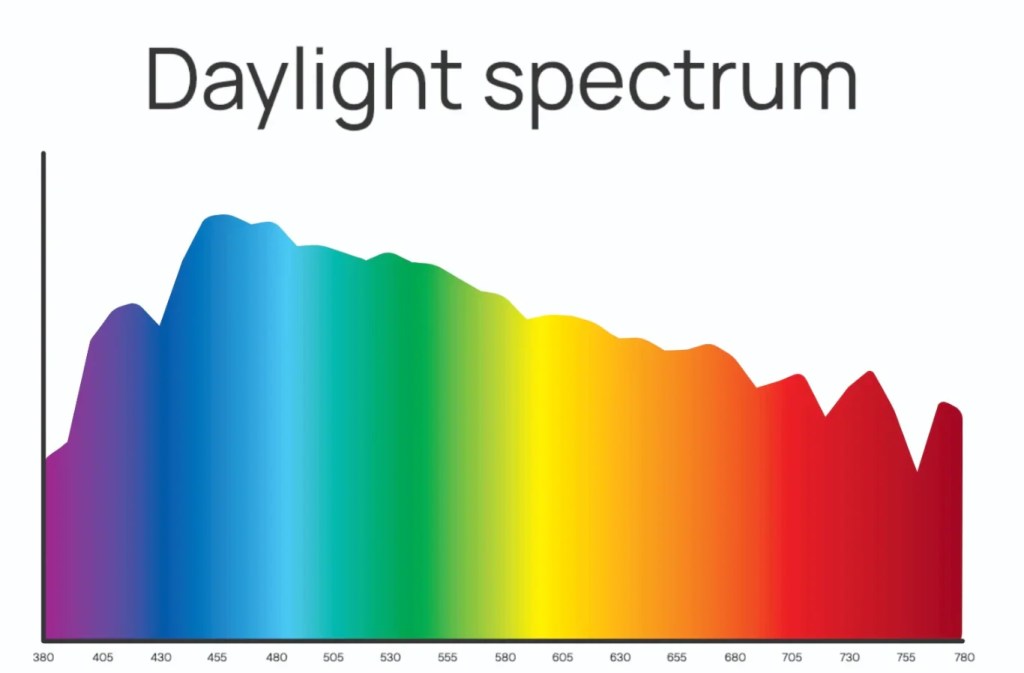
This is an image of the color spectrum of natural light across the area visible to humans. (380nm to 750nm) Ultraviolet light would be off the chart, on the left and infrared light is situated off the chart, on the right. While there are some peaks in the blue area, most of the colors are equally and evenly delivered.
If selecting artificial daytime light, you want to look at a spectrum diagram of the light and select one that is as close to this as possible. It is important to know that artificial daytime light should ONLY be used during the day. We need great light during the day and minimal levels of warm/red light at night. Using full spectrum light at night might have an adverse impact on our circadian system. Again, go back to our analogy of a pre-electricity farmer. Even on a great day, the sun did not shine for 24 hours. Think of a full spectrum light as a replacement for sun, not a light bulb. (Some full spectrum LED is available with a nighttime mode that removes the blue, thus creating a warmer evening illumination.)
Remember too, Full Spectrum lighting is NOT the same as Daylighting. Most daylight LED is simply 5000K to 6500K and not likely to be spread across the full spectrum. Full spectrum lights do not have to be 5000K or 6500K, but might.
One more thing. The sun is very bright. Light bulbs are not the same as the sun. You can get the right color of light from a lamp, but not the same amount. Think of full spectrum artificial light as a supplement to the sun, not a replacement.
I hope this has helped a bit. This remains a complicated issue. We are hoping artificial light can alter lifestyle changes. Perhaps it can help, but it is unlikely to replace the body’s need for sunlight. When possible, get outdoors, plant some flowers, drag the laptop onto the patio when you’re working and do your homework on a lawn chair. Your body will thank you…and you’ll sleep better, too.

 Lighting by Jeffrey