Categories
Technical Lighting Help

What if We Don’t Care About Keeping LEDs Cool?

Sleeveless Garment – China – 1880s

The Cleveland Museum of Art holds, what most experts believe to be one of the best collections of Asian Art in the world. The post WWII Curator-Director, Sherman E. Lee made important connections throughout the continent while serving there in the military during and after the war. Those connections proved invaluable as the museum ramped up the department. Special Exhibitions of the collection are well attended and always of interest. In the latest, “China’s Southern Paradise: Treasures from the Lower Yangzi Delta,” I saw something I had never seen before.

The lower Yangzi was a crucial center for the trades, craftsmanship and production for centuries. It was close to water, fertile land and necessary raw materials. Unfortunately, working in this era was still difficult and the climate is often humid. To keep the laborer cool, a bamboo “sleeveless garment” was created. That piece, in remarkably good shape was included in the exhibition. Small 1/16” diameter by 1” long segments of bamboo reeds were strung together in a diamond pattern. The undershirt created a layer of air between the skin and fabric, thereby helping to keep the worker cool. I was amazed by this utilitarian object, far more than the decorative ceramic vases, jade carvings and fine scroll paintings.

Keeping cool has always been the goal of LEDs. Like the creation of an elaborate woven undershirt, a fair amount of time (and money) has been spent insuring that the LED is operating at peak performance in lamps and luminaires. But what if we didn’t care? What if we allowed LEDs to “run hot?” What would happen?

The short answer is what we are now seeing in many LED replacement lamps, premature death. In an effort to cut costs, long hours of life have been sacrificed. Rather than the 40,000 to 50,000 hours of expected life, most commonly available light bulbs are now promising 15,000 to 20,000 hours. There is a belief that consumers are “OK” with lower levels of performance. Decisions have been made based on this assumption. To establish lower replacement lamp costs, forgo the “costly” heat protection components and shorten life expectancies.

I worry about what’s next. As we become accustomed to LED light in our homes, will we see lower lumen output next, like the shift from 120V to 130V on budget incandescent lamps a few decades ago? Will lower levels of color rendering be tried? Sure people with higher levels of color sensitivity will see the differences, but almost 85% of the population won’t. That might be worth the gamble.

I believe this is setting the stage for the creation of a “GE Revel-type” LED lamp. If you’re not an old codger like me, in a world of 25¢ light bulbs, GE determined that some people (15% of the population?) would spend more money (four to eight times more!) for better quality light bulbs. I have no way of knowing, but this had to be a profitable decision. Revel lamps were still available last year before the exit of incandescent.

I look forward to longer life, better lumen output and higher, more consistent levels of color across the spectrum in my light. I’d be a customer. For those features, I’ll gladly pay more. Now, swapping out my Banana Republic tees for a bamboo version…maybe not so much!

Categories
Lighting Commentary

The Shape of Light

Photo by Dhivakaran S on Pexels.com

Artificial light has been around since some caveman figured out how to create, or harness fire. In those early days, the shape of light was roughly equivalent to the pile of combustible material gathered to keep the fire functioning. Those early Neanderthals quickly learned that if the material was tightly packed, the burn was much more controlled and consistent. A heap of wood created a heap of light.

As we moved from caves to constructed dwellings, fire was now allowed inside, the fire transitioning from outdoor pits to fireplaces. Human demand for a more controlled application led us to create lanterns fueled by oils and candles supported by wax and wick. The candle and the lantern were no longer associated with its byproduct of either heat, or food preparation. Its sole reason for existence was illumination. Humans have been stuck with that shape ever since.

Stuck? What?

As interiors transitioned to gaslight, hanging lights, chandeliers and sconces retained the same basic shape and size of candlelight and oil light by forcing the gas to similar delivery shapes. A gas stopcock was added to form a flame that replicated the wick created fire. Barely a change in size is evident in the diffusers. While all of the creators of incandescent light started with a variety of proportions and dimensions, the eventual shape of electric light was finessed into the parameters established by flame and gas. The luminaire industry STILL to this day uses gas pipe thread as a standard across the industry and many of the components of a lighting fixture carry gas or plumbing names along with their odd thread sizes. Some of the most popular incandescent light bulbs are those shaped to replicate a flame. They fit nicely into chandeliers that replicate candle-holding lights of the past.

New York Magazine recently featured a reasonably well-researched article about the writer’s beef with LED. (There’s Something Off About LED Bulbs by Tom Scocca) He does makes some mistakes about CRI. I’ll reserve those for another blog post. The bulk of the content contains some of the typical complaints people have with LED, many of which I have addressed in previous posts relating to our desire for “cheap” and then being unhappy with the results; blaming it on the supplier who gave the consumer what they wanted. If you’ve ever seen the political cartoon “Tammany Ring” by Thomas Nast, you’ll understand this circular argument. Don’t give the customer what they want, because they don’t know what they want. Throughout the article he relates problems with LED because of shape.

Regardless of technology, consumers seem to want light in the package to which they have become accustomed. We want our LED to be shaped like incandescent, which was shaped like gas, which was shaped like a candle flame. Unfortunately, that is where science is having a bit of a problem. That problem is fodder for writers like Scocca.

When LED were new, cost was of secondary importance and the new light could be formed into whatever function was required. Form follows function was a principle attributed to Architect Louis Sullivan that states the item should in some way relate to the purpose. LED are not well suited for the confining shape of an incandescent envelope and screwshell. They must be kept cool and the narrowing screw-thread section of a light bulb provides so little space for cooling, as the article title intimates, they do some odd things. Function can’t (shouldn’t) follow form.

I have continually promoted and pushed fully integrated LED luminaires in opposition to retrofit LED lightbulbs for this very reason. Our kitchen was remodeled at the very early hours of LED. EVERY light in the room is LED. Almost all of them were “the first” LED products developed by companies like Cree, Philips and Kichler. They were also substantially more expensive than their incandescent counterparts at the time. None of the luminaires were “stuffed” into incandescent lamp enclosures. All of them are still functioning. I have had no problems with any of them and performance has been excellent.

As consumers, we can get what we want, but we should instead take what experts suggest. There is the old line about the first automobile that remains valid today. If asked, customers did not want a car, they just wanted a faster horse. Closer to today, no one ever asked for a mobile phone. Life today without a car or a mobile is almost inconceivable. Possible, but unlikely.

The same should be considered with LED. Eventually, engineers might figure out how to stuff LED into hot tiny confining places and maintain their performance characteristics. In the meantime, look to integrated luminaires as the later-day automobile or mobile phone. You’ll get what you do not yet know you want.

Categories
Technical Lighting Help

Hey! My Light Bulb Doesn’t Fit!

Since the introduction of fluorescent and LED retrofit lamping designed to take the place of incandescent light bulbs, fit has occasionally been a problem for consumers. Sockets are designed for the shape and contour of incandescent glass envelopes. Because of ignorance or lack of detail, poorly realized retrofits lamps on occasion, do not “fit” or function.

Why?

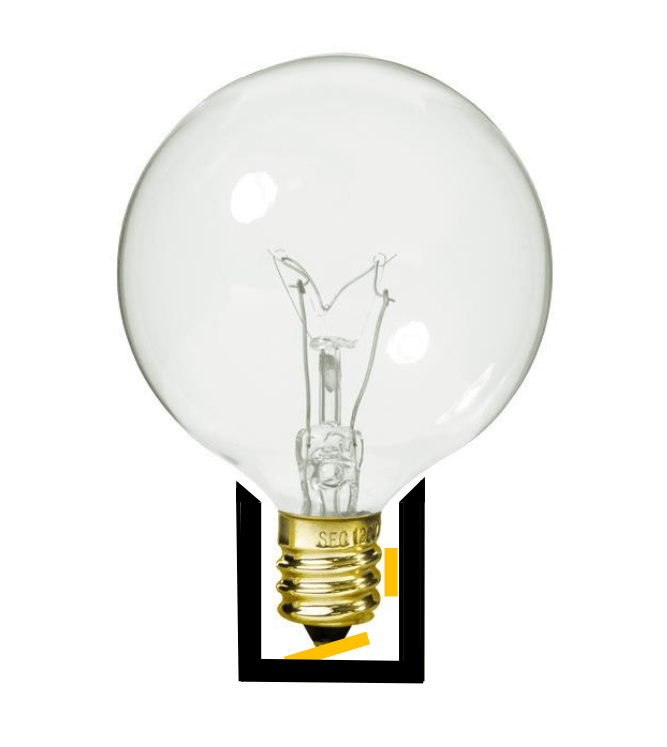
Fit has especially been a concern with “globe” or sphere shaped lamps (“G” type, as ascribed by the industry.) To understand the problem, let’s first look at an incandescent G-16 ½ candelabra based lamp. Many people call these golf ball lamps because of their similar size. Similar issues may occur with larger, medium-based “G” lamps, as well.

A typical G-16 1/2 Incandescent lamp.

With a full glass envelope on the incandescent product, you can see how the blown glass envelope gently tappers into the screwshell (the threaded portion at the base of a lamp.) The screwshell makes contact with the electricity delivered inside the socket.

A typical incandescent G-16 1/2 lamp installed in a candelabra socket. Note the base touches the copper tab at bottom of the socket and the threaded side touches copper on the side.

When inserted into a socket, the “hot” side of the electric current touches the bottom of the light bulb via a small copper tab at the inside bottom of the socket. The negative, or neutral half of the electric supply is provided to the screwshell on the inside edge of the socket. The positive and negative contacts are represented in the image as gold rectangles.

Also, note how the rolled edge of the glass curves into the screwshell and curves around the tapered inside edge of the socket. This insures the bottom of the light bulb easily touches the contact at the bottom of the socket.

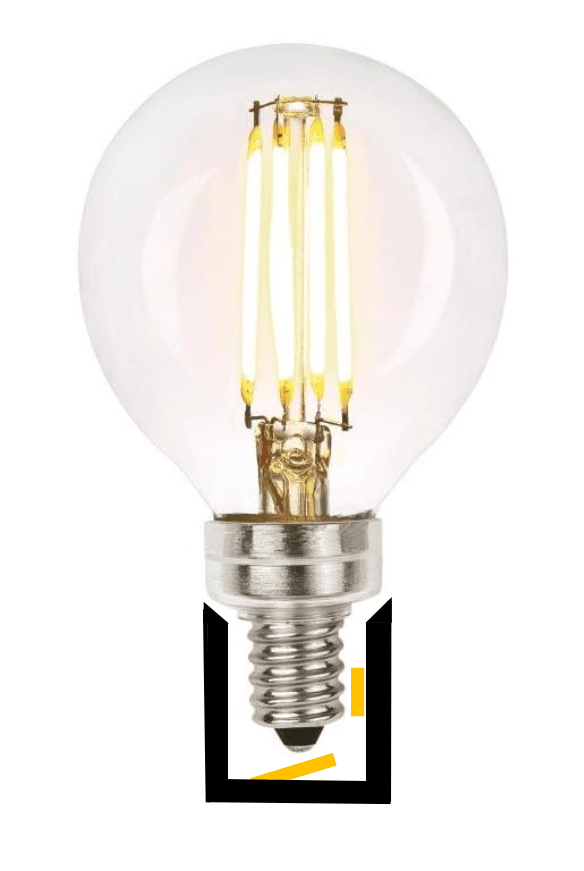
LED retrofit lamps create light with the use of a collection of electronics. Those electronics are located in the area between the glass envelop and the screwshell. In the photo below, the chrome sleeve under the glass houses the electronics.

A LED retrofit G-16 1/2 lamp. One of many styles available in the market.

When we insert the LED retrofit lamp, the chrome sleeve prevents the screwshell from fully turning into the socket. When that occurs, the bottom of the light bulb cannot touch the copper tab and the light bulb will not function.

A LED retrofit G-16 1/2 lamp installed in a candelabra socket. Note: the collar under the glass envelope prevents the base of the lamp from making contact with the copper tab at the bottom of the socket, thus preventing a complete electric connection.

Many people, when experiencing this failure believe it to be a LED lamp malfunction, but it is really a design failure. In instances where the socket is slightly wider, the copper tab is sitting higher or the edge of the socket is shorter, the lamp will work without an issue.

What to Do?

If this is an experience you have, the best thing to do is buy a different brand lamp, one with a better contour between envelope and screwshell. Some screwshells have also been elongated. If an alternative is not possible, there is one other thing you could do, but it must be done with care. Usually, the contact between copper and light bulb is millimeters away from making contact. A gentle lift of the copper tab could be all that is needed. It could also be unusually flattened over years of use. The reason for caution is electricity. We tell children not to shove things into electric outlets for a reason. An electric shock, a short, or worse can happen.

If you’d like to try a solution, shut off the switch on the wall and trip the circuit in the electric panel or unscrew the fuse in the fuse box. BOTH are a MUST!! Do not go any further without completing these steps!! (Seriously, unless you like the feeling of 120 volts of electric power coursing through your body, do not move forward without shutting off the power at the circuit!)

With a long, strong, wood or plastic stick (chopstick, knitting needle or crochets hook,) gently pry the copper tab up EVER SO SLIGHTLY!! As said, the gap is a fraction of an inch. There is no need to exert Hulk-like power! Reenergize the circuit and turn on the switch. If it does not work, it is time to try another brand of replacement lamp.

Expect Things to Get Better

Retrofit lamps are getting better. The electronics are getting smaller and even the least sophisticated manufacturers now understand what could be inhibiting a full electric connection.

I live in a historic home build with a two-car garage in the basement. This was quite an unusual feature for homes in the late 1920s. At the time, cars were substantially narrower and much longer than the average car of today. Consequently, I have no storage at the sides of my garage, but the front is packed solid with all the things we house in our garages. Moving the car in and out of the garage requires skill, with about 2” of room separating the rearview mirrors and the door frame, on each side.

Like newer cars and my garage’s elongated shape, the new light bulbs can and will work on sockets designed for a different era of technology. Just a little skill and patience is required.

Categories
Technical Lighting Help

Buying Cheap Will Cost You!

Photo by Medhat Ayad on Pexels.com

A recent Wall Street Journal article (Why LED Bulbs Don’t Always Live Up to the Hype About Their Life Span – Jo Craven McGinty 10-1-2021) detailed some of the frailties surrounding expected lifespan of LED light bulbs. Unfortunately, they failed to discuss a crucial element that is now leading to shorter lived lamps…the desire for cheap.

The reporter talked to the Director of Research at the Rensselaer Polytechnic Institute and he clearly defined the reasons for lower longevity. There is, however an underlying reason for his recommendation to use “LED System Life” rather than LED life as a better way to measure expected life. Multiple reports and investigations indicate failure is most likely to occur in the driver and electronics. The LED have proven to be very effective and hardy, failing at a very low rate. A quick overview by the DOE https://www.energy.gov/sites/prod/files/2014/04/f14/life-reliability_fact-sheet.pdf helps us to understand the conclusion delivered by Rensselaer.

Consumers were never able to justify a light bulb that cost tens times a conventional incandescent lamp. Initial sales were poor. At those prices, efficiency needs would not be met.

One of my favorite jokes tells the story. A kangaroo walks into a bar and orders a martini. The bartender prepares the drink and places it on the bar. “That will be $35.” The kangaroo pays the bartender and the bartenders comments, “You know, we don’t get many kangaroos in here.” The kangaroo responds, “At these prices, I’m not surprised!”

To make LED lighting more acceptable to the greater kangaroo population, they had to be cheaper. That means money needed to be extracted from the components and manufacturing process. Using high quality LED, electronic circuitry, drivers and a strong deference to thermal management, the original LED would last far longer than the advertised 50,000 hours. Cheaper electronics, disregarding heat or combining circuits on a common board all make the light bulb less expensive, but at a cost to longevity.

There is a wonderful analysis conducted by the website “Hackaday” that tells this tale. By analyzing the components and construction of three readily available LED lamps, understanding “you get what you pay for” is easy.

To paraphrase the research, a very inexpensive lamp combines the LED and driver on a single board. (There are other electronic and wiring variations I will not recount.) With inexpensive components, wiring and assembly, this lamp promises a life of 7500 hours. The second lamp is a bit more expensive and the life expectancy is doubled to 15,000 hours. This is accomplished by separating the driver, thereby protecting it from the heat and delivering an incrementally better product. The best of the three tested light bulbs separates the driver and LED and uses superior capacitors rated for higher temperatures. (There are other improvement as well.) The price is the highest of the three and it lasts the longest, at a promised 25,000 hours. If longer lasting light bulbs are desired, they can be had, but it will cost more.

(If desired, you may read the full report here: https://hackaday.com/2019/02/05/what-happened-to-the-100000-hour-led-bulbs/)

LED System Life should be the barometer of the future. The reality of our desire for cheap, cheaper and cheapest has forced a realignment of expectations for LED. It is a shame that the LED is getting the bad name.