Categories
Lighting Commentary

LED – The Only Light Source Left in the Game

Photo by Medhat Ayad on Pexels.com

Much of the regular media has reported on the “death” of the incandescent light bulb over the last few weeks. As I poured over the information, the fact that 30% of light bulbs sold were STILL incandescent came as a pretty astounding fact. Digging deeper into the numbers, I found that high-efficacy adoption was substantially slower, the more economically challenged the consumer/geographic area. Higher “first-costs” continue to be a barrier, despite the long-term financial benefits. Hopefully, as we move farther into efficiency regulations, we will remember that a large percentage of the population will be equally challenged. We must find a way to balance that inequity.

Another aspect of America’s incandescent use has been cleared up as well. 40% of the light bulbs in use were initially excluded from the original Energy Independence and Security Act (EISA) of 2007. Reflector lamps, candle, or flame-shaped lamps and spherical-shaped lamps did not need to comply with the same higher efficacy requirements as General Service Lamps (GSL.) I always found that a peculiar omission, but the overlook was remedied during the subsequent Obama administration. Unfortunately, those requirements were overturned during the Trump reign. With professionals back in charge of the Department on Energy, this large pool of inefficient lamping joins the GSL and must again comply with higher efficacy standards.

It is important to remember, EISA was written and signed into law as a bipartisan solution to an inability of utilities to provide long-term, adequate amounts of energy. As demand continued to rise, the cost of new energy creation grew prohibitively high. There was a real possibility that “brown-outs” would be as common as currently found in third-world areas of the planet. California actually experienced a summer of just such a reality before increasing their product efficiency standards. It is the reason why crackpot ideas like Michele Bachmann’s “Light Bulb Freedom Act” never went anywhere, even in a more conservative Congress. This was/is a solution that actually works and actually solved a problem. The energy saved here, combined with scores of policies covering appliances and other consumer goods has paved the way to facilitate automobile charging without throwing the country into darkness every time a load of laundry is started.

Concurrent with the higher efficacy demands has been the slow reduction and removal of fluorescent lighting technology. As America becomes more sensitive to leaving a cleaner planet for the next generations, hazardous chemicals are being reassessed. Mercury, a key component in the functionality of fluorescent lamping remains a dangerous element that has never been successfully recycled in large quantities. California and Vermont have already joined the European Union (EU) in outlawing their continued use. Canada is considering the same thing. Rhode Island, Colorado and Maine have expiration dates already defined in signed legislation, with Hawaii’s ban date imminent. Illinois, Massachusetts, Nevada, New Jersey and Oregon are considering legislative bans. With such a large quantity of geography preventing their use, one must assume that manufacturers will be discontinuing these products, effectively removing them from the remaining states and some countries.

That leaves us with LED as the only remaining light source standing. For those of us who have been on this conversion ride for twenty years, it has been quite the journey. Some of us will say, “I told you so!” Others might ask, “What’s next?” I may have made both statements over the years. There were too many things fighting against the continuation of incandescent. This was an inevitable shift. RIP incandescent. You served us well.

Now, watch out for the explosion of sensors and controls and their integration into smart homes. Obituary for the single-pole, wall-mounted light switch coming soon!
Categories
Technical Lighting Help

Hey! My Light Bulb Doesn’t Fit!

Since the introduction of fluorescent and LED retrofit lamping designed to take the place of incandescent light bulbs, fit has occasionally been a problem for consumers. Sockets are designed for the shape and contour of incandescent glass envelopes. Because of ignorance or lack of detail, poorly realized retrofits lamps on occasion, do not “fit” or function.

Why?

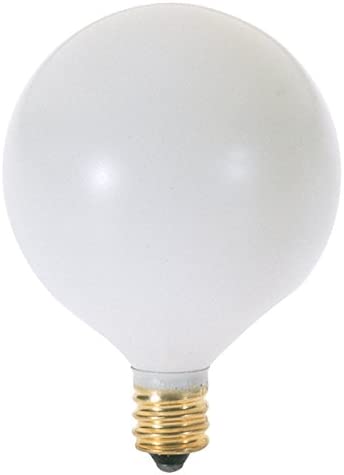
Fit has especially been a concern with “globe” or sphere shaped lamps (“G” type, as ascribed by the industry.) To understand the problem, let’s first look at an incandescent G-16 ½ candelabra based lamp. Many people call these golf ball lamps because of their similar size. Similar issues may occur with larger, medium-based “G” lamps, as well.

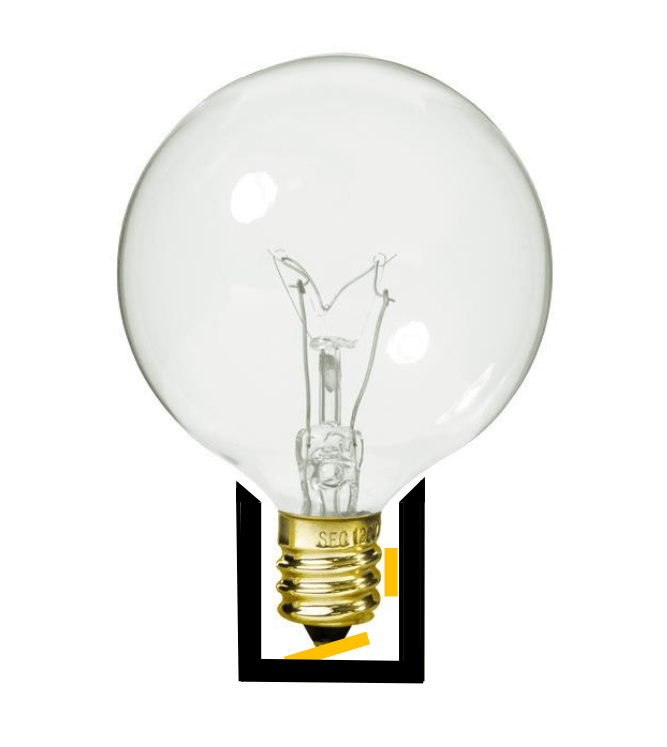
A typical G-16 1/2 Incandescent lamp.

With a full glass envelope on the incandescent product, you can see how the blown glass envelope gently tappers into the screwshell (the threaded portion at the base of a lamp.) The screwshell makes contact with the electricity delivered inside the socket.

A typical incandescent G-16 1/2 lamp installed in a candelabra socket. Note the base touches the copper tab at bottom of the socket and the threaded side touches copper on the side.

When inserted into a socket, the “hot” side of the electric current touches the bottom of the light bulb via a small copper tab at the inside bottom of the socket. The negative, or neutral half of the electric supply is provided to the screwshell on the inside edge of the socket. The positive and negative contacts are represented in the image as gold rectangles.

Also, note how the rolled edge of the glass curves into the screwshell and curves around the tapered inside edge of the socket. This insures the bottom of the light bulb easily touches the contact at the bottom of the socket.

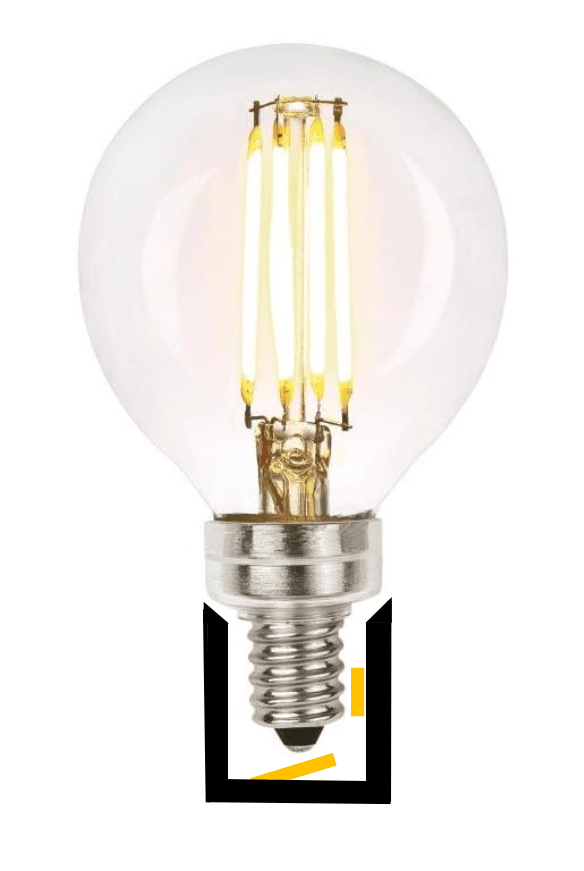
LED retrofit lamps create light with the use of a collection of electronics. Those electronics are located in the area between the glass envelop and the screwshell. In the photo below, the chrome sleeve under the glass houses the electronics.

A LED retrofit G-16 1/2 lamp. One of many styles available in the market.

When we insert the LED retrofit lamp, the chrome sleeve prevents the screwshell from fully turning into the socket. When that occurs, the bottom of the light bulb cannot touch the copper tab and the light bulb will not function.

A LED retrofit G-16 1/2 lamp installed in a candelabra socket. Note: the collar under the glass envelope prevents the base of the lamp from making contact with the copper tab at the bottom of the socket, thus preventing a complete electric connection.

Many people, when experiencing this failure believe it to be a LED lamp malfunction, but it is really a design failure. In instances where the socket is slightly wider, the copper tab is sitting higher or the edge of the socket is shorter, the lamp will work without an issue.

What to Do?

If this is an experience you have, the best thing to do is buy a different brand lamp, one with a better contour between envelope and screwshell. Some screwshells have also been elongated. If an alternative is not possible, there is one other thing you could do, but it must be done with care. Usually, the contact between copper and light bulb is millimeters away from making contact. A gentle lift of the copper tab could be all that is needed. It could also be unusually flattened over years of use. The reason for caution is electricity. We tell children not to shove things into electric outlets for a reason. An electric shock, a short, or worse can happen.

If you’d like to try a solution, shut off the switch on the wall and trip the circuit in the electric panel or unscrew the fuse in the fuse box. BOTH are a MUST!! Do not go any further without completing these steps!! (Seriously, unless you like the feeling of 120 volts of electric power coursing through your body, do not move forward without shutting off the power at the circuit!)

With a long, strong, wood or plastic stick (chopstick, knitting needle or crochets hook,) gently pry the copper tab up EVER SO SLIGHTLY!! As said, the gap is a fraction of an inch. There is no need to exert Hulk-like power! Reenergize the circuit and turn on the switch. If it does not work, it is time to try another brand of replacement lamp.

Expect Things to Get Better

Retrofit lamps are getting better. The electronics are getting smaller and even the least sophisticated manufacturers now understand what could be inhibiting a full electric connection.

I live in a historic home build with a two-car garage in the basement. This was quite an unusual feature for homes in the late 1920s. At the time, cars were substantially narrower and much longer than the average car of today. Consequently, I have no storage at the sides of my garage, but the front is packed solid with all the things we house in our garages. Moving the car in and out of the garage requires skill, with about 2” of room separating the rearview mirrors and the door frame, on each side.

Like newer cars and my garage’s elongated shape, the new light bulbs can and will work on sockets designed for a different era of technology. Just a little skill and patience is required.