Categories
Technical Lighting Help

What if We Don’t Care About Keeping LEDs Cool?

Sleeveless Garment – China – 1880s

The Cleveland Museum of Art holds, what most experts believe to be one of the best collections of Asian Art in the world. The post WWII Curator-Director, Sherman E. Lee made important connections throughout the continent while serving there in the military during and after the war. Those connections proved invaluable as the museum ramped up the department. Special Exhibitions of the collection are well attended and always of interest. In the latest, “China’s Southern Paradise: Treasures from the Lower Yangzi Delta,” I saw something I had never seen before.

The lower Yangzi was a crucial center for the trades, craftsmanship and production for centuries. It was close to water, fertile land and necessary raw materials. Unfortunately, working in this era was still difficult and the climate is often humid. To keep the laborer cool, a bamboo “sleeveless garment” was created. That piece, in remarkably good shape was included in the exhibition. Small 1/16” diameter by 1” long segments of bamboo reeds were strung together in a diamond pattern. The undershirt created a layer of air between the skin and fabric, thereby helping to keep the worker cool. I was amazed by this utilitarian object, far more than the decorative ceramic vases, jade carvings and fine scroll paintings.

Keeping cool has always been the goal of LEDs. Like the creation of an elaborate woven undershirt, a fair amount of time (and money) has been spent insuring that the LED is operating at peak performance in lamps and luminaires. But what if we didn’t care? What if we allowed LEDs to “run hot?” What would happen?

The short answer is what we are now seeing in many LED replacement lamps, premature death. In an effort to cut costs, long hours of life have been sacrificed. Rather than the 40,000 to 50,000 hours of expected life, most commonly available light bulbs are now promising 15,000 to 20,000 hours. There is a belief that consumers are “OK” with lower levels of performance. Decisions have been made based on this assumption. To establish lower replacement lamp costs, forgo the “costly” heat protection components and shorten life expectancies.

I worry about what’s next. As we become accustomed to LED light in our homes, will we see lower lumen output next, like the shift from 120V to 130V on budget incandescent lamps a few decades ago? Will lower levels of color rendering be tried? Sure people with higher levels of color sensitivity will see the differences, but almost 85% of the population won’t. That might be worth the gamble.

I believe this is setting the stage for the creation of a “GE Revel-type” LED lamp. If you’re not an old codger like me, in a world of 25¢ light bulbs, GE determined that some people (15% of the population?) would spend more money (four to eight times more!) for better quality light bulbs. I have no way of knowing, but this had to be a profitable decision. Revel lamps were still available last year before the exit of incandescent.

I look forward to longer life, better lumen output and higher, more consistent levels of color across the spectrum in my light. I’d be a customer. For those features, I’ll gladly pay more. Now, swapping out my Banana Republic tees for a bamboo version…maybe not so much!

Categories
Technical Lighting Help

Quantum is the New…

Photo by Julia Volk on Pexels.com

I must admit, I have not stayed up to date on quantum dot LED technology. While I’ve read a few technical articles about them and I know they have had a big impact on flat screen color performance, I haven’t found where they will quickly appear in residential lighting.

My interest in quantum dot LED or OLED was sparked again while reading a Wired Magazine article on passwords. Like quantum dots, quantum computing is on the precipice of impacting that industry. If quantum computing comes to fruition, passwords as we know them will become obsolete. Regardless how many numbers, how many capital letters and how many special characters we use, passwords will be unearthed in seconds because of the unimaginable processing speed of quantum computing.

Of course, now that lighting is part of the “tech” sector (remember, LED are simply semiconductors) rapid change is an inevitability. No one in the computer industry is suggesting quantum computing will not happen just as I’m not denying quantum dot LED will show up in residential lighting…eventually. Despite this coming technology, passwords, or baseline security protection is not making advances, or more succinctly put, they are not finding security protections options as fast as quantum technology normalization is advancing.

I can’t imagine a career dedicated to creating digital security options. I can only say, “Good luck!” Even though lighting has been my life for almost fifty years, I’m not sure I’m smart enough to visualize how quantum dots LED/OLED will impact residential lighting. My guess is the quantum technology will be packaged to create almost perfectly replicated natural light that easily changes throughout the day, minute by minute, season by season. Our bodies circadian demands will be full satiated and the harm done by artificial lighting up to this point will be placed in the rearview mirror, but does residential lighting have a “password issue?”

Is there something we currently enjoy with today’s LED lighting that will be changed by quantum LED/OLED? Will any of our power savings disappear? Will output suffer? The swap from incandescent light to LED forced a realignment of our perception of the color of light. Will the introduction of quantum LED cause a revisit of this issue? Does the elimination of light within the UV and infrared spectrum disappear with quantum technology? Will UV and infrared light again be a concern?

Perhaps these are being answered as I type. I plan on spending more time trying to understand the impact quantum LED/OLED might have on residential use lighting. In the meantime, I better change some computer passwords…or not.

Categories
Technical Lighting Help

How to Effectively Select LED Tape – Part Two

Photo by Max Rahubovskiy on Pexels.com

In the last post I talked about the ubiquity of LED Tape and where it can be placed. Three key areas remain. First, how much light do I need? What lumen output should I select when considering the addition of LED Tape? Then, maximum run lengths must be regarded. These will be a factor when designing the system. Lastly, we’ll review color temperature recommendations. With the four areas covered, selection, design, specifying and implementing LED Tape into an interior design is easy…or can be easy, once you’ve done it a few times!

Output

Like a Ford Model “T” black-only color choice, when LED Tape was first introduced, there was a single light output available. A quick glance at almost every major manufacturer’s catalog today will result in a huge variety of lumen output options. That is in response to the varied applications in which LED Tape has found itself. Toekicks, above cabinets, inside cabinets, coves, tray ceilings, drop ceilings and under countertops. Each of these spots need different light. In addition, surrounding surface colors will impact output, so more light should be used with darker colors.

When looking at an LED Tape product catalog. You will find a key piece of information, “Lumens per Foot.” This will range from 100 to about 1000 lumens/foot. You can assume cost will be commensurate with output, so it is important for lighting professional to select the item that delivers the right amount of light; but what is right?

Here are few guidelines based on use. Remember darker surrounding colors should use the numbers at the high end of the range. Light on taller ceiling might need a bit more light than an older 8’-0” ceiling height. If the distance from the top of the cabinet to the ceiling is short, use less light, if the cabinet is small, minimal lighting is needed inside. These are lumen ranges for a reason. Categories are intentionally vague to invite design professional input.

ApplicationLumens per Foot Range
Mood lighting / Light Used as a Background100 to 300
Accent lighting / For Added Aesthetics150 to 500
Task Lighting – Close275 to 500
Task Lighting – Far Away (light location)350 to 700
Indirect Lighting375 to 575
Cove Lighting180 to 500
Principle Lighting in a Room400 to 1000
As a Replacement for Linear Fluorescent Lamping500 to 950
Kitchen Under-Cabinet Lighting175 to 550*

*see comments regarding kitchen under-cabinet use in the previous post

Remember, lighting is cumulative, if you cannot find 800 lumens per foot tape at your favorite retailer or from a preferred brand, use two rows of 400 and you will get the same output. Two low-lumen output lengths might also be less expensive than a single length that delivers twice the light. Consider all options.

When designing with light, as with any other aesthetic element, extra attention might be desired in select areas. Feel free to veer from the suggestions. Like with anything, understand the guidelines and alter them with knowing intent.

Diffusers – The use of diffusers over LED Tape will reduce the lumen output. In some places, it is necessary, such as in-wall, drywall deep designs. That should be factored into the design. Some clients prefer the clean, non-mechanical looks of a channel and diffuser even in under-cabinet or above cabinet applications, usually for cleaning purposes. When not required, consider eliminating diffusers. Better output will result.

Run Lengths

The other piece of information you will find next to every manufacturer’s product is “Maximum Run Length.” You will typically find an inverse correlation between “Lumens per Foot” and “Maximum Run Length.” Essentially, you can run tape farther with less lumen output. If large amounts of light are needed, the runs will be shorter. You will see maximums of as little as 10’-0” and I have seen some specifications that reach up to 65’-0”, but usually 32’-0” is the limit.

Maximum run lengths comprise of the actual lighted length of LED Tape, so if the start of the tape is 5’-0” from the power and wire is needed to jump from one cabinet section to another requiring 9’-0” of interconnection wire, those are NOT counted into the maximum run length.

When laying out a LED Tape system, clever power supply placement can maximize these limitations. For example, if a 10’-0” square tray ceiling is to be illuminated and 20’-0” run length maximums are selected, place the power supply in a corner and run the first 20’-0” length in one direction and the second run in the opposite direction. This will not be a contiguous 40’-0” run, but it will give the exact same appearance. A small amount of pre-planning will eliminate hours of rework or multiple power supplies.

Color

If you read this blog regularly, or if you have heard me speak at any point in the last decade, you know I regard light color in residential applications very narrowly. I believe lighting should be either 2700K or 3000K. Warmer finishes used in the home, such as beige walls, wood cabinets and earth-tone carpets will always look better with 2700K light. Homes that are “cooler” with lots of white, black, blues, greys and stainless steel will find those colors best represented using 3000K. The ONLY time I suggest or use anything different is if a client has a display case with collectable crystal or sterling silver. 4000K adds the necessary blue to allow these object to “sing!” Other designers disagree and employ a wider variety of color. Many of their opinions are well placed, but I still maintain the “A” or “B” decision is all that is required. It doesn’t have to be complicated.

While most reputable LED Tape uses diodes with a Color Rendering Index (CRI) of 90 and above, be sure to check the CRI is in this range. CRI is an important indicator of how well the colors in a room will look.

Another frequently asked question regarding color is, “Can I mix color temperatures in a room/home?” My response is always the same. “Do you mix colors in a room?” If you’ve ever painted a room with two or three different shades, you did that for a reason. A deliberate decision was made to use light blue paint on the wall, mid-range blue tiles on the floor and deep indigo on the window dressing. Apply the same logic to light. If there is a reason for 3000K light in a tray ceiling and 2700K at the counters, then mix away. Do not, however simply scatter varying colors of light pell-mell across the room. This is the design equivalent of five different fluorescent tubes in the ceiling troffers of an old office.

A Few More Things

As we have seen change in LED Tape over the last ten years, change continues today. Manufacturers introduce new “bells and whistles” every month and the popularity of the product has pushed vendors to change, update and rethink almost everything about it. Following are a few things you can buy now or will see on the horizon.

COB Tape – Some consumers have objected to the dot of LED reflecting in polished granite surfaces. One solution is placing the LED Tape inside an extrusion and adding an etched acrylic cover or diffuser. While this does ameliorate the bright spot of light, it also reduces the lumen output, sometimes considerably. Chip-on-Board (COB) Tape delivers a continuous strip of light, rather than individual dots. Some brands are offering it today. It is priced higher than traditional LED Tape, but the output is good and the run lengths are likewise acceptable. This could be a nice option when faced with this particular client pushback.

Dimming – Most every manufacturer now offers dimmable LED Tape. Remember, dimming requires a power supply with dimming capabilities and like all LED, the dimmer and the power supply MUST be compatible. Always consult the tape manufacturer’s dimmer recommendation. Before that, ask whether dimming is even required. With the wide range of lumen output, dimming might take a great lighting design and ruin the results as output is constantly in flux.

120V LED Tape – We are seeing more and more “line-voltage” LED. The elimination of a power supply is very enticing. Simply connecting the electrical wires directly to the LED is an intoxicating draw. Some are good. Many have problems. Caution should be used if 120V LED Tape is considered. The same cautions you would attribute to 120V LED bath lighting or chandeliers.

  • 120V LED are substantially more vulnerable to flicker. This can be eliminated, but it required additional circuitry that might reduce the monetary savings achieved by removing the power supply. Ask about flicker rates or percentages, especially if clients are physiologically vulnerable to flicker.
  • 120V LED are more difficult to dim. Again, this can be solved, but the added circuitry means more money. If dimming is necessary, be sure to investigate the approved dimmers and other requirements.
  • LED Life – Most 120V LED do not last as long as low-voltage LED. The functional light provided by LED Tape could easily overlap multiple room remodels. Low-life cycle LED might not be the best option in these applications.

What started as a simple four part answer turned into a two-post response. It might sound complicated, but it isn’t. Once one systems is installed, it becomes much more intuitive. Trust me.

Categories
Technical Lighting Help

How to Effectively Select LED Tape – Part One

Photo by Max Rahubovskiy on Pexels.com

Since its introduction about a decade ago, LED Tape has become an almost ubiquitous element of lighting design. When introduced, it was the first LED lighting product that was less expensive than the legacy product it replaced. Festoon lamp based linear lighting soon disappeared. (Good riddance! What a horrible product!) LED Tape prices continued to drop and wider varieties and options were soon added. The market is now filled with a massive array of LED Tape, such that a very frequent question is the title of this post. “How do I effectively buy or specify LED Tape?” Put as simply as possible, I recommend using four factors in the decision. Color, output, placement demand and run lengths.

I originally thought I could cram all of this into a single post, but the more I wrote, the more I realized readers might be better served if I went a bit deeper into each section. Part One will cover placement. The next post, Part Two will complete the information and discuss color, output and run lengths.

Placement Demand

Since I began this blog, I have periodically provided some suggestions for LED Tape placement. Avoiding many of the reasons and some details, I’ll quickly recap my location suggestions for a group of the most popular and emerging uses.

  • Above Cabinets – Place the tape 3” from the front edge of the cabinet. Follow the full perimeter edge if variations in depth are present. Place tape on the side of the cabinet, to the wall, if there is a break in the continuity of the cabinet run. (i.e. a doorway, appliance or room entrance)
  • Above Cabinet Alternative (installed as back-lighting or to highlight a wall) – Run a straight line of tape along the BACK of the upper cabinet 3” to 6” from the wall the full length of the upper cabinets.
  • Inside Cabinet WITH Front Fascia – Mount the LED Tape on the inside of the fascia faced into the cabinet on the hinge side. Tape should be run from the top to the bottom. If more light is desired, or if the cabinet is wide, mount a strip on both sides.
  • Inside Cabinet WITHOUT a Front Fascia – Mount the LED Tape on the hinge side wall perpendicular to the door surface. Tape should be run top to bottom. Try to avoid using a run on the handle-side of the cabinet. When the cabinet is opened, it could be too blinding. If additional light is needed in this type of cabinet design AND shelves are translucent, consider a strip along the top. While it will be seen when the door is opened, it will likely be far enough out of sight and cause only minimal glare issues.
  • Under Countertop – A ½” wide by 1/16” to 1/8” deep router about ½” from the front edge of the countertop will accommodate most every tape option. Surface depth of counter might need to be increased. If an ogee edge is used, fabricators have told me that the router cut must start where the full thickness of the material starts. This may require and even larger surface depth. My experience indicates that a granite, marble and quartz stone routered groove may be more problematic than Formica, Corian and concrete. Always review the need with the countertop fabricator. Don’t forget the “mouse hole” that allows the wire to enter the inside of the cabinet!
  • Under Countertop Alternate – If the space between top of the lower cabinet doors and the underside of the countertop is sufficient, the LED Tape can be mounted on the underside surface in a channel without a router. If this option is considered, always check the door swing clearance.
  • Under Island – Run the tape the full length of the island overhang installed about 9” from the chairside front edge of the island top.
  • Toekick – Run the LED Tape along the center of the toekick space. Remember, do not place toekick lighting in front of appliances. Instead, use an extension around the sides of the cabinet and behind the appliance opening so there will be no issue when removing the appliance for cleaning or servicing.
  • Cove – Mount the LED on the wall, just below the front edge of the cove material height.
  • Cove Alternative – Mount the LED on the front edge of the cove material aimed inward toward wall or at the bottom of the cove aimed upward to the ceiling, depending on the desired lighting effect.
  • Drop Ceiling – Mount the LED Tape on the end of the drop panel, about 2” from the edge, aimed up.

Tray Ceilings

There are countless versions of tray ceiling construction. Adding LED Tape here is easy, but rather than providing ten locations, let me provide a few thoughts.

  • Unless using an LED Tape aluminum extrusion where the visible light become a part of the design, try to avoid seeing the LED light. Place them behind barriers of forward enough so direct sign is impossible.
  • Be careful with corners. Linear light that intersects at boxed corners will deliver odd lines and shadows that some people like and others dislike. If you think this could be an issue, test the output prior to finished installation. One option is to cut the tape short of the corner to reduce some of the light patterns you might dislike. Mounting the tape on a different surface will also change the light/shadow patterns.
  • To connect LED Tape corners, a corner-connector is used. Be careful with the wire! It can also lead to odd shadows. Use electric tape and affix the connector wires to the mounting surface so it will not rise above the light.
  • Cove extrusions mounted inside a simple tray construction are a nice way to achieve the same effect with less complex tray framing.

Aluminum Extrusions Aided Placement

Shortly after the creation of LED Tape, installers and designer realized that new and exciting ideas could be realized with the assistance of aluminum extrusions. A row of LED Tape (or two, or three, or six, depending on the extrusion size!) is adhered to the inside of the aluminum. Most have matching diffusers. These combinations have unleashed an avalanche of exciting installation options.

  • Drywall deep light designs in walls and ceilings
  • Inside and outside (drywall) corner illumination
  • Wall wash ceiling perimeter lighting
  • Tray ceiling edge lighting (see above)
  • Step tread lighting
  • Stair rail lighting
  • Lighted baseboard perimeters
  • IP rated floor lighting installation

The combination of extrusions that accommodate various quantities of LED Tape and a little creativity has allowed these options to change interior lighting design.

LED Tape Used In Under-Cabinet Kitchen Applications

The old, self-contained under-cabinet lights used to deliver between 200 and 400 lumens per foot. Because they contain 1, 2, 3 or 4 individual lamps, they were also somewhat spotty. There is virtually no reason to use them any longer LED Tape in a simple channel or in a stylish aluminum extrusion can service the same need, deliver even light across the full length of the countertop AND save a fair amount of money. The only question that need resolution. Can the installation accommodate the required remote power supply? Perhaps it is located in the attic, at the top of the upper cabinets, in the basement or the inside of the cabinet with low-voltage wire traveling to the tape. Determine power placement as carefully as the lighting for the best results.

Once power supply location is resolved, how much light is the right amount of light? When deciding, I ask about the cooking practices of the owner. Are they a gourmet chef, “Heat-n-Serve” cook or a Door Dash practitioner? With that information known, good decision can be made.

  • The gourmet will need plenty of high quality light and it will be used for many hours. Specify the highest lumen per foot options (500+ lumens per foot) from the most reputable manufacturer.
  • The “Heat-n-Serve” cook needs light, but will be opening cans and ripping envelops to mix up a quick meal. The mid-range numbers will serve them well. Find 250 to 400 lumens per foot tape.
  • When countertops are only used to read online menus and find pizza delivery numbers, there is no need to invest in expensive under cabinet lighting. The low lumen output product is fine. Spend the savings on better island pendants!

Lastly, ALWAYS use an extrusion on wood, at a minimum, the low-priced plastic option, when installing LED Tape to the underside of a cabinet. The double-back tape, even the high quality 3M is no match for raw wood. The wood will pull moisture from the tape and before you know it, a sag will occur.

Occasional Demand Use

The client wants to light an area that is used only on birthdays, Halloween and the end of year holidays. If this is the case, consider using some of the readily available “budget” LED Tape options on the market. They are cheap, they may not last 40,000 hours, but for the occasional use, they could be just what is needed. Again, save the money and spend it elsewhere. Conversely, this budget product might be enticing to use everywhere. Don’t do it! It is budget priced for a reason! It will likely fail to withstand the demands of continual use, might have subpar color rendering and the double-sided tape will almost certainly not last.

In two weeks, I’ll post the second half of this discussion and talk about lumen output, run lengths and color.

Categories
Technical Lighting Help

Akira Kurosawa and Lighting

As a follow-up to seeing the English film, “Living” a friend allowed me to borrow his Janus Film copy of the original Akira Kurosawa masterpiece, “Ikiru.” I typically do not watch the “extra features” included in most digital packages, but the interview with the visionary director was too compelling to ignore. The talk was broken into various aspects of his approach to film. One was titled, “Lighting” so of course, I could not help but pay extra attention.

In his conversation on the importance of lighting, he mentioned that to embolden colors that appear on film, he would paint and tint reflector panels that would pick-up the set lighting and bounce additional color with light onto what was being filmed, thereby resulting in more dense, fuller tones. It is the reason why so many of his color films have such vibrant appearances. If you haven’t seen “Ran” give it a watch to understand the value this technique brought to the movie. Trust me, whatever you see on your flat-screen was better in the theater using projection. After so many years, I still remember it.

I started to think about its use in residential lighting. I knew a landscape lighting designer who used seven different gels or tinted blue filters on incandescent lamping to complement each varietal of evergreen, resulting in an otherworldly feel to the exterior spaces he lit. Perhaps the client didn’t know, but he and I suspect other designers certainly did.

Can we bring Mr. Kurosawa’s and my acquaintance’s dedication to color into the interior of a home? In fact, we may have already done that when we introduced LED to the home a few years back.

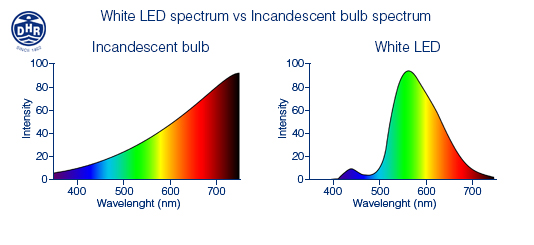
Incandescent light was VERY yellow, rendered dark blue, deep purples and browns poorly, but the amount of red did make it feel “comfortable/warm” to a large majority of the population. LED presents color in a different way because the spectral power distribution (a representation of the amount of each color in the visible electromagnetic spectrum) is different.

Don’t be frightened. The electromagnetic spectrum is easy to understand. Visible light spans from 380 nanometers to 700 nanometers. Ultraviolet light has a smaller measurement than 380nm (it appears to the left) and infrared light is larger than 700nm (it appears to the right.) The visible range begins after the ultraviolet light on the spectrum, runs from purple to blue, to green, into yellow, orange and finally red before disappearing from the human eye’s visible range into infrared light.

In this image, you can see the assortment of colors visibly represented across the horizontal, the intensity of each color is displayed vertically.

The incandescent light features a very small amount of intensity in the purple and dark blue area on the left, hence the reason it is so difficult to “see” the difference between a navy blue suit and a black suit.

All white LED starts with a blue diode that is influenced by phosphors. That blue seed is visible in the LED spectrum as the blue hump on the left, before the huge rise into light blue, green and yellow. The almost nonexistent “red” at the right is the reason humans feel that LED is somewhat cold, or less comforting than the “warm” old incandescent.

The good thing about LED is that the spectral curve CAN and HAS changed since the first LED were introduced into the market. The incandescent curve hasn’t changed since Thomas Edison. That means we have options today that were unimaginable yesterday. A 3000K output will increase the “hump” of blue slightly resulting in better rendering on purple, blues, blacks and even white. With the 2700K white light as illustrated here, the blue is marginally suppressed and the red is increased a bit allowing for better color rendering of warmer colors like beige, yellow, orange, wood and eathtones. Red is a VERY dominant color, so even with substantially lower intensity, it still renders the color well.

Most lamp and luminaire manufacturers now produce 2700K and 3000K LED products, so as consumers, we are faced with a very simple choice. Do we have a “warm” or a “cool” space? If warm, we should select 2700K products, cool means buying the 3000K option.

Akira Kurosawa’s movies are complex and will be studied by film scholars for decades to come. How he achieved some of the results will continue to illicit post-screening, coffee shop conversations for as long as we have movie fans. Choosing color in a residence is decidedly easier. As long as you grasp the underlying science.

Categories
Technical Lighting Help

A New CALiPER for GUV

Photo by Alena Shekhovtcova on Pexels.com

When LED lighting was new, the US Department of Energy began the CALiPER program. The research provided by this series of investigations (spanning 2007 to 2014) was revelatory. I devoured each of these reports as I prepared information to help people understand this new “highfalutin” technology. These were helpful, straightforward and fair reports to the consumer and industry.

The concept was easy to understand. The DOE went to a retailer and bought a dozen (or so) LED products in a similar category, reviewed the enclosed documentation, website claims and marketing promises. The product was then independently tested. The results were compared with the promise and presented in a series of reports released periodically over the seven years. No vendor names were shared. Product identification was blanketed. The intent was to distribute data on the progress of the technology.

At the time, I was working for a manufacturer and I found the information helpful in combating crazy claims by competitors. It was also comforting to see that the results we were getting, were in-line with the realistic numbers unearthed by CALiPER. As someone who helped educate users about this new technology, I could confidently warn them of irrational claims. As the technology improved, the gap between manufacturer’s claims and actual test results continued to shrink. More realistic promises were made. What LED could and could not do became clearer. Each CALiPER report was immensely helpful. When they discontinued the program, it was time. LED had become a mature product category. I would miss them, but I knew they served the industry well. I said a silent “thank you” for a meaningful bank of data.

CALiPER is now back. This time, doing the same yeoman’s work, but instead concerning Germicidal Ultra Violet (GUV) lighting. The first installment is out and I’m almost as excited! (Go ahead, make fun. “This guy gets excited by a US government data report release.” Just keep in mind. I do this so you don’t have to!!) 13 GUV products were reviewed and like the initial round of LED, product claims were wildly in excess of reality. One line from the summary says it succinctly, “This CALiPER GUV Round 1 report demonstrates the significant education and training manufacturers and vendors still require to accurately test and report the performance of their GUV products.”

The CALiPER testing does not review the germicidal efficacy and cleansing capacity, only the light measurement and performance, plus more importantly, photobiological safety when using potentially hazardous ultraviolet light.

It is important to remember that most of the light within the UV spectral range is harmful to humans. “Some” UV is considered “safe” and those same very specific wavelengths of UV have been found effective in combating germicidal pathogens. Some of the units tested claimed to be safe for use when a human is in the room (other units are intended for use when the room is empty) but those did not deliver the UV as promised, potentially causing harm to skin and eyes. Because they have fallen out of the effective spectral range, they might not be very effective killing pathogens either. (Again, those claims were not part of the testing scope.) Light distribution was also reviewed. The analysis found some had a very poor intensity distribution, so while the spectral characteristics might be correct, the light would not necessarily “hit” or reach the germicidal target unless it fell into a very tiny point in space.

The report provides a number of additional findings, including some of the unexpected testing shortcomings. Equipment needed to test UV product is rare and very specific. The agency admits that it could not adequately test some claims because testing agencies don’t have the required equipment. It does raise the question how the manufacturer can make a claim that cannot be substantiated.

This is the first of what could be hundreds of test. More will be learned and the industry will be stronger for this work. The first group of LED MR16 lamps included a product claiming to be an exact replacement for a 50W halogen version and the test showed it barely equaled a 15W halogen. Fewer and fewer of the blatant lies occurred in each subsequent testing tranche. With the increase of airborne pathogens, such as COVID-19, GUV lighting can be an effective combatant. As users, we simply need good data from reputable sources, just like LED lighting. It’s great to know the same review process is now in place.

If, like me you want to dig into the details, links to the actual reports are included below.

Summary Report

Full Report (for the hard-core data nerd!)

Categories
Technical Lighting Help

Please Read the Instructions!

I learned something this week.

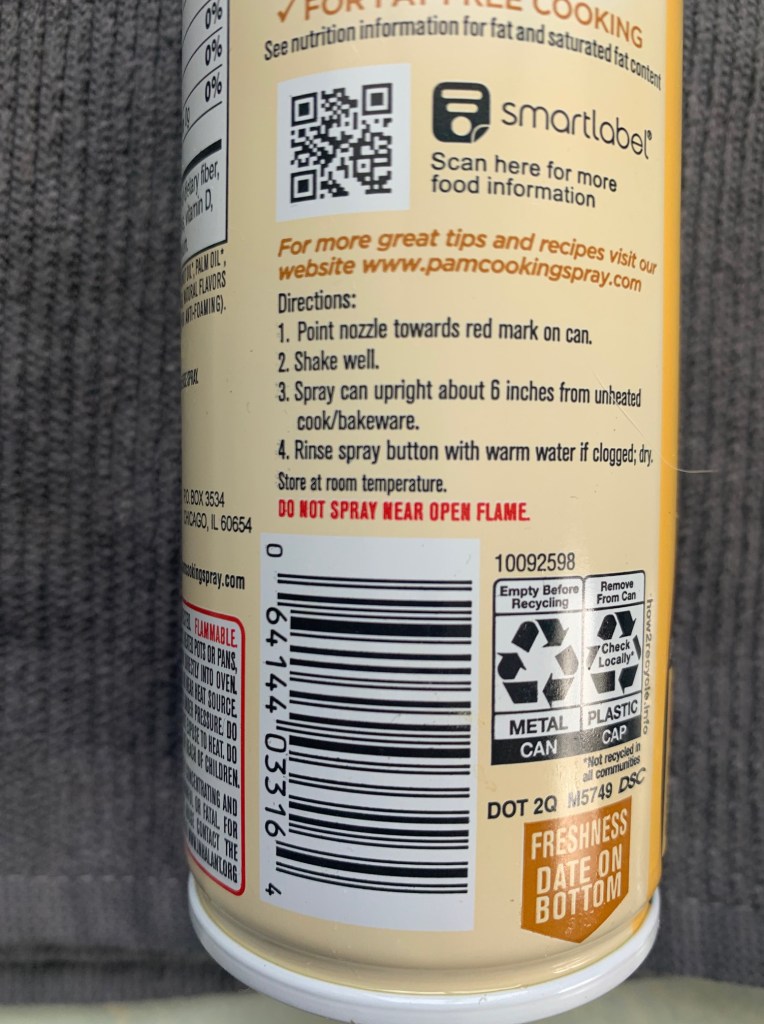
I’ve always thought it odd that instructions on whether or not to shake a product before use were buried in the fine print of a label on the back of a container. I thought it had reached the height of lunacy when I grabbed a can of cooking spray and “read” that I should aim the nozzle, THEN shake the can. It irritated me so, I sent a photo (below) to a friend. In the nicest way possible, he told me, I hadn’t read the instructions.

Did you notice, “…toward red mark on can?” I didn’t!

Instruction step #1 does in fact instruct the user to point the nozzle, but I apparently did not read the remainder of the sentence, “…toward the red mark on the can.” My friend helped me understand that inside the can, there is a hose that brings the cooking spray up into the nozzle and it has been intentionally engineered longer, to extract every last drop from the corner, when the can is tilted during use. By aiming the nozzle toward a red mark on the lip of the can (that I, for the first time found) the entire content of the can will be consumed.

Why didn’t I take as much care with the instructions as my buddy? I was in the middle of making dinner, quickly grabbed the can while the other hand was likely balancing some other part of the meal. A quick glance and bang. I’m done. He saw the second part of the sentence. He also went online and researched the exact reason why it was so important to align the nozzle and the now completely visible “red mark” on the can.

In the process of writing the many blog posts here, I’ve made a big deal out of the importance of doing things according to “best practices” and in accordance with what experts have found to be the most efficient. I have essentially asked each and every reader to “Read the Instructions!” but haven’t been following that same advice when I am dealing with a product that isn’t my core competence.

Likely, we all do this. The plumber probably rolls his eyes when he sees yet another clogged drain and the electrician shivers when he sees an extension cord plugged into another extension cord, under a rug with a splitter on the end. My friend spent a career that included among other things, technical writing and editing. He has been trained to actually read, and actually write (not glance!) at what the author intended. He quickly picked up on what I missed. The rest of us want everyone else to be as sensitive as we are when it regards our knowledge specialty. That typically doesn’t happen.

I was asked by an artists to visit her studio and provide comment on her lighting. She had a feeling something was “off.” As soon as I walked into the space, I cringed. She had replaced all of the lighting with “daylight” LED lighting bulbs. Daylight sounds great to everyone who is not a lighting person. Mother Nature has determined that daylight will be VERY blue, so her studio was extremely blue. All was still not lost. I asked if the bulk of her work was installed in exterior locations. Unfortunately, that was not the case. Most of her work was traditional in nature, warm in color and typically found itself in interior locations. I suggested better lamping options.

Before leaving, I asked how she came to buy these particular lamps. They were on sale. She has the room illuminated for long periods of time while she works. LED consumes less energy. She followed all the instructions, except for those dealing with the color of light. Like me and cooking spray, she knew what a light bulb did and she knew she was consuming more than the average amount of power. She also understood she should find a more efficient way. As I ignored or overlooked, “…toward the red mark on the can,” she glanced over the Color Temperature and Color Rendering Index on the light bulb carton.

Saying “read the instructions” sounds a bit pedantic, but it does make a difference. It’s the reason you are reading a blog post about lighting and probably a reason I have a job. From this point forward, I will try to be more understanding toward those who fail to aim the LED nozzle toward the red mark, as instructed.

Now I just need to get manufacturers to more prominently place “SHAKE” instructions on cans.

Categories
Technical Lighting Help

Switch Placement

Photo by Andrea Davis on Pexels.com

When my wife and I were first married back in the Paleolithic Age, we rented half of a duplex in Shaker Heights, OH. To turn on the light that illuminated the pantry area of the kitchen, you had to slide your hand sideways between the wall and the refrigerator side. The switch was located unusually high on the wall surface and access was only achieved via fingertips. Clearly, not the best placement, but in a century old home, light switches were often placed in peculiar, inconsistent spots.

I recalled this after publishing my last blog on sconce use. A friend dropped me a note after reading my comments about using them in bedrooms, rather than bed lamps. He didn’t mind the idea, but has always felt the switches are placed in inconvenient locations, requiring the skills of a contortionist to activate or reenergize the lighting from a lying position.

He is right. As designers we must design good lighting that performs well and functions in accordance with need. Part of that functionality is adequate access to switching. As a designer, do you plan the switch placement? Do you actively discuss switch placement and preference with clients? If not, you should.

In the midst of thinking about my friend’s input, I went to see the movie, “Living.” Aside from the incredible performance by Bill Nighy, I took note of the alternate light switch placement represented in English homes of the 1950s. English light switches are substantially higher up the wall than a typical North American home. As the actors moved through the movie, they effortlessly and with little conscious thought, engaged the controls. Regardless of who we are in the world, we must interact with lighting with the least amount of effort. That occurs when designers think about it first.

Switches? We Don’t Need No Stinking Switches!

Considering lighting controls moving into the future, it might actually be less of an issue. As home automation increases, I’m not really seeing a long-term need for wall-mounted controls and all of the extra wiring needed to connect them. Were I “Carnac the Magnificent” (look it up) I’d suggest the answer to, “Reduced new home construction, energy savings and increased convenience,” is, “Why will there be no more light switches in new homes?”

Think about it. A small module is connected in the outlet box between the house wires and the luminaire. It is assigned a digital name and voice activation takes over from there. “Google, turn off bedside sconce left.” Diming instructions and even establishing an activation time can be programed into the module. Walking into a dark room will no longer be needed. Lights left on in unoccupied spaced will no longer waste electricity. They will shut off once everyone leaves the area. Seniors will no longer fall on their way to the bathroom (a huge concern for an aging population.) In the future I expect light switches to go the way of iPods, the Blackberry and Flip Cameras. Like all of these antiquated pieces of tech, they will be replaced with your smart phone.

Until Then

Admittedly, switches still have a few more years of use and some people will nostalgically demand their use, despite their upcoming impotence. While we wait for the next trolley, think about switch placement:

  • Where is the best location for placement?
  • In a bank of switches, which switch is first, second and third, etc.?
  • Will standard height placement work, or should this particular switch be located in a different spot for better function?
  • Do I want or need a dimmer here?
  • Will the addition of a motion activated switch or an occupancy sensor switch improve function, user experience or performance here?

A few questions and the sound thoughts all good designers and engineers put into product application and the user will never think about it. That is, after all, the goal of every good designer and product engineer, effortless uncomplicated use.

Categories
Technical Lighting Help

Germicidal UV Light

I recently read that Germicidal UV Lighting (GUV) has not produced the sales manufacturers had expected. The amount of available products has quickly plummeted and there is some thought that with the retreat of COVID, people are no longer worrying about airborne particulates and how to protect their family. With the pushback against common-sense vaccines, even in the face of overwhelming scientific evidence, it might not be surprising. Still, the use of light to help combat germs and viruses remains in play. The method of delivery might shift and change as new ideas arise and research becomes more pointed.

Using UV is nothing new. The sun is often considered the ultimate cure-all and of course, it delivers plenty of light in the UV spectrum. In the 1920s, capitalizing on this understanding, Vi-Rex devices were sold to plenty of vulnerable people based on their promise that the electric shocks of UV would make one, “vital, compelling and magnetic.” I’m hoping that was figuratively magnetic, not literal. SAD lights provide a blast of bright UV-filled light for those who are effected by Seasonal Affective Disorder. This more current application is an equally suspicious solution. Does it really work, or is this the 2020s version of wearing a copper bracelet to cure arthritis?

Essentially, viruses are vulnerable to light in certain areas of the electromagnetic spectrum. By adding that type of light to typical luminaires, we can include an effective germ cleanser. The problem is us. Humans have negative reactions to light in this area of the spectrum. When we stay in the sun too long, our skin becomes sunburnt. This is one, very simple, easy to understand reaction to UV. Science-fiction movies remind us of the many other harmful effects of UV and infrared light. Specific spectrum can be VERY damaging. Some areas are deemed safe, but I still read research papers where the exact specifics of “safe” wavelengths is debated. For that reason, care must be employed when considering this option.

I however remain bullish on GUV. The science is still young, but the results are narrowing toward some very specific results. I expect better scientific direction to arrive soon. Coupled with the constant increase in immune resistant antibiotic bacteria (basically, bacteria and fungi that have developed an ability to defeat the drugs designed to kill them) it appears to me that use is inevitable.

As we enter this New Year to growing reports of increases in childhood hospitalization due to viral infections, added help will be required. If GUV employing better research results can help, we should all be receptive. If the germs can improve their defense against antibiotics, then humans should happily add light to their side of the battlefield. In doing so, we must use them knowingly and with greater and greater understanding of the direction of use provided by carefully derived research.

Categories
Technical Lighting Help

A Happy Lighting Holiday!

About twenty-five years ago my wife and I started to collect blow-mold lighted snowmen. We bought them at garage sales and end-of-season closeout sales. Before long, friends would call from their own estate sales adventures and ask, “There’s a 4’-0” snowman here. Do you want it?”

In the previous house, we arranged them on the porch in a chorus. When we moved to the current porch-less home, we set them in the flowerbed alongside the front path. On the porch, they were pretty well protected, but in the newer house, they became fodder for vandals. A 10’-0” blow-up snowman, compliments of another garage sale attending friend was dragged across the lawn before the “genius” teen-vandals realized it was tethered to the ground and the heavy blower unit had torn a hole in the sagging white giant’s base. It lay on the sidewalk, exhausted and deflated. No more holiday greetings for this guy.

The last time I set them up, a year ago, another collection of vandals decided it would be fun to knock over the chorus, bowling pin-like. When they fell, of course, some of the incandescent lamps broke.

After the vandals, some of the lighted snowmen were not as illuminating as before! Incandescent filaments are very sensitive.

So why this tale of snowmen and vandals in a lighting blog? The last sentence. “…some of the incandescent lamps broke.” They broke, because of impact. Had I placed LED lamping in the snowmen, it is likely my repair task would have been easier. Stand them back up and I would have been back inside with a hot cup of cocoa ten minutes later. Instead, I had to open them all and replace all of the lamps…and it was COLD! LED are much more resilient to vibration and impact. The fragile filament could not handle being thrashed to the ground. LED, like the blow mold snowmen themselves bounce back, unharmed.

There is another reason to consider using LED lamping in your lightened holiday menagerie. Heat. I was reminded of this by a friend when he began setting up his holiday decorations. Most of these items came equipped with a very low wattage maximum. The large 4’-6” snowmen have labels warning against anything over 40-watts of incandescent light. That warning is not there for illumination maximization, but instead, because of heat. If too much heat was generated, the plastic snowman, might begin to look like the blow-up version the kids destroyed a few years back, all melted into a puddle, or at the very least deformed in some way.

A 40-watt incandescent lamp delivers 450 lumens of light, but creates a fair amount of heat at the same time. Because the LED lamps create a fraction of the heat, increasing the lumen output is now possible. My friend called because his decorations appeared “dark and gloomy.’ He wondered if he could increase the lumen amount to brighten them by switching to LED. A jump to 800 lumens (a 60 watt incandescent equivalent) consumes about 11 watts of power and will be cooler than the 40 watt incandescent, despite an almost doubling of light output.

This year, as you bring the holiday décor down from the attic, remember that re-lamping with LED will save you some money on electricity, but it also could invigorate your gloomy lighted treasures and make them that much more festive.

To everyone, have a great, well-lit holiday season and stay tuned for more tips and information on lighting, from your friendly neighborhood lighting geek, as we move into 2023!