Photo by u0415u0432u0433u0435u043du0438u044f u0415u0433u043eu0440u043eu0432u0430 on Pexels.com
I regularly read a newsletter about lighting, Light Now published by my friend David Shiller and his consulting organization, Lighting Solution Development. I urge you to do the same. (https://www.lightnowblog.com/ ) There is always great information and insight. Often times, it is research you didn’t know you need to know. In a recent post, Light Now pointed to new research on “why flying insects gather at artificial light.”
When LED was new I delivered hundreds of educational talks about this newfangled technology. As people learned more about it, better, more pointed questions would be posed. Through one of these queries, I was compelled to understand an insect’s attraction to light and laissez faire reaction to LED light. Why? I quickly learned that bugs are not actually attracted to light, but instead the infrared glow of a heated incandescent light bulb and the hot metal surroundings of the luminaire. LED do not emit any light in the infrared spectrum and the low heat produced by LED barely warms the surrounding lighting fixture. If you were the moth’s version of SNL’s Stefon, pointing out the “hottest new club” in the neighborhood, it would not be located at the newly installed LED outdoor wall bracket. All of the “cool moths” are of course, still hang around the IR rich, incandescent lamps.
That explained the attraction, but not the kinetic action of the flying insects. This new report finds that when the insect “sees” the artificial light, it assumes it to be natural light. In their world, light is overhead and dark is below. The movement is the insect’s natural reaction to place the light in the right relative location, at their backside. Flying bugs are actually backing into the vertically installed luminaire and erratically circling the light with rises and dips.
I’ve written a few posts about sustainability and our responsibility as lighting professionals to “do the right thing” with light. The way we add light to the human environment has a tremendous impact on the animal population. This scientific research points out that even an insect as simple as a moth understands the proper position of the moon and the darkened land at night. Their hysteric dystonia is an effort to correct something which in their mind must be of their doing, not the peculiar humans who cohabit their neighborhood.
Artificial light has been around for as long as humans have employed fire and will remain for as long as humans exist. We could simply ignore the problem, but the natural balance of life will be tipped. When adding light to the nighttime, think about neighboring wildlife, plant life and aquatic life as well as the human client. While small, we shouldn’t forget bugs, either. Mother Nature will thank you.
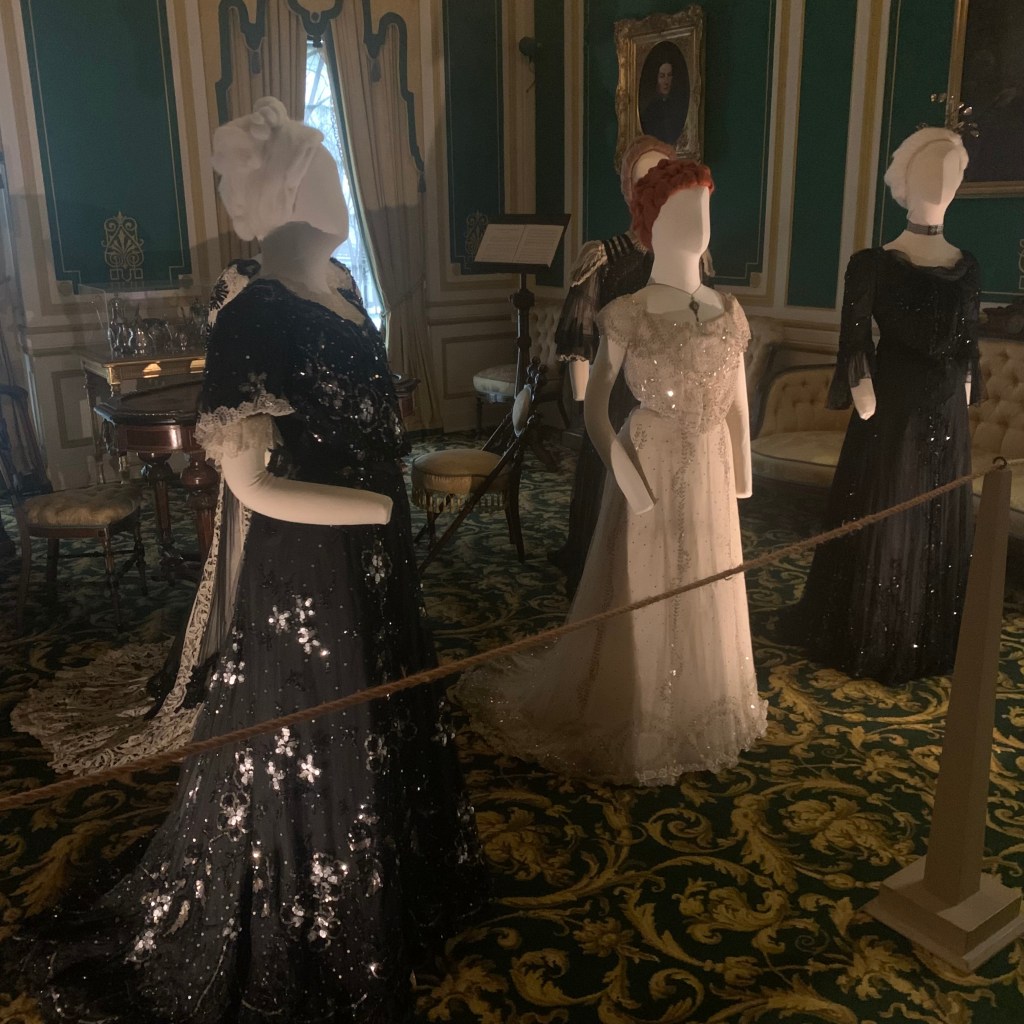
Western Reserve Historical Society – Cleveland History Center – “Fashion After Dark” Exhibit
Viewing the show, “Fashion After Dark” at the Western Reserve Historical Society – Cleveland History Center, forced me to remember the famous (infamous?) dress that “changed colors” a few years ago. Depending on who was asked, a black and blue dress looked gold and white or many shades in-between. While there remains conflicting opinions on “the dress” all of the theories center on human perceptions of color. Through a combination of light and the brain, via the photoreceptors in our eyes, we see color. Most of the time, it works without a hitch. Sometimes we see different things.
In subsequent experiments, when viewed under warm light, most people agreed it was a blue and black dress. Under cooler color light, everyone saw white and gold. Light has a tremendous impact on how we perceive color and that statement was the premise of the museum exhibit.
Beginning in the 1840s, the moneyed class was introducing gas lighting to their homes. Gas light was brighter than candlelight and the flickering variations delivered a unique atmosphere not experienced before. In the 1890s change was again afoot when gas lines were switched to electric and incandescent lamping presented another different illuminance. Outdoors, arc lighting illuminated the porte-cochere entrances of theaters, the orchestra and opera, yet another variant to artificial light.
The couture designers of the day realized they could take advantage of each of these changes in lighting. Fabrics that had been created, but rarely used, were now rising in popularity. Watered Silk (moiré) and taffeta delivered a subtle movement that provided an intriguing shimmer in gaslight. The application of sequins, rhinestones and jet pulled small slices of available light and presented multiplied glints of dazzle that drew attention to the wearer. Lamé fabrics likewise reflected and magnified glistening light across the entire gown.
The problem for the society women of the 1800s is the same one that faces all of us in the new world of LED lighting. The type of light we use impacts our color perception. The best local lighting retailers have “lighting labs” that help the consumer understand what they are buying. Most commercial lighting installations are preceded with a test, or in situ model that proves what the real installation will look like. Dress and fabric shops of the era featured evening hours and artificially darkened rooms so the materials could be best appreciated.
When my wife and I were rehabbing our second house, we used a purple and green theme in the master bedroom and wanted a VERY subtle violet on the wall. We selected the quietest tone we could find among the thousands of paint swatches. When we painted the walls the minimal amounts of daylight and deep purple (no heavy metal implied) carpet magnified the paint to such an extreme that I was forced to have the paint remixed with half the pigment, resulting in the room we had envisioned.
The importance of paint, countertop, tile, cabinet and fabric selection in the planned light and space cannot be overstated. LED light will likely function for the whole time people typically live in a home. It also presents colors in slightly different ways from incandescent, halogen or fluorescent light. The addition of daylight will add yet another element to the discourse. Taking a clue from 1800s couture can be a smart way to insure the maximum impact of an aesthetic choice.
Coda
One additional point about the exhibition must be noted. To replicate the visual fluidity of gaslight, flickering LED light was used in the exhibitions, placed just as they would have in the residential dining rooms, reception halls and ballrooms of the day. Wall sconces, table lamps and chandeliers illuminated the gowns. This was a wonderful way to help curators tell the story. Pumping natural gas into a museum of flammable collectables could never be considered. The breadth of LED continues to amaze me and I know applications will only grow in in the future.
The Mantis Shrimp and their dozen photoreceptors Photo by William Warby on Pexels.com
I recently finished reading An Immense World by Ed Yong. The book covers an overview of how animals use their senses in substantially different ways from humans. Some of the information is well known. Dogs have a sense of smell that is somewhere between 10,000 to 100,000 time better than humans. Bats use an echolocation “sense” to navigate at high speeds in the dark to locate miniscule flying game. Birds of prey (eagles, falcons, etc.) have superior eyesight that allows them to see forward and sideways to best home in on a meal. The book however goes deeper and helps the reader understand that most every “superiority” is balanced.
The dog has a remarkable sense of smell, but their eyes have only two color photoreceptors, so their world looks different than what humans see. Humans have three photoreceptors, a handful are tetrachromats with the benefit of four (I wrote about this phenomenon in a previous post: “Tetrachromatic Vision” https://lightingbyjeffrey.com/2022/05/09/tetrachromatic-vision/ ) but the mantis shrimp has TWELVE photoreceptors! Wow! You’d think their sight was miraculous, but alas, they have a tiny brain (brain size and functional capacity is a crucial piece of data in these analyses) so rather than witnessing colors beyond our imagination, they use the twelve photoreceptors as a type of binary coding system. If, for example photoreceptor one, three and eleven are triggered, they know prey is within reach. If photoreceptor two, eight and nine send feedback to the brain, it is time to move, an enemy is near. All benefits are balanced by Mother Nature.
Humans are sighted creatures and we regard the world based on sighted preferences. (I wrote about this in yet another post: “Eyes, Light and Sometimes, Brain” https://wordpress.com/post/lightingbyjeffrey.com/684 ) When we do that, we ignore the needs and demands of the other animals who occupy the planet. Even other animals who enjoy sight as their primary sense, do not use it in the same way as humans. Owls need dark nights to survive. The lack of light and their ability to see in it, sustains them. Bees have three photoreceptors, but because they can see UV light, the three receptors read different information and feed that back to the brain, so their color palette is radically different from ours.
Humans have risen to the top of the community of earth’s animals and our single-minded concern with human need is unfortunately harming the greater animal community. This summation ended the book. The human need to illuminate “everything” is doing irreparable harm to other animals. It is only getting worse, despite an avalanche of data on animals and their worlds. We read books like An Immense World and still increase street lighting, parking lot lights and high-rise building illumination. After becoming enamored with the content of the book, his plea to the reader is for some kind of action.
As a lighting community, we can do better. I’ve just looked at a wide variety of new luminaires released at the January Dallas Market and still we offer light aimed up into the sky where it does no good and only delivers harm to plants and animal. We use lumen levels way beyond what is necessary and that color of light is often blue, not only bad for humans, but many in the animal community are likewise impacted.
Can we help? We are in a unique situation to do just that. We can’t help much directly with pollution, micro-plastics in the oceans or noise levels that also impact, confuse and confound animals, but we can control light. That’s what we do as lighting professionals. Could we start to include concern outside of our genetic spectrum in addition to the color spectrum?
The Cleveland Museum of Art holds, what most experts believe to be one of the best collections of Asian Art in the world. The post WWII Curator-Director, Sherman E. Lee made important connections throughout the continent while serving there in the military during and after the war. Those connections proved invaluable as the museum ramped up the department. Special Exhibitions of the collection are well attended and always of interest. In the latest, “China’s Southern Paradise: Treasures from the Lower Yangzi Delta,” I saw something I had never seen before.
The lower Yangzi was a crucial center for the trades, craftsmanship and production for centuries. It was close to water, fertile land and necessary raw materials. Unfortunately, working in this era was still difficult and the climate is often humid. To keep the laborer cool, a bamboo “sleeveless garment” was created. That piece, in remarkably good shape was included in the exhibition. Small 1/16” diameter by 1” long segments of bamboo reeds were strung together in a diamond pattern. The undershirt created a layer of air between the skin and fabric, thereby helping to keep the worker cool. I was amazed by this utilitarian object, far more than the decorative ceramic vases, jade carvings and fine scroll paintings.
Keeping cool has always been the goal of LEDs. Like the creation of an elaborate woven undershirt, a fair amount of time (and money) has been spent insuring that the LED is operating at peak performance in lamps and luminaires. But what if we didn’t care? What if we allowed LEDs to “run hot?” What would happen?
The short answer is what we are now seeing in many LED replacement lamps, premature death. In an effort to cut costs, long hours of life have been sacrificed. Rather than the 40,000 to 50,000 hours of expected life, most commonly available light bulbs are now promising 15,000 to 20,000 hours. There is a belief that consumers are “OK” with lower levels of performance. Decisions have been made based on this assumption. To establish lower replacement lamp costs, forgo the “costly” heat protection components and shorten life expectancies.
I worry about what’s next. As we become accustomed to LED light in our homes, will we see lower lumen output next, like the shift from 120V to 130V on budget incandescent lamps a few decades ago? Will lower levels of color rendering be tried? Sure people with higher levels of color sensitivity will see the differences, but almost 85% of the population won’t. That might be worth the gamble.
I believe this is setting the stage for the creation of a “GE Revel-type” LED lamp. If you’re not an old codger like me, in a world of 25¢ light bulbs, GE determined that some people (15% of the population?) would spend more money (four to eight times more!) for better quality light bulbs. I have no way of knowing, but this had to be a profitable decision. Revel lamps were still available last year before the exit of incandescent.
I look forward to longer life, better lumen output and higher, more consistent levels of color across the spectrum in my light. I’d be a customer. For those features, I’ll gladly pay more. Now, swapping out my Banana Republic tees for a bamboo version…maybe not so much!
I must admit, I have not stayed up to date on quantum dot LED technology. While I’ve read a few technical articles about them and I know they have had a big impact on flat screen color performance, I haven’t found where they will quickly appear in residential lighting.
My interest in quantum dot LED or OLED was sparked again while reading a Wired Magazine article on passwords. Like quantum dots, quantum computing is on the precipice of impacting that industry. If quantum computing comes to fruition, passwords as we know them will become obsolete. Regardless how many numbers, how many capital letters and how many special characters we use, passwords will be unearthed in seconds because of the unimaginable processing speed of quantum computing.
Of course, now that lighting is part of the “tech” sector (remember, LED are simply semiconductors) rapid change is an inevitability. No one in the computer industry is suggesting quantum computing will not happen just as I’m not denying quantum dot LED will show up in residential lighting…eventually. Despite this coming technology, passwords, or baseline security protection is not making advances, or more succinctly put, they are not finding security protections options as fast as quantum technology normalization is advancing.
I can’t imagine a career dedicated to creating digital security options. I can only say, “Good luck!” Even though lighting has been my life for almost fifty years, I’m not sure I’m smart enough to visualize how quantum dots LED/OLED will impact residential lighting. My guess is the quantum technology will be packaged to create almost perfectly replicated natural light that easily changes throughout the day, minute by minute, season by season. Our bodies circadian demands will be full satiated and the harm done by artificial lighting up to this point will be placed in the rearview mirror, but does residential lighting have a “password issue?”
Is there something we currently enjoy with today’s LED lighting that will be changed by quantum LED/OLED? Will any of our power savings disappear? Will output suffer? The swap from incandescent light to LED forced a realignment of our perception of the color of light. Will the introduction of quantum LED cause a revisit of this issue? Does the elimination of light within the UV and infrared spectrum disappear with quantum technology? Will UV and infrared light again be a concern?
Perhaps these are being answered as I type. I plan on spending more time trying to understand the impact quantum LED/OLED might have on residential use lighting. In the meantime, I better change some computer passwords…or not.
Lighting for Tomorrow was a new product competition that sought to highlight inventive uses of energy efficient lighting. When started, fluorescent lighting was considered pedestrian and good for only the most functional of lighting chores. America installed fluorescent lighting into garages, basement workshop areas and MAYBE the laundry room. Why not other areas? The competition encouraged manufacturers to reimagine fluorescent use in decorative products.
As a Product Manager of a luminaire manufacturer at the time, I readily accepted this opportunity. I asked the talented design staff to create products that would ameliorate the undesirable aspects of fluorescent light. While fluorescent lamping was the only energy efficient option, we received recognition for multiple products. Once LED entered the scene we again enjoyed awards in different categories. Our product was recognized and displayed at many trade shows, countless publications and industry events.
When the competition accomplished its goals, the adoption of energy efficient lighting across the luminaire spectrum, Lighting for Tomorrow was retired. A new goal was then established. Controls. Many consumption researchers found that the next “big” reduction in energy could be achieved through the use of intelligent controls. The most far reaching predictions were an additional 25% savings of electric consumption simply by better controlling light use.
At the same time, other areas outside lighting were going through their own efforts to reduce energy consumption. What if all of this were combined? When people leave their home they shut off lights, reduce the heat, turn on a security system, lock a door, close a garage and start a car. Electric power is plentiful throughout the night, why not run the dishwasher, clothes washer and dryer when demand is at its lowest? Lighting for Tomorrow was transitioned into the Integrated Home Competition.
The Integrated Home Competition seeks to find high efficiency products that easily integrate with home control systems and other like-minded products, are well built, easy to install and set up and provide the consumer with perceived value and security. Among the categories is lighting.
Manufacturers
Do you have a product that, in addition to saving money on energy, also easily links with home control systems (Alexa, Google Home, Apple Home) and perhaps, interacts with HVAC systems, security systems and/or utility data sharing apps? Is it a product that works beyond the simple wall switch control? If so, consider submitting it for consideration.
Sales Representatives and Design Practitioners
You see new products every day. Does something you’ve seen recently break new ground? Does it make installation and set-up easier? Does it facilitate easy transition between other consumers of energy in the home? Urge the manufacturer to submit the product for consideration.
Winners
I was honored to be asked to judge the submitted products entered into lighting and ceiling fan 2023 competition category. A group of us with decades of experience in lighting and controls installed, set-up, operated and tested each submitted item. We read the included instructions (I know that sounds unusual!) and watched online installation videos to determine if the product functioned as promised. We paired products with smart phones, Alexa and Google Home and tested functionality. Via conversation and a genial exchange of view, we unanimously agreed upon the products that deserved a year’s worth of recognition.
While testing and talking we wondered if there were other products that should have been submitted. We all agreed to do what we could to encourage additional submissions, hence my inclusion of this information in the blog. Every one of us will benefit from reduced energy consumption. Let’s work to recognize those who are creating products to meet that end.
In the last post I talked about the ubiquity of LED Tape and where it can be placed. Three key areas remain. First, how much light do I need? What lumen output should I select when considering the addition of LED Tape? Then, maximum run lengths must be regarded. These will be a factor when designing the system. Lastly, we’ll review color temperature recommendations. With the four areas covered, selection, design, specifying and implementing LED Tape into an interior design is easy…or can be easy, once you’ve done it a few times!
Output
Like a Ford Model “T” black-only color choice, when LED Tape was first introduced, there was a single light output available. A quick glance at almost every major manufacturer’s catalog today will result in a huge variety of lumen output options. That is in response to the varied applications in which LED Tape has found itself. Toekicks, above cabinets, inside cabinets, coves, tray ceilings, drop ceilings and under countertops. Each of these spots need different light. In addition, surrounding surface colors will impact output, so more light should be used with darker colors.
When looking at an LED Tape product catalog. You will find a key piece of information, “Lumens per Foot.” This will range from 100 to about 1000 lumens/foot. You can assume cost will be commensurate with output, so it is important for lighting professional to select the item that delivers the right amount of light; but what is right?
Here are few guidelines based on use. Remember darker surrounding colors should use the numbers at the high end of the range. Light on taller ceiling might need a bit more light than an older 8’-0” ceiling height. If the distance from the top of the cabinet to the ceiling is short, use less light, if the cabinet is small, minimal lighting is needed inside. These are lumen ranges for a reason. Categories are intentionally vague to invite design professional input.
Application
Lumens per Foot Range
Mood lighting / Light Used as a Background
100 to 300
Accent lighting / For Added Aesthetics
150 to 500
Task Lighting – Close
275 to 500
Task Lighting – Far Away (light location)
350 to 700
Indirect Lighting
375 to 575
Cove Lighting
180 to 500
Principle Lighting in a Room
400 to 1000
As a Replacement for Linear Fluorescent Lamping
500 to 950
Kitchen Under-Cabinet Lighting
175 to 550*
*see comments regarding kitchen under-cabinet use in the previous post
Remember, lighting is cumulative, if you cannot find 800 lumens per foot tape at your favorite retailer or from a preferred brand, use two rows of 400 and you will get the same output. Two low-lumen output lengths might also be less expensive than a single length that delivers twice the light. Consider all options.
When designing with light, as with any other aesthetic element, extra attention might be desired in select areas. Feel free to veer from the suggestions. Like with anything, understand the guidelines and alter them with knowing intent.
Diffusers – The use of diffusers over LED Tape will reduce the lumen output. In some places, it is necessary, such as in-wall, drywall deep designs. That should be factored into the design. Some clients prefer the clean, non-mechanical looks of a channel and diffuser even in under-cabinet or above cabinet applications, usually for cleaning purposes. When not required, consider eliminating diffusers. Better output will result.
Run Lengths
The other piece of information you will find next to every manufacturer’s product is “Maximum Run Length.” You will typically find an inverse correlation between “Lumens per Foot” and “Maximum Run Length.” Essentially, you can run tape farther with less lumen output. If large amounts of light are needed, the runs will be shorter. You will see maximums of as little as 10’-0” and I have seen some specifications that reach up to 65’-0”, but usually 32’-0” is the limit.
Maximum run lengths comprise of the actual lighted length of LED Tape, so if the start of the tape is 5’-0” from the power and wire is needed to jump from one cabinet section to another requiring 9’-0” of interconnection wire, those are NOT counted into the maximum run length.
When laying out a LED Tape system, clever power supply placement can maximize these limitations. For example, if a 10’-0” square tray ceiling is to be illuminated and 20’-0” run length maximums are selected, place the power supply in a corner and run the first 20’-0” length in one direction and the second run in the opposite direction. This will not be a contiguous 40’-0” run, but it will give the exact same appearance. A small amount of pre-planning will eliminate hours of rework or multiple power supplies.
Color
If you read this blog regularly, or if you have heard me speak at any point in the last decade, you know I regard light color in residential applications very narrowly. I believe lighting should be either 2700K or 3000K. Warmer finishes used in the home, such as beige walls, wood cabinets and earth-tone carpets will always look better with 2700K light. Homes that are “cooler” with lots of white, black, blues, greys and stainless steel will find those colors best represented using 3000K. The ONLY time I suggest or use anything different is if a client has a display case with collectable crystal or sterling silver. 4000K adds the necessary blue to allow these object to “sing!” Other designers disagree and employ a wider variety of color. Many of their opinions are well placed, but I still maintain the “A” or “B” decision is all that is required. It doesn’t have to be complicated.
While most reputable LED Tape uses diodes with a Color Rendering Index (CRI) of 90 and above, be sure to check the CRI is in this range. CRI is an important indicator of how well the colors in a room will look.
Another frequently asked question regarding color is, “Can I mix color temperatures in a room/home?” My response is always the same. “Do you mix colors in a room?” If you’ve ever painted a room with two or three different shades, you did that for a reason. A deliberate decision was made to use light blue paint on the wall, mid-range blue tiles on the floor and deep indigo on the window dressing. Apply the same logic to light. If there is a reason for 3000K light in a tray ceiling and 2700K at the counters, then mix away. Do not, however simply scatter varying colors of light pell-mell across the room. This is the design equivalent of five different fluorescent tubes in the ceiling troffers of an old office.
A Few More Things
As we have seen change in LED Tape over the last ten years, change continues today. Manufacturers introduce new “bells and whistles” every month and the popularity of the product has pushed vendors to change, update and rethink almost everything about it. Following are a few things you can buy now or will see on the horizon.
COB Tape – Some consumers have objected to the dot of LED reflecting in polished granite surfaces. One solution is placing the LED Tape inside an extrusion and adding an etched acrylic cover or diffuser. While this does ameliorate the bright spot of light, it also reduces the lumen output, sometimes considerably. Chip-on-Board (COB) Tape delivers a continuous strip of light, rather than individual dots. Some brands are offering it today. It is priced higher than traditional LED Tape, but the output is good and the run lengths are likewise acceptable. This could be a nice option when faced with this particular client pushback.
Dimming – Most every manufacturer now offers dimmable LED Tape. Remember, dimming requires a power supply with dimming capabilities and like all LED, the dimmer and the power supply MUST be compatible. Always consult the tape manufacturer’s dimmer recommendation. Before that, ask whether dimming is even required. With the wide range of lumen output, dimming might take a great lighting design and ruin the results as output is constantly in flux.
120V LED Tape – We are seeing more and more “line-voltage” LED. The elimination of a power supply is very enticing. Simply connecting the electrical wires directly to the LED is an intoxicating draw. Some are good. Many have problems. Caution should be used if 120V LED Tape is considered. The same cautions you would attribute to 120V LED bath lighting or chandeliers.
120V LED are substantially more vulnerable to flicker. This can be eliminated, but it required additional circuitry that might reduce the monetary savings achieved by removing the power supply. Ask about flicker rates or percentages, especially if clients are physiologically vulnerable to flicker.
120V LED are more difficult to dim. Again, this can be solved, but the added circuitry means more money. If dimming is necessary, be sure to investigate the approved dimmers and other requirements.
LED Life – Most 120V LED do not last as long as low-voltage LED. The functional light provided by LED Tape could easily overlap multiple room remodels. Low-life cycle LED might not be the best option in these applications.
What started as a simple four part answer turned into a two-post response. It might sound complicated, but it isn’t. Once one systems is installed, it becomes much more intuitive. Trust me.
Since its introduction about a decade ago, LED Tape has become an almost ubiquitous element of lighting design. When introduced, it was the first LED lighting product that was less expensive than the legacy product it replaced. Festoon lamp based linear lighting soon disappeared. (Good riddance! What a horrible product!) LED Tape prices continued to drop and wider varieties and options were soon added. The market is now filled with a massive array of LED Tape, such that a very frequent question is the title of this post. “How do I effectively buy or specify LED Tape?” Put as simply as possible, I recommend using four factors in the decision. Color, output, placement demand and run lengths.
I originally thought I could cram all of this into a single post, but the more I wrote, the more I realized readers might be better served if I went a bit deeper into each section. Part One will cover placement. The next post, Part Two will complete the information and discuss color, output and run lengths.
Placement Demand
Since I began this blog, I have periodically provided some suggestions for LED Tape placement. Avoiding many of the reasons and some details, I’ll quickly recap my location suggestions for a group of the most popular and emerging uses.
Above Cabinets – Place the tape 3” from the front edge of the cabinet. Follow the full perimeter edge if variations in depth are present. Place tape on the side of the cabinet, to the wall, if there is a break in the continuity of the cabinet run. (i.e. a doorway, appliance or room entrance)
Above Cabinet Alternative (installed as back-lighting or to highlight a wall) – Run a straight line of tape along the BACK of the upper cabinet 3” to 6” from the wall the full length of the upper cabinets.
Inside Cabinet WITH Front Fascia – Mount the LED Tape on the inside of the fascia faced into the cabinet on the hinge side. Tape should be run from the top to the bottom. If more light is desired, or if the cabinet is wide, mount a strip on both sides.
Inside Cabinet WITHOUT a Front Fascia – Mount the LED Tape on the hinge side wall perpendicular to the door surface. Tape should be run top to bottom. Try to avoid using a run on the handle-side of the cabinet. When the cabinet is opened, it could be too blinding. If additional light is needed in this type of cabinet design AND shelves are translucent, consider a strip along the top. While it will be seen when the door is opened, it will likely be far enough out of sight and cause only minimal glare issues.
Under Countertop – A ½” wide by 1/16” to 1/8” deep router about ½” from the front edge of the countertop will accommodate most every tape option. Surface depth of counter might need to be increased. If an ogee edge is used, fabricators have told me that the router cut must start where the full thickness of the material starts. This may require and even larger surface depth. My experience indicates that a granite, marble and quartz stone routered groove may be more problematic than Formica, Corian and concrete. Always review the need with the countertop fabricator. Don’t forget the “mouse hole” that allows the wire to enter the inside of the cabinet!
Under Countertop Alternate – If the space between top of the lower cabinet doors and the underside of the countertop is sufficient, the LED Tape can be mounted on the underside surface in a channel without a router. If this option is considered, always check the door swing clearance.
Under Island – Run the tape the full length of the island overhang installed about 9” from the chairside front edge of the island top.
Toekick – Run the LED Tape along the center of the toekick space. Remember, do not place toekick lighting in front of appliances. Instead, use an extension around the sides of the cabinet and behind the appliance opening so there will be no issue when removing the appliance for cleaning or servicing.
Cove – Mount the LED on the wall, just below the front edge of the cove material height.
Cove Alternative – Mount the LED on the front edge of the cove material aimed inward toward wall or at the bottom of the cove aimed upward to the ceiling, depending on the desired lighting effect.
Drop Ceiling – Mount the LED Tape on the end of the drop panel, about 2” from the edge, aimed up.
Tray Ceilings
There are countless versions of tray ceiling construction. Adding LED Tape here is easy, but rather than providing ten locations, let me provide a few thoughts.
Unless using an LED Tape aluminum extrusion where the visible light become a part of the design, try to avoid seeing the LED light. Place them behind barriers of forward enough so direct sign is impossible.
Be careful with corners. Linear light that intersects at boxed corners will deliver odd lines and shadows that some people like and others dislike. If you think this could be an issue, test the output prior to finished installation. One option is to cut the tape short of the corner to reduce some of the light patterns you might dislike. Mounting the tape on a different surface will also change the light/shadow patterns.
To connect LED Tape corners, a corner-connector is used. Be careful with the wire! It can also lead to odd shadows. Use electric tape and affix the connector wires to the mounting surface so it will not rise above the light.
Cove extrusions mounted inside a simple tray construction are a nice way to achieve the same effect with less complex tray framing.
Aluminum Extrusions Aided Placement
Shortly after the creation of LED Tape, installers and designer realized that new and exciting ideas could be realized with the assistance of aluminum extrusions. A row of LED Tape (or two, or three, or six, depending on the extrusion size!) is adhered to the inside of the aluminum. Most have matching diffusers. These combinations have unleashed an avalanche of exciting installation options.
Drywall deep light designs in walls and ceilings
Inside and outside (drywall) corner illumination
Wall wash ceiling perimeter lighting
Tray ceiling edge lighting (see above)
Step tread lighting
Stair rail lighting
Lighted baseboard perimeters
IP rated floor lighting installation
The combination of extrusions that accommodate various quantities of LED Tape and a little creativity has allowed these options to change interior lighting design.
LED Tape Used In Under-Cabinet Kitchen Applications
The old, self-contained under-cabinet lights used to deliver between 200 and 400 lumens per foot. Because they contain 1, 2, 3 or 4 individual lamps, they were also somewhat spotty. There is virtually no reason to use them any longer LED Tape in a simple channel or in a stylish aluminum extrusion can service the same need, deliver even light across the full length of the countertop AND save a fair amount of money. The only question that need resolution. Can the installation accommodate the required remote power supply? Perhaps it is located in the attic, at the top of the upper cabinets, in the basement or the inside of the cabinet with low-voltage wire traveling to the tape. Determine power placement as carefully as the lighting for the best results.
Once power supply location is resolved, how much light is the right amount of light? When deciding, I ask about the cooking practices of the owner. Are they a gourmet chef, “Heat-n-Serve” cook or a Door Dash practitioner? With that information known, good decision can be made.
The gourmet will need plenty of high quality light and it will be used for many hours. Specify the highest lumen per foot options (500+ lumens per foot) from the most reputable manufacturer.
The “Heat-n-Serve” cook needs light, but will be opening cans and ripping envelops to mix up a quick meal. The mid-range numbers will serve them well. Find 250 to 400 lumens per foot tape.
When countertops are only used to read online menus and find pizza delivery numbers, there is no need to invest in expensive under cabinet lighting. The low lumen output product is fine. Spend the savings on better island pendants!
Lastly, ALWAYS use an extrusion on wood, at a minimum, the low-priced plastic option, when installing LED Tape to the underside of a cabinet. The double-back tape, even the high quality 3M is no match for raw wood. The wood will pull moisture from the tape and before you know it, a sag will occur.
Occasional Demand Use
The client wants to light an area that is used only on birthdays, Halloween and the end of year holidays. If this is the case, consider using some of the readily available “budget” LED Tape options on the market. They are cheap, they may not last 40,000 hours, but for the occasional use, they could be just what is needed. Again, save the money and spend it elsewhere. Conversely, this budget product might be enticing to use everywhere. Don’t do it! It is budget priced for a reason! It will likely fail to withstand the demands of continual use, might have subpar color rendering and the double-sided tape will almost certainly not last.
In two weeks, I’ll post the second half of this discussion and talk about lumen output, run lengths and color.
As a follow-up to seeing the English film, “Living” a friend allowed me to borrow his Janus Film copy of the original Akira Kurosawa masterpiece, “Ikiru.” I typically do not watch the “extra features” included in most digital packages, but the interview with the visionary director was too compelling to ignore. The talk was broken into various aspects of his approach to film. One was titled, “Lighting” so of course, I could not help but pay extra attention.
In his conversation on the importance of lighting, he mentioned that to embolden colors that appear on film, he would paint and tint reflector panels that would pick-up the set lighting and bounce additional color with light onto what was being filmed, thereby resulting in more dense, fuller tones. It is the reason why so many of his color films have such vibrant appearances. If you haven’t seen “Ran” give it a watch to understand the value this technique brought to the movie. Trust me, whatever you see on your flat-screen was better in the theater using projection. After so many years, I still remember it.
I started to think about its use in residential lighting. I knew a landscape lighting designer who used seven different gels or tinted blue filters on incandescent lamping to complement each varietal of evergreen, resulting in an otherworldly feel to the exterior spaces he lit. Perhaps the client didn’t know, but he and I suspect other designers certainly did.
Can we bring Mr. Kurosawa’s and my acquaintance’s dedication to color into the interior of a home? In fact, we may have already done that when we introduced LED to the home a few years back.
Incandescent light was VERY yellow, rendered dark blue, deep purples and browns poorly, but the amount of red did make it feel “comfortable/warm” to a large majority of the population. LED presents color in a different way because the spectral power distribution (a representation of the amount of each color in the visible electromagnetic spectrum) is different.
Don’t be frightened. The electromagnetic spectrum is easy to understand. Visible light spans from 380 nanometers to 700 nanometers. Ultraviolet light has a smaller measurement than 380nm (it appears to the left) and infrared light is larger than 700nm (it appears to the right.) The visible range begins after the ultraviolet light on the spectrum, runs from purple to blue, to green, into yellow, orange and finally red before disappearing from the human eye’s visible range into infrared light.
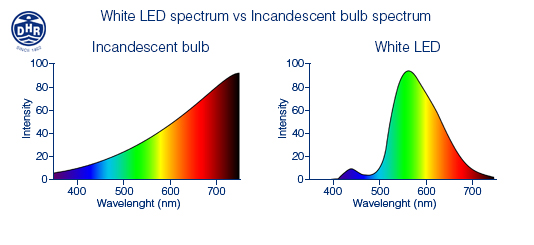
In this image, you can see the assortment of colors visibly represented across the horizontal, the intensity of each color is displayed vertically.
The incandescent light features a very small amount of intensity in the purple and dark blue area on the left, hence the reason it is so difficult to “see” the difference between a navy blue suit and a black suit.
All white LED starts with a blue diode that is influenced by phosphors. That blue seed is visible in the LED spectrum as the blue hump on the left, before the huge rise into light blue, green and yellow. The almost nonexistent “red” at the right is the reason humans feel that LED is somewhat cold, or less comforting than the “warm” old incandescent.
The good thing about LED is that the spectral curve CAN and HAS changed since the first LED were introduced into the market. The incandescent curve hasn’t changed since Thomas Edison. That means we have options today that were unimaginable yesterday. A 3000K output will increase the “hump” of blue slightly resulting in better rendering on purple, blues, blacks and even white. With the 2700K white light as illustrated here, the blue is marginally suppressed and the red is increased a bit allowing for better color rendering of warmer colors like beige, yellow, orange, wood and eathtones. Red is a VERY dominant color, so even with substantially lower intensity, it still renders the color well.
Most lamp and luminaire manufacturers now produce 2700K and 3000K LED products, so as consumers, we are faced with a very simple choice. Do we have a “warm” or a “cool” space? If warm, we should select 2700K products, cool means buying the 3000K option.
Akira Kurosawa’s movies are complex and will be studied by film scholars for decades to come. How he achieved some of the results will continue to illicit post-screening, coffee shop conversations for as long as we have movie fans. Choosing color in a residence is decidedly easier. As long as you grasp the underlying science.
I remember this quote from about a decade back while attending a lecture. It is attributed to Chris Harrison – Future Interface Group.
If you showed Thomas Edison the Hue light bulb he’d say, “All you did in 120 years was make it change colors?”
For the next couple of weeks, we’ll see a lot of colored light. There will be trees decorated with light, homes decorated with light and even a few Santa caps will be illuminated. There is a good chance, every one of these applications will use LED. (Especially, the cap!) Unless you have one of those retro-holiday friends who scour flea markets for old school light bulbs, holidays are now made festive with LED light. We probably don’t think about it, but the energy savings is substantial. Your utility company has definitely thought about it. Power use always accelerates during our end-of-year celebrations. LED has helped to make that less daunting for the power producers.
Think about the changes in holiday light that are brought about by LED, then consider this is technology we had relegated to audio-video equipment on-off buttons and wristwatches until about fifteen years ago. Sure, it took 120 years to extract ourselves from the incandescent light bulb, but since that unhinging, I believe we’ve made up for a lot of lost time. More will occur and change will continue, but inventors and consumers deserve a pat on the back. Well done, all.
As you drive to visit family and friends this month, check out the now ubiquitous icicles hanging from gutters, the whole-home façade light displays and inflatable yard toys, all lit with LED. We all did this. Congratulations!
As for your ample-bellied Uncle wearing an oversized sweater emblazoned with a flashing red reindeer nose, I’m sorry. You know people will always find a way to mess with new technology.
Have a wonderful holiday and an even better 2024. I’ll have more to say about light in the New Year…as always, but you already know that!






 Lighting by Jeffrey