
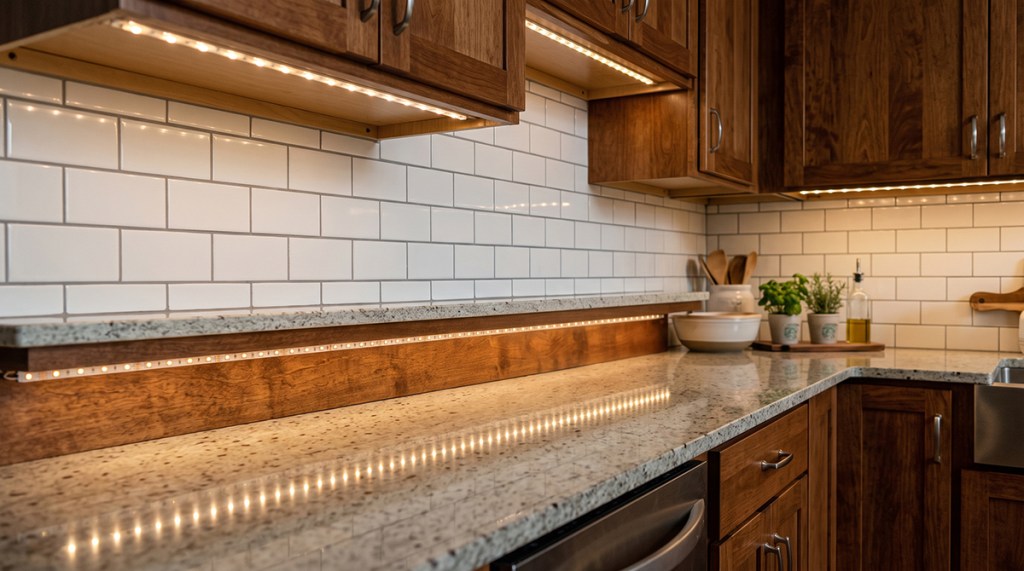
When the first LED undercabinet lighting was introduced, the biggest complaint was the line of dots reflected in the countertop. I always responded in the same way. “Don’t blame the LED!”
At the same time LED was transitioning into the residence, the kitchen countertop was also experiencing an update. Prior to polished granite and quartz, the “hot” counter was made of Corian®, a solid surface. Before that was Formica®. Both featured a matte finished. Scattered about, over the previous decades were formed concrete, ceramic tiles and wood. All matte finished. For the first time, we were using a reflective surface on countertops. Of course you can see the LED diode. A fluorescent T5 tube would also be visible. Nonetheless, LEDs took the fall.
Most LED and especially, LED used in early undercabinet lighting are Surface Mounted Diode (SMD.) A lens, or white cover could have ameliorated the offensive “dot” of light reflected off the shiny surface, but because the early LED produced limited quantities of light, we certainly did not want to reduce output by 20% to 40%. I reminded people, once they placed their toaster and canister set on the counter, the “dot” would disappear and they’d hardly remember it was there.
I was wrong. Consumer didn’t forget. Enter Chip on Board (COB) LED. With chips mounted directly on the PCB and a built-in diffuser, light was emitted in a continuous strip. Consumers still found reason to complain. This time they did not like the unsightly yellow band that replaced the dots, when the light was off. This complaint always struck me as difficult to grasp. How many people are upside-down on their kitchen cabinets looking up, onto the underside of the upper cupboards? (Maybe I don’t want to know the answer to that one.)
Now just as the most popular countertops feature a swede, or matte leather type finish, the last glossy countertop solution has arrived. SMD on Board (SOB.) In this case, the individual diodes are back on the printed circuit, but they are covered by a silicone ribbon that squashes the intense dots. Each diode is now powerful enough to compensate for the slight reduction in output caused by the ribbon. Because they are back to individual diodes, CCT and Color Temperatures are more controllable.
Last week, my wife, a retired RN, showed me a photo from an RN Facebook page she follows. She asked me if I could read it. I couldn’t. It was strings of indecipherable letters that looked like English, but sure didn’t read like it. She took the iPad back and began to read a Nurse’s entry in a patient’s chart, detailing food intake, vital measurements and personal observations. If I had more wit about me, I could have easily responded with a history of under cabinet lighting; T-12 to T8 to T5 to Halogen to Xe to SMD to COB to SOB. Lighting people can speak in code, too!
Regardless of the language, even if we might not need it, LED continues to improve. I wonder what will arrive after the SOB.

