
Here are a few realities about US electricity.
- The US federal government has pulled its support or hindered alternative power sources such as solar, wind and battery.
- Inefficient and dirty coal-run electric power plants are regularly being decommissioned. Natural gas fueled plants are also shutting down. Some for these two reasons, others because they are simply at a natural “end of life” and can no longer function properly. Most are not being replaced.
- Electric demand is on the rise, primarily from data centers being added to support an Artificial Intelligence (AI) boom.
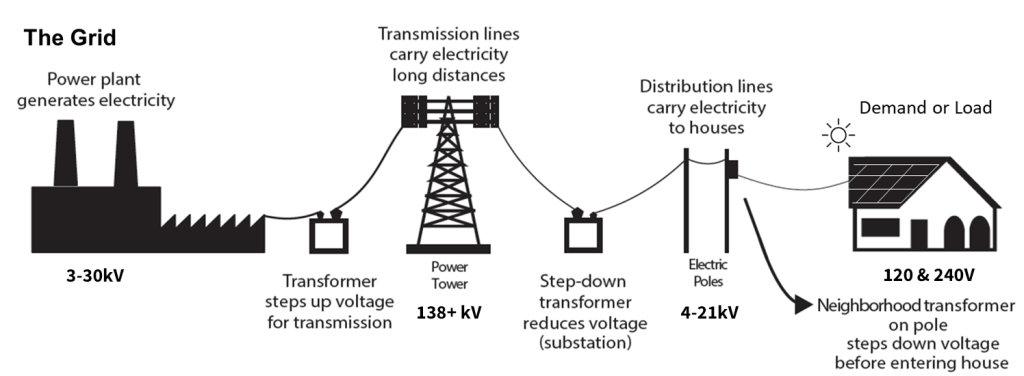
- The rest of the US electric grid (substations, high-voltage transmission lines and local distribution lines) is OLD, in poor health and crumbling.
- Electric rates are increasing.
According to the North American Electric Reliability Corporation, (NERC) “Long-Term Reliability Assessment” of January 2026, this combination of events will result in a higher levels of blackouts, impacting tens of millions of users over the next five years.
The most vulnerable area is Texas. Apparently, Texas is like Hawaii, in that its grid is not largely connected with the greater national system. They are also seeing an increase of residents, industrial demand, data centers and bitcoin mining. Their grid isolation led to the 2021 power failure that resulted in over 200 deaths and makes them extremely vulnerable for future blackouts and losses. They are not alone, The Upper Mid-west, the Mid-Atlantic and the Pacific Northwest were also cited as vulnerable.
Add to this what we already know. (According to the Energy Information Agency [EIA] 2020 report and research done by the University of Minnesota on this topic.)
- Americans experience an average of six hours of electrical disruption per year.
- North Carolinians experience 30 hours of electrical disruption, five times the national average and twice as much as #2 Vermont.
- The United States has more power failures than any other developed nation.
- Americans experience more time without electricity than eight other industrialized countries.
- Power failures in 2012 were ten times more common than in 1985.
- Power failures doubled from 2003 to 2012.
What Do Lighting Folks Do?
It is time to take resilient lighting more serious. We can all buy some clunky battery backup light that looks like it was designed for a garage, but you wouldn’t want to put it anywhere else. If regular power outage is our new reality, we’ll need a recessed can (that looks like all the other cans in our ceiling) with backup power. We’ll need a decent looking flush mount and perhaps semi-flush luminaire that functions once the power disappears. There will need to be multiple styles, sizes and finishes. Building codes should be adjusted to require a handful of resilient luminaires in crucial spots across the home. To meet the needs of consumers, they should mimic their non-resilient sister. We should not suffer aesthetically because our power grid in not being protected by our elected officials. We need to do better.
I live in an older, inner-ring suburb of Cleveland that is supplied by underground electric from the 1925s to 1950s. We lose electric regularly; on an average of six times per year. As we rehabbed our mid-century ranch (also in the same neighborhood) we wanted to protect ourselves from this inevitability. We were okay with the occasional loss of electricity, (we’ve been here almost 25 years, it’s a reality of our life) except for the loss of heat. I wanted some sort of battery back-up for the thermostat and igniter/pilot. The furnace (and before it, the boiler) were gas powered. Once started, the natural gas would function fine. The only thing preventing a warm house was a small, low-voltage “spark” from the thermostat. Nothing was available. Everyone looked at me like I was asking for a gold-plated raccoon. Their only solution was a whole-home generator. That’s like using a gold plated .50-caliber rifle to kill the gold-plated raccoon. Perhaps the HVAC community won’t help, but lighting could be a better partner for homeowners.
The NERC report does provide some good news. California is no longer considered a vulnerable location for blackouts. After years of weakness, they now have a solar-powered grid of batteries ready to serve as backup, should the need arise. If only other states and the federal government would adopt this solution, we wouldn’t be in such a pickle. Until then, it’s up to lighting people to help America live with rolling blackouts by dedicating more resources to the creation of well thought-out, aesthetically pleasing, resilient lighting.
You know I love a big tranche of data! This report is chock full of good information. To read the entire report:
 Lighting by Jeffrey