Categories
Technical Lighting Help

Is Home Automation a “Time-Saver?”

Photo by picjumbo.com on Pexels.com

My wife and I have just moved into our new-old home. We have spent almost a year restoring and reinvigorating a mid-century ranch that will deliver a more carefree (and step-free) life for us as we age. Because of the rough state of the home when we purchased it, a rewire was required. Many walls were removed (black mold) the ceilings were taken out (water ingression from a leaky roof) and fuse boxes removed (Federal Pacific Electric Panel.) The lack of physical encumbrances made the lighting choices easier. I could spec almost everything I wanted and the wiring part would be easy. (Well, easier. Doing so within the confines of maintaining the mid-century characteristic of the home soon became the hindrance.)

I decided to install a Control 4 Home Automation system to “run” the house. Security, lighting, garage door, shading controls, temperature control and intercom could fall under one umbrella. The Bosch appliances, themselves supported by a proprietary app could be brought into the group. There are other functions that could be integrated as well. Luckily, I have been using a local tech-guru that helped me through this process. More often than not, when I asked if something could be done, his answer was, “Yes!” I cannot amply stress the importance of having a tech-champion on your team. This person is as important as a plumber or an electrician. (Please note, a tech person COULD be an electrician, but an electrician is not necessarily a technology expert! Get the right person for the needed job.)

I wanted the system because of my belief that, despite the conflicting realities, automation is probably more beneficial to seniors than the tech-savvy Millennials. My wife selected faucet handles that will work better for arthritic hands, the AIP contractor suggested a drawer microwave because it is more conducive to someone who might be wheelchair bound. Wet baths were included to eliminate the possibly hazardous step and aesthetically sensitive grab bars were included, just in case. Automation systems can be equally helpful for many of the other things that become a struggle as we age.

The back of the house features sixteen large windows that look out on a wooded area (in the middle of an inner-ring urban/suburban neighborhood.) Without automation, opening and closing them daily could be an onerous task. Insuring nightlights are turned on at night has shown to reduce falls in seniors. That is an easy thing for home automation systems. Nighttime security checks can quickly be achieved by a control system. All of these things should make life for us better as we age. All of these things should not be a burden.

I was reminded of the burden of automation after reading a New York Times opinion feature that shared the fact that automation is NOT saving us any time. Workers using AI to “help” are not saving time. Technology-enhanced homes are not allowing active young homeowners added time to lollygag and “chill.” Statistics state they spend roughly the same amount of time doing (loosely defined) housework as their parents. But why? The creators of these products promised me peeled grapes and a pink pony!

Each time my wife attempts to book a doctor’s appointment online, I am reminded why technology does not always save time. The two-step authentication becoming more and more ubiquitous was probably invented by lawyers in an effort to protect their litigious-prone industry. How many times has a slow server, or a weak Wi-Fi connection caused you to “time-out” of your ability to enter the six-digit code? My moderate dyslexia invariably forces me to reenter the number more than once. Does the cybercrime version of Boris & Natasha really care my annual physical is scheduled for next Thursday?

I’ve never figured automation to save me time. In pre-computer days, when I managed an Engineering Department, I had an assistant. If I needed communication to be sent to people in the company, outside the company, whomever, I asked her to write a note to them about whatever topic was required. Later that day, she had typed a letter covering the required topic. As fax machines came online, I was required to write letters with sketches and details she could not complete. When each of us was given a computer and an email address, all of the correspondence was now my responsibility. My assistant could no longer handle that portion of my workload. I was now the typist. Luckily for her, she was an immensely talented person and went on to manage her own collection of people in a different area of the company. Automation simply meant I now had more work. Different work, but more than I had prior.

I did not buy and have installed a Control 4 home automation system to save time and money. I did not expect to save energy. I did hope a home support network would allow my wife and me to live in our last home longer by eliminating some of the more cumbersome tasks from our daily routine. I still believe this to be true. I am also realistic (and old) enough to know that sometimes you get wasabi and sometimes you get horseradish with food coloring and cornstarch, more often, the latter.

Categories
Lighting Commentary

Jimmy Carter and Energy Efficiency

In the 1976 election, I worked on the presidential campaign of Mo Udall. I didn’t care much for Jimmy Carter as a candidate, or the emerging neoliberal era he would ultimately introduce. During the 1980 reelection campaign, after it was clear Ted Kennedy could not unseat him for the Democratic nomination, I supported third-party candidate, John Anderson. Carter was not worthy of reelection and Ronald Reagan proved to be as divisive and damaging to the United States as I had imagined at the time. It is safe to say, I was not a fan of Jimmy Carter’s presidency. There are, however a few things worthy of respect as it regards Mr. Carter.

After defeat he established a pattern to which all Ex-Presidents should aspire. He is the best Ex-President America has ever had. He used his celebrity and stature where it could do the most good and forewent notice when the only result would be narcissistic. This was so tough, 36 others could not and have not been able to pull it off.

More importantly to this blog, in the face of much derision, Jimmy Carter introduced America to the frailty of fossil fuel use and the inevitable problems that would bring to the country if changes were not made. In response to what he saw, he delivered speeches to the American public indicating that this problem was “the moral equivalent of war.” He addressed the nation wearing a cardigan sweater rather than the typical suit, he urged Americans to use less energy, reduce the wintertime temperature of homes to 65°F, and changed highway speed limits to a maximum of 55 miles-per-hour. He installed solar panels on the White House and in a speech delivered April 5, 1979 he said:

“The energy crisis is real. It is worldwide. It is a clear and present danger to our Nation. These are facts and we simply must face them.”

Despite a pretty consistent message, the American public ignored almost all of what he said. After his reelection defeat, the shortsighted and backward-looking Reagan removed the solar panels. Surely we could “drill” our way out of this crisis. That was, after all the probable reason for his election. We don’t have to face up to our problems because America is “stronger, number one, unbeatable” or some other diversionary adjective. All we need is a different leader who will change the storyline. A spent “B” movie actor was just the person to do it. We are still reeling from the wayward direction of his leadership.

In high school, we were required to periodically deliver “current events” reports. The job was to find a story in the newspaper, read it and deliver a three or five minute speech about the subject. While I likely did this scores of times, I only remember one. In the early 1970s, I found an article in the Cleveland Press that indicated we would run out of oil by a date in the reasonably near future. As was the case with all current events reports, the class ignored the information, just like America ignored Jimmy Carter.

Jimmy Carter was an untypical politician. He was not a lawyer. Instead, he was an engineer. He looked at information differently than most political people. He knew that fossil fuels were a finite source and hence would need replacement eventually. Imagine if we had listened in 1979 rather than acquiescing to faux cowboy bluster about superiority.

If we would have treated shrinking fuel availability as a true “moral equivalent of war,” America could have led the world in new power source creation, elevated product performance and developed thousands of other energy saving advances. Countries around the world would have been compelled to buy goods from the US rather than the reverse. Perhaps more manufacturing would have remained in America rather than fleeing as a result of the anti-worker policies heralded by Reagan. We would never have had to listen to the foolish “don’t take my light bulbs” arguments by light-brained politicians like Michele Bachmann, Joe Barton and Mike Enzi because we would have been in the middle of a national effort to move beyond. One could also argue that the climate crisis and sustainability drive we are now facing would be of substantially less a world concern had we addressed fossil fuel use when Carter suggested, rather than 40 years later.

While I barely supported the political life of Jimmy Carter, I had grown to respect him since. Under different circumstances and perhaps with different political advisors, he could have been a better president. Nonetheless, he made an impact and proved a very prophetic voice in a central part of my career, energy efficiency. If on this one point, we would have listened more carefully to a man from Plaines, Georgia, we’d all be in a much better place.

Rest in peace, Mr. President.

Categories
Lighting Commentary

Solar Panels and Exterior Architecture

Photo by Kindel Media on Pexels.com

My wife and I current live in a home that is listed on the US Department of the Interior, National Register of Historic Places. We have both served on the board of the local historic preservation society and remain active members of the Cleveland Restoration Society. It is safe to assume we like the look and feel of older architecture…of any generation. That last part is becoming important, now that we have reached “old age.” Our current home features LOTS of stairs and living with them increases mobility difficulty. We are both very healthy, but my wife has the cumulative effect of having stood in a surgery theater for most of her career and I have a degenerative joint disorder that has impacted my wrists and already eliminated one of the discs in my spine. Who knows what will be next for us?

Luckily, there are a number of one-story homes in our neighborhood. These are classic mid-century ranches build in the 50s that feature some very “cool” attributes, such as real hardwood paneling, under-counter vertical refrigerators and front doors with the doorknob in the center. For the last few (five?) years, we have been looking for a home with great bones that has seen better days. We have finally found, what will ultimately be our retirement home. To get to that point will require months (and months) of repairs and restoration.

It is our intent to bring in as many elements of home automation as possible. We are also providing for accessibility needs that might be required as we age and deteriorate. Of course, the lighting must be right and there are hundreds of other things we want to do, so we won’t have to worry about them when we’re 90 years old. All of that will of course be wrapped around our desire to be sensitive to the mid-century roots of the building design.

To remain cognizant of energy consumption, we talked about added insulation, but what of solar panels? That is where our two desires have collided.

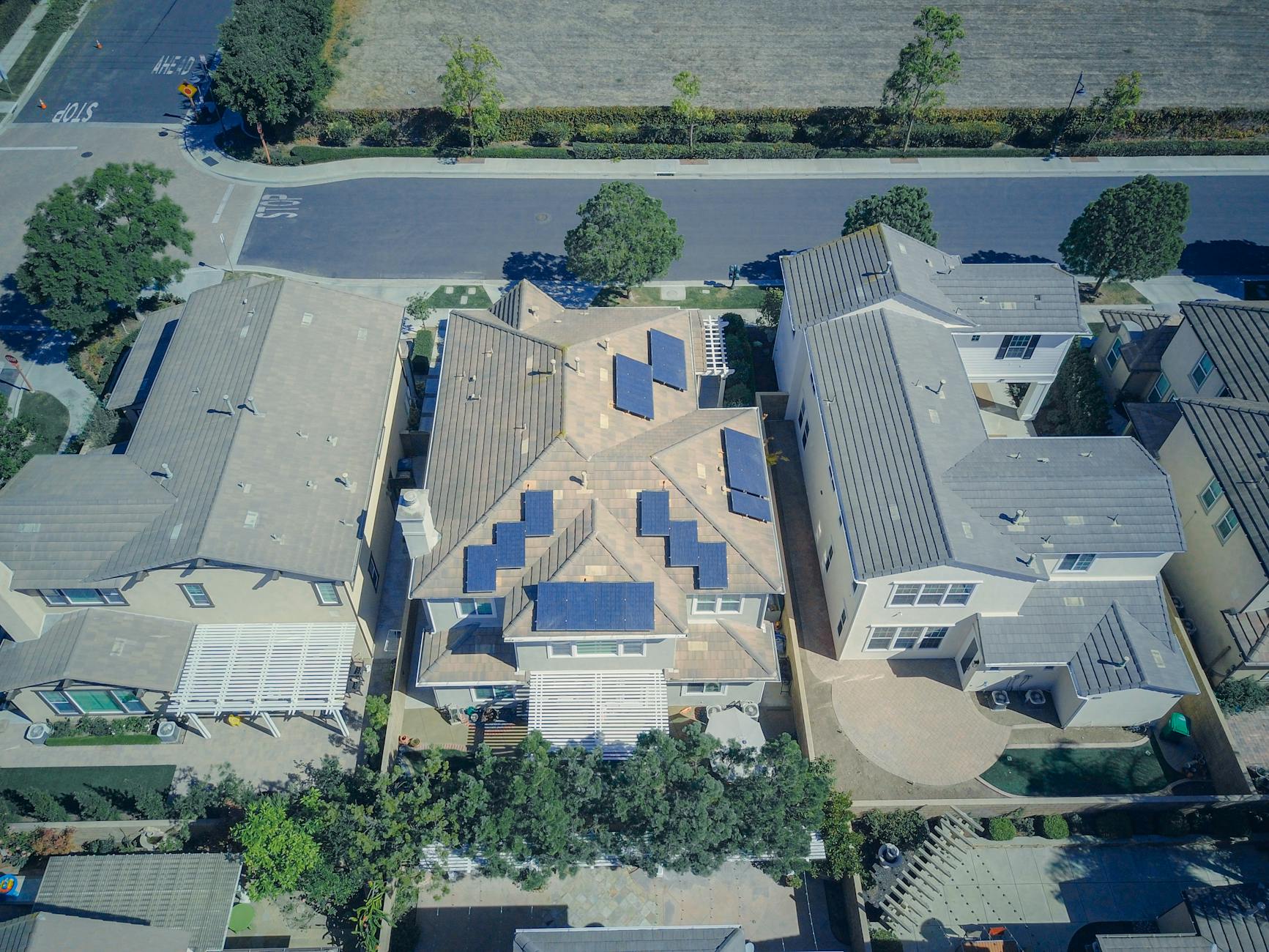
If you drive around new neighborhoods in the south and southwestern US, you will immediately see solar panels slapped on roof in whatever pattern and manner possible. Most new construction has only a marginal concern for exterior aesthetics, so a couple of big black plates on the roof are no more a deterrent to style than the plastic faux shutters, veneered brick façade and vinyl siding. That they are arranged on the roof in no particular pattern and with no regard to appearance probably isn’t a concern. Plopping these panels on a piece of classic mid-century architecture that includes an old-growth, cedar shake roof is.

This is where my active, dual, right-side/left-side brain gets me in trouble. I love the confluence of design and space and visuals, but I also see the statistical importance of energy savings and the mounting cost per kilowatt hour of electricity. I could easily create a spreadsheet that details the month and year when I would break-even on the solar panel investment.  I also know it will never happen, because that pesky “other-side” of my brain won’t allow it.

My plea to the solar panel world remains the same and has remained the same for years. Design a panel or panels that include some aesthetic finesse. Come to terms with the fact that your product is big and highly visible. Do something to ameliorate the appearance of big, black blobs glued on a roof.

A few years ago, someone developed an individual solar shingle that interlocked with the adjoining shingles to form a solar roof that delivered the appearance of typical roofing material. They were shaped as slate, tile, shingle, shake, etc. I assumed the look and benefits would quicken their adoption. Perhaps they were cost prohibitive, but I never saw them again.

I have also heard of growing complaints with solar panels, not the performance, but instead, with installation. Solar installers are typically not roofers, but installation requires hole drilled into the roof of a home or building. The solution to roof holes is often caulk. To a roofer, caulk is a supplement to proper installation technique, not a solution. Their advice; select a roofer who installs solar panels, not a solar specialist who will install a panel anywhere you need, including a roof. You want an installer who knows how to properly flash around every hole added to a roof. Failure will result in a leaky roof.

A renovated mid-century ranch can have the latest home automation, it can be equipped with integrated LED luminaires throughout, the garage can feature electrical plugs and capacity to charge an electric vehicle and it can be packed with insulation to control HVAC energy consumption. In my case, it will not include solar collection panels on the roof, until the solar panel industry makes a product that can live in visual concert with the architecture of a home. That is where I draw the line.