Categories
Lighting Commentary

Different Materials

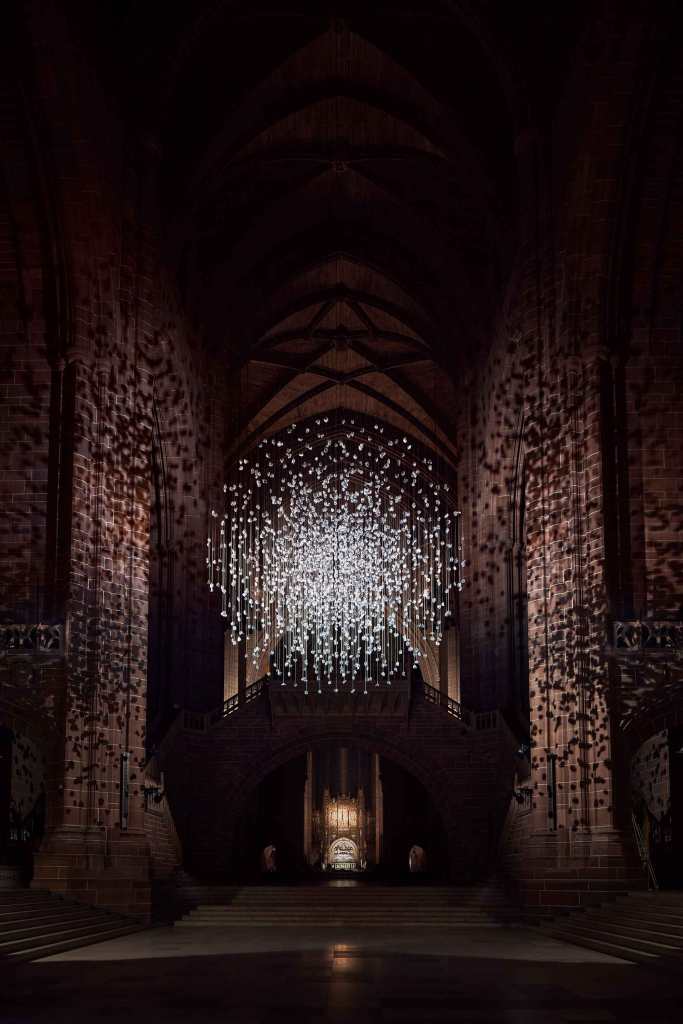
I read recently that nature artist and designer, Paul Cocksedge created a new piece of art, now on view inside Liverpool Cathedral. As is the case with so much of his work, it is based on natural materials and in this instance, provides a commentary on the world’s fossil fuel dependence. Cocksedge has arranged 2000 pieces of coal, weighing a half-ton, into a sphere. The amount of coal used is apparently equal to the amount needed to keep a 200W light bulb illuminated for a year.

After looking at the images, I realized it created the illusion of a chandelier. He has arranged downlights around the piece to reflect the luminous surface of the type of coal he used, anthracite. This look is every bit as engaging as crystal and gold.

This got me thinking. Why do luminaire manufacturers stay with the same materials? Brass, glass, steel, aluminum and some resins are pretty much the pallet from which they work. Occasionally, we see alabaster being used. Mica has had a place in mission style lanterns. Corten® steel is occasionally employed. Lead crystal and now optical crystal have gone in and out of fashion. The same can be said for wood. Could we think farther outside of the material box?

Anthracite really does deliver a beautiful look. Where could we unearth the next material that provides the same unexpected result? Would formed, thin wall concrete allow for simple shapes to be created? I’ve just read about a new translucent concrete used for lighted park benches. Is there wider application?

A couple of years ago, dichromatic glass became popular with artists and craftspeople. You couldn’t toss a hammer in a summer arts fair without hitting a booth employing this material. I wonder why it did not translate to lighting. Just prior to that, the same could be said of hematite. Its lustrous black finish would probably work today as we enjoy continued use of matte black in so much home fashion.

I remember an early trip to the Philippines where artisans were fabricating fossil stone (Mactan) into lamp parts. It was exciting to see something new being tried. It had a nice run for five or six years. Capiz Shells, made from the windowpane oyster, likewise could be found “everywhere” for almost a decade.

I’m waiting for the next new material. What could it be? When will it arrive? How will it get here? If you’re trying to determine “what’s next” like me, look to artists and artisans, find out what they are creating and how they are making new things. Understand the medium they use. Seek out those that are striking a new path.

Perhaps this is the reason societies have artists. They are trained to look at thing differently. That different outlook can lead to materials that will find their way into every-day products…and perhaps, lighting.

Categories
Aesthetic Lighting Help

It’s a Semi-Flush World, After All

Ceiling semi-flush lighting has been reasonably popular. Coming into heightened demand when builders started to increase ceiling heights around fifteen years ago, these have been an easy way to bring the lighting deeper into the room and deliver more illuminance for a reasonable price. Flip through a couple dozen luminaire catalogs and you will see scores of units in the 13” to 15” size. They have become somewhat ubiquitous to the industry.

I’ve always wanted more from a semi-flush luminaire. If sized appropriately, these could grow into a much more aesthetically desirable option. A 13” diameter is fine when running down a hallway or filling a pantry, but why can’t a grand-sized semi flush take center stage? My vision was piqued at the January Lightovations show when I saw a healthy 22” piece offered. (Image below.) Now here was a semi-flush that demanded respect. It had come to play with the big boys.

Eurofase – Jalore Semi-Flush 22″ diameter – Introduced January 2023

This piece was perfect for a single story foyer. I wanted it to also command a smaller dining room. Simply employing a semi-flush lighting fixture in these key spaces would set them apart, force attention and demand reckoning.

But wait! There’s more! How about three or five of them in a pattern over a larger dining room? If a second size was available, think about varying sizes AND elevations dotting the ceiling! If no added sizes are offered, could a larger chandelier size be hung with little or no chain or stem and achieve a similar look? Wow! My head was spinning with ideas.

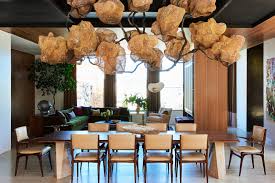
I thought my fever dream of semi-flush lighting was singular. I was singing solo in the Mohave. “Table for one, please!” Then, the new issue of Architectural Digest arrived. (Crowning Glory – February 2023) In a home designed for a couple of worldly software engineers/investors the Interior Design firm, The Archers placed a goliath semi-flush light/sculpture over their 10-seat dining room table. “Alas, I am not alone!”

Nacho Carbonell’s oversized semi-flush

This piece was designed by Spanish designer, Nacho Carbonell https://www.nachocarbonell.com/ and introduces us to a place where centerpiece lighting is destine, a position that straddles art and luminaires. As we use fewer decorative pieces and more functional lighting to answer multiple demands, such as sustainability, functional light will carry the bulk of the luminance weight, while centerpiece lighting will provide a glow and an aesthetic punch to the space. His work does that and in this instance, it forgoes the expectation of a chandelier and affixes the light, tight to the ceiling. It will be hard for me to forget the look created here.

A Few Asks

To join me in this requests, let’s all row together in the same direction.

Manufacturers, how about a few more oversized semi-flush pieces? If that isn’t feasible, how about an occasional application photo where a large chandelier is hung tight to the ceiling as an alternative to “every other set-shot in the world” where the chandelier is located at the prescribed 30” from the tabletop.

Designers, let’s step off the green and into the rough. Suggest a showpiece worthy, semi-flush luminaire as a way to create a unique look. Remember too, most large chandeliers and pendants CAN easily be hung close to the ceiling. Be sure to select a piece wisely, some will not adapt to this position, others may not look “right.” Those that do can excel in this alternate configuration. Think differently as you plan a space.

Consumers, you don’t need to hang a chandelier in a dining room! There is no such thing as The Lighting Police…yet. (I would however like a position of authority when it is established!) If your friendly neighborhood lighting salesperson suggests a semi-flush, don’t lift your nose in disgust. Relax and say, “Yes!” Your visiting friends and family will be envious! You’ll be the talk of your posse. It is, after all, a semi-flush world.