In my last blog post, I explained the recent recommendation by the CIE (International Commission on Illumination) to move away from CRI and replace it with Rf, CIE General Color Fidelity Index. Almost immediately, I was asked why. It’s a good question. On the surface, they appear to be very similar.
Both use a zero to 100 ranking system
Both use the same Spectral Power Distribution (SPD)
Both compare a source against reference colors
This last point is what makes the biggest difference.
Color Rendering Index (CRI) uses only eight reference colors. All eight are pastels with similar levels of saturation. For years, known flaws included the lack of red, bold colors and flesh tones, but because incandescent light does a good job rendering pastels, it never raised much concern. The rise of LED laid bare the failures.
To solve this key flaw, Rf uses 99 reference colors, evenly spread across the color spectrum. These are also colors drawn from real-world objects and dyes. A wider sampling will deliver a more realistic metric.
One additional pushback I have heard concerns the similar results garnered by each test method. Perhaps the CRI is 90 and Rf is 92. Of course, that is possible. MicroSoft Windows 1.0 could allow us to write a letter and the same can be said about today’s most current operating system. The difference is in all of the other features. As we begin to use and understand Rf, the added features will grow in value. With the added data provided by Rf, one might find one light source does a great job rendering wood tones and another a better with bold blue colors. As lighting professionals, we can select the light that best suits the application. As the CIE address the other know flaws, new measurements will build on this foundation to be more robust method of color measurement.
I can’t stress this more. Find a way to introduce yourself to this new metric. Like commercial lighting professionals have realized before us, the advantages will far outweigh the learning curve.
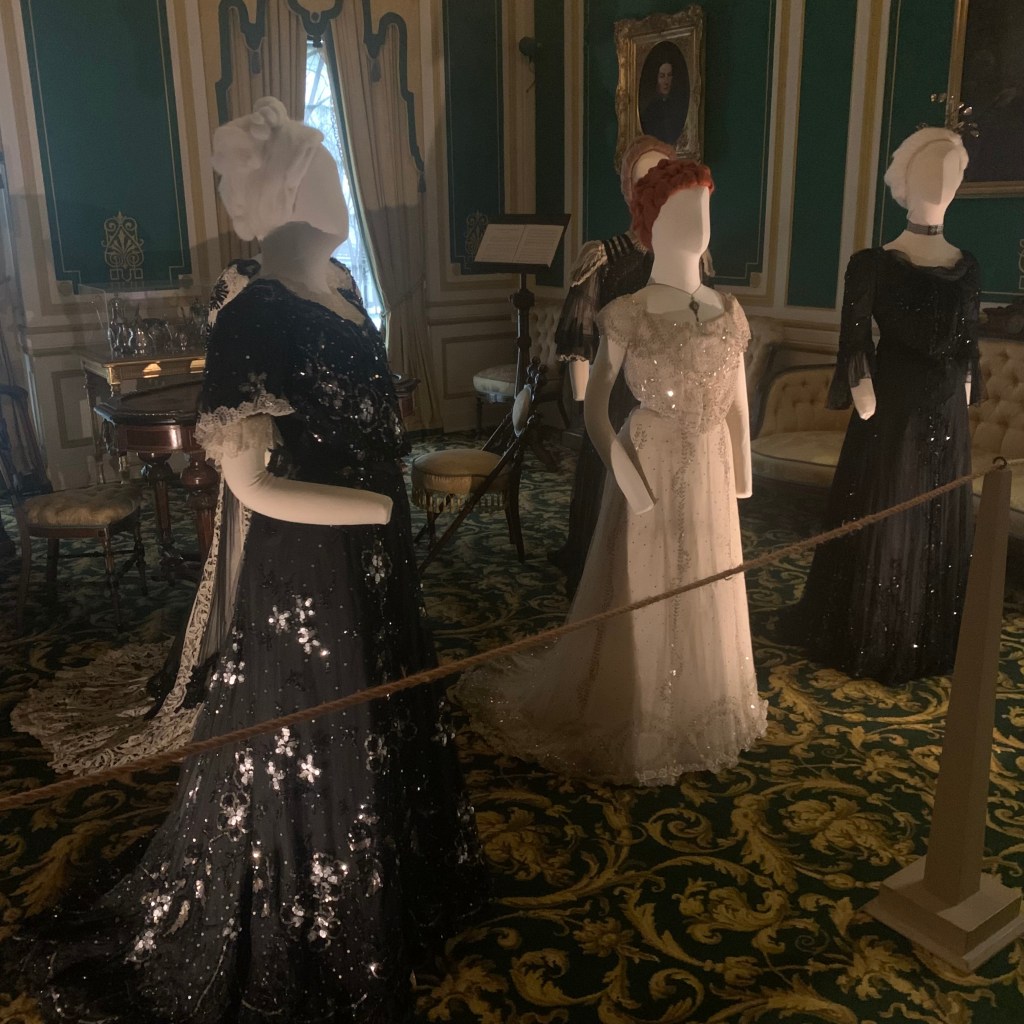
Western Reserve Historical Society – Cleveland History Center – “Fashion After Dark” Exhibit
Viewing the show, “Fashion After Dark” at the Western Reserve Historical Society – Cleveland History Center, forced me to remember the famous (infamous?) dress that “changed colors” a few years ago. Depending on who was asked, a black and blue dress looked gold and white or many shades in-between. While there remains conflicting opinions on “the dress” all of the theories center on human perceptions of color. Through a combination of light and the brain, via the photoreceptors in our eyes, we see color. Most of the time, it works without a hitch. Sometimes we see different things.
In subsequent experiments, when viewed under warm light, most people agreed it was a blue and black dress. Under cooler color light, everyone saw white and gold. Light has a tremendous impact on how we perceive color and that statement was the premise of the museum exhibit.
Beginning in the 1840s, the moneyed class was introducing gas lighting to their homes. Gas light was brighter than candlelight and the flickering variations delivered a unique atmosphere not experienced before. In the 1890s change was again afoot when gas lines were switched to electric and incandescent lamping presented another different illuminance. Outdoors, arc lighting illuminated the porte-cochere entrances of theaters, the orchestra and opera, yet another variant to artificial light.
The couture designers of the day realized they could take advantage of each of these changes in lighting. Fabrics that had been created, but rarely used, were now rising in popularity. Watered Silk (moiré) and taffeta delivered a subtle movement that provided an intriguing shimmer in gaslight. The application of sequins, rhinestones and jet pulled small slices of available light and presented multiplied glints of dazzle that drew attention to the wearer. Lamé fabrics likewise reflected and magnified glistening light across the entire gown.
The problem for the society women of the 1800s is the same one that faces all of us in the new world of LED lighting. The type of light we use impacts our color perception. The best local lighting retailers have “lighting labs” that help the consumer understand what they are buying. Most commercial lighting installations are preceded with a test, or in situ model that proves what the real installation will look like. Dress and fabric shops of the era featured evening hours and artificially darkened rooms so the materials could be best appreciated.
When my wife and I were rehabbing our second house, we used a purple and green theme in the master bedroom and wanted a VERY subtle violet on the wall. We selected the quietest tone we could find among the thousands of paint swatches. When we painted the walls the minimal amounts of daylight and deep purple (no heavy metal implied) carpet magnified the paint to such an extreme that I was forced to have the paint remixed with half the pigment, resulting in the room we had envisioned.
The importance of paint, countertop, tile, cabinet and fabric selection in the planned light and space cannot be overstated. LED light will likely function for the whole time people typically live in a home. It also presents colors in slightly different ways from incandescent, halogen or fluorescent light. The addition of daylight will add yet another element to the discourse. Taking a clue from 1800s couture can be a smart way to insure the maximum impact of an aesthetic choice.
Coda
One additional point about the exhibition must be noted. To replicate the visual fluidity of gaslight, flickering LED light was used in the exhibitions, placed just as they would have in the residential dining rooms, reception halls and ballrooms of the day. Wall sconces, table lamps and chandeliers illuminated the gowns. This was a wonderful way to help curators tell the story. Pumping natural gas into a museum of flammable collectables could never be considered. The breadth of LED continues to amaze me and I know applications will only grow in in the future.
As a follow-up to seeing the English film, “Living” a friend allowed me to borrow his Janus Film copy of the original Akira Kurosawa masterpiece, “Ikiru.” I typically do not watch the “extra features” included in most digital packages, but the interview with the visionary director was too compelling to ignore. The talk was broken into various aspects of his approach to film. One was titled, “Lighting” so of course, I could not help but pay extra attention.
In his conversation on the importance of lighting, he mentioned that to embolden colors that appear on film, he would paint and tint reflector panels that would pick-up the set lighting and bounce additional color with light onto what was being filmed, thereby resulting in more dense, fuller tones. It is the reason why so many of his color films have such vibrant appearances. If you haven’t seen “Ran” give it a watch to understand the value this technique brought to the movie. Trust me, whatever you see on your flat-screen was better in the theater using projection. After so many years, I still remember it.
I started to think about its use in residential lighting. I knew a landscape lighting designer who used seven different gels or tinted blue filters on incandescent lamping to complement each varietal of evergreen, resulting in an otherworldly feel to the exterior spaces he lit. Perhaps the client didn’t know, but he and I suspect other designers certainly did.
Can we bring Mr. Kurosawa’s and my acquaintance’s dedication to color into the interior of a home? In fact, we may have already done that when we introduced LED to the home a few years back.
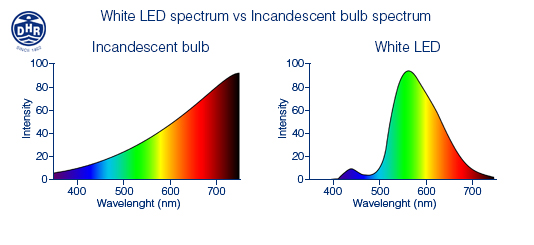
Incandescent light was VERY yellow, rendered dark blue, deep purples and browns poorly, but the amount of red did make it feel “comfortable/warm” to a large majority of the population. LED presents color in a different way because the spectral power distribution (a representation of the amount of each color in the visible electromagnetic spectrum) is different.
Don’t be frightened. The electromagnetic spectrum is easy to understand. Visible light spans from 380 nanometers to 700 nanometers. Ultraviolet light has a smaller measurement than 380nm (it appears to the left) and infrared light is larger than 700nm (it appears to the right.) The visible range begins after the ultraviolet light on the spectrum, runs from purple to blue, to green, into yellow, orange and finally red before disappearing from the human eye’s visible range into infrared light.
In this image, you can see the assortment of colors visibly represented across the horizontal, the intensity of each color is displayed vertically.
The incandescent light features a very small amount of intensity in the purple and dark blue area on the left, hence the reason it is so difficult to “see” the difference between a navy blue suit and a black suit.
All white LED starts with a blue diode that is influenced by phosphors. That blue seed is visible in the LED spectrum as the blue hump on the left, before the huge rise into light blue, green and yellow. The almost nonexistent “red” at the right is the reason humans feel that LED is somewhat cold, or less comforting than the “warm” old incandescent.
The good thing about LED is that the spectral curve CAN and HAS changed since the first LED were introduced into the market. The incandescent curve hasn’t changed since Thomas Edison. That means we have options today that were unimaginable yesterday. A 3000K output will increase the “hump” of blue slightly resulting in better rendering on purple, blues, blacks and even white. With the 2700K white light as illustrated here, the blue is marginally suppressed and the red is increased a bit allowing for better color rendering of warmer colors like beige, yellow, orange, wood and eathtones. Red is a VERY dominant color, so even with substantially lower intensity, it still renders the color well.
Most lamp and luminaire manufacturers now produce 2700K and 3000K LED products, so as consumers, we are faced with a very simple choice. Do we have a “warm” or a “cool” space? If warm, we should select 2700K products, cool means buying the 3000K option.
Akira Kurosawa’s movies are complex and will be studied by film scholars for decades to come. How he achieved some of the results will continue to illicit post-screening, coffee shop conversations for as long as we have movie fans. Choosing color in a residence is decidedly easier. As long as you grasp the underlying science.


 Lighting by Jeffrey