My wife and I really don’t do anything special for the holidays. Beyond a few small decorations, we don’t transform the house like others. Over the years we have made a few concessions. One New Year’s day, we visited a swimming pool store that transforms into a Christmas Tree retailer for a couple of months each year. There we saw the anti-Christmas Tree of our dreams. It was all-white with all red ornaments and all red lights…and it was 75% off! Whenever we were so inclined, we’d set up the tree and as soon as we did, we’d remember why we avoided it the previous year. Our cat would gather up the cotton batting we used at the base to replicate snow. In the morning it would all be in a ball next to the exposed steel tree trunk. Dutifully, we’d reassemble it. Just as dutifully, she’d rearrange it each night. The lesson here is you NEVER win in a duel of persistence with a cat. Oh, some of the low-hanging ornaments would also be on the floor, just to make sure we knew who the boss was.
Eventually, it just stayed in the attic, until we moved this spring. The white tree had aged and yellowed after a decade and a half in storage. As we were downsizing this was an easy “toss.”
As I looked at the pile of white branches ready for the trash heap, I couldn’t envision tossing the strings of lights with hundreds of miniature red dots. I unbound all the strings from around the faux needles and put them in a bag. Surely, I can come up with a clever way to reuse them in the new home.
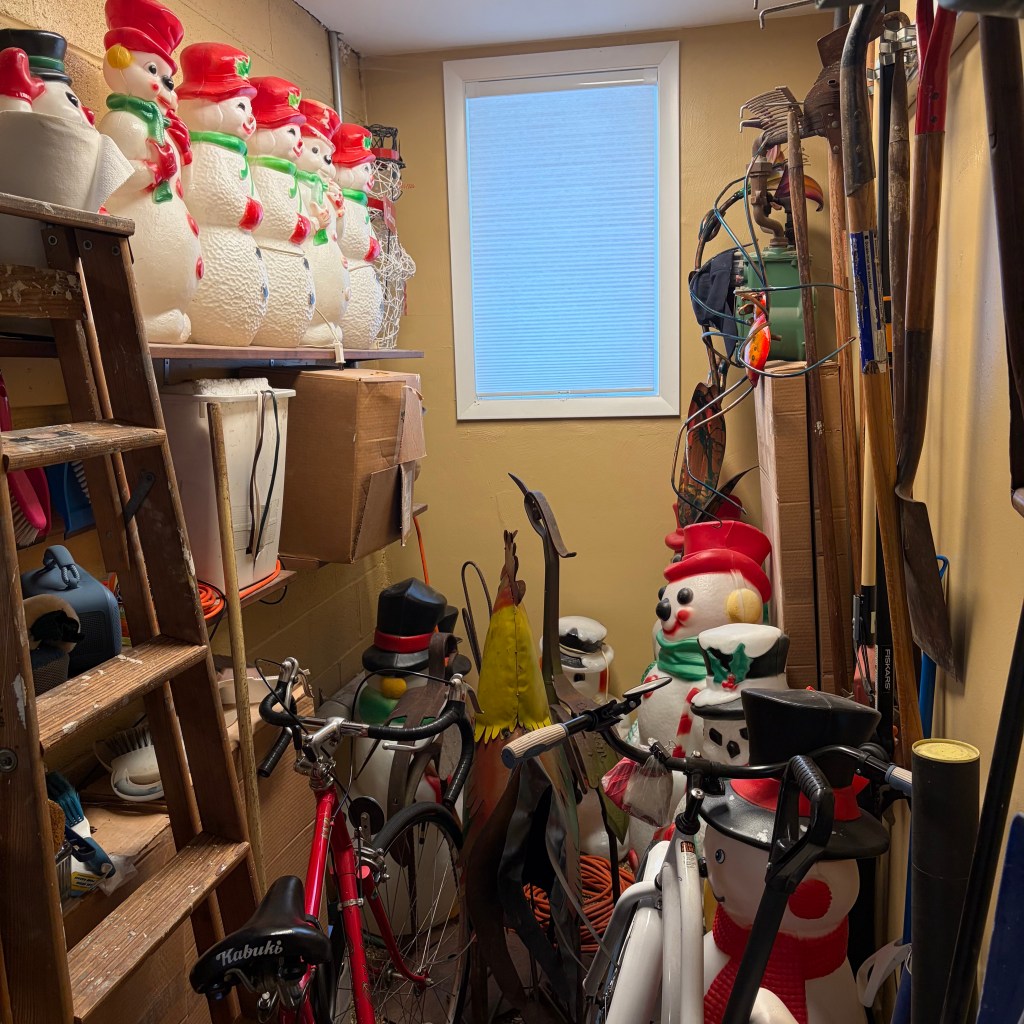
2025 has been a year of transition and lots of work. Restoring one house, selling a second, packing, moving and the hundreds of challenges all of this brings have plunked us down in December with no good idea and even less motivation. To be fair, we barely had a moment to think of one. So I sit here with a new/old house and another Christmas with no decorations. The chorus of snowmen are not set up because of an early snowfall. Coupled with that shelved bag of red lights, our home is decidedly non-festive, just like normal.
Here’s hoping you have a “normal” holiday season, whatever normal means to you and your people. Stay tuned for more tales of lighting in 2026.
Consumer Insight Now has released the results of their August 2025 consumer shopper’s survey. You may be aware of this because of the stats on lighting (22% of those surveyed plan on buying lamps and 11% planned on buying lighting fixtures in 2025.) As lighting people, this is of course interesting, but as I dig deeper into the data, I think there is additional information we can glean.
At some point in the past, I attended a window dressing conference in Baltimore. Honestly, it was very underwhelming, but flights to Baltimore were very inexpensive at the time and I did not know what I could learn there. It could have been a bonanza, like my first ICFF. While walking the convention hall, someone looked at my badge and said, “Lighting? What are you doing at a conference covering shades and drapes?”
I told the person that we are all in the house together. A home consists of furniture, wall coverings, plumbing, appliances, floor covering, window dressing and lighting. If we hope to deliver a product that blends effortlessly with all of the other things a consumer purchases, we need to understand them just as deeply as we embrace our own product categories. Hence, the reason I’ve dug into this survey. Following are a few observations on in-store vs. online preference I’ve pulled from this report.
On average, 70% of the surveyed consumers prefer to shop in a store, with 30% favoring online purchases. If you look at the reason for the preference, it is almost a yin for yang relationship.
Store shoppers want sales associates assistance, online shoppers feel salespeople pressure them
Prices are lower online and higher at a retail location
Stores have a smaller selection, but include displays and use ideas. Online sellers have a wide selection, but include reviews and a full set of specifications not available in the store.
Intuitively, we know that the older the consumer, the more they rely on legacy purchasing habits, so Boomers are more inclined to shop in a brick and mortar location. Young Millennials still prefer a store, but by a substantially smaller margin. Here’s the interesting thing; that number is ticking up for Gen Z (ages 18-28 in 2025.) This could be a good thing for retailers, IF they know how to service that customer. Will we embrace this new customer, or alienate them?
Income has VERY little to do with preference of retailer vs. online. Customers earning less than $50K and over $100K have exactly the same preferences, with only a 3% uptick for those in-between.
Whether you like to shop for furniture, or you loath it, there is little difference in preference in stores vs. e-comm.
There is almost no difference in the retailer type if you want it now, or can wait months for delivery.
Across income, generational demographics and preference to retailer, people feel confident choosing furniture.
For those consumers who prefer a store, touch, feel, visualization, comfort and quality cannot be replaced with the perceived “risk” of purchasing online. A perceived higher-quality is also a factor for those who want to use a local retailer.
The survey also leaves us with improvements consumers would like to see to make in-store shopping easier.
Eliminate the pushy sales people
Clear and prominent pricing
Better access to “more information”
Better, enhanced technology
Why do people who shop online prefer that method?
No sales people
Prominent pricing
Lots of data and information
Visualization tools
Free shipping
Comparing these two lists, you again see the yin and yang, with one exception, shipping. I continue to be amazed at how popular “free shipping” has become. Since moving into our new home, we have paid plenty of money over and above the cost of a product in shipping costs from local retailers. Has anyone considered the opposite? Include the shipping in the cost and offer a reduction if the customer wants to pick it up? It could put them on equal footing with online retailers. Mark your store as a “Free Delivery” destination. No one knows why audiences inexplicably applauds when a theatrical chorus line kicks in unison, but they do. Join the chorus.
One last comparison is also of note. The survey revealed a four year progression of sales percentages according to categories. Between 2022 and 2025, MOST have inched toward a preference for online purchases, except sofas and only by a single percentage. In the reverse is lighting. In 2022 59% of lighting was purchased in a store, 41% online. In 2025 that ratio is 61% to 39%. A small, but perhaps meaningful shift. What could cause that? Statistical error? Consumer dissatisfaction? That is unclear, but it could be something on which to capitalize.
What to Do?
As with almost everything I write here, I try to interpolate any data I explore into a value for lighting. How do I improve my position with this information? Were I a retailer, I’d look at the four previously mentioned yin-yang bullet points. If you have a storefront, learn how your salespeople interact with customers, determine how you might provide better pricing visibility, and be ready with added data if a consumer shows interest. (Perhaps a QR Code be placed on a product to direct the visitor to more information.) Finally, how can a brick and mortar lighting store introduce more technology to help the consumer better visualize their future purchase. If you are an online retailer, why are purchases slowing? Is the need to “touch and feel,” like the sofa channel, so clear that a reverse is inevitable?
As of today, the Gen Z demographic is still up for grabs. They still remain a sliver of influence in the home retail space, but they should not be ignored. They will be an important factor in the next decade. It is time to cultivate them now.
Surveys and data can contain interesting visions and helpful tips. Ignoring information from related industries is typically a mistake. To better understand your business, learn from as many sources as possible.
How often do we think about bedding? I believe I read somewhere that most people need (or should) visit a bedding store every seven years, that being the viable life expectancy of a typical spring & fabric mattress. Interestingly, that same seven years is the average span of time most people visit a lighting store. A recent article in Bedding News Now pointed out that there is more commonality than consumer visit frequency.
The article written by Texas Mattress owner, Lawrence Heilers, detailed how smart mattress showroom layouts can elevate the store and increase the customer satisfaction and ease of shopping.
“When mattresses are placed too close together, the display can feel cluttered and overwhelming. The customer’s eye is drawn to the sheer number of options rather than the unique qualities of each product. However, when you provide ample space, each mattress becomes its own focal point.”
Now, remove the word mattress in this article’s paragraph above and replace it with lighting fixture. Mattress showrooms apparently have the same problem as lighting showrooms.
Over the years I have visited hundreds of lighting showrooms across America and 90%, perhaps even 95% are too crowded, packed wall-to-wall, floor to ceiling with products.
“…when you provide ample space, each mattress becomes its own focal point This simple change subtly tells the customer that each bed is a distinct, high-quality item worthy of individual attention.”
Isn’t that what we want? Don’t we want customers to see the unique character of the product we sell? Allowing the consumer to envision the luminaire in their personal space is the best way to secure a sale.
Years ago, I was a guest speaker for the grand owning of a newly remodeled showroom. The place took my breath away. It was the most perfectly designed showroom I had seen in my career. The invited designers and architects were likewise mesmerized. Finally, a showroom that understood what was needed to help the client.
Two years later, I was asked to provide an educational program for the local NKBA chapter, hosted by the same showroom. What I saw was Mr. Hyde. Product was stuffed everywhere. Aisles were cluttered with boxes to support a “truckload sale of ceiling fans!” Traditional crystal was mixed with Mid-Century pendants. It was a mess and it was a shame.
On one of my first trips, to a reportedly, “good customer” showroom, I saw displayed products from a company that, at the time, had been out of business for 30 years! (In their defense, it was marked down 40%.) I asked the local sales rep for an explanation. He told me, “The owner is in love with his inventory.” Apparently, he’d rather clog up ceiling space with a quarter century old item then toss it away as a business loss, which consequently prevents the display of a more saleable items. Is this a viable use of showroom space?
Last example. After a fire, a popular showroom rebuilt, but instead of the typical slats displays, installed individual outlet boxes, thereby creating a finite quantity of display options for the showroom. Their grand re-opening was met with praise from the industry. Subsequent visits a decade later and again, almost two decades afterwards presents the same satisfactory reaction. It never looks cluttered, it is easy to imagine the pieces in your home. The showroom is a joy to visit. Shopping is effortless and pleasant.
(Sorry, no showroom names will be shared, but I will be happy to share the name of the retailer who does it correctly, if you ask me!)
Displaying lighting is more difficult than a lot of retail industries, but we are not alone. Window treatments need lots of walls and must be equally challenging. Flooring needs lots of floor space and must surely be overwhelming. Furniture can’t be stacked on racks or selected from behind a glass cabinet. Despite their dissimilarities, one thing is clear, to help in the selection process, customers need retailers to step out of their own heads, take off their industry hats and imagine themselves buying a new mattress.
I had to chuckle as I read an article in the September 2025 issue of LD+A about the importance of freehand sketching. (Drawn to Life by Cristobal Correa and John Slone) https://www.ies.org/lda/drawn-to-life/ If I had any success in lighting it occurred in the twelve years I spent traveling to China to help the manufacturing facilities build the products the company wanted and consumers expected.
The scenario was essentially the same in every visit. I sat at a table with our translator. On the “opposite side” one or two people from the factory spoke English. Most did not. I had to communicate what I wanted and what we expected via translation. I quickly realized the easiest way to get what I wanted was a sketch. I sketched various ways to solve issues that caused interruptions or impasses in our conversation.
Since the 1980s, I’ve been writing with a fountain pen. These trips were no different. On an early trip to The Philippines, I found a great Waterman blue pen with a classic 24K gold nib at a local shop. Waterman pens are wonderful to use and tough as nail. The pen gallery was offering this one on sale at quite a bargain. I couldn’t resist. With fountain pens, that is a common problem I have. I can’t resist a purchase.
I began to travel with this pen on all my subsequent trips to Asia. Upon departure, I’d grab three legal pads of white lines paper, my trusty Waterman and a pile of cartridge refills. Only the pen returned. I later learned, our staff and the factory folks used to joke (in Mandarin, Shanghainese and Cantonese) “Bring out the blue pen!” Years after their creation, factories would retrieve a ratty, wrinkled sketch I created, some time ago containing a solution I arrived upon, in the moment and on the fly. To be honest, these almost always were collaborative efforts and some problems helped competitors as well.
After I exited the Engineering Department to manage product lines and eventually help in the education of lighting use, newer, younger engineers didn’t/couldn’t sketch, instead relying on CAD snippets and words. The beauty of a sketch is it contains NO WORDS. I could “talk” to the factory engineer, who spoke no English and we understood each other completely because often, he’d grab the paper and pencil-in a counter-sketch. Two or three sheets of white lined legal paper later, we had a solution.
The LD+A article discusses the limitations that computer-based “sketch” programs deliver, compared with the freedom of a clean sheet of white lined legal paper. Like Apple’s insistence on changing words in a text message, the predefined program digitally pushes back against the sketchers intent, making it more difficult than necessary. A pen or pencil is easy.
A lot of people can’t sketch. Even some talented, artistic people do not sketch well. I believe sketching should be considered a treasured gift. The most successful people I knew, who interacted with personnel in another country were blessed with the skill of sketching.
I’m the last person to discount the importance of technology. What can be done today with a computer, as opposed to a pencil “T” Square and Triangle is astounding. In a collaborative manufacturing setting, the real results are often found in conversation between the designer, engineer and manufacturing management. More often than not, that battle takes place over sheet of sketch paper.
I receive email blasts from “The Architect’s Newsletter” every day. It keeps me informed of the many things happening in an industry I thought would be my life’s work. (I studied architecture and thought I would become an architect. Lighting somehow snagged me at an early age.) I also read and scan a number of subscribed emails covering houseware, design, hospitality, interiors, kitchens & baths, furniture and a few I’m not recalling right now. While consuming this information I often run across new things that could impact lighting. Here are a few items that might help you, as you think about the future of lighting.
Soli
A Mexican industrial designer has created a landscape light that is powered by soil. Milú Brunell found when insects, fungi and microorganisms/microbes break down the organic compounds in soil, they release electrons. Those electrons can be captured and converted to small electric currents. The result of her study is Soli, a prototype landscape light.
In one of the articles I read about this product, they mentioned that this idea followed in the line of a lamp, powered by photosynthesis and a server powered by tomato plants. By her own admission, the lumen output of Soli is low, as I suspect the photosynthesis lamp is as well, but remember, LED started with that dot of light on our stereo receiver in the 1970s. (If you’re young, ask your parents or grandparents to explain!) We all know what has happened since.
Powered by Sweat
I’m not talking about hitting the gym real hard. Researchers at the University of Massachusetts at Amherst are harnessing sweat for the creation of electricity. They have developed a biofilm (think of a high-tech Band-Aid) that makes use of the moisture we all have on our skin. With the use of a bacteria, it converts the moisture vapor (evaporation) into electric. They see the most viable use as a method for powering wearables. Imagine if iPhones, watches or fitness monitors did not need a battery. Consider all of the healthcare monitoring equipment. All could be considerably smaller. As we grow more and more dependent upon our mobile devices, powering our home automation with sweat could be just a few steps away.
COB Building
Far from new, COB building is undergoing a resurrection lately. COB is a mixture of clay soil, sand, water and typically straw. (Think of adobe construction.) The walls of a home are “built-up”, very thick and typically get a bit narrower as they reach the top. COB building dates back to the 1600s, perhaps farther, but have had very little use until recently.
With newfound interest in a more sustainable building world, COB is getting a second look. While the current methods of use are more expensive to construct, the end result is fire-proof, termite-proof and like adobe construction, the thick walls can be better insulators than stud-fiberglass construction.
COB is also being reconsidered now because of the high cost of building materials, especially in our new reality of tariff uncertainty and sustainability demands. It is unlikely to replace current construction techniques in mass market installations, but could become a niche player that we will need to illuminate. It is time to begin asking ourselves how.
LEDs, All Day, Every Day, Everywhere?
There was a time when I thought different light sources would start to peel away layers of the LED onion. I didn’t think we would use LED for EVERYTHING. I appear to have been wrong on that account. OLED seemed so natural for office troffer lighting, backlighting and illuminated displays. LEP (Light Emitting Plasma) were so powerful that stadium lighting, large exterior parking lot lighting and shipping docks sounded like the perfect fit. Automobiles had adopted Laser lighting and it was featured on a few production cars, mostly German imports.
OLEDs, while still out there seem to have stalled in elevated development. I haven’t heard anything about LEPs in at least five years and now I read in the “Lighting Now” blog that BMW and Audi have halted laser development, essentially because of the more cost effective LED options.
Why did that occur? Is Donald Trump right to pull federal research grant dollars from universities because, at a certain point, it is self-defeating? Was money that could have helped develop LEPs used for the mature LED industry? Once LED efficacy approached 90% of its expected efficiencies, should we have transferred those dollars to OLED research? Is it possible that LED is the perfect light source and no other competitor is even close to being strong enough to overtake them? I’m doubting that conclusion. We are now rethinking the AC/DC debate that was won over a century ago. It would be a shame to abandon options. I hope someone, some place continues to investigate these alternatives.
There are plenty of ideas that go nowhere. This could be a collection of a few more, or one might just breakout and become the next lithium battery. Like the “Butterfly Effect” a flap of the wings here might result in a seismic change in a whole industry. Paying attention to as many as possible can only help us as we continue to move into the future.
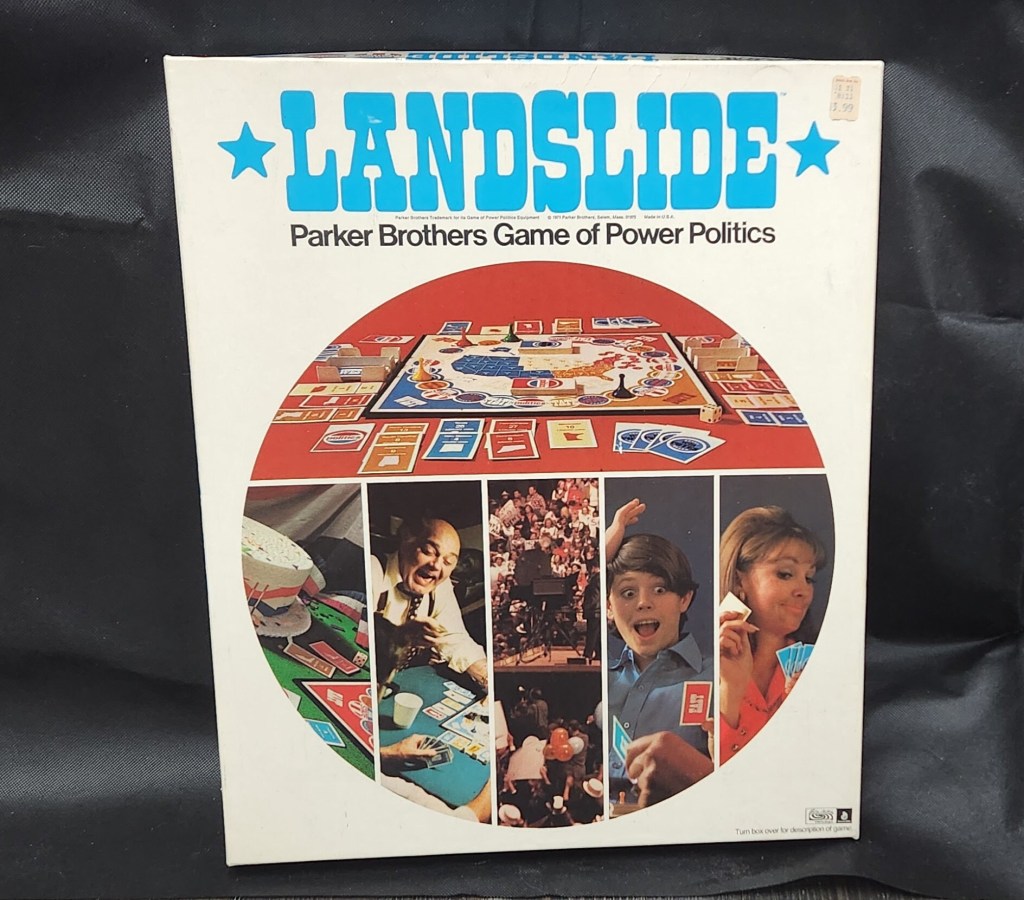
As a young guy, my group of friends loved to play the board game, Landslide. During the game, players collected electoral votes in order to win the US Presidency. (We were a VERY politically active bunch.) We cosplayed various politicians, discussed real political scenarios during the game and got so involved in the action, we managed to defeat the rules and were forced to add rule addendums to prevent us from blowing up the game. Since that time, I haven’t really played board games, so it was a quite a surprise when I read an article in the New York Times about the decimation of the current board game business thanks to Donald Trump’s tariff policies.
As I read the article, I was surprised to learn that the new board games are not big corporate endeavors. (Landslide was a Parker Brothers game, a large corporation also responsible for producing Monopoly.) Rather they are now smaller boutique businesses where the games are developed as limited-run titles for curated consumers. The reason tariffs are hitting them so hard is the same reason lighting is being blasted. Low volume.
From the outside, those not involved in lighting probably assume lighting is produced on an assembly line, much like a car or an air conditioner. Sure, some luminaires might have sales commensurate with the demands of automation, but the majority never reach that level. Low volume is typically supported by hand-built labor and that is where the reshoring argument falls apart.
In the game of Landslide there were player tokens, dice, a cardboard playing field and delegate/electorate cards. Easily produced in the US or almost anywhere. As explained in the article, the new games are much more complex with more tokens and accessory playing items, all of which require production skills not available in the United States. Those elements that can be replicated stateside, require volume, or the cost is prohibitive. These games, already pretty pricy, could rise 50% into the $80 to $300 range. That’s a lot of money for a couple of hours of comradery.
Almost everything I read in the article allowed me to harken back to family-owned lighting manufacturers and retailers. I know, many of the companies are now owned by corporations or investment groups, but volumes have nonetheless not altered much. For better or worse, decorative residential lighting is a low-volume business because it is a fashion business. The same problems that these board game producers are having are being experienced by lighting manufacturers.
The board game producers have started to back down on production. They have laid off employees and have determined they cannot produce a viably-priced game that the market will embrace. That is unfortunate. Games can bring a great amount of fun and memories to players. They are not, however, a necessity. Lighting is. We must have light. Light is a key feature of every home and its importance is growing as each new scientific study is released. We don’t have the option of stopping production. Consumers need and must buy lighting. Trump has left us with only one option, abandoned the new bejeweled, shiny boutique luminaires and go back to the lighting fixture version of glossy printed cardboard games.
Is everyone out there ready to play a game of Landslide with lighting?
A kangaroo walks into a bar and orders a martini. The bartender looks up quizzically, grabs the gin and start preparing the drink. After an appropriate shake and swirl, he pours out the drink into a glass with the olive and slides it across the bar to the kangaroo.
“That will be fifty buck.”
The kangaroo reaches into his pouch, grabs his wallet and pays the bartender.
“You know, we don’t get many kangaroos in this place.”
The kangaroo looks up from his drink and says, “At these prices, I’m not surprised.”
My favorite joke sprang to mind as I listened to a news report that indicated tariffs were starting to become a factor in consumer spending. Yes, the TACO president has kicked the can down the road time and again and the road has now apparently ended. Just a few countries have played along and those that have appear to have snookered Trump with promises of reciprocal spending that will never maturate. In a need for immediate gratification, he’ll get the press release, the news story and no change will be realized beyond the price increase to the consumer.
Products now cost more. Shipments are slowing, containers, once at a premium are waiting for freight. Prognosticators continue to suggest a bleak holiday shopping season. The US Treasury is however seeing an increased input of funds from these new duty payments. Those dollars are going to be hard to end in a country so deeply in debt. We must assume these to be the new normal. This is not good news for someone building or rehabbing a home. Lighting (and a lot of other things) is getting very close to kangaroo pricing. Nice, if you can afford it, but likely to keep away a mob of kangaroos.
I had believed that LED was going to substantially alter the type and quality of lighting used in new home construction. In some cases, it has. Think LED Tape. Other light types have fallen in the opposite direction. Good recessed light has now been replaced with surface mounted, glare-inducing blobs of light. That popularity is not because of LED, but instead, due to a low price. I now believe price will drive a total reassessment of what type lighting builders will include in new homes.
In a previous blog post I shared that builders have been forced to provide rebates or “give backs” to try and ameliorate the impact of higher interest rates, but they are not going to be able to do that forever. Manufacturers have also done the same thing with heavy buying of inventory. Ford Motors is expected to lose $2 Billion this year because of tariffs. They and every other company cannot continue this practice. Prices will rise.
Because of these new prices, inflation is a real concern and interest rates are unlikely to lower. The best case has rates remaining stable. If Donald Trump decides to fire Federal Reserve Chair, Jerome Powell and replace him with a toady, we should all assume higher inflation. Don’t believe me? Ask Richard Nixon to explain how presidential intervention in monetary policy fared for him and the country. (Who remembers his successor’s WIN [Whip Inflation Now] policy? I still have the lapel pin.) You can almost bank on it.
Builders might be forced to look again at more steel stud use in residential construction to avoid the Canadian lumber tariffs, but it is difficult to see an alternative to drywall. An almost total elimination of copper plumbing, if not already a reality is probable, but appliances, whether imported or made in the US are still going to see increased cost because of component tariffs. Electric and lighting changes COULD however result in savings.
In the recent rehab of our new, older home, a total rewire was needed. A pile of superfluous switches were code mandated, forcing the addition of way more wire and labor than I had ever expected. This is ripe for change. Builders could push for changes that automate a home, eliminate all switches and in-turn reduce the amount of copper needed to wire a home. We might also see a switch from AC wired homes to AC wall plugs and DC lighting, thus allowing much less expensive wire to run to the luminaires. Eliminating the transformer could mean a less expensive lighting fixture. As lighting people, are we ready to explore these ideas?
LED Tape has made LED undercabinet luminaires obsolete, but I still see a ton offered. Why? Manufacturers still haven’t developed a quick, stable, sure and visually appealing connection method from the service wire to the LED Tape. I’ve often said, the company that does this, wins. Cost per foot of lumen output makes this a hands down deal. Crappy wire connection points have kept the old, more expensive (lumens/foot) luminaires in business.
Dining Rooms are going to disappear in multi-family and entry level new home construction. So too will the dining room chandelier. I can’t see any trend where this stays. (Higher-priced homes will be untouched.) Have new light source types been developed to fill the sales gap these losses will create?
The bathroom bar lights concepts are the oldest remaining lighting types still in continued use. I think more lighted mirrors and mirrors with better lighting are a solution that will take over. We do need to ask ourselves how that will impact our sales numbers. In addition, we’ll need to consider additional sizes, better light output and light delivery that reduces glare. Today, we are selling mirrors that include light, in the future, we should be selling bathroom lighting that includes the mirror. Of course, the recently announced mirror tariff increases might totally change this burgeoning demand.
These are just a handful of thoughts. Were I a manufacturer with connections to mass builders, I’d try to arrange a working summit, toss out any preconceived ideas on what lighting is needed in a room and instead discuss lighting that would provide good lumen output AND cost less. Can we rethink everything about lighting with the goal of better lumen output, less wires and less cost? I think it is possible. In a world now filled with $50 martinis, it might also be necessary.
The recently released “2025 State of the Nation’s Housing” report from the Harvard Joint Center for Housing Studies is a daunting read. Try as I might, I could not find a silver lining in this cloudy collection of stats and data. As anyone involved in decorative residential lighting knows, there is a close correlation between home sales and lighting sales and like the relationship between Harvard University and Donald Trump, it looks rocky.
Let’s start with a few statistics that should make us all a bit uneasy.
The median price for a previously owned home has risen to $412,500.
The “Home Price to Income Ratio” has risen to 5.0:1, the highest it has been since the housing bubble of 2006.
Of the top 100 metro areas, only three had a “Price to Income Ratio” below 3.0.
The monthly mortgage payments on that median home have reached record highs of $2560. That is an incredible 40% higher than 1990 after adjustments for inflation.
This reality has resulted in even more harrowing information.
The lowest number of previously owned home sales since 1995 at 4.06 million.
A decline in home ownership to 65.6% of the population.
A record high median age for 1st time home buyers at 38 years old.
Add to this another stat. The Leading Indicator of Remodeling Activity (LIRA) also just published, indicates lower than expected home renovation and repair activity with just a 1.2% growth for 2026. (to the 2nd quarter)
As folks involved in supplying decorative accessories to homeowners, this does not bode well for us. New home ownership usually sparks spending on redecorating and remodeling. No new homes means no new lighting purchase.
We might be encouraged by the increase in rental market participation as an alternative, but according to the report, that too is a place of concern. Renters are experiencing an affordability crisis.
A record number of households are spending more than 30% of their income on rental housing at 22.6 million.
A record number of households are spending more than 50% of their income on rental housing at 12.1 million.
There are now record low amounts of remaining income after paying for housing of only $250/month for renters who earned less than $30,000/year.
There are record levels of homelessness, now at 771,480 humans.
Even the good news is tempered with red flags. 1.02 million new single family homes were completed in 2024, representing a 3% increase over the previous year. A 7% increase in starts was reported for 2024 as well. However, to deal with the rising price of a home, homes are now equipped with fewer or cheaper amenities. The average size at 2150 sq. ft. is the third decline in three years. The average price for a new home fell to $420,300, because builders were forced to offer incentives and mortgage rate “buy-downs.” Pointing to the reality, the reports suggested this was an untenable situation that could not legitimately continue. Inevitably, prices would need to rise, meaning fewer units would be sold. Add to this the tariff implications and the amount of new construction homes is sure to plummet.
Splashing cold water on the “it’s got to get better” argument, household formation was also included in the report. For the second year, there is deceleration. New homes are needed as new households are formed. A major driver of new households is immigration. With the near total elimination of immigration provided by the new presidential administration, a slowdown is on the horizon. Immigration is not, however, the only bellwether that should draw concern.
In 2026, Baby Boomers will reach the age of 80 and this massive driver of economic power will experience accelerated levels of mortality that will NOT be replaced with the next generation’s new household replacement levels.
As can be witnessed by the recently passed “Big Beautiful Bill” (I have a few other nom de plumes that could replace that moniker) federal housing assistance will not be maintained, further exacerbating the cost complications of housing.
What Can Lighting People Do?
I worked with a guy years ago who self-deprecatingly referred to himself as, “just an old light bulb salesman.” A few drinks into an evening and added adjectives were pasted onto his faux title. Like my former coworker, we just want to create, market, design, employ and sell lighting. How do we do this in this new environment? Here are a few thoughts. I’m sure you have a number of your own.
Cater to the Boomer generation and their much smaller sister, the “X” generation. Together they command about 75% of wealth in the United States today and they are viable consumers for at least ten, perhaps twenty years. Just realize, they are a diminishing entity.
Wealthy people are now in the driver’s seat. As we see from the afore mentioned federal funding legislation, we will be witnessing the greatest transfer of money from the middle-class and working poor to the wealthy and “well to do.” Cater to this consumer. This is a small, but mighty block of people, if you can figure out how to meet their needs, you can win.
Despite the setbacks, a lot of homes and apartments will be built, but they will likely be of lower cost, so that means a need for viable, low-cost lighting. What does that mean today? What will it mean tomorrow? I expect to see a total reassessment of what lighting is included in new construction, tract housing and multi-family housing, Forget what is used today and invent the low-cost requirements of tomorrow. If there is ever a time to toss away the box and consider what lies beyond, it is now.
Growth might be reduced. With that inevitability, how do you plan for that? A non-rising, bottom-line isn’t necessarily a bad thing, as long as you understand this reality,
Does the “middle class” disappear? Are we about to find ourselves in a world with super wealthy and everyone else? Based on the reality of politics today, this looks like the future. If that is, in fact the reality, companies and distributors might need to bisect their lines to accommodate the new norm.
This information and many others like it is available from many sectors. There is lots of information and some of it is conflicting. Read as much as you can and digest it well. I believe you will find that the home furnishings market is moments away from a paradigm shift. Are you ready? Is anyone ready?
I was reading an article the other day talking about the increase in woman who have taken up woodworking as an artistic outlet. After reading the first sentence, I stop for a moment and thought, “Wow, this is interesting. I wonder how that might manifest itself?” If I would have continued reading, I would have quickly learned that one of the artists created a 4’-0” wooden box stand perfectly sized for an 18-pack of tampons. Again, I stopped reading. This time I grabbed a pen and jotted in the blank space of the article, “Why is diversity a good thing?” It was immediately clear to me that there is not a single male woodworker I know, or have known that would have created a storage box for tampons. Had I just continued to read, the very capable writer went on to make that exact point. Not covered in the article was my final thought. “Perhaps I should just read the article and avoid the stop-think-start method of digesting information! I’m an old guy. That ship might have sailed.
Diversity, Equity and Inclusion are very much on the minds of everyone today as political leaders work to destroy the voice of all in favor of the supremacy of one. I’m not sure I understand why this is considered a favorable action. I’ve never heard a cogent argument for exclusion. If all voices are uniform, then why do you need more than one “yes man?” Who believes inequity should be a defining goal of a business, let alone a government and its people? This is just one example where there is a benefit to a different voice.
During most of my career in residential lighting, we knew our primary customer is a female between the ages of 35 and 50. That is a narrow palette and it has since widened, but while men are now more involved in home décor, most residential design decisions are still made by women. Nonetheless, more men are employed in the lighting business. That too is changing. I see multiple notices in LikedIn featuring the promotion of a woman taking on a new role. Perhaps they’ll do a great job. Maybe they’ll fail, but it won’t be genital based, it will be skill-based. In the past there was this mythical “old boys network.” We now see the ALA has a “Women in Lighting” subgroup that appears to be growing each year. This can only be a good thing.
I remember, in the early days of LED I was asked to give a talk to a Houston area NKBA meeting. By that time, I was pretty good at explaining this more complicated technology to people who only understood the simplicity of incandescent. After the talk, one of the attendees of the all-female audience stopped me. I’ve never forgotten what she said. (Some paraphrasing may be included after so many years!)
“I did not want to come to this meeting, but I knew I had to. I knew this LED technology was going to change a large portion of what I do for a living and if I was going to be a successful guide for my clients, I had to understand it. My apprehension was that some pencil-neck engineer was going to either speak down to me, or speak over my head. When I saw you with that bowtie and cool shoes, I figured it would be OK and I was right. You told me exactly what I needed to be successful. Thanks!”
Imagine if the speaker at this afternoon lunch was a female engineer. Would more female designers have attended? Would the design community have adopted LED faster? Would the LED stigma have disappeared quicker?
Sometimes the messenger is as important as the message. We can’t immediately assume acceptability, hence the importance of opening our arm to everyone. We need everyone because we never know from where the next great idea will emerge. By including a wide expanse of people, we have the best possible shot at overall and total excellence. Just because our political leaders want to narrow the future does not mean the lighting community must follow.
My wife and I enjoy traveling and have our entire life together. Our United frequent flyer numbers were actually generated by Eastern Airlines (which became Continental, which became United) we have (permanently) unused reward miles with TWA and PanAm. In 2018, I became a United 1 Million-Miler. I did not however, get that status from leisure travel (despite our herculean efforts!) Million Mile status came because I spent twelve years traveling back and forth to China as manufacturing of luminaires transitioned from the United States to Asia.
I was reminded of this as I listened to the “manufacturing return to America” pipe-dream espoused by our President. Tariffs will be raised, manufacturers will shutter Asian facilities, reopen US buildings, start making goods here. No more tariffs. “Easy-peasy!”
Oh, if it were as simple as this President believes. Transitioning to a new factory in a new country is HARD work. It can and has broken many companies. Simply moving a factory across town has crippled some organizations. It takes years and the efforts of countless people to make a move successful.
Before I ever set foot in Korea (my first factory visit in Asia) I was preceded by my boss, who did the initial legwork over a five-year period. While he was on the ground, I was writing directions and drawing illustrations via a fax machine to insure product outcomes were clear. Samples were shipped back and forth with detailed information on how to correct the problem and what end result we wanted. When I started to travel instead of him, I arrived with three legal pads of paper and multiple pen cartridges, leaving all of the filled paper with the factories, each sheet containing sketches, suggestions, options and instruction that needed to be done to make the product correctly. After a twelve hour day in the factory, I spent a few hours in my hotel room or lobby bar writing reports, then an hour in the “Business Center” faxing that information back to the office. (Note: fax machines were slow! Especially US to Asia!) If anyone ever asked me if I “enjoyed” my trip to China, I responded with a less than charitable answer. 24 concurrent 18-hour days does not equal “fun.” If it weren’t for the magnificent people I met and the few “days-off” I was afforded, I might not remember this time as fondly as I do now. It was a tough but rewarding part of my life’s work.
…and I wasn’t alone!
Purchasing people would make shorter trips, managers for different lines arrived for conversations, designers, planning the next release and logistics people all worked on their particular aspect of insuring good product arrived for the consumer. Perhaps even more challenged than engineering was the QA function. They were probably in the factory as long, or longer than me.
Multiply that by every other lighting company in the US and Canada. (Plenty of Europeans and Australians, too!) There was a buzzing hive of lighting people all helping a collection of 100, perhaps more factories make quality goods for the world market.
Today, a lot of that is reduced. The roads are better, so travel is easier. The hotels are more accommodating to western preferences. There are more people who speak English and more Americans who mumble through Mandarin. Some of this is being repeated right now in India, where the skills are not yet as well formed, but at least communications are easier.
A Quick Return to America?
When I read about a return to American manufacturing, I typically chuckle. Not because of the improbability, but because of the hubris. It took the blood, sweat and tears of thousands of Americans, Taiwanese, Chinese, Filipinos and Koreans over a dozen years to get manufacturing set up in Asia. Returning it to the US will be accomplished in a few months? I have more optimism that my wife and I can return to Portugal using our TWA frequent flyer miles.