I spent a considerable amount of time in China between 1995 and 2006. During that time I enjoyed friendships with a fairly large group of Chinese citizens, one gentleman in particular. During the Cultural Revolution his parents, both “Country Doctors” (his term) were victimized as intellectuals and he was subjected to levels of degradation that would belie his genial nature. (His story was not unique. Almost everyone of the same age had similar stories about that time period.)
After a day of LONG hours working to insure the product that reached the United States was in excellent shape, we talked about many things over dinner, personal, political and professional. These conversations were among the most rewarding in my life. I remember him telling me of the importance of Deng Xioping, former Chairman of the People’s Republic of China. Through his policies, Deng finally allowed my friend’s education to be of value and found to be unapologetically well-respected. His parents had suffered; he had suffered, but it would be a greater day for his son. Virtually every Chinese person I had the joy of knowing, expressed the optimism of the New Year greeting, “gong xi fa cai” or “great happiness and prosperity for the future.” A better life is around the corner.
It is an opinion now share by scores of people, that the current Chairman of China, Xi Jinping has effectively ended that optimism. I haven’t been to China in eighteen years, but the hope I encountered must be depleting. “Peak China” is over and Xi, like his communist partner Vladimir Putin of Russia, is attempting to reestablish an idyllic version of his country in a world that has experienced substantive change. In the process, he has alienated the bulk of the world and disenfranchised his own population.
The majority of lighting products and lighting components are made in China. Unfathomable just a decade ago, India is growing in importance to the lighting industry, almost exclusively at the expense of China. The importance of China to the lighting industry is shrinking each week. I suspect people in many other industry are saying something similar. That is going to have an impact on every Chinese citizen, including my old group of friends.
This is unfortunate. The move to Chinese manufacturing elevated lighting to new aesthetic, technological and mechanical heights. Advances were quickly made possible and fashion trends could be rapidly answered. Hundreds of talented young people were brought into companies across the country to learn from older industry experts and lend their skills in the English language to a parade of American, Australian and European customers. No doubt, much of that experience will now be employed servicing the growing domestic market, but “Peak China” has passed. Gone are the double-digit growth percentages and an era of mutual benefit. For their sake, I hope the new domestic market can support this mass of talent. I fear it cannot.
I’m glad I had an opportunity to learn from my involvement in this transformative era and hopefully, I left something in China with which they were able to grow their knowledge and businesses. It is unfortunate when politics and narrow minds ruin a good thing.
While the number of homes purchased by investors has shrunk in the most recent quarters, the percentage of homes owned by investors remain high, at a national average of 18.4% (2022 – Redfin.) The percentage of homes also varies widely based on location, with highs of over 30% in Miami, FL and lows of 9% in Warren, MI. These are higher numbers than the real estate industry has seen in the past and this new type of ownership is going to change the way America spend money on durable aspects of the home, such as lighting.
I live in a historic part of suburban Cleveland, an “inner-ring” or very old suburb. Moneyed and “white-collar” Clevelanders in the early part of the1900s wanted to escape the industrial dirt and grim that made the city home of vast amounts of wealth. The solution was to “head for the Heights” literally located at a higher elevation than the steel mills, factories and foundries centered on the river lowlands. Homes in my portion of the city (a slightly newer area) are all architect designed and built between 1929 and the post-war late 1940s and 50s. They are graced with excellent quality materials including roofs primarily of slate, with some tile and shake.
Because of its proximity to the highly regarded cultural and healthcare industries in Cleveland, investors have started to buy homes in the area. Cleveland also enjoys some of the lowest home prices in the nation, primarily due to the outmigration of young people. Investors have determined they can easily buy low, sell (reasonably) high here with minimal amounts of money.
Slate roofs last a lifetime, but they do require regular “tune-ups” to avoid water ingression. Rather than replacing my roof every twenty or thirty years, I need to spend a few buck every other year. Investors view this differently. Rather than spend, say $6000 to bring a neglected slate or tile roof back to par, they are electing to tear off a lifetime roof and replacing it with a $4000, 10-year warranted asphalt shingle. From an investor’s perspective, he has saved $2000. From the point of view of the neighborhood, the investor has markedly altered the timbre of the community.
Now, take that logic and multiply it to all other aspects of the interior and exterior rehab. Good recessed lighting is not used. The cheap “10-pack” found at the big box stores are instead employed. A builder-grade chandelier is hung and ferrous exterior lanterns are slapped on the porches, sure to last long enough to see just one winter. The initial reaction to the completed home is a buyer who doesn’t have to change anything. They falsely believe, no money will be spent beyond the celebratory bottle of champagne.
When a downtrodden house is purchase by people who hope to live in the home “forever” they will be more inclined to choose products of higher quality. They may opt for the more impressive island pendants, a show stopping chandelier for the dining room and even a ceiling fan that is correctly sized to the room. They will enjoy the benefits of “better” rather than rolling it over to a new buyer in a few months.
This is a problem with no easy solution. Folks in my neighborhood were successful in getting the permit application for roof replacement changed to include a viability assessment of the existing historic roofs after dozens were removed for investors, by unreputable contractors working weekend hours. The illegal removals are now being forwarded to the city’s Law Department for prosecution. Lighting doesn’t have that quick fix. Mr. & Mrs. Buyer won’t know they have substandard recessed cans until they die an early death. At that point, it’s too late. No one will go to jail because they bought a cheap chandelier.
From the opinion of a lighting guy, perhaps the prospect of incarceration might get people to think more carefully about this very important aspect of a home interior. I do however live in the real world (at least some of the time!) People have been using bad lighting since Thomas Edison suggested an alternative to natural gas. Perhaps the emerging push for a more sustainable world will magically instill some sense of duty in investors. The more likely scenario is investor’s failure to find customers for poorly conceived rehabs. When money is the driver, only a lack of return will change their direction. As customers we should reject homes when historic roofs have been removed, cheap appliances have been installed and bad lighting has been used.
I love the artwork of Thomas Hart Benton. My favorite artist is Edward Hopper. I remember when the Cleveland Museum of Art bought the Grant Wood’s painting, “Haystacks.” I rushed to the museum unveiling and immediately fell in love. George Bellows’, “Stag at Sharkey’s” is the best piece of art at the second best art museum in the country.
I really enjoy opera and can’t get enough Broadway musical show tunes. Peggy Lee can do no wrong and “Kind of Blue” is unlikely to be bettered in my lifetime. Thank you, Miles.
With this cadre of preferences, people might expect me to be a bit more conservative, but to the contrary, I am always looking for the “next big thing.”
My favorite movie is “Chinatown” but I recently saw “Beau is Afraid” and it completely blew me away. This director is performing a high wire act while most others are barely juggling two bowling pins. I almost never listen to “oldies” instead I spend most of my radio time tuned to the local college stations, where they play a mix of rap, jazz, Latin and progressive contemporary rock. There is a reason Kendrick Lamar is the first rap artist to receive a Pulitzer Prize. Got a few hours? Listen to Kamasi Washington’s “The Epic” and you will understand the emergence of jazz genius. (Perhaps it might entail a second listen, too!) I am constantly looking at new art, checking out what maturing artists are doing at the Museum of Contemporary Art Cleveland and excited to see what is presented at the Cleveland Institute of Art graduate show each year. When I’m out of town and have an hour, I look for a gallery, museum or art show.
When I look at home furnishings, I also want to see the next new thing. When LED emerged, I was all-in. When home automation popped up, I immediately clung to its every possibility. I have spent a fair amount of time trying to understanding germicidal UV light and remain fascinated with the possibilities of circadian-effected light. Each and every day I wait for an inkling of proof that LED will be replaced with [fill-in the blank.] Somebody has to be working on something, right? Two lectures at the recently completed, LightFair talked about Laser Lighting and my mind has begun to resemble a top. Where could laser lighting head? What will it mean? Does it have any residential applications?
I do not want change, just for the sake of change. I do however know that as a society, we are constantly moving forward. As humans, we like to see alternatives. Technology cannot and should not be stopped, despite the Luddite tendencies we occasionally display. (Why do they keep changing my iPhone power cord, for example? I know, I know, there are very valid reasons.) Progress has lessened the drudgery of laundry cleaning and reduced the reams of paper required for long division. Movement forward means kids born in this decade will likely fail to understand what “changing a light bulb” means. They will not relate to a stack of light bulbs in a closet. Lighting that does not illuminate will mean a call to a professional, or replacement. It will be an anomaly rather than typical.
I read recently that young people are being educated in a slightly different way than I and perhaps most readers of this blog. Rather than repetition and memorization (When was the Magna Carta signed?) they are being taught critical thinking and more application of thought. To me, this makes much more sense, when combined with the tools you and I never had. Multiplication tables were crucial information in an era before calculators, but have become redundant when math solutions can now be resolved with a dollar store accessory purchase. Students can now spend less time on the mechanics of math and more on the reason and application of the calculations. That will be a far better use of a mind.
As I wrote this post, I could not recall the actual name of the George Bellows painting in the Cleveland Art Museum. I knew it included “Sharkey’s” and thought vaguely it might include the word, “Stag” but was uncertain how they were combined. “Stag Night at Sharkey’s?” “Sharkey’s Stag?” “Sharkey’s Night?” “Fight at Sharkey’s” Rather than fret over it, I simply did a quick internet search and immediately had the correct name, correct spelling and another look at this powerful piece of brutal, realistic art. My recollection of the name of a particular painting was substantially less important than the point I was/am attempting to make. Young people, guided under these alternate parameters of knowledge application will be far more valuable than a student who can recite from memory all the capitals of Europe. Knowing unaided and immediately that Vaduz is the capital of Liechtenstein is of value only when playing Trivial Pursuit. Understanding that Liechtenstein is a country and Vaduz is a city, located on the European continent does however constitute a baseline of knowledge that some students have overlooked. This realignment is important and valuable.
I like the combination of my life’s concentrations. I can be passionate about older art and new art ideas. I can find antiques as interesting as the new furnishings created by Zaha Hadid’s company. I can sing along with a show tune and remember my time in the theater seeing the performance while at the same time, marvel at the newness of “Chaise Lounge” by the (really young) women who headline Wet Legs. I’m an old lighting guy that can revel in the replacement of LED lighting. I think that’s a good thing. What about you?
PS: If you don’t understand some of the cultural references made here, you could ask your grandmother or daughter and they might be able to explain, but Google will most assuredly know and even provide some background.
Much of the regular media has reported on the “death” of the incandescent light bulb over the last few weeks. As I poured over the information, the fact that 30% of light bulbs sold were STILL incandescent came as a pretty astounding fact. Digging deeper into the numbers, I found that high-efficacy adoption was substantially slower, the more economically challenged the consumer/geographic area. Higher “first-costs” continue to be a barrier, despite the long-term financial benefits. Hopefully, as we move farther into efficiency regulations, we will remember that a large percentage of the population will be equally challenged. We must find a way to balance that inequity.
Another aspect of America’s incandescent use has been cleared up as well. 40% of the light bulbs in use were initially excluded from the original Energy Independence and Security Act (EISA) of 2007. Reflector lamps, candle, or flame-shaped lamps and spherical-shaped lamps did not need to comply with the same higher efficacy requirements as General Service Lamps (GSL.) I always found that a peculiar omission, but the overlook was remedied during the subsequent Obama administration. Unfortunately, those requirements were overturned during the Trump reign. With professionals back in charge of the Department on Energy, this large pool of inefficient lamping joins the GSL and must again comply with higher efficacy standards.
It is important to remember, EISA was written and signed into law as a bipartisan solution to an inability of utilities to provide long-term, adequate amounts of energy. As demand continued to rise, the cost of new energy creation grew prohibitively high. There was a real possibility that “brown-outs” would be as common as currently found in third-world areas of the planet. California actually experienced a summer of just such a reality before increasing their product efficiency standards. It is the reason why crackpot ideas like Michele Bachmann’s “Light Bulb Freedom Act” never went anywhere, even in a more conservative Congress. This was/is a solution that actually works and actually solved a problem. The energy saved here, combined with scores of policies covering appliances and other consumer goods has paved the way to facilitate automobile charging without throwing the country into darkness every time a load of laundry is started.
Concurrent with the higher efficacy demands has been the slow reduction and removal of fluorescent lighting technology. As America becomes more sensitive to leaving a cleaner planet for the next generations, hazardous chemicals are being reassessed. Mercury, a key component in the functionality of fluorescent lamping remains a dangerous element that has never been successfully recycled in large quantities. California and Vermont have already joined the European Union (EU) in outlawing their continued use. Canada is considering the same thing. Rhode Island, Colorado and Maine have expiration dates already defined in signed legislation, with Hawaii’s ban date imminent. Illinois, Massachusetts, Nevada, New Jersey and Oregon are considering legislative bans. With such a large quantity of geography preventing their use, one must assume that manufacturers will be discontinuing these products, effectively removing them from the remaining states and some countries.
That leaves us with LED as the only remaining light source standing. For those of us who have been on this conversion ride for twenty years, it has been quite the journey. Some of us will say, “I told you so!” Others might ask, “What’s next?” I may have made both statements over the years. There were too many things fighting against the continuation of incandescent. This was an inevitable shift. RIP incandescent. You served us well.
Now, watch out for the explosion of sensors and controls and their integration into smart homes. Obituary for the single-pole, wall-mounted light switch coming soon!
Since my “retirement” I have had the opportunity to continue interfacing with thousands of interior designers. Through these points of connection, I have noticed a trend of questions and commentary that are driving designer’s conversations. The topic that is top-of-mind today is “sustainability.” Specifically, how long-lived LED can possibly coexist with short-lived fashion. It is brought up in virtually every Q&A session I conduct.
Supreme is a brand of clothing that was birthed by way of the skateboard culture of the 90s to poke a finger in the eye of staid fashion nameplates. Consisting of tees, baggy pants and sneakers, it became a huge success to a point where the company is now valued at over $2 billion. What started as a “fashion-less” alternative to seasonal runway offerings is now riding atop the same tiger. To stay ahead, Supreme must now continue to create new and equally desirable products.
Supreme could have been the answer to sustainability in fashion, the “Mao Suit” of its generation. Alas, humans want, perhaps need change. Hemline rise and fall, lapels narrow and widen. Hair lengthens and shortens. This constant desire for change forces us all back into the retail market, continues to circulate dollars and keeps the world employed.
Magic Wand
So let’s say, tomorrow, by nature of a magic wand, trends die, fashion becomes frozen and the human desire for something new stops. What then?
First, there will be a lot of unemployment. Designers, engineers, marketers, retail associates, home remodelers, construction workers, dock worker, virtually every facet of the supply chain will be impacted. We will have a substantially more sustainable world, but we won’t have much of a world to enjoy.
I think it is safe to say, this is an unlikely scenario. Fashions have shifted almost since cavemen sought out a new pelt covering. Some variant is much more likely.
The Alternative
More realistically, we might stop buying so many variations of things in our lifetime. This would allow us to buy better quality with the idea that it will last for a longer period of time. Liken this to the difference in American vs. European roadways. America installs cheap roads with minimal foundation and limited attention to drainage that in turn, need frequent repairs and quicker replacement. European countries install much more expensive pavements based on multiple layers of substructure and ample drainage that last substantially longer and show less wear and tear during their long life.
That idea fits nicely into the use-pattern of LED. Well-built LED product can last as long as twenty to thirty years with limited need for maintenance. Better built LED product simply lasts longer.
Rethinking Lighting Use
New, more sustainable lighting still requires a bit more forethought in the development of the overall lighting design. This is a point I have been making for a number of years. The future of lighting means more functional light (that transcends fashion) and less decorative lighting (which will require replacement when the style ages,) despite the continued viability of the light source.
If we are going to blend sustainability with fashion, we will need to reassess the financial parameters used to make buying decisions. Rather than first-cost, (the initial cost of the luminaire, only) we will need to consider life-cost (cost of luminaire, repair cost, operational costs, etc.) Purchasing lifetime functional lighting that dies after ten years does not support the cause of sustainability. We will need to pay more attention to quality components, conscientious construction and whether the company building the product will be around in fifteen years, should there be a warranty issue. Our initial cost will be higher, but decades of trouble-free operations make that dollar amount easy to swallow.
I was talking to someone in the window business about the plethora of replacement window companies and the avalanche of advertisements they’ve placed on television. Knowing I live in a 90+ year old home, he said, “Despite what they say, those ads aren’t for old-old home like yours. Your windows and windows from that era are a bit less energy efficient, but are usually of excellent quality and most probably don’t need to be replaced. (There are always exceptions.) These guys are servicing the bad windows put into new construction over the last twenty-five to forty years. New tract home construction windows are getting cheaper and cheaper and they barely make it out of warranty.” The low initial cost is intriguing, but the life cost is high.
Added Opportunities and Challenges
That allows for another opportunity; the return of manufacturing to North America. The desire for “cheap” forced manufacturing to Asia. The revolving door of style and trends kept manufacturing there. The combination of geopolitical events and sustainability demands might now encourage some companies to recalculate their costs. If consumers are willing to pay more, they might be able to build longer lasting items locally.
The pushbacks are often the same. If a new home is more expensive, or the remodel too costly, fewer people will buy them. Because of that, the banking/lending industry might also need to reset in an era of more sustainability. If the cost of “living” in a house is lower, more money, as a percentage, could be allotted to the mortgage because less will be needed for repairs. Think of the money used to buy “one window” so they can get, “the second window for free!” When windows don’t need replacing and insulation doesn’t need to be added and cheap LED doesn’t need to be upgraded, all that results in a higher value of the home. If sustainability can equate to higher property value, almost everybody wins.
When all of these things happen (insert image of plates balancing on a row of sticks!) fashion can be sustainable. When a single aspect is not adopted, the whole concept fails. For sustainability to succeed, we must embrace ALL of these ideas, all at once. That then becomes the challenge. How good of a juggler can we become?
With increased interest rates, existing homes are not selling at the rate they were a year ago. The hyper-charged seller’s market has softened and owners must again find ways to entice buyers. According to a number of sources, homes that require some level of rehab are even more difficult to sell. The combination of initial price, higher interest rates and the cost of the rehab, to say nothing of the problems encountered when trying to find and hire a contractor, move-in-ready houses can make all the difference.
That raises the question, “Is it necessary to swap out the lighting during a pre-sale rehab?”
You’re reading commentary written by a lighting guy, so the answer to the question might be self-evident. If all of the lighting supplied in the home is decorative, then that answer too, might be self-evident. There are however, a few other factors that could come into play. Following are some guidelines to help answer the question, “Do I need to replace the lighting to quicken a real estate sale?”
Finish
What finish is the lighting? Like all fashion, the material finish carries with it, a date of expiration. If you still have a textured sand chandelier in the dining room, YES you must replace it. Same with Verdigris, multi-layered umber paints and a painted brick-mahogany color. If the lighting is finished in Oil-Rubbed Bronze, or painted in a similar dense bronze, there is a 75% likelihood that it will need to be replaced. The Bronze trend lasted longer in the “middle” of the United States and portions of Canada, so you might have a more forgiving buyer than those who are seeking homes in more populous areas and on each coast of North America.
The popularity of Brushed Nickel is winding down right now. If the satin or brushed nickel is used on more traditional products, you might be able to get by without a change. If it is on a more contemporary designed product, the brushed finish will appear dated. These should go.
You’ll be OK if the lighting is finished in Chrome, Natural Brass, Matte Black or White. Polished Brass will define the product and design of the space as firmly planted in the 1990s. Respond accordingly.
Style
Heavy Olde-European looks with scores of scrolls and crystal droplets are a telltale sign the lighting was installed in the early part of the millennium. You will need to replace this lighting. Same thing with Mission or Arts & Crafts lighting. Tiffany-style lamps, unless they are original Tiffany art pieces should also be replaced. These will provide hints to the buyer that you haven’t redecorated since the Bush administration, a time when Donald Trump was still considered a successful businessman.
The era of Modern Industrial design is over. Vintage Edison lamps, exposed inside all the luminaires in the home will look older and older each week. Because of its design specificity, like the Tuscan kitchen, it can quickly be identified as an old look. It is very likely you will need to make a change here, unless you can somehow contemporize the look with a simple change of glass, lamping or shades.
Despite what a recent New York Times article suggested, the shine is definitely off the Farmhouse-look, but there are still enough people who haven’t got the notice yet (the point of the article.) There are also easier ways to mask this trend, so you are probably OK to leave it alone. There are a few years of forgiveness left on Mid-Century Modern, especially if it is not too specific in its implementation. If there is a way to drive the feel more toward Art Deco, that should be tried, as well. It might be helpful in attracting some hyper-aware buyers.
Stark, cool, Hard Contemporary is softening, so you might need to find ways to polish the edges off the crisp look. A warmer room color might negate the need to replace some of the internal products. In all likelihood, you can leave this lighting alone and the future buyer will be happy.
Homes with an eclectic look, parred-down traditional, transitional and softer contemporary styles will be fine. Spend rehab money elsewhere.
Type
A big, three-tier chandelier in the foyer is a telltale sign of age. (There is some regionality in this observation; the middle of the country employing them longer than other areas.) Swapping this to a cascading suite of pendants will elevate the entry and make it feel newer.
A collection of mushroom-shaped glass diffusers marching down the hallways can also add an older look to the home. A swap to slender surface-mounted lighting, or replacing them with recessed cans/pot lighting will elevate the look of the whole house.
If the bathroom mirror is surrounded by rows of clear ball-shaped light bulbs, just like a Hollywood makeup station, then it is time for a change. There are many LED strip options now on the market. Be certain they deliver adequate lumens of light and they will be an excellent alternative to the old-school lighting of the 1980-90s.
Are the mini-pendants over the island in the kitchen really small? Are they perhaps, cobalt blue? If so, these are ripe for change. Larger mini-pendants are now needed. If the ceiling height is 9’-0” or greater, be sure to select taller pieces. If the island is wider/larger, move to pendants in the 12”+ range. They will feel more in-sync with today and the way kitchens are used currently.
Functional Lighting
The more functional light is used, the less alteration is needed. A prospective buyer will not regard this type of light to be detrimental. They will not see functional lighting as something that will require post-purchase dollars. Sure, newer recessed lighting might be desired and a swap to new under-cabinet lighting might be nice, but it will not trigger the same warning flags as a big fluorescent box of light in the center of the kitchen. Don’t allow dated lighting to be the reason a house doesn’t sell.
Vanessa Friedman writes fashion reviews for the New York Times. I read her regularly, but I’ve always found her commentary to be somewhat tough to comprehend. She clearly understands the industry and fully recognizes the vision presented in each show of each season, but she can often, perhaps too often, deliver it in a way that is too “inside baseball.” (Wow, mixing sports and haute couture! Who the hell is going to understand what I’m trying to say?) Regardless, her comments in her February 26, 2023 review are crystal clear. (Diesel is Here to Show Us Why Designers Matter) https://www.nytimes.com/2023/02/23/style/diesel-glenn-martens-milan-fashion-week.html?searchResultPosition=1
Pharrell Williams, a musician with a clear understanding of fashion has been appointed Creative Director of Louis Vuitton men’s wear, but what in god’s name does a musician know about creating fashion? (An in-depth feature on his first season was subsequently featured in another Times article on June 18, 2023. https://www.nytimes.com/2023/06/18/style/louis-vuitton-menswear-pharrell-williams-louis-vuittons.html?searchResultPosition=1 ) Do fashion houses even need a designer now? Why not just appoint a well-dressed celebrity?
Through her observation of the work of Glenn Martens, Creative Director of Diesel, she helps even the most aesthetically-oblivious to understand what a designer brings to a line. In detailed examples, without a negative assertion toward Mr. Williams, she helps her readers to comprehend the impact that Mr. Martens has had on Diesel in two short years and why things are better when a mature designer is in command.
As an old (old) retired guy, I am often asked to comment on lighting design trends. Why are certain companies or specific lines so popular? Why is [fill-in-the-blank] trending up now? Inevitably, the queries boil down to some celebrity “designer” and their involvement in the line. In their mind, success is based on the celebrity involvement. Without Ellen Degeneres or Kathy Ireland, the company would not be such a hot property.
Nothing could be farther from the truth. As Ms. Friedman carefully points out, the kernel of an idea hatched by some famous name is just that. Diesel integrated a co-branding with a condom company into their recent Milan Fashion Week 2023 offerings. No doubt some marketing guru realized the possible synergy between a sex-forward brand like Diesel and condom maker Durex, but it was up to Glenn Martens to figure out HOW. Some lighting manufacturer, likewise thought it a good idea to invite Degeneres to “design” a luminaire. In the background of the manufacturer is a real designer who figured out how to translate a sketch, photo, 3-D image or whatever Degeneres’ people submitted into a functional, viable lighting product that could actually be manufactured and could also be built for a reasonable cost. Long after Williams and Degeneres cash their check, work will continue and that work will be accomplished by a trained designer.
Kathy Ireland, Ellen Degeneres, Parrell Williams and even Donald Trump know how to plaster their names on all types of goods and services, beyond the reach of their core capabilities. A bedding designer mopped-up after Ireland dropped off her sheet and pillow case sketches, a fashion designer will be responsible for gathering William’s thoughts at Louis Vuitton and making them a reality and a professional golf course designer must translate the mush delivered by Trump and turn it into a playable 18-hole course. Let’s send out a little respect to the unknown designers, who make the celebrities who play designers on TV, look good.
I had spent a career in lighting working for a popular-priced manufacturer. They never created “cutting edge” product, but rather met trends as they were ascending and brought them to the consumer with fair and reasonable prices. To understand when to introduce a popular-priced product, it is crucial to understand the cutting edge creations. Talented designers, using this information as inspiration are given a pathway to good product that average consumers can afford and perhaps more importantly, ready to accept in their home.
That brings us to the International Contemporary Furniture Fair (ICFF) where many boutique creators present interesting and thought-provoking lighting, alongside the furniture, wall coverings and plumbing addressed in the previous blog post. Which of the many creative products will inspire the next popular trend? Let’s see if we can figure that out. Here are the lighting solutions I though most interesting.
New Materials
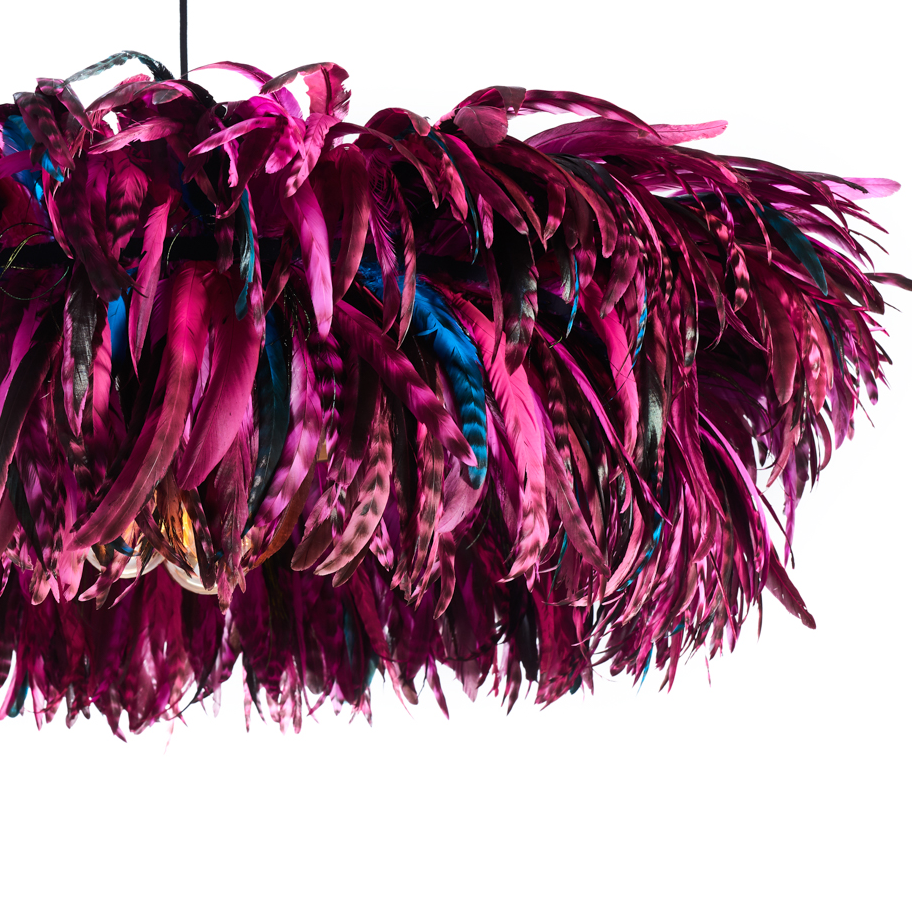
I’m not so sure how well these would age and I don’t know that I felt the overall design was very strong, but I have to applaud the use of a unique material. Coldharbour Lights showed pendants with feather diffusers. My wife, very practically asked, “How do you keep that clean?” I’m less concerned about that (typical for me!) and more concerned about longevity. Love the idea, worry about quickly growing tired of the eclectic look.
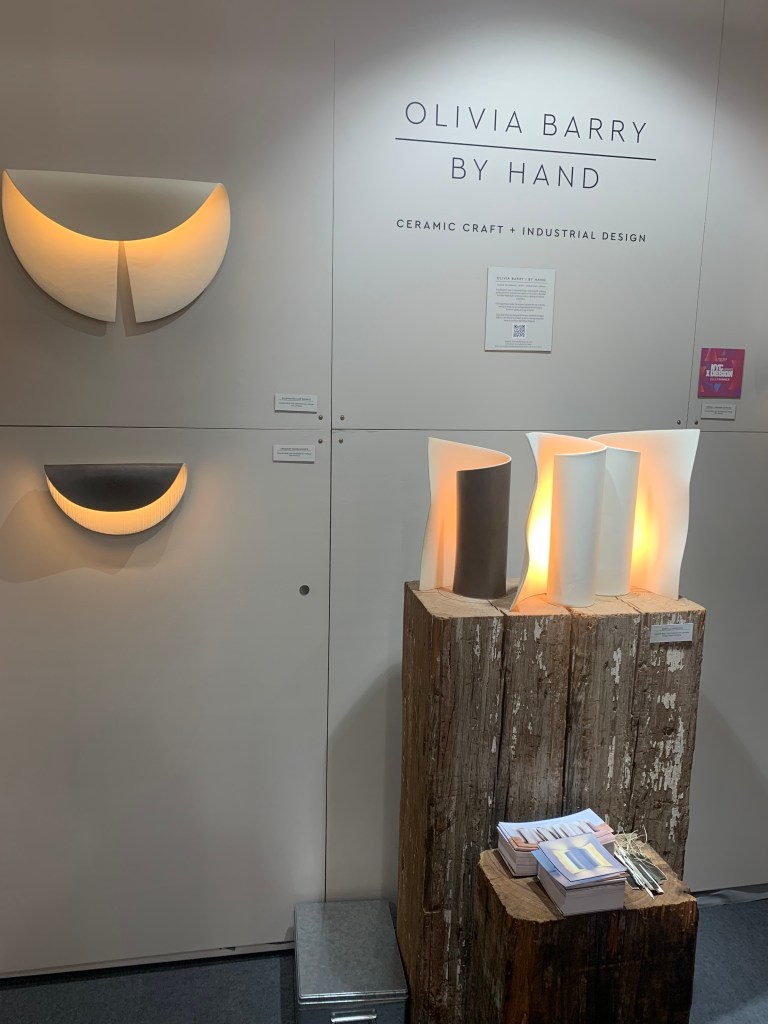
Olivia Barry was able to achieve a delicacy of shape as she deliberately folded thin sheets of ceramic around a light source. The lamps and sconces provided a soft, indirect light. When not illuminated, it was impossible not to be drawn to the shape and feel of the sculptures. I would hope more manufactures start to explore ceramic options.
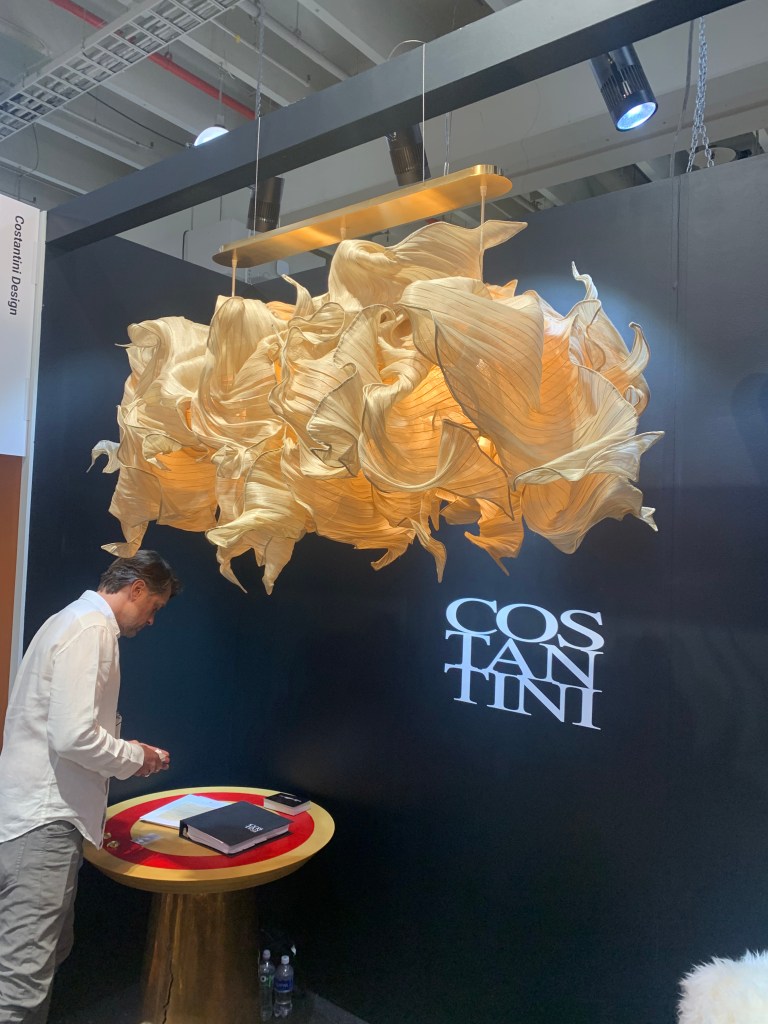
Yet another interesting diffuser material was found at Costantini. Starched, stiff fiber was formed into a “cotton-candy-esque” cloud around the light source. We have seen plenty of organza used in lighting over the past decade, why not other fabrics?
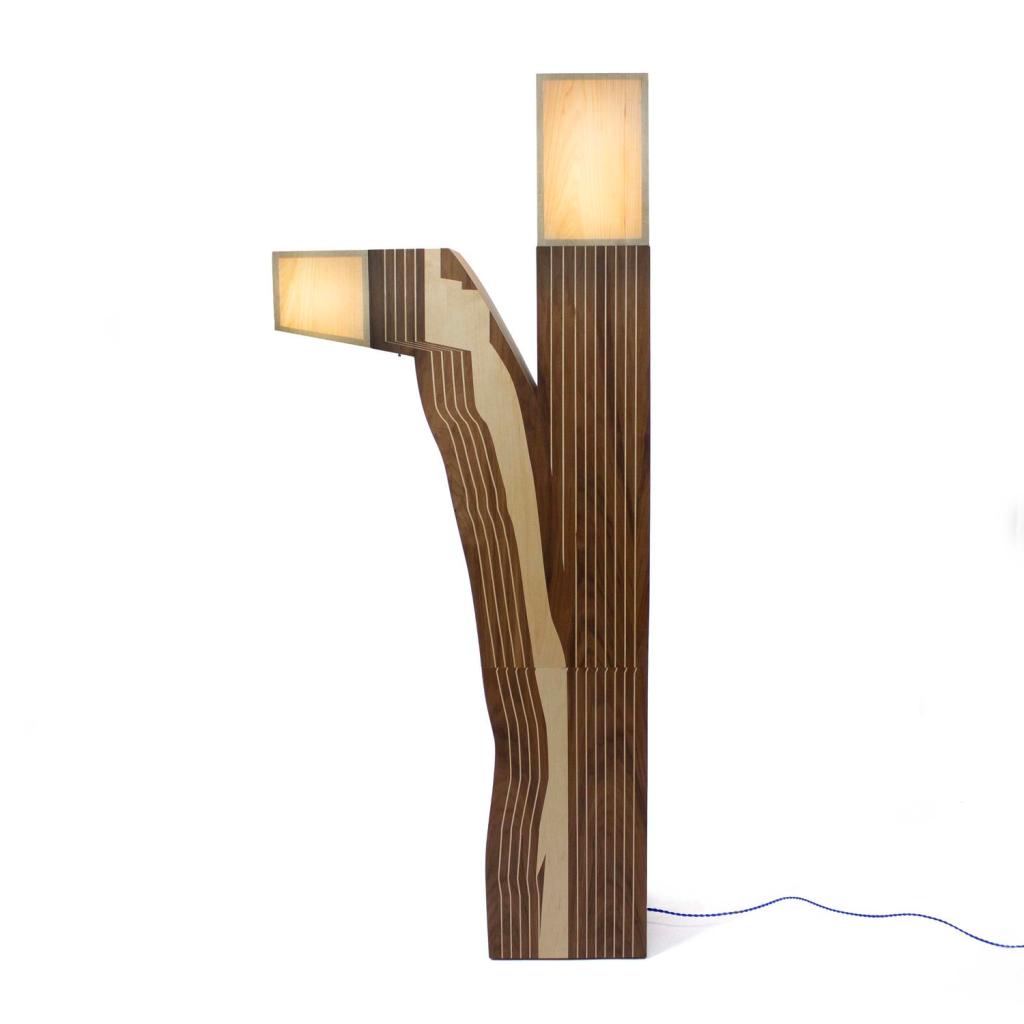
Wood has been a part of lighting, probably since day-one. Used as a diffuser? Probably less so. N J Roseti used thin slices of wood as a diffuser on quirky, “Memphis-esque” floor lamps. The wood delivered a warm glow and a totally different look. So nice to see this material use departure.
Hand and Eye Studios has created a simple, clean design aesthetic in ceramic lighting. I especially liked the palette of colors as we embark on a wider use of bold tones in kitchens and elsewhere in a home.
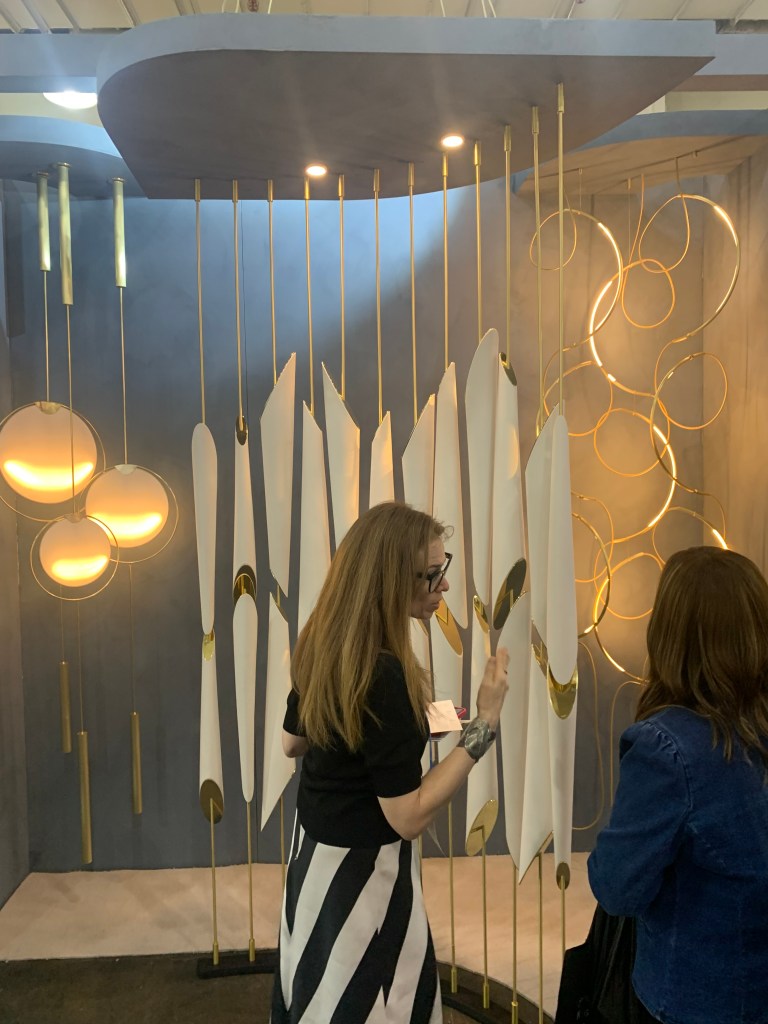
As we create more and more “open-concept” living environments, interior designers are challenged with ways of subdividing these large areas. I’m seeing an increase in room dividers, so the lighted options provided by Elish Warlop make logical sense. They segregate space, deliver vertical lighting and do it in a way that has heretofore been unseen. This could easily be an emerging trend, so I would watch this space for added development in the future.
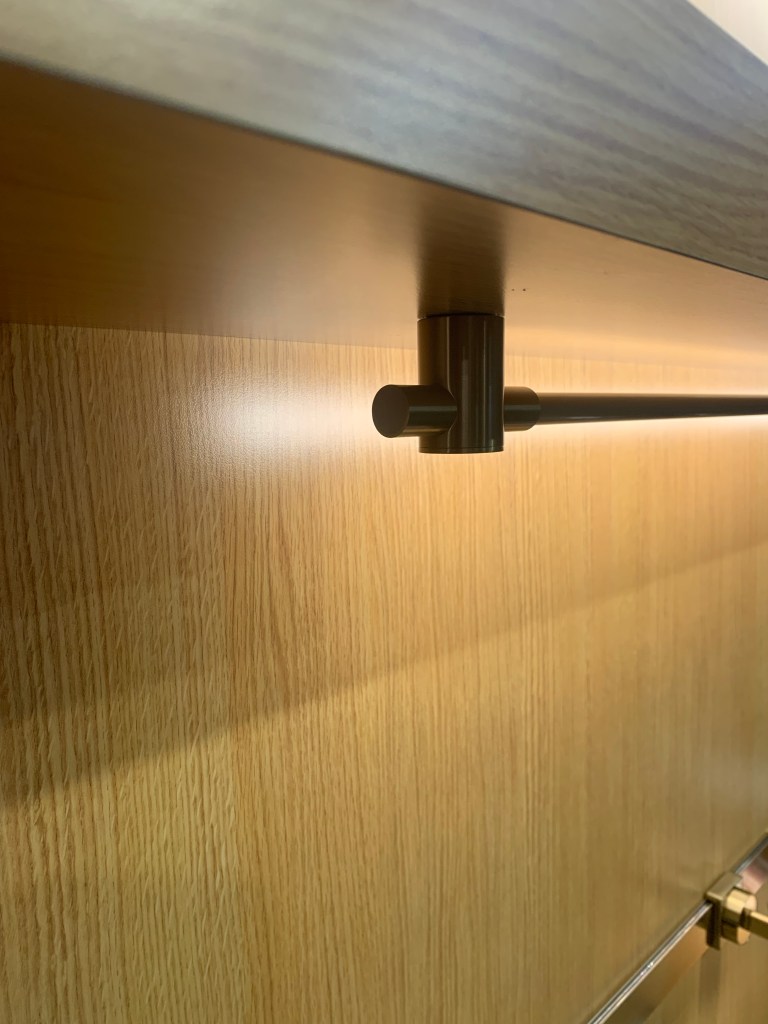
I really liked the Juniper alternative to under-cabinet lighting. Rather than the utilitarian box, this is a rail, offset from the underside of the cabinet by a barrel on each end. The rail rotates to deliver light as directed. This is a great solution for finished-bottom cabinets and shelves with a very purposeful look and design.
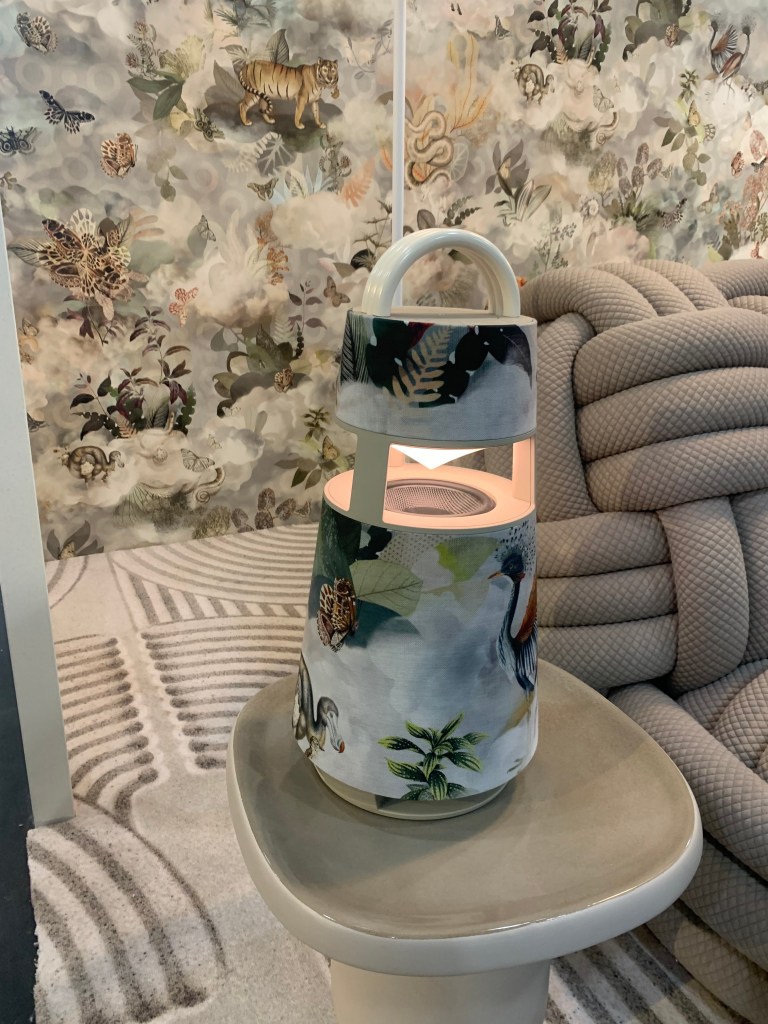
I’ve been a fan of Moooi since their life-sized horse floor lamp was introduced. (Do a Google Image search, if you’ve never seen it.) So why not a lighted Bluetooth speaker? Perfect for fun exterior environments.
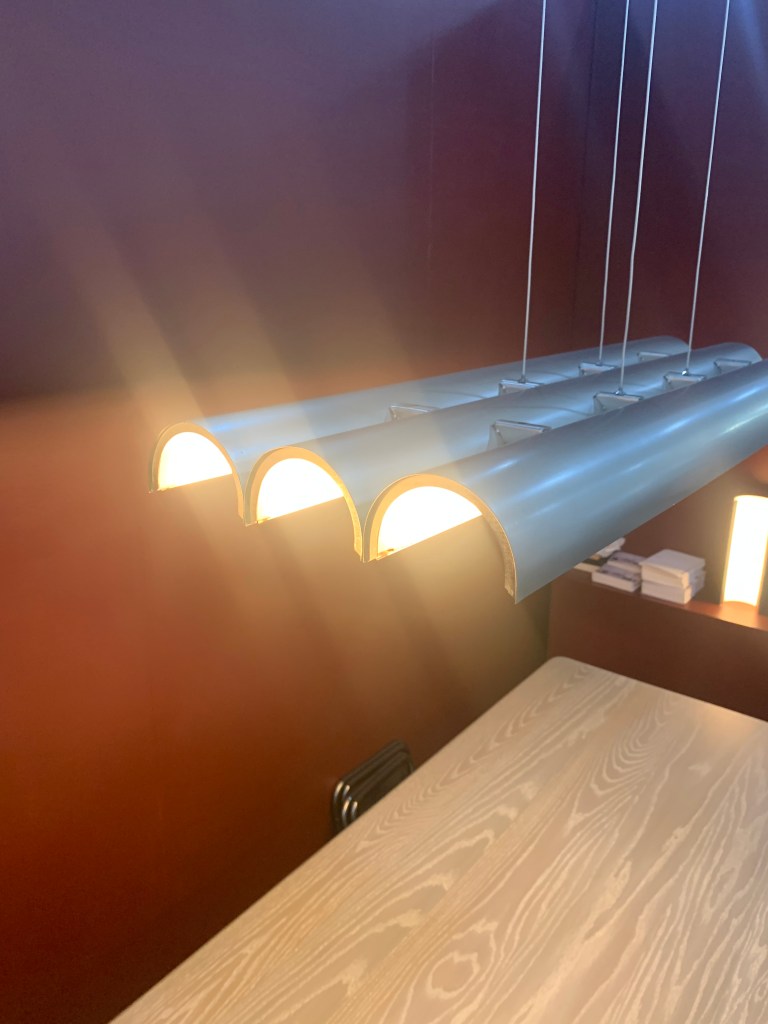
Some beautiful indirect light is now available by simply employing LED Tape. The ease of use and even delivery of light has allowed creative people to quickly develop interesting luminaires. Anony, showed Pola, a triple-arch, linear pendant that poured plenty of light in a downward direction, but eliminated the upward glare. The collection includes single arches and arches used vertically as portable lamps, also. By carefully positioning the LED Tape at the correct angle, the most effective use of this technology delivers maximum output. I liked this unit.
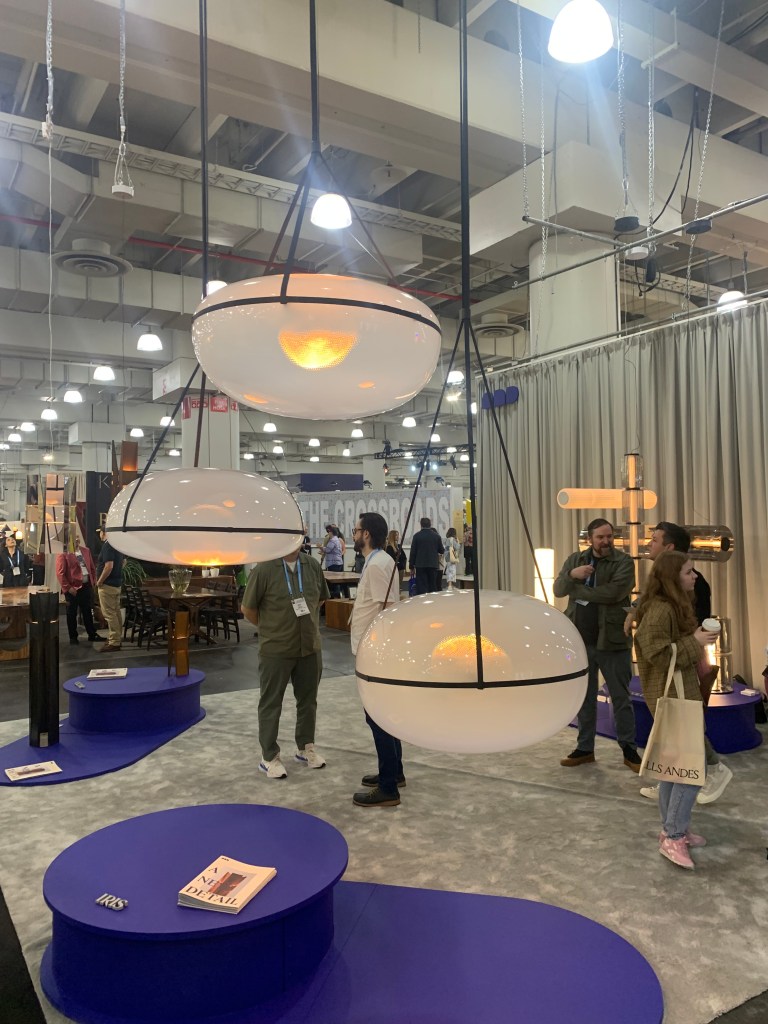
The Iris pendants shown by A-N-D, a Vancouver based firm were very exciting. The company has molded two large textured resin domes. They can be used together, separate and/or positioned up or down. The beauty here is the way in which the light is diffused. Think of an emerging sunset, or a falling moon trapped in a cloud of etched white. Great size, too! If you have a moment, it would be worth a scroll through this company’s exciting collection of lighting.
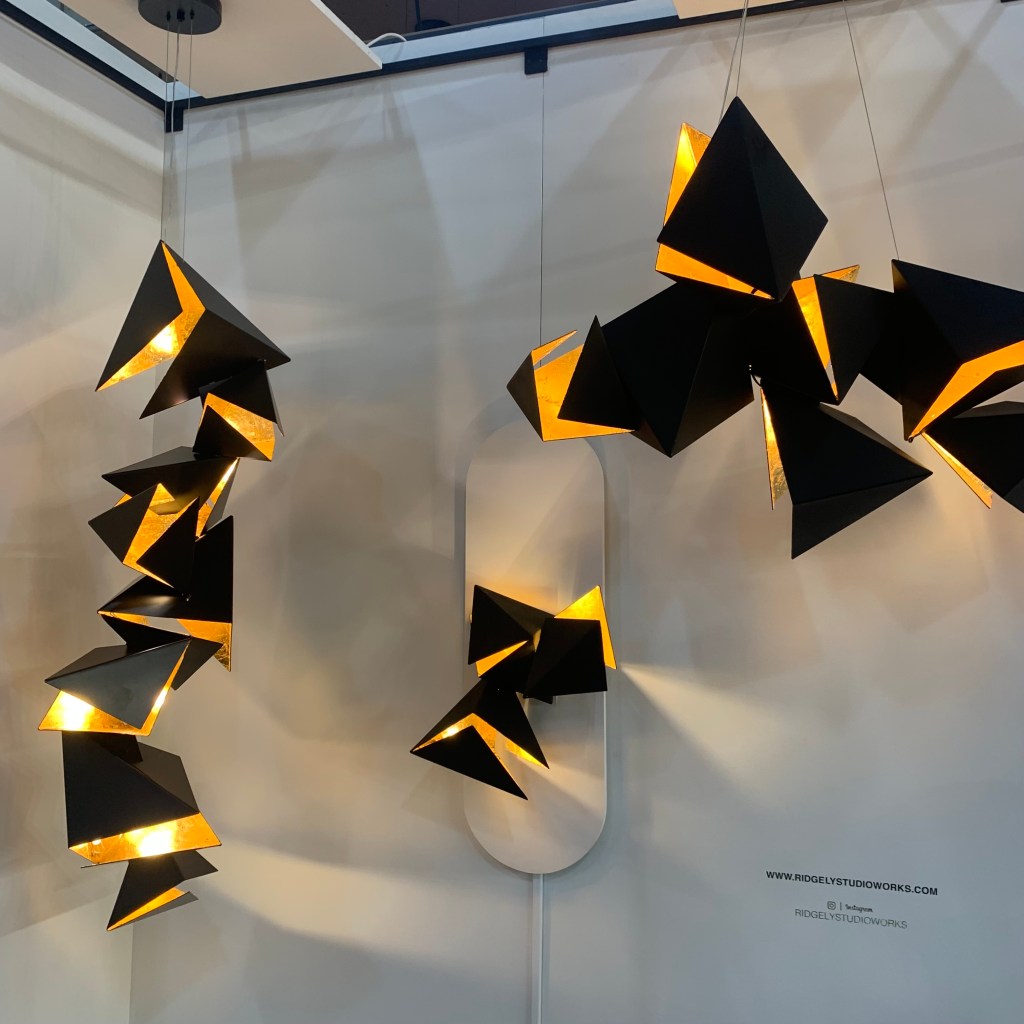
Plates of metal, black on one side and gold leaf on the other are arranged as if a stack of paper were tossed in the air and allowed to freefall downward. These Ridgely Studio Works luminaires create angular surfaces that block the light, on the black side and reflect the light, on the gold side. A vertical pendant, chandelier and sconce all display an exciting balance of light and dark.
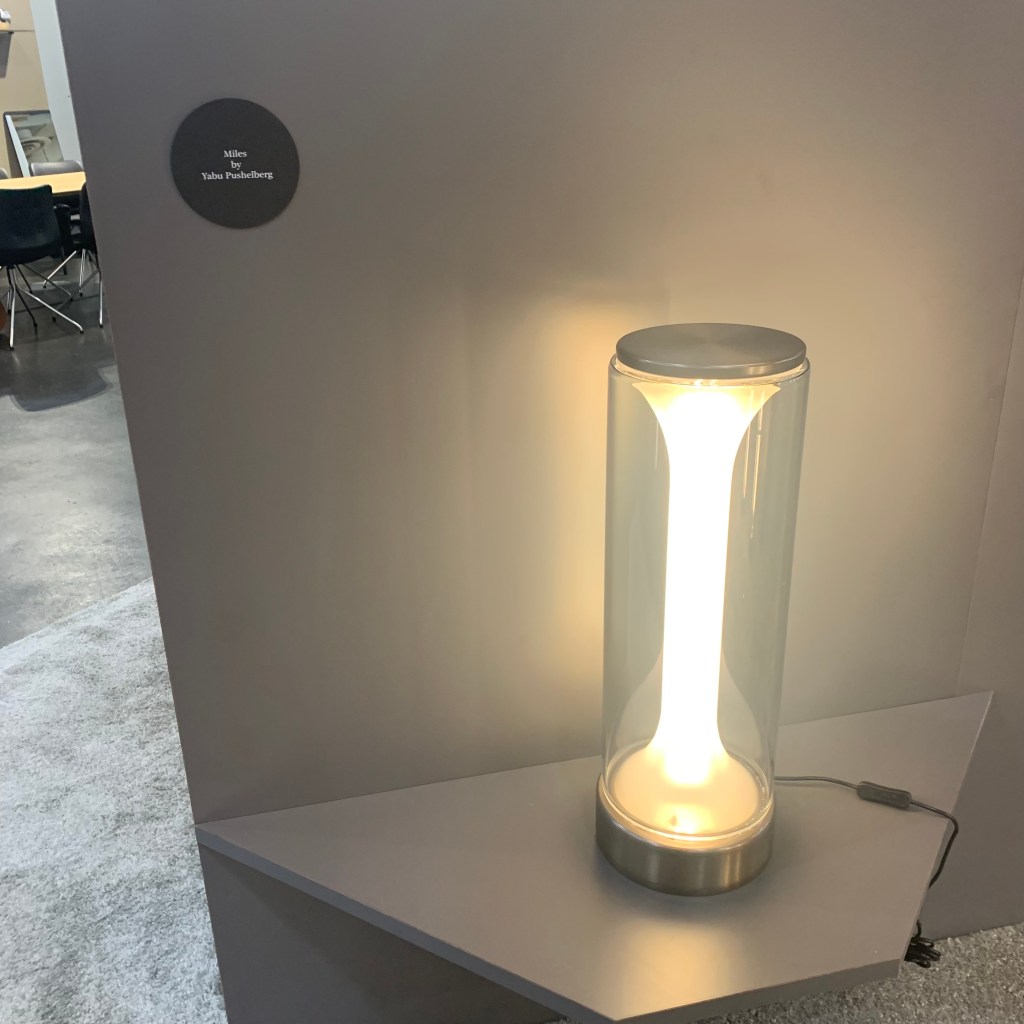
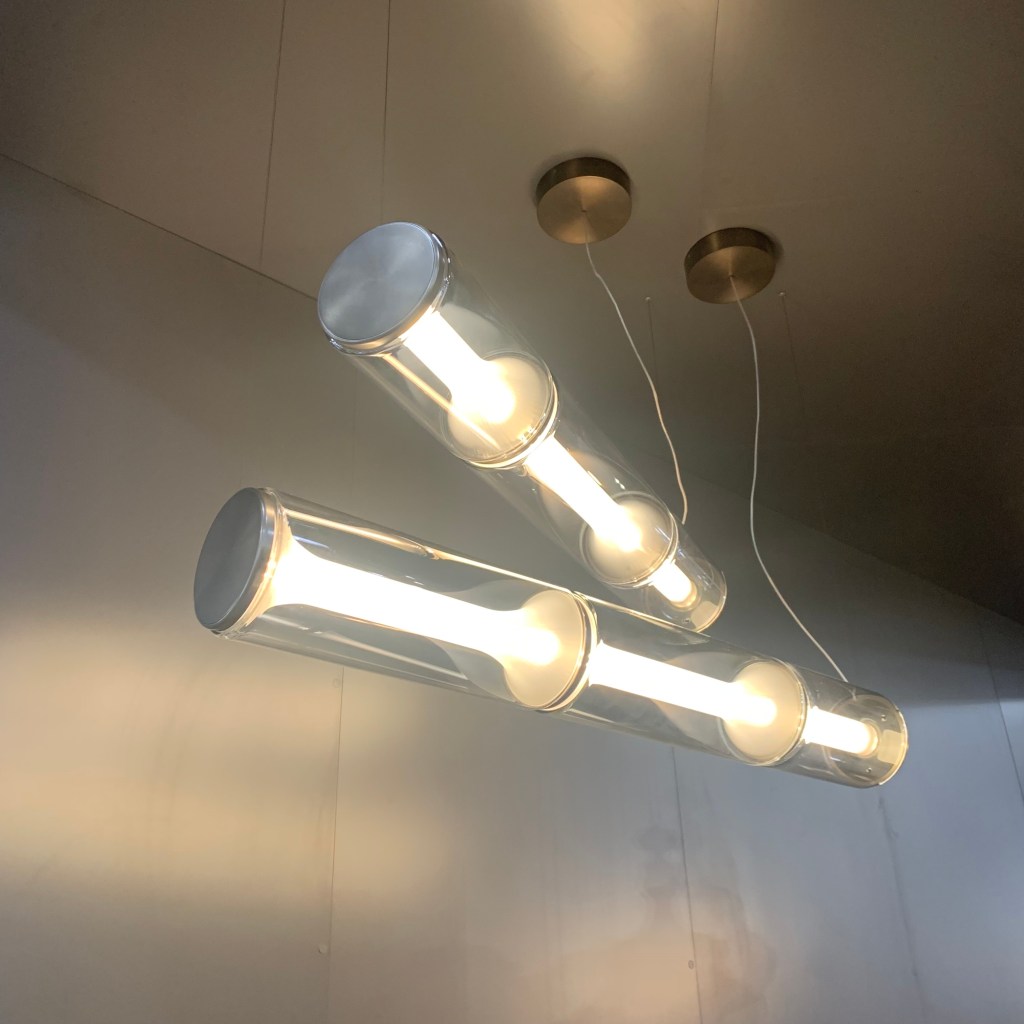
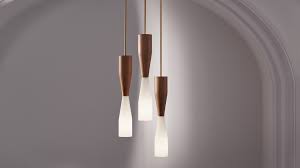
The Miles linear pendant and accent lamp by Lasvit was very nice. I can see these pieces being used immediately in a wide variety of interiors. A ribbed and tapered white diffuser is captured inside a smoke cylinder. I really liked this look.
ICFF 2023 – Lasvit – Milo accent lampICFF 2023 – Lasvit – Milo linear pendant
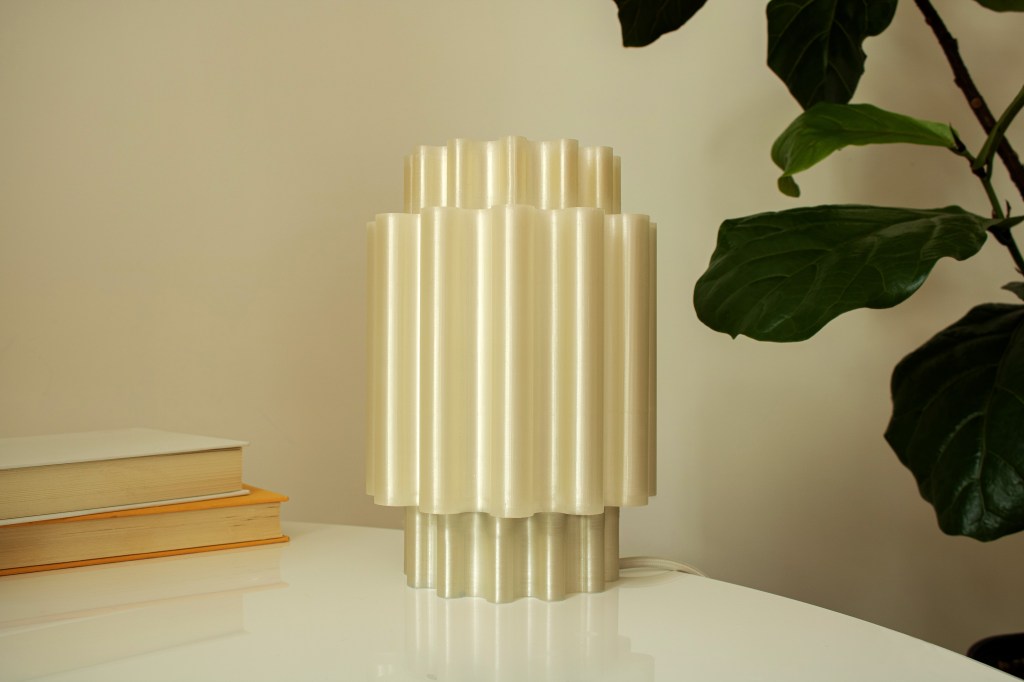
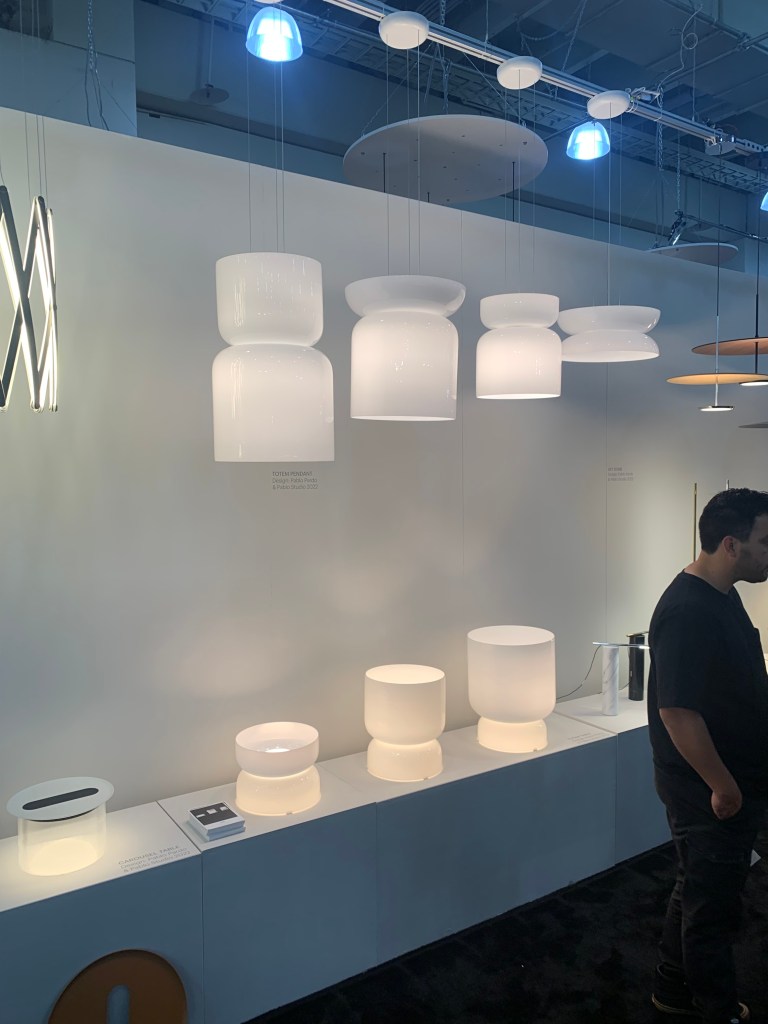
The Totem concept created by Pablo was apparently introduced last year, but I must have missed it. (One demerit for Jeff!) By stacking varying heights of white cylinders, a whole family of sizes is offered. Pendants and lamps can be mixed and matched across a space. I guess I need to pay better attention in the future!
ICFF 2023 – Pablo – Totem pendants and accent lamps
There was a nicely thought-out use of glass and wood in the pendants and sconces created by Lightmaker Studio. Employing the same shape, you will find the two materials used at the top, bottom, separate or together on each piece. Nice flexibility and beautiful shapes.
Moorish influence pops in and out of lighting trends. Perhaps it is the material, the beautifully pierced hole patterns, the unique color of brass or the smart metal fabrication. Nonetheless, Dounia Home displayed a wide variety of pieces that could allow Moroccan design to reemerge.
Only a few things grabbed my attention at the ever-shrinking LightFair.
I was very interested in the approach LED Dynamics Perfektlight has taken with tunable light. This appears to be intelligently selected LED and engineered in a way to deliver an excellent output that more closely replicates the sun’s spectrum than has been accomplished by prior manufacturers. Coupled with astronomical input and their proprietary app program, I thought this was a very wise tunable solution.
I have no connection to the area lighting industry, but I thought the snap-on replaceable heads developed by Tekpoles made a lot of sense. Rather than multiple people working multiple hours, repairs can now be handled with a single person. If this “snap together” concept is of interest, consider taking a look at their website.
The new Glint recessed light looks like a real solid winner. Once the luminaire is installed, it never moves, but the light can easily be adjusted to meet any changing demands. It has won scores of awards, disappears easily into the ceiling and looks good too. I think I’d like to try this one.
Based on this show, I would hope ceramics and fabric will find their way into more conventional lighting. I also think illuminated room dividers could grow into a more important category of lighting along with the “pearl necklace” type luminaire strings. These kindred spirits are both different and needed categories. As we move away from HARD Contemporary and pared-down traditional aesthetics, this show helps us understand what the “new” will look like. That’s my takeaway. What’s yours?
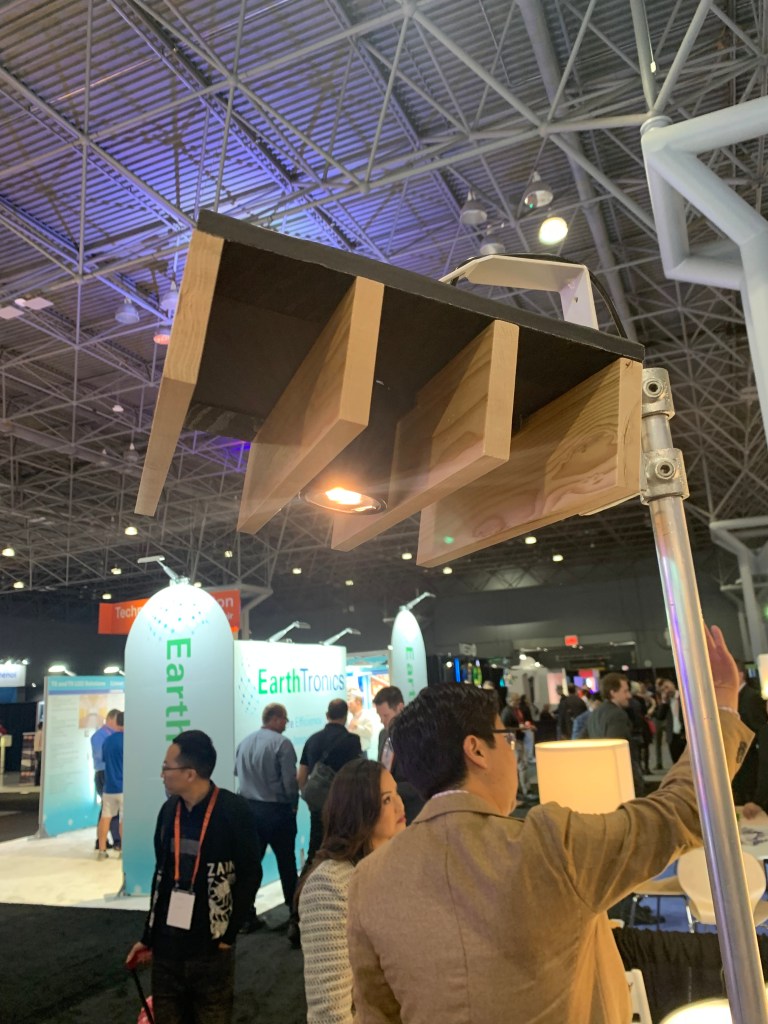
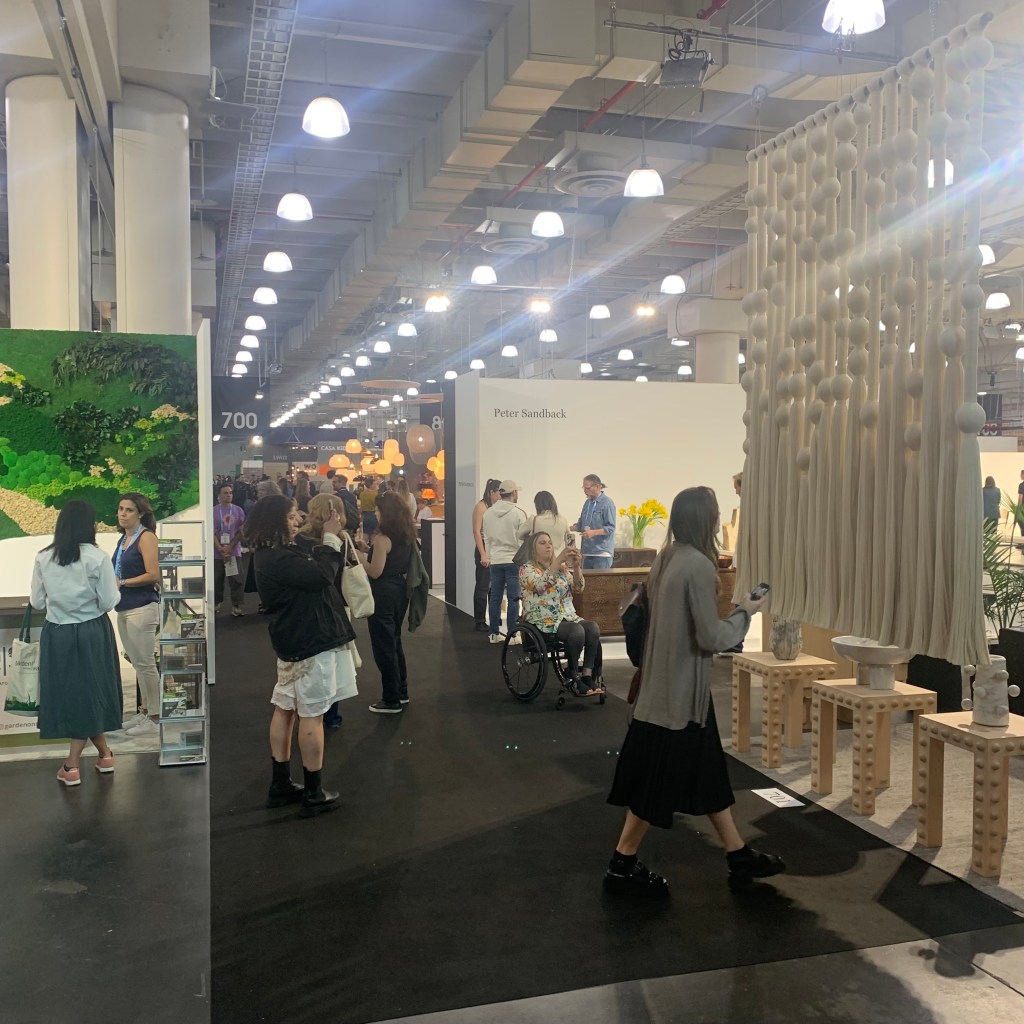
I was happy to experience an elevated level of excitement this year at the International Contemporary Furniture Fair (ICFF) held at the Javits Center in New York.
ICFF 2023 – Crowded aisles and lots of interest.
Overall, I think we are seeing more complexity being added to products. At a macro level, this makes sense. Design was pared down to bare minimums in the 2010s and we are seeing that inevitable trend swing back to increased levels of detail and a higher appreciation for craftsmanship.
Wall coverings and floor coverings were uniformally more complicated. Furniture moved away from straight lines to added layers of detail. We have not yet returned to the nouveau European product of the early 2000s and I don’t believe we will reach that far, but an increased appreciation for a more deliberate approach to design is blooming.
Following are observations on non-lighting elements that caught my eye as indicators of design direction or unique approaches to complex solutions. In the next post, I will cover lighting and combine it with the few interesting things I saw at LightFair 2023, held concurrently, upstairs at the Javits.
Floor Coverings
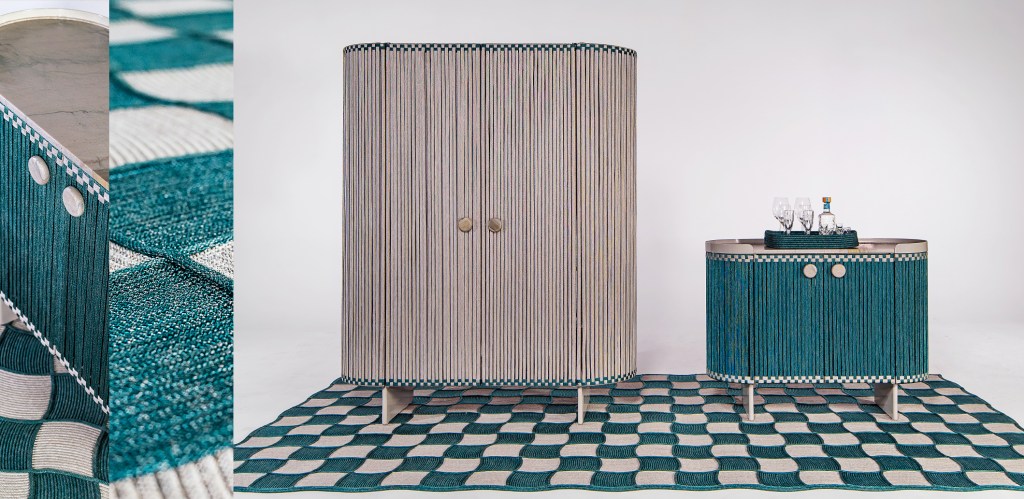
If the interior rugs are headed in a specific direction, rest assured exterior rugs are doing the same. The Brazilian company Tidelli offered a nice assortment of patterns and shapes that will enliven outdoor living spaces.
From a distance, the rugs created by Auda Sinda appear to be simple tweed weaves. Upon closer examination, they are handwoven by artisans located in the Pacific Northwest and include leather strips, fiber, fabric and any number of linear strands. These were beautifully complex, bespoke pieces made in the United States.
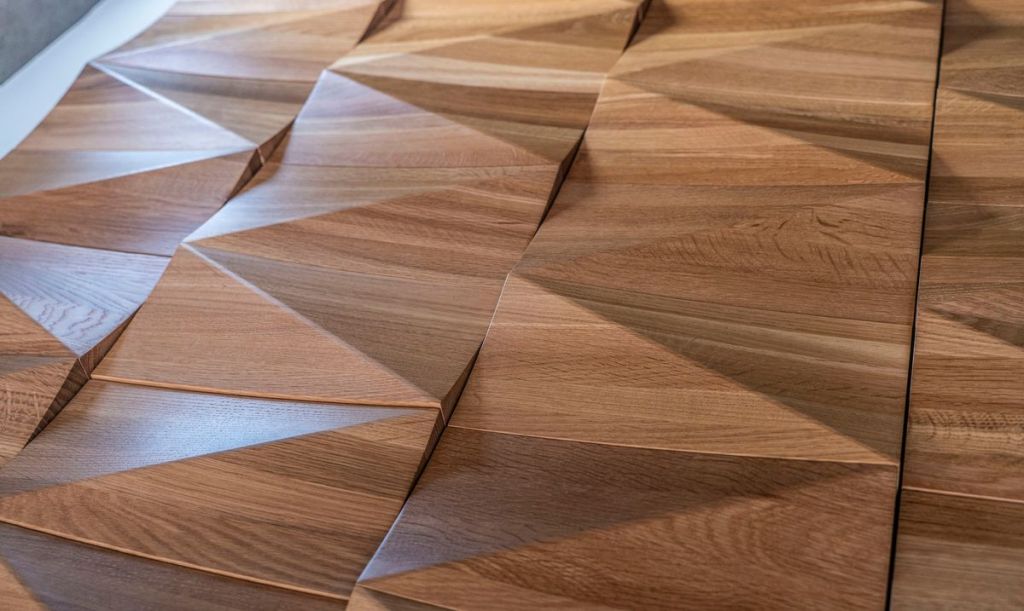
60s walnut paneling never looked this good. Evove sculpts the panels with cut patterns. When washed with good lighting (it all comes down to good lighting!) a wall takes on added meaning and interest. With the use of Mid-Century and Art Deco showing only minor deterioration, these are going to be meaningful now and should easily carry into more involved design trends.
ICFF 2023 – Evove wall panels
Furniture
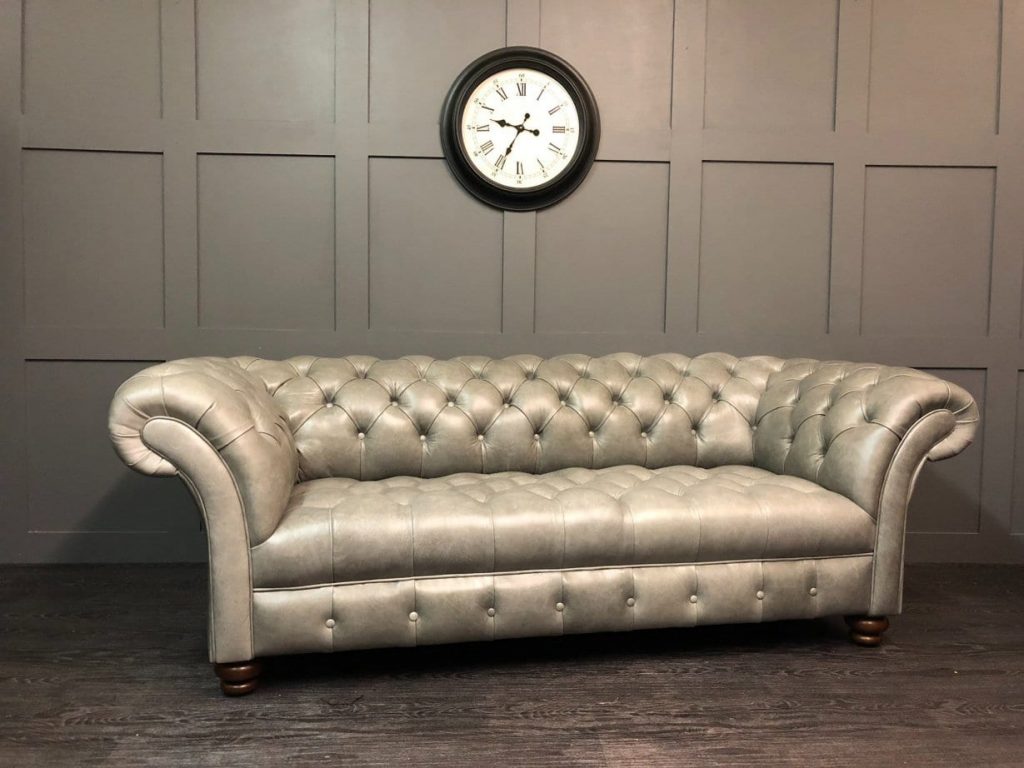
My father was an upholsterer. Creating good tufting was always a challenge and as a kid, amazing to watch. The “buttoned” center of the pleat was installed first, so while the whole piece of furniture was naked, a blossom of rows and columns was developing across the chair back. A similarly complex set of deliberate steps allowed for the creation of pleated arm fronts. Decorative nailhead placement is also another near-lost art. All of this came back to me looking at the beautifully crafted headboards and seating at Fleming & Howard. This step back in time did not seem dated, but instead, the rediscovery of a lost art.
As we slowly add detail back into design, finesse is a key. Wooliv, a Portuguese furniture manufacturer really showed an adept hand. Meaningful design elements were carefully added to create some of the cleverest pieces in the show. I wish I was redecorating now!
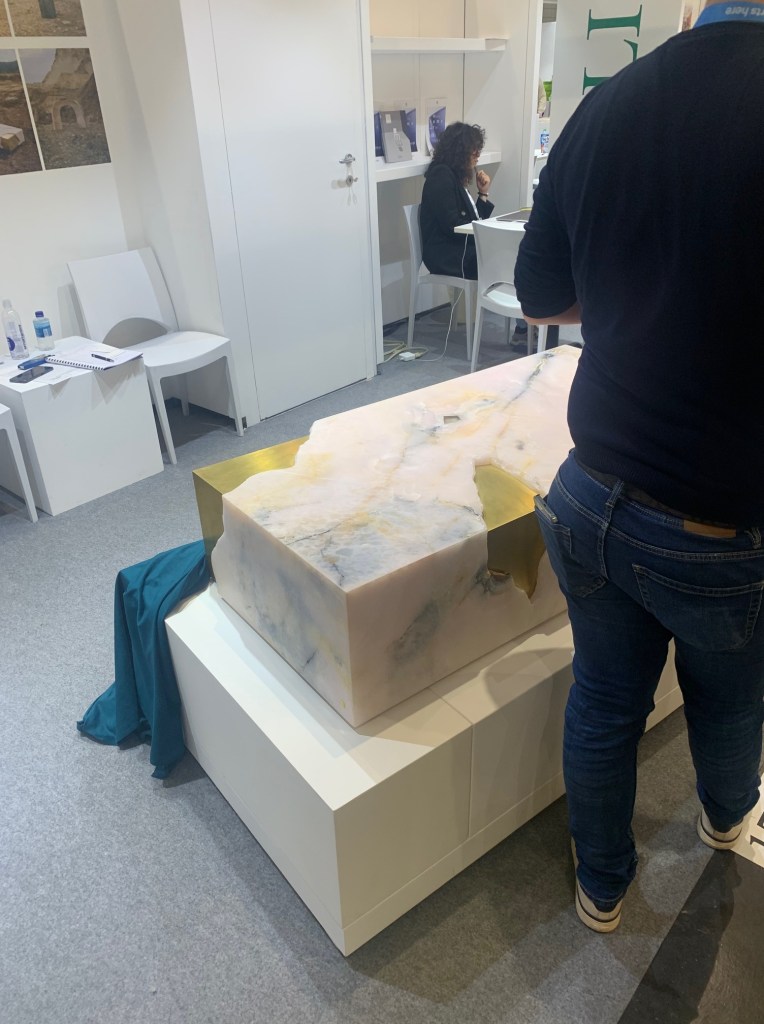
Almost as a definition of the transition to more detail, Serafini showed a solid brass block table. As a way of defining the shift, a marble overlay with snapped and natural edges clung to the corners. The cold, hard brass was softened by the warm embrace of marble.
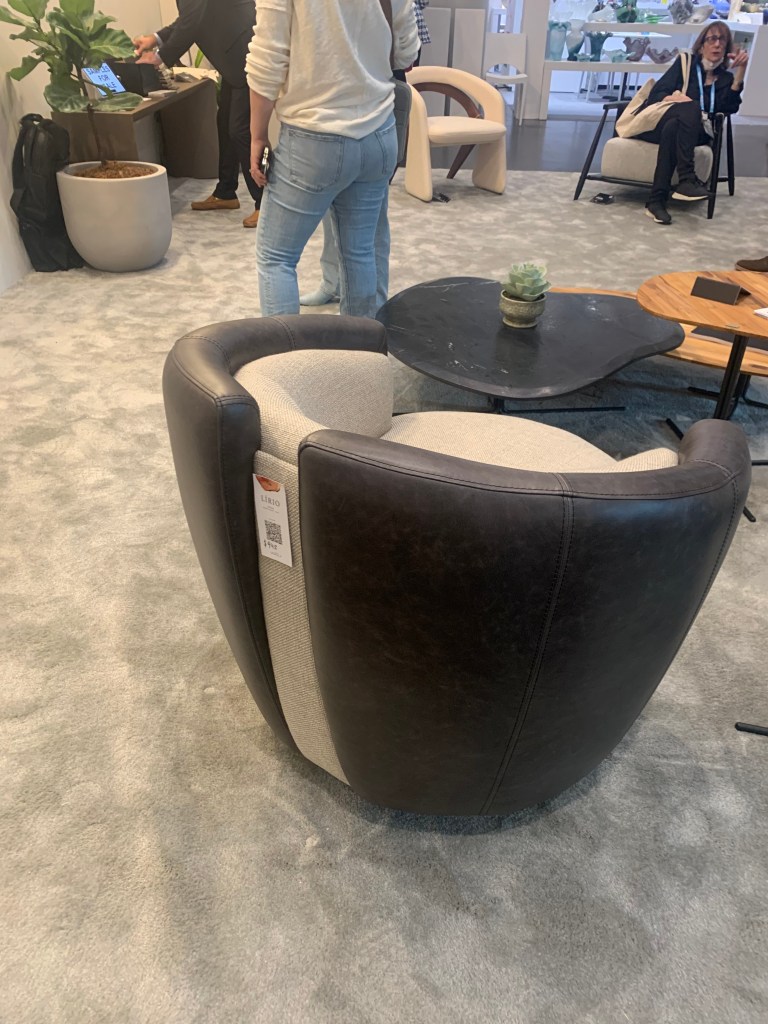
Liro from Brazil displayed split-back leather chairs. To differentiate, the “split” was filled with a tweed fabric or a rattan fiber. Adding this alternate material to the cool leather softened the look and elevated the interest.
ICFF 2023 – Liro
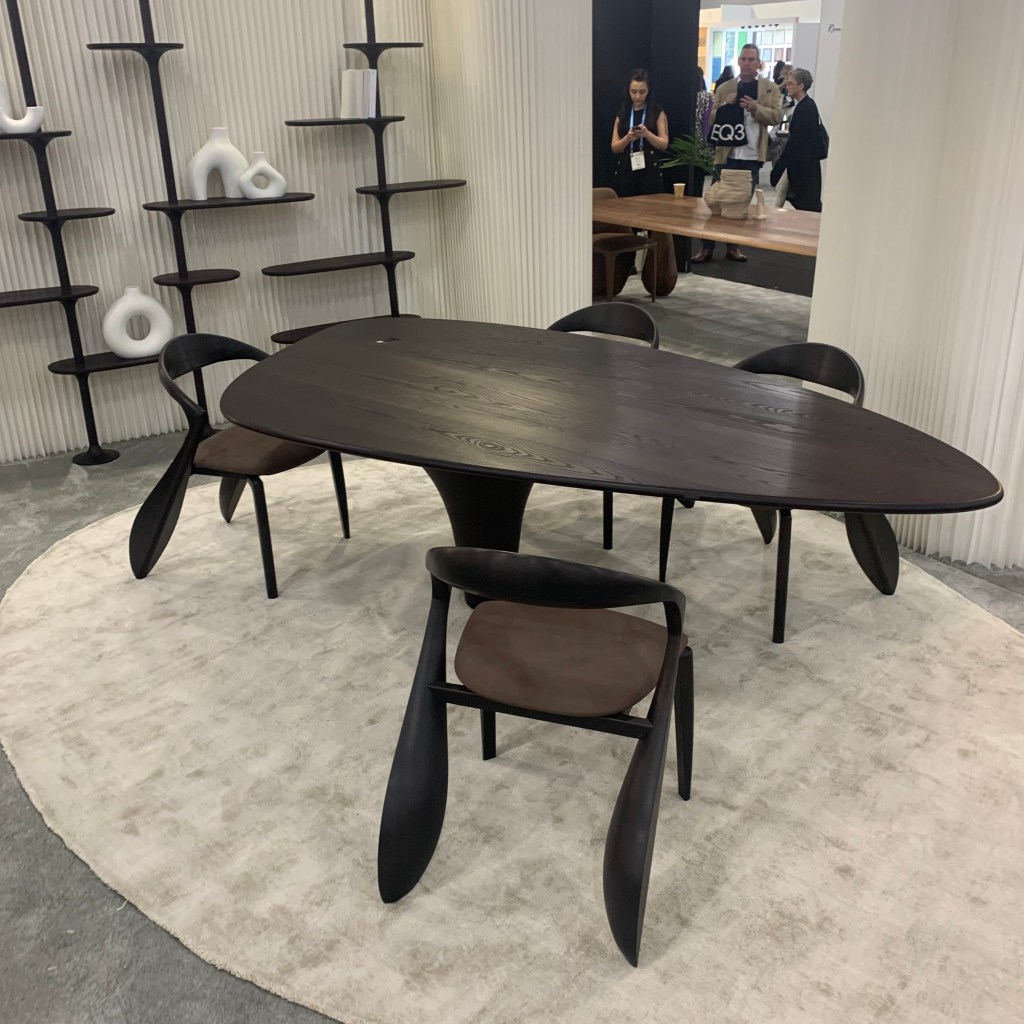
I fell in love with the Mozea asymmetric dining table and especially the Locus chairs with tri-sided legs. Everything about this work of art detracts from the norm. Great lines, a different approach and how it will fill a room.
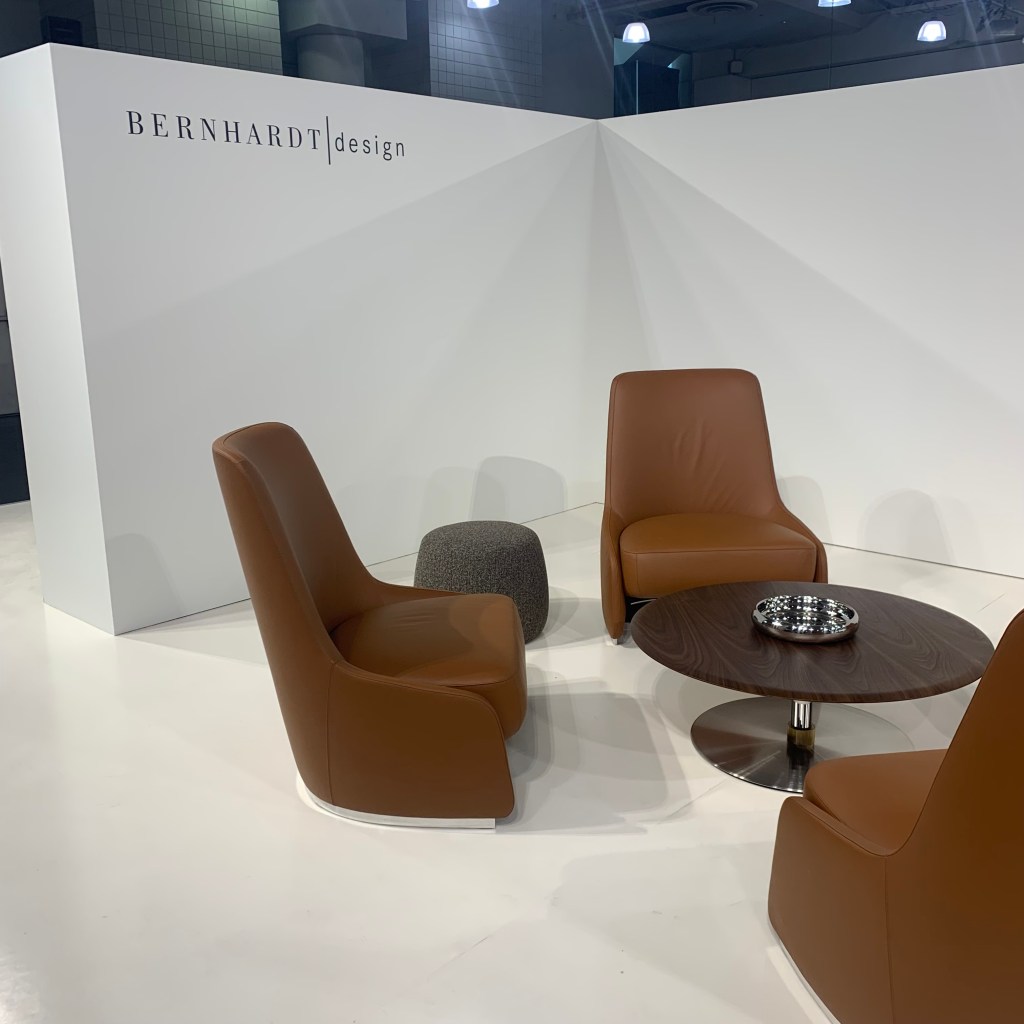
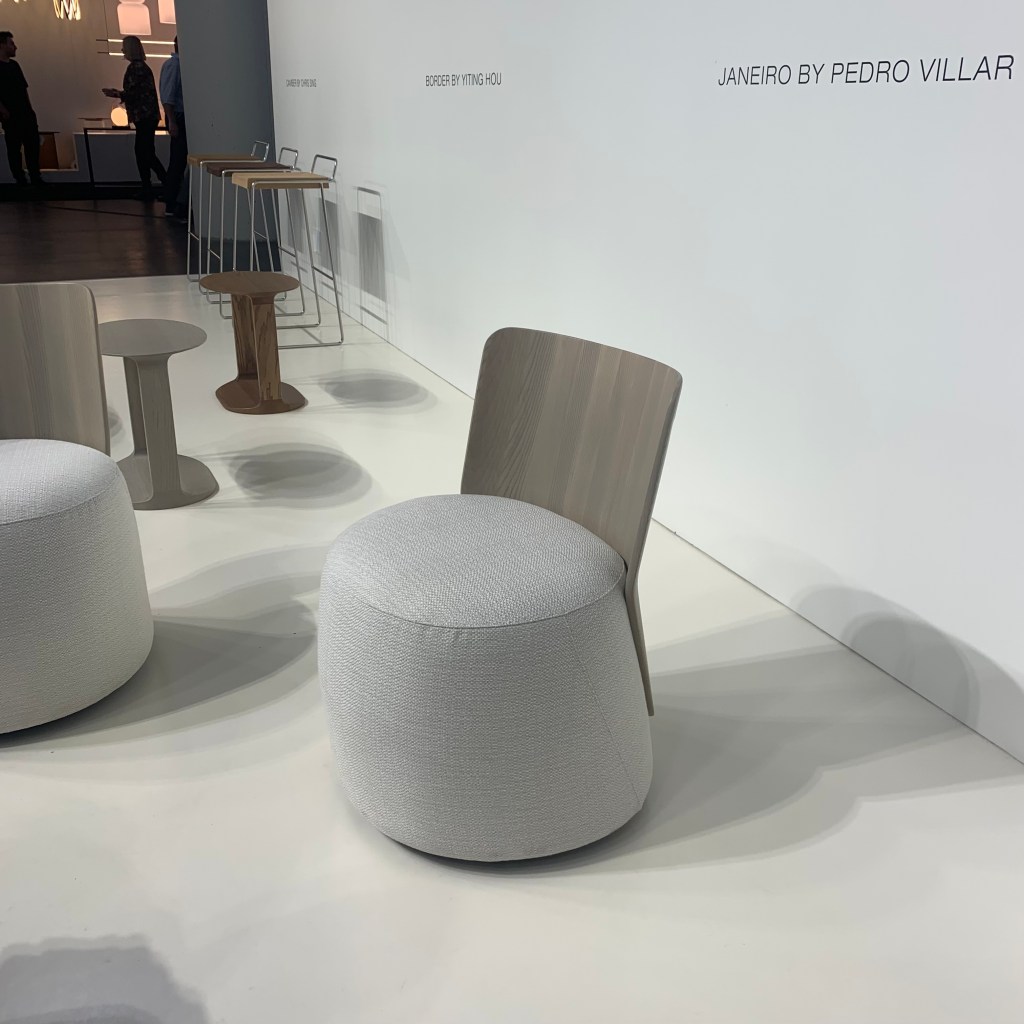
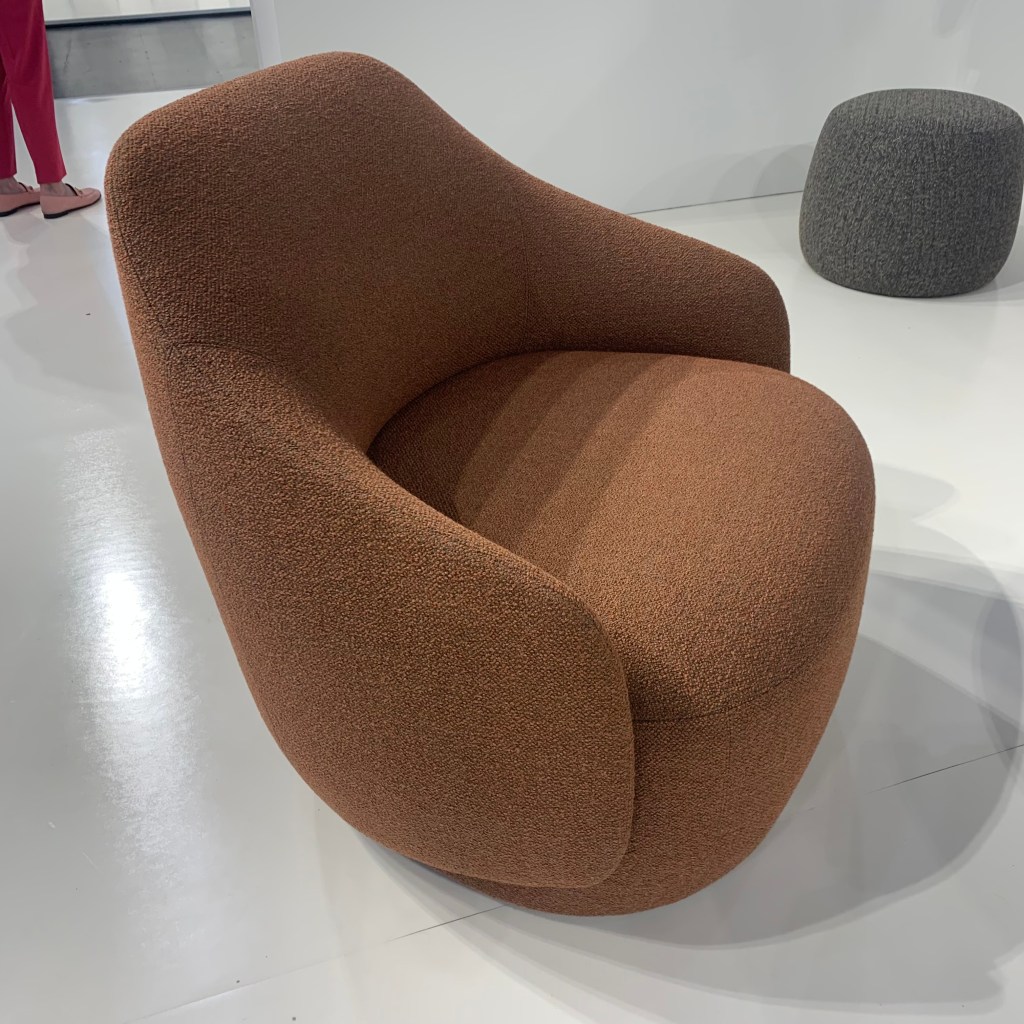
The Bernhardt display is often the largest at the show and they always feature a nice variety of new lines. I liked the small barrel chairs, Janeiro designed by Pedro Villar. Like the dual materials of the Liro pieces, they used a mix of fabric and a formed walnut slab. I also look forward to the new Terry Crews design, a reoccurring feature each show. His RKC chair has beautiful lines with a base that solidly connects the piece to the floor, but doesn’t feel weighed-down, probably because of the reduced seat height.
ICFF 2023 – Bernhardt RKC by Terry CrewsICFF 2023 – Bernhardt Janeiro by Pedro VillarICFF 2023 – Bernhardt
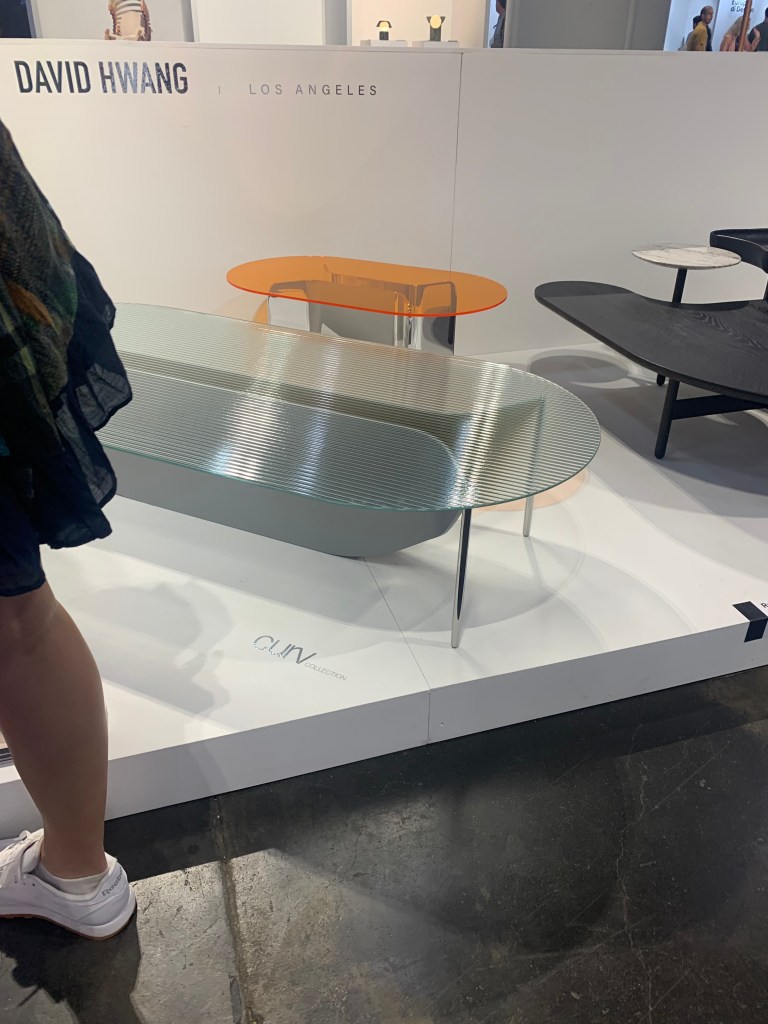
My favorite student, or emerging designer piece of the year was by David Hwang. Curv has a beautifully curved base that just barely connects to the pencil legs, all holding an oval clear ribbed top. He also showed an amber top. This is a young person with a future.
Raising sustainability to new levels, Model No is 3-D printing furniture from biodegradable, plant-based material. The whole process is also net-zero. While some of the product was interesting, the company was more important because of their manufacturing direction. I suspect we will see more of this in the future.
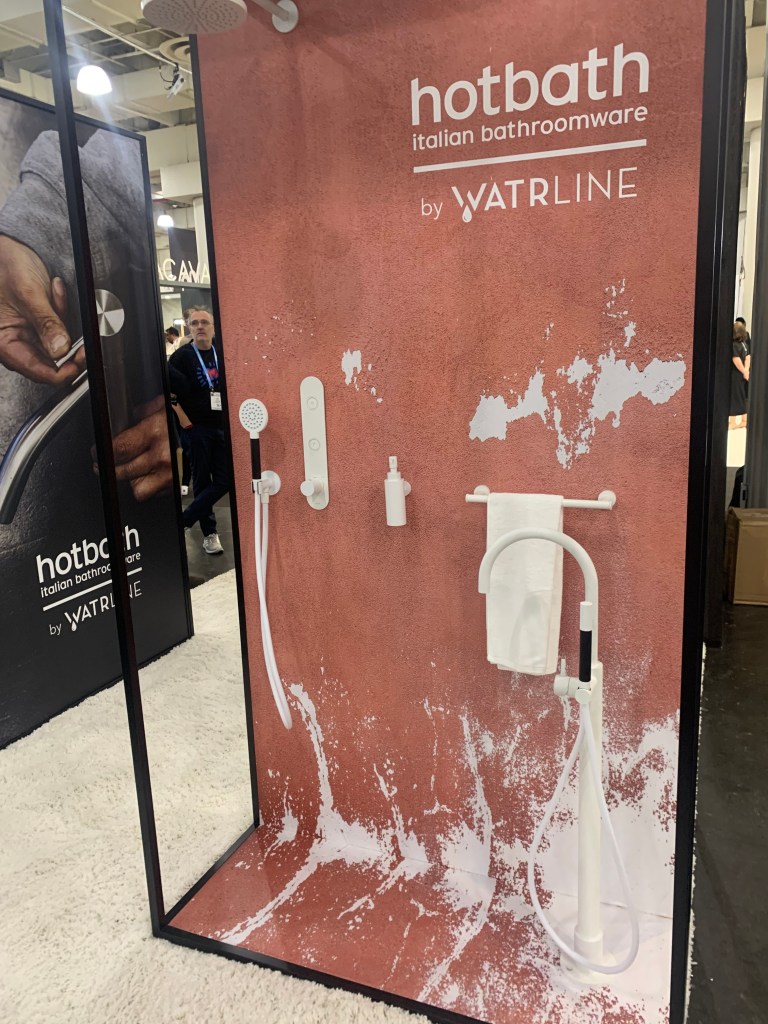
There is only one overarching trend I see in plumbing. Tenzo FinePlomberie is the latest to show decorative knurling details on the handles and faucets, but I’m more interested in the impact of matte white.
For a few years, most of the manufacturers have been offering matte white tubs and sinks as an alternative to the ubiquitous glossy white porcelain. A few years ago, Jason Wu, who really started the Matte Black trend at Brizo, showed matte white on plumbing hardware. This year, Watrline featured some of the same. I think we need to pay attention to this. We are seeing an uptick in white accessories throughout the house, including lighting, probably as a balance to the more involved and detailed other furnishings that complete a room. I also believe that Matte Black, very popular now, but must be nearing an end. Since 1960, black as a finish has never lasted this long. Matte White will be a nice transition from the density of Matte Black and a good compliment to the brass tsunami that will dominate finishes for the next decade.
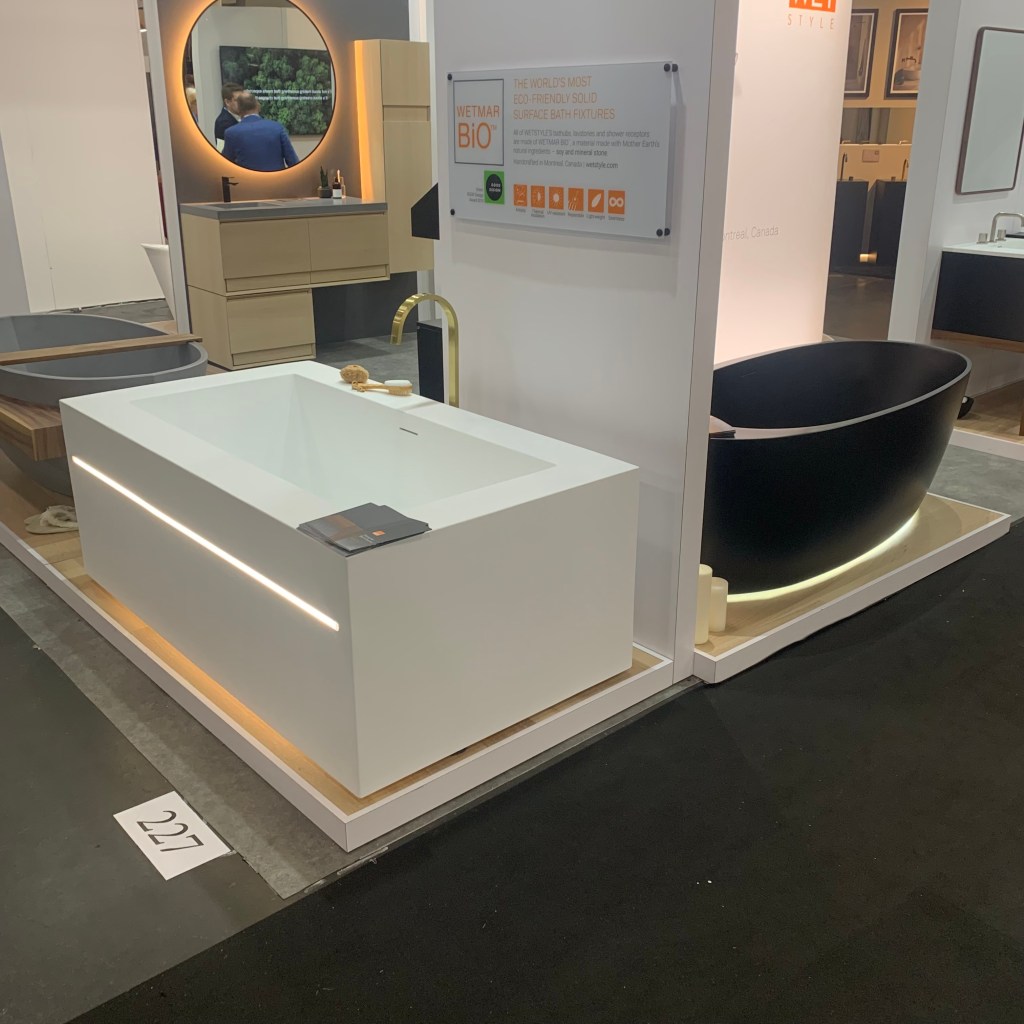
The Wetstyle tubs sort of bridge the gap between this post and next week’s. They are now embedding their tubs with LED to highlight the sides and serve as toekick accents. This is such a natural use of light.
ICFF – WetStyle
Fire!
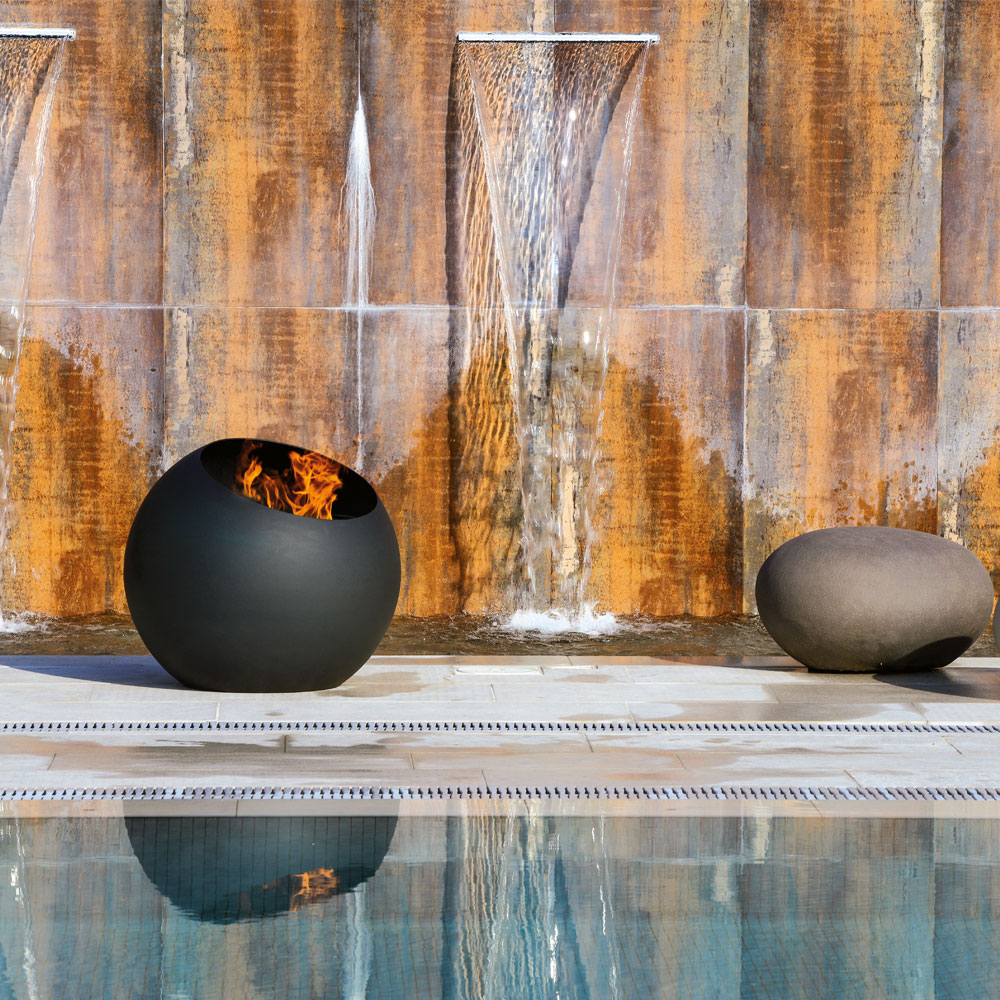
No, I’m not talking about the late 60s song by The Crazy World of Arthur Brown. There was, however an equal fascination with the subject matter at the show. Fire pits are hot (no pun intended) and some very creative options were on display. The Lumacast line is a much more refined than the chimineas we saw a decade ago. These are cast concrete in a stylish, sleek design. The “pit” area is filled with an equally appealing group of stone or glass. We have come a long way in the creation of exciting outdoor environments.
Focus suspended a fireplace from the ceiling, but perhaps more interesting where the sphere-shaped fire pits for the outdoors. The Bubble is a great shape for contemporary exterior spaces and different from the majority of what is currently offered.
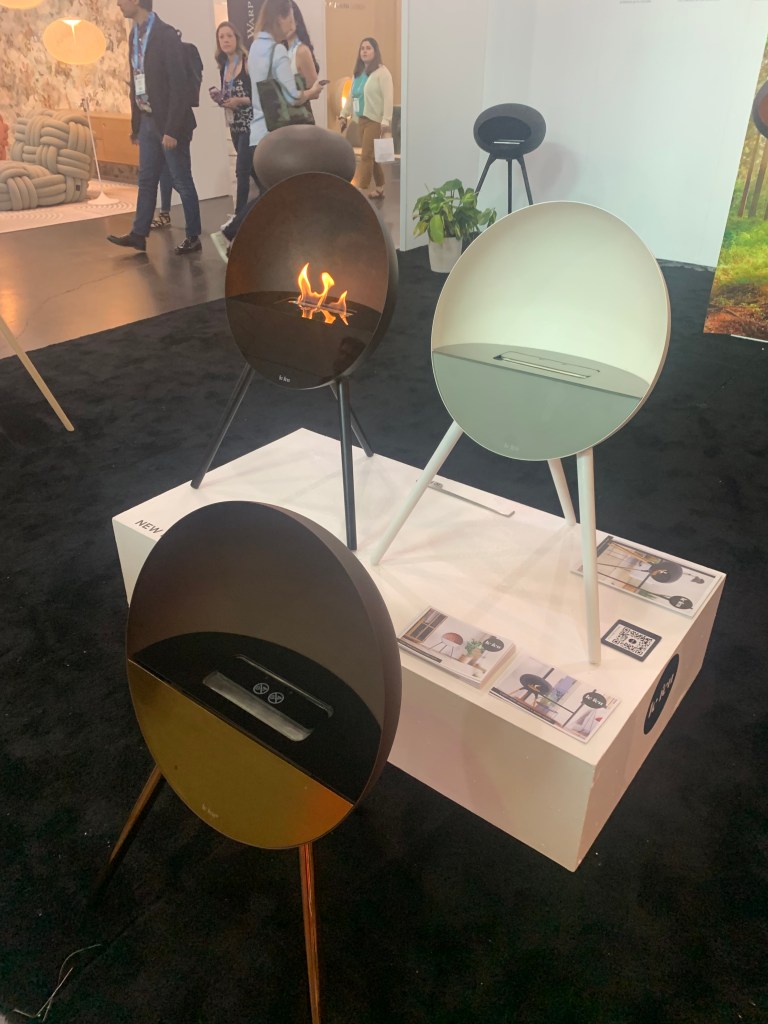
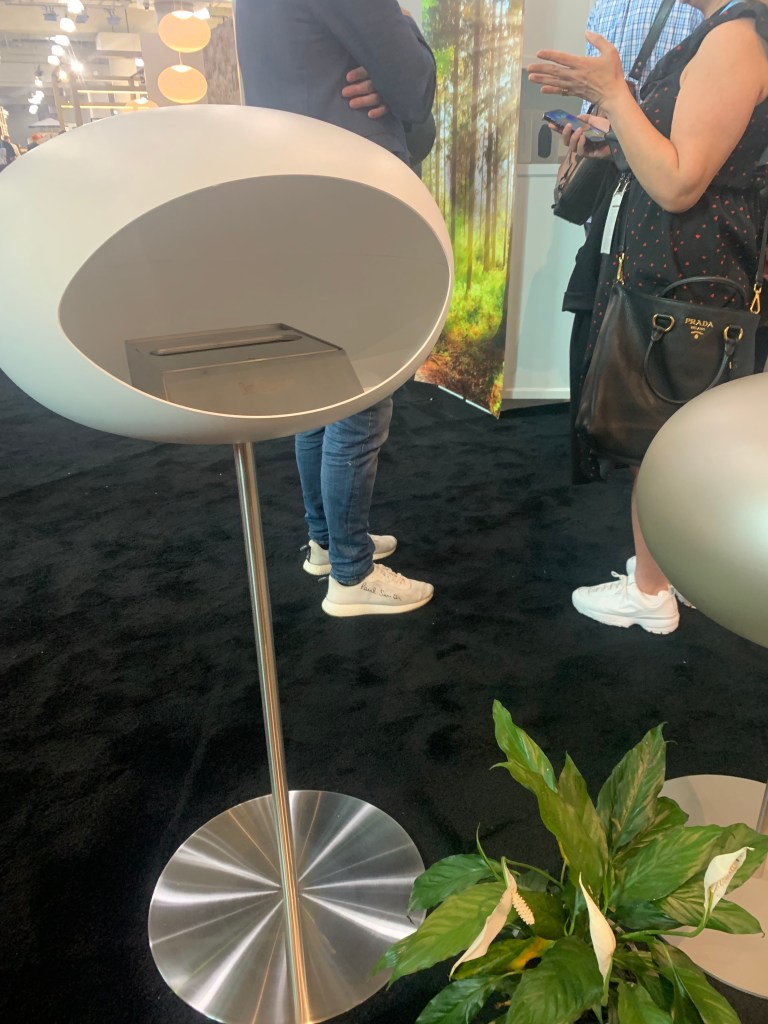
My favorite fire feature in the show were the Le Feu “pots.” Somewhat reminiscent of the 60s suspended fireplace, (see Focus above.) but in an ellipsoid, oval shape. They are also quite compact in size, making them very usable in a number of applications. They use bioethanol to create the flame. As explained, bioethanol is made from agriculture waste and claims to be more sustainable than other options. This combo of a trend and sustainability is exactly the type of product that could “catch fire.” (Pun intended?)
Reduxwood has discovered submerged forests of trees in Central American lakes. They rescue these water-infused skeletons and use them in furniture. The years of water apparently alter the grain and color making them stunning “live-edge” tabletops. Live-edge is not new, but the influence of decades-long submersion add an element of interest here that is quite unique.
The show featured two suppliers of “live walls,” essentially plants arranged on a wall surface in patterns, using different species to present multiple colors. Wildleaf Design and Garden on the Wall showed this biophilic solution but I wonder if this has staying power. Does the maintenance warrant the end result?
I didn’t know this was needed, but Trova sells biometric-access safes. Rather than a key or combination, they allow access via a combination of secure app and biometric scanning. Only “you” can open the safe making it easier to use and more secure.
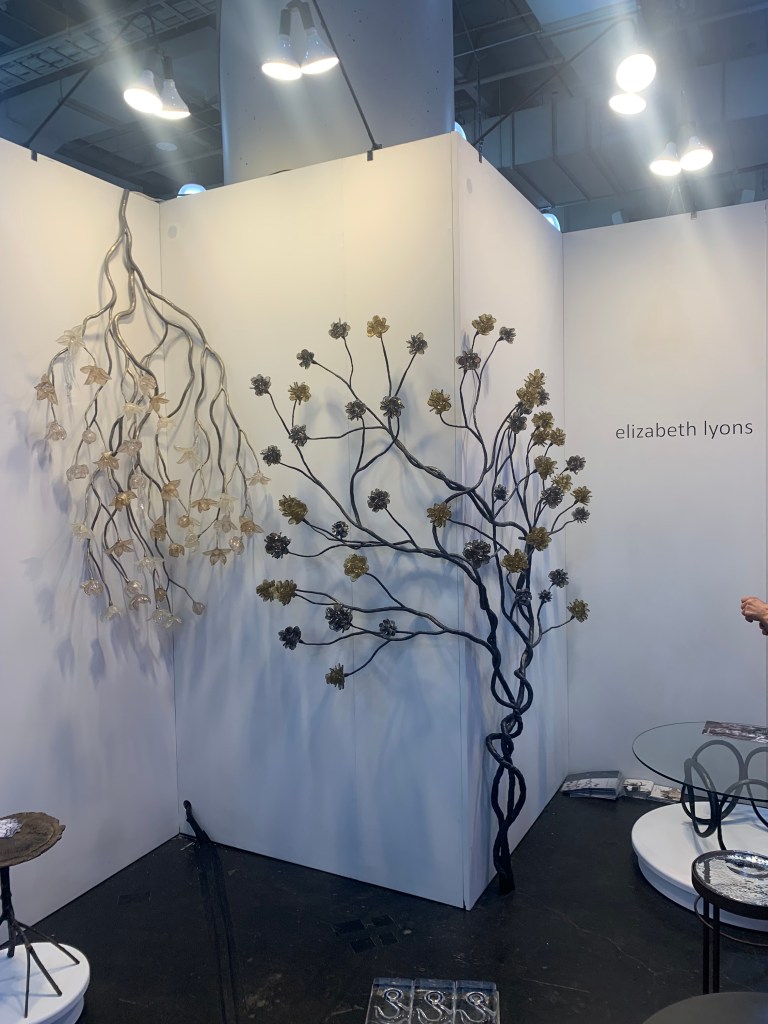
Why don’t we decorate corners? There aren’t a lot of options. Elizabeth Lyons showed some nice choices using her glass creations, combined with organic-inspired wrought iron, filling an unused space is now possible.
Beyond aesthetics, it was easy to see the growing value of sustainable products. More respect was given to biophilic solutions, locally sourced goods and low/no waste production. As I listen to future concerns and worries, the climate and the way in which humans have negatively influenced it has reached a point where a lack of response is unconscionable. As is always the case, smaller manufacturers and designers are always at the forefront of new solutions and fresh ideas. Eventually, this will trickle up as demand increases. This is a great thing for the future of design, but an even better thing for the future of the planet.
On a recent webinar I delivered covering exterior lighting, I was asked about the validity of solar. My unfortunate response, on residential-sized products had to be, “Not Ready for Primetime.”
That weekend, I watched a documentary on Mária Telkes, a pioneering biophysicist who made research into solar energy her life’s work, so much so that she was eventually nicknamed “The Sun Queen.” Unfortunately for her, she was a woman in science in the 40s and 50s and oil was becoming the “Big Oil” behemoth we now know. Because of that, her vision was never nurtured and the potential of solar was never allowed to be realized.
When talking with people who are knowledgeable on solar today, the reason continually stated for its stagnation is “energy storage” and the measured distribution of that stored power. I was struck, while watching the documentary to learn that these were the same challenges she faced and she was attempting to address, while also fighting the patriarchy and the small mindedness of male colleagues. If she was concentrating on these problems in the 1950s and had been provided with a modicum of support, my answer to the designer’s question might have been substantially different today.
I have been attending the International Contemporary Furniture Fair (ICFF) for about twenty years. The reason this blog post is a day early is because I am on my way to New York for the next installment of this show. A great feature of this show if the “Student/Emerging Designer” section. Clever, interesting and relevant new ideas created by new, recently graduated or emerging product designers are given a prominent, underwritten stage. Many of these ideas are fun, exciting and thought-provoking. A decade or so ago (could be longer!) I talked with a young guy who had developed a solar landscape lighting path light. Rather than the solar collection panel being a wart on the top of the luminaire, he had integrated the panel into the contour of the fixture head. He likewise integrated the color and tone of panel with the finish. It was a beautiful product. I talked to the student/inventor about the solar capabilities. I asked about the storage and distribution of power. He, like Telkes was optimistic. This is a problem that will be solved soon.
Exterior lighting and landscape lighting in particular is a natural for solar. It is the reason this particular question comes up almost every time I talk about outdoor lighting. As we strive for more energy independence and look for more ways to reduce our carbon footprint, it sure would be nice if we would have supported a person who had different ideas, alternate vison and unique viewpoints. Think about that as you witness governmental mandates against people, lifestyles and education that does not conform to the “norm” (whatever that might be.) Supporting those who think differently might in-fact be the most substantial move we make to insure a better future.











 Lighting by Jeffrey