
In my last blog post, I provided some building stats on my wife’s and my new rehabbed home. I also indicated that, despite being well lit (in my opinion!) it did not meet many energy efficient watts per square foot standards.
To achieve LEED certification for a residential property, a lighting power density of 1.1W per square foot is the minimum. (I did reach this benchmark.) By decreasing the power density, points are awarded. The more points awarded to a home, the higher the LEED certification. If I bring the power density down to 0.72W/Sq. Ft. I could earn 0.5 point. 0.60W/Sq. Ft is awarded 1.0 point and a power density of 0.48 would earn me 1.5 points. These accumulated points allow one to earn higher levels of certification.
If I would have reduced some of the lighting I could have easily meet the first tier LEED requirements of 0.72, but then, the impact would have been reduced. This point has begun to upset me. I understand that it is possible that some homeowners might always turn on all the lighting all at once, so the only fair assessment is to include everything. That is unfortunate because that is not how most people live in their homes. Lights go on and off as needed, where needed. With fewer options, the higher consuming luminaires will always be used, thereby using a larger quantity of power than one which offers the homeowner choice.
Let’s take three examples of the shortsightedness of total lighting power consumption in the kitchen, bathroom and outdoor lighting.
Kitchen
The kitchen is a galley design with a dinette at the far end. It measures 7’-6” x 23’-6” or 179.36 square feet. The room has an 8’-0” ceiling height. I placed a large semi-flush decorative unit over the dinette. In the food preparation area, I used six recessed cans, undercabinet lighting, toekick lighting and lighting over the top of the cabinets. Each are controlled separately. The LED Tape has a different lumen output for each location.
| Type | Quantity | Wattage Each | Total Wattage |
| Recessed | 6 | 11W | 66W |
| Undercabinet | 13’-0” | 7W / Ft. | 91W |
| Above Cabinet | 25’-0” | 3.65W / Ft. | 91.25W |
| Toekick | 25’-0” | 2.19W / Ft. | 54.75W |
| Dinette | 1 | 13.2W | 13.2W |
| Total | 316.2W |
Using 316.2 watts of electric to illuminate 179 square feet puts the efficacy at 1.76 watts per square foot. Still within the average, but well above the LEED cutoff and nowhere near the optimums of 0.7 to 0.48. That number supposes all lights are engaged at all times. In the year we have lived in the new house, we can think of no time when all five switches were live. There are multiple illumination options for a reason.
When I wake in the morning, I like the above cabinet lighting. I do not turn on anything else. The indirect glow is relaxing and easy. That means, I’m using 0.51 watts per square foot. My wife only uses the undercabinet lighting, consuming the same approximate levels of electricity. When cooking, the overhead recessed lighting and undercabinet lighting are both used and result in the heaviest consumption in the room at 0.88 watts per square foot. In the evening, only the toekick lighting is employed, demanding just 0.31 watts per square foot.
What’s more, the toekick lighting is used for the greatest amount of hours, controlled by the home automation system to turn on at dusk and off at 11:00PM.
Ignoring the dinette area for a moment, if I didn’t have four switches controlling four different light options, I would most likely need to increase the output of the current cans or select a different recessed cans with a smaller beam angle, then use more of them. When the current units are supplemented with the undercabinet lighting, it is the perfect placement and level of light for food preparation, but if I removed the under cabinet tape to meet LEED, I’d need a bit more output from the ceiling. I could use the more powerful 16W unit with the same beam angle. Conversely, I could specify a unit with a shallower beam angle which would deliver a higher level of light on the countertops. Not perfect, but ok. Using a narrower beam angle would however mean nine units, plus the dinette. That total of 112.2 watts delivers 0.63 watts per square foot. (Swapping the six to a higher output option would deliver something similar.) By eliminating light layering and the energy saving toekick lighting, I can now qualify my lighting for the higher level LEED certification, but would I want to? The energy consumed calculates to less, but in practice, we’d have no option but to always use all the light. I’d only have one light switch! That means, in practice, the higher “LEED” qualified lighting option would require more electricity than a good layered lighting design. I can’t imagine that was their intent.
Bathroom
My wife and I believe the secret to a happy and successful marriage is separate bathrooms. In the new house, one (hers) has been designed for wheelchair accessibility. Regardless, they are lit essentially the same. I used mini-pendants to flank the mirror, she wanted sconces. Painted surfaces, while different colors, are both deep, rich colors. Her porcelain tile is basically white with deep blue veining. My tile is celadon, so she benefits from a touch more reflectance.
Her bathroom is 11’-0” x 6’-0” (66 square feet.) My bathroom is the same length but 5’-6” width, with an extra opening space at the door, so my area is 67.8 square feet. Each shower area is lit with two recessed cans. The mirrors are flanked by the decorative pieces; a recessed can is mounted directly over the drain. Under each vanity is a strip of LED Tape connected to two step lights for nighttime navigation.
| Type | Quantity | Wattage Each | Total Wattage |
| Recessed | 3 | 11W | 33W |
| Mini-Pendant (His) | 2 | 24W | 48W |
| Sconce (Hers) | 2 | 33.9W | 67.8W |
| Step Lights | 2 | 4W | 8W |
| Under Vanity | 2’-0” | 2.19W / Ft. | 4.38W |
| 93.38W / 113.18W |
93.38 watts illuminate 67.8 square feet of my bathroom for an efficacy of 1.38 watts per square foot. Because she chose different lights at the mirror, her bathroom needed 113.18 watts to support 66 square feet. Her power consumption is 1.71 watts per square foot.
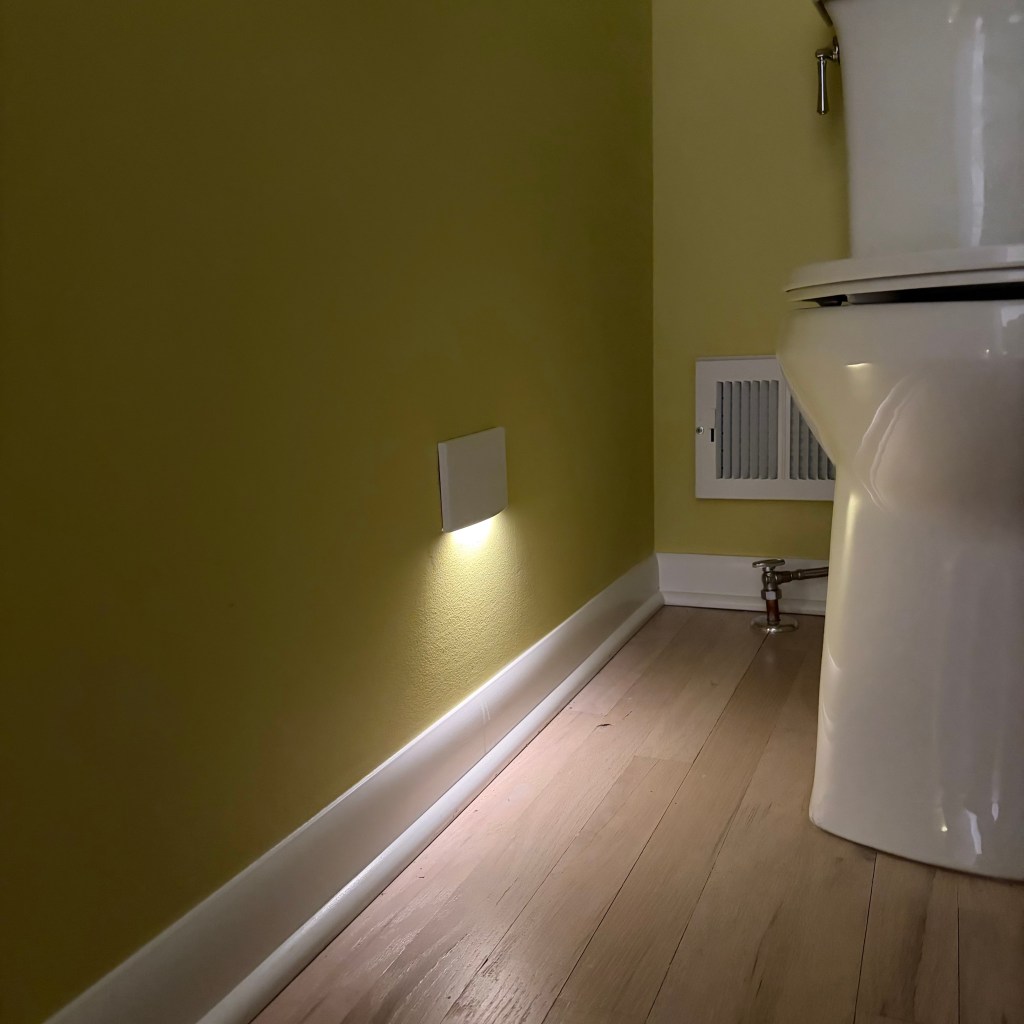
Like almost everyone, bathrooms are fully illuminated for less than an hour each day. Shower, personal grooming and you’re out of the room. From that point, there are only periodic visits. One of the most common accidents for seniors is falling and it is most chronic during nighttime visits to the bathroom. We all think we know the way, but nonetheless, falls occur. A curled-up cat, a stray ball of that day’s socks tossed on the floor and balance is lost. Having low-level light and a clear path from bed to the bathroom is essential as we age. In our scenario, the under-vanity and step lights are the hardest working fixtures in the bathroom. They consume a miniscule 12.38 watts of electricity, but can be lifesaving.
If I were trying to reduce my total home wattage consumption, these would be a great candidate. Honestly, from a cost perspective, the LED Tape is a good candidate, too. To run the strip of light under each vanity, I needed a power supply. The low-output tape is inexpensive, but most manufacturers sell only a 30W power supply as the smallest option, so a lot of money is needed to prevent a nighttime fall. Because the power consumption is so low, it won’t help the efficacy much. I’d likely need to remove something else, perhaps one of the recessed lights in the shower area and also eliminate the recessed unit over the sink. I could also replace the two flanking lights at the mirror with a single over-mirror option, That would probably get to the reduced power levels for acceptability.
While it saves energy, it runs counter to good lighting practices. The older eye is very sensitive to glare and becomes more so as cataracts become worse. Lights flanking the mirror are one of the best ways to ameliorate the impacts of glare. Light from three directions avoids shadows, making personal grooming easier. In larger shower areas, one light introduced more shadows and does not provide adequate illumination, hence the reason for two. We could eliminate some of the light to meet efficiency goals, but the price paid is not really worth it. Again, to achieve a higher level of efficiency and earn LEED (or some other standard) certification, poorer quality lighting is needed and more electricity will likely be consumed.
Outdoor
The surface mounted lighting on the exterior of our “Y” shaped ranch consists of two types. Recessed units are positioned under the eaves, over all the doors around the perimeter and a few additional places. Articulated spots are located in four other areas.
| Type | Quantity | Wattage Each | Total Wattage |
| Recessed | 10 | 11W | 110W |
| Spots | 4 | 30W | 120W |
| Total | 230W |
Exterior lighting is gaining more regulations, almost on a weekly basis. The state of Maine just introduced some of the toughest Dark Sky legislation in the country. A Hawaii law is on the horizon. Less light and less offensive, or visible light will be demanded in the future.
I included these, because of their home automation control. The home security cameras are linked with the lighting, so 99% of the evening, they are off. When the camera detects a human or an automobile, I have them configured to activate. Activation is also geographic, so if a car pulls into the driveway, the spot over the garage illuminates. If a human is detected in the western back patio, the light over the dining room door turns on. If a person appears on the bedroom patio, the lights at that door are energized. For most of the evening, they are dark. Interlopers are the only reason for their use. From an energy saving certification standpoint, I’m consuming 230W of power. From a realistic point of view, that is only the case if a bad-guy decides to intrude at night and then, only a portion of the 230 watts will be consumed.
I could have sealed up all of the recessed eave lighting and removed the outlets that service the spots. This would have given me a more efficient home, but we would not have the “bad guy” deterrent the automated lighting provides.
I love the idea of energy savings. I want the country to be less reliant on fossil fuels. I’m OK with mandates to reach those goals. I am, however, a lighting guy. I’ve spent the larger part of my career trying to get people to use better lighting solutions. When those worlds collide, I want to find resolution. Is there a way to combine better lighting with these important efficiency demands? Could the inclusion of a home automation system trigger provisos covering light source use? Could lighting, used primarily as nighttime navigation be removed from calculation? I don’t want to sacrifice good lighting for efficiency, especially when I know, the efficiency measurements will actually demand extra electric use. That’s just not right.
https://www.usgbc.org/credits/homes/v4-draft/eac13?return=/credits/homes/v4
 Lighting by Jeffrey