
My wife and I current live in a home that is listed on the US Department of the Interior, National Register of Historic Places. We have both served on the board of the local historic preservation society and remain active members of the Cleveland Restoration Society. It is safe to assume we like the look and feel of older architecture…of any generation. That last part is becoming important, now that we have reached “old age.” Our current home features LOTS of stairs and living with them increases mobility difficulty. We are both very healthy, but my wife has the cumulative effect of having stood in a surgery theater for most of her career and I have a degenerative joint disorder that has impacted my wrists and already eliminated one of the discs in my spine. Who knows what will be next for us?
Luckily, there are a number of one-story homes in our neighborhood. These are classic mid-century ranches build in the 50s that feature some very “cool” attributes, such as real hardwood paneling, under-counter vertical refrigerators and front doors with the doorknob in the center. For the last few (five?) years, we have been looking for a home with great bones that has seen better days. We have finally found, what will ultimately be our retirement home. To get to that point will require months (and months) of repairs and restoration.
It is our intent to bring in as many elements of home automation as possible. We are also providing for accessibility needs that might be required as we age and deteriorate. Of course, the lighting must be right and there are hundreds of other things we want to do, so we won’t have to worry about them when we’re 90 years old. All of that will of course be wrapped around our desire to be sensitive to the mid-century roots of the building design.
To remain cognizant of energy consumption, we talked about added insulation, but what of solar panels? That is where our two desires have collided.
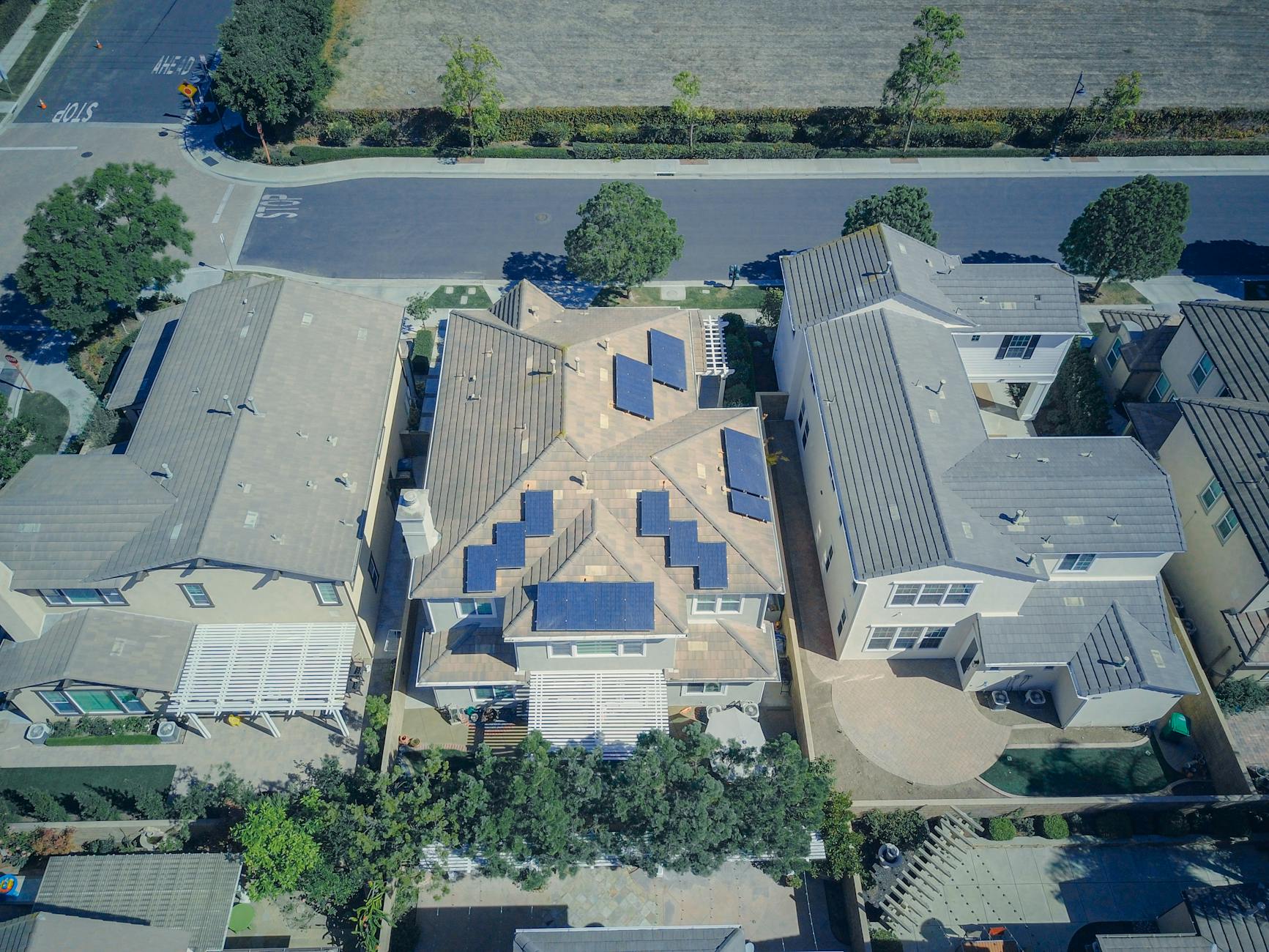
If you drive around new neighborhoods in the south and southwestern US, you will immediately see solar panels slapped on roof in whatever pattern and manner possible. Most new construction has only a marginal concern for exterior aesthetics, so a couple of big black plates on the roof are no more a deterrent to style than the plastic faux shutters, veneered brick façade and vinyl siding. That they are arranged on the roof in no particular pattern and with no regard to appearance probably isn’t a concern. Plopping these panels on a piece of classic mid-century architecture that includes an old-growth, cedar shake roof is.
This is where my active, dual, right-side/left-side brain gets me in trouble. I love the confluence of design and space and visuals, but I also see the statistical importance of energy savings and the mounting cost per kilowatt hour of electricity. I could easily create a spreadsheet that details the month and year when I would break-even on the solar panel investment. I also know it will never happen, because that pesky “other-side” of my brain won’t allow it.
My plea to the solar panel world remains the same and has remained the same for years. Design a panel or panels that include some aesthetic finesse. Come to terms with the fact that your product is big and highly visible. Do something to ameliorate the appearance of big, black blobs glued on a roof.
A few years ago, someone developed an individual solar shingle that interlocked with the adjoining shingles to form a solar roof that delivered the appearance of typical roofing material. They were shaped as slate, tile, shingle, shake, etc. I assumed the look and benefits would quicken their adoption. Perhaps they were cost prohibitive, but I never saw them again.
I have also heard of growing complaints with solar panels, not the performance, but instead, with installation. Solar installers are typically not roofers, but installation requires hole drilled into the roof of a home or building. The solution to roof holes is often caulk. To a roofer, caulk is a supplement to proper installation technique, not a solution. Their advice; select a roofer who installs solar panels, not a solar specialist who will install a panel anywhere you need, including a roof. You want an installer who knows how to properly flash around every hole added to a roof. Failure will result in a leaky roof.
A renovated mid-century ranch can have the latest home automation, it can be equipped with integrated LED luminaires throughout, the garage can feature electrical plugs and capacity to charge an electric vehicle and it can be packed with insulation to control HVAC energy consumption. In my case, it will not include solar collection panels on the roof, until the solar panel industry makes a product that can live in visual concert with the architecture of a home. That is where I draw the line.
 Lighting by Jeffrey