
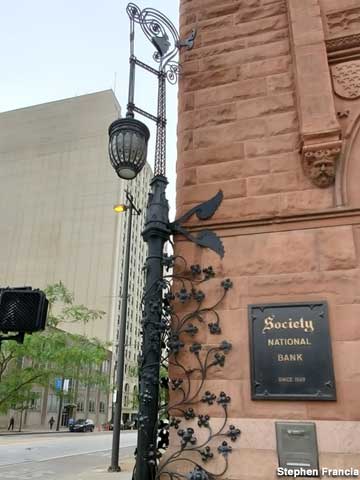
Most people are unaware of the outsized place Cleveland holds in the history of lighting. I live in the inner-ring suburb of Cleveland Heights, less than a mile from Nela Park, the original home of the National Electric Lamp Co., later General Electric. Nela Park itself is considered the first “industrial park” in the nation. It is also the location of many lighting “firsts.”
In 1878, the arc light was invented in Cleveland by Charles Brush of the Brush Electric Company, later to become the lighting division of General Electric. His creation allowed Cleveland’s Public Square (then Monumental Park) to feature the first street lighting in America in 1879. That original fixture remains in place today.
Based on the foundation of work completed by scored of researchers and scientists across the globe, GE built the first prototype fluorescent lamp in 1934 in Cleveland. After a series of patent battles and product demand, egged on by the requirement of low cost lighting to run factories 24 hours a day for the war effort, they began production of the first fluorescent lamp (that delivered white light) in 1938.
Working on the concept that had confounded scientists previously, Elmer Fridrich began to experiment with halogen based lighting. By 1959, with colleagues Bill Hodge and Emmett Wiley they created Tungsten Halogen lamps. Fridrich continued to work on the improvement of lighting at GE Nela Park Cleveland until the 1980s.
While not in Cleveland, the first baseball game played at night, under artificial illumination took place on May 24, 1935. The Cincinnati Reds beat the Philadelphia Phillies 2-1. Crosley Field in Cincinnati is over 200 miles away, but the lighting was designed by GE and in the history of light, it is often mentioned in the same breath.
We all know incandescent lamping can be VERY yellow and warm. The GE Reveal lamp was an immediate success because it enriched colors and improved the look of residential surroundings. Through the efforts of Julianna Reisman, improving on the foundational work of Bill James, a viable coating that could filter out the undesirable yellows was made possible here in Cleveland (with a little help from a Spanish glass manufacturer Cristalerias de Mataro.)
Even beyond the influence of GE, there are other notable lighting milestones in Cleveland.
The world’s first red & green electric traffic light was put into service at the intersection of Euclid Avenue and East 105th Street in Cleveland in 1914. The very prolific Cleveland inventor Garrett Morgan improved on the concept after witnessing a bad automobile accident. He introduced the “caution” light, that allowed intersections to be cleared, prior to the start of traffic flow in the opposite direction. (Note to Hollywood, a biopic or documentary of this guy should be made!)
More recently (2014) the world’s largest outdoor chandelier has been in place at the intersection of Euclid Avenue and East 14th Street in Playhouse Square, downtown Cleveland. It is 20 feet tall, weighs 8500 pounds, features 4200 crystals and is suspended by a triple-post, 44 foot high steel structure. Playhouse Square is the world’s largest theater restoration project and the second largest theater district in the United States, after Lincoln Center, in New York City.
At a more professorial level, The Michelson-Morley experiment was conducted in 1887 at Western Reserve University (now Case Western Reserve University) in Cleveland. The experiment was designed to detect the motion of the earth via a theoretical substance that was essential to the transmission of light. Through the interference of light waves, precise measurements could be taken. Their failure to detect movement confirmed and supported Albert Einstein’s Theory of Relativity (E=MC2). This is very foundational work in our understanding of light.
Many average people (not lighting nerds like me) know Cleveland as the home of the creators of Superman (Jerry Siegel and Joe Shuster) and the place where the first rock concert (The Moondog Coronation Ball) was held and the term “Rock and Roll” was coined (by disc jockey Alan Freed.) The Cleveland Orchestra is generally regarded as the best symphony orchestra in America and the Cleveland Art Museum is typically considered to have the finest collection outside of New York. (Arguments will be accepted by fans of the Chicago Institute of Art and the Philadelphia Museum of Art.) At the turn of the last century, there were more millionaires in Cleveland than anywhere else on the planet. Cleveland was also know for many years as the “Sixth City” because it was “that” large and “that” influential. The endowment to cultural entities in Cleveland continues to support the arts while other cities across America struggle. (St. Louis enjoys the only other similarly endowed cultural landscape.) Add to that the foundational milestones of lighting and it is easy to understand why I really love living in Cleveland and why Cleveland is so important to the world of lighting.
 Lighting by Jeffrey
3 replies on “Lighting History in Cleveland”
OMG !!! Who knew ?
Thank you so much for the lighting history.
LikeLiked by 1 person
[…] Lamp Co.), has roots in the city. Charles Brush invented the arc light there in 1878, according to Lighting by Jeffrey, a blog written by industry expert Jeff Dross. The Brush Electric Company ultimately became the […]
LikeLike
As Jeff knows, I was born in Cleveland and truly appreciate the Cleveland history lesson. It’s good to know about our community history and contributions to society. Keep writing Mister Dross – always a joy to read your words of wisdom!
LikeLike